
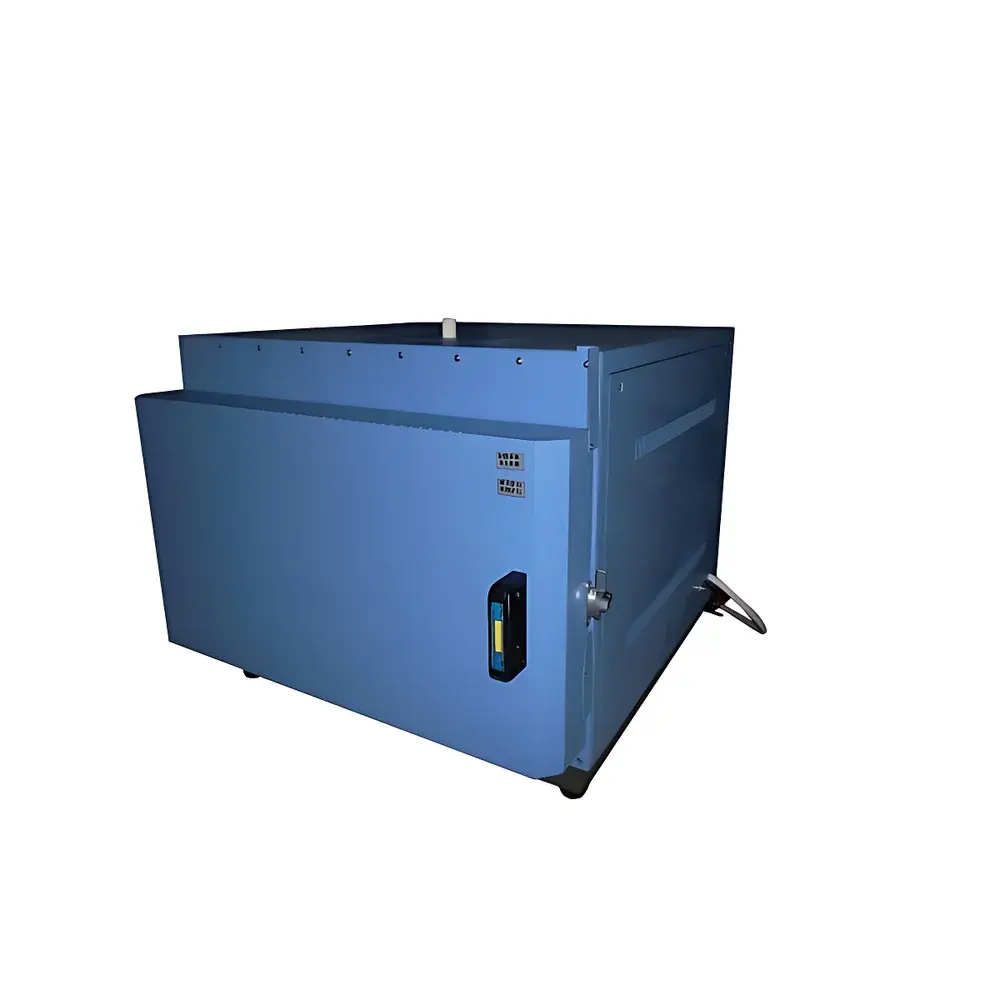
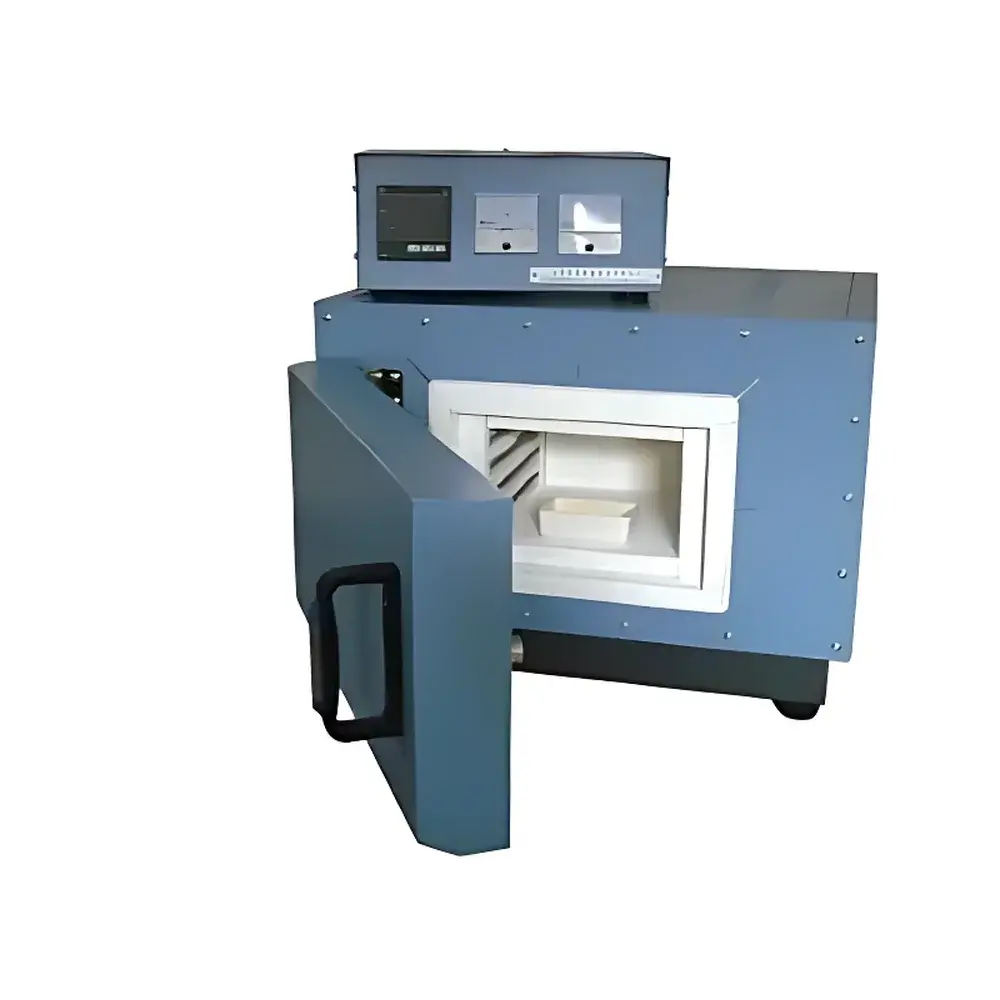
Zhongke Aobo TL0617 Ceramic Fiber Muffle Furnace – 1700 °C High-Temperature Box-Type Laboratory Furnace
| Brand | Zhongke Aobo |
|---|---|
| Model | TL0617 |
| Type | Box-Type Muffle Furnace |
| Max Temperature | 1700 °C |
| Rated Temperature | 1600 °C |
| Internal Chamber Dimensions (W×D×H) | 250 × 160 × 150 mm |
| Chamber Volume | 6 L |
| Heating Element | Silicon-Molybdenum (MoSi₂) Rods |
| Temperature Control Accuracy | ±1 °C |
| Power Rating | 5 kW |
| Supply Voltage | AC 220 V, 25 A |
| 升温 Time (100 → 1700 °C) | <90 min |
| Insulation Material | High-Purity Alumina-Silica Ceramic Fiber |
| Thermocouple Type | Type B (Pt/Rh) |
| Weight | 95 kg |
| Compliance | Designed for GLP-compliant sample ashing, thermal analysis, and materials processing per ASTM E1131, ISO 1171, USP <281>, and EN 15407 |
Overview
The Zhongke Aobo TL0617 Ceramic Fiber Muffle Furnace is a high-temperature, precision-controlled laboratory furnace engineered for applications requiring stable, repeatable thermal treatment up to 1700 °C. Built on a robust box-type architecture with dual-wall construction and high-density ceramic fiber insulation (alumina-silica, ≥95% Al₂O₃), it achieves rapid heating kinetics while minimizing thermal mass and external surface temperature rise. The furnace operates on the principle of radiant and convective heat transfer within a sealed, oxidation-resistant chamber—ideal for ashing, calcination, sintering, pre-firing, and thermal gravimetric sample preparation. Its MoSi₂ heating elements deliver exceptional stability at ultra-high temperatures, resisting oxidation in air up to 1800 °C and enabling long-term operation at 1600–1700 °C without degradation. The TL0617 is not a general-purpose oven; it is a metrologically traceable thermal platform designed for laboratories where temperature uniformity, ramp reproducibility, and process documentation integrity are critical—particularly in accredited testing environments subject to ISO/IEC 17025 or FDA 21 CFR Part 11 requirements.
Key Features
- High-purity ceramic fiber insulation (density: 128 kg/m³) reduces thermal inertia, enabling <90-minute ramp from 100 °C to 1700 °C and limiting external casing temperature to ≤60 °C under steady-state operation.
- Side-opening door with reinforced ceramic fiber gasket ensures uniform seal integrity and minimizes heat loss during loading/unloading—critical for maintaining thermal homogeneity across the 250 × 160 × 150 mm working zone.
- Modular MoSi₂ heating elements mounted on ceramic insulators allow field-replacement without disassembling the furnace shell—reducing downtime and supporting extended service life (>3,000 h at 1600 °C).
- Dual-zone PID intelligent controller (TL17 series) with 30-step programmable ramp/soak profiles, real-time digital display, and auto-tuning capability ensures ±1 °C control accuracy and <0.5% FS temperature stability over full range.
- Safety-integrated design includes automatic power cutoff upon door opening, redundant over-temperature protection (independent limit controller), and grounded chassis with IP20-rated enclosure.
- Optional through-wall ports (M12 threaded) support inert gas purging (N₂, Ar), vacuum connection (KF16), or thermocouple feedthroughs—enabling controlled-atmosphere experiments per ASTM D5630 or ISO 1171.
Sample Compatibility & Compliance
The TL0617 accommodates crucibles (Pt, Al₂O₃, SiC, ZrO₂), quartz boats, and ceramic setters up to 120 mm in height. It is routinely deployed in coal quality labs (ASTM D3174 ash, D3175 volatile matter), pharmaceutical QC (USP residue on ignition), environmental testing (EPA Method 2540C total solids ashing), and advanced ceramics R&D (sintering aids activation, oxide precursor decomposition). All electrical and thermal performance specifications comply with IEC 61000-6-3 (EMC), GB/T 10066.1-2004 (industrial furnaces), and CE-marked safety directives. Traceable calibration certificates (NIST-traceable Type B thermocouples) and audit-ready log files meet GLP/GMP documentation standards.
Software & Data Management
The integrated TL17-series controller supports RS485 Modbus RTU communication for integration into LIMS or SCADA systems. Optional PC software enables remote monitoring, profile upload/download, real-time graphing of T vs. t, and export of CSV-formatted temperature logs with timestamps. Full audit trail functionality—including user login, parameter changes, and alarm events—is retained for ≥30 days and satisfies 21 CFR Part 11 electronic record requirements when paired with validated user access controls.
Applications
- Ash content determination in coal, biomass, and foodstuffs (ISO 1171, ASTM D2974)
- Residue on ignition testing for APIs and excipients (USP , Ph. Eur. 2.4.15)
- Thermal decomposition studies of catalysts, battery cathode precursors, and MOFs
- Pre-firing of ceramic green bodies and metallurgical powder compacts
- Calibration of thermogravimetric analyzers (TGA) and differential scanning calorimeters (DSC)
- High-temperature annealing of optical substrates and semiconductor wafers
FAQ
What thermocouple type is used for temperature measurement and control?
Type B (Platinum/Rhodium 30–6) thermocouples are standard, rated for continuous use up to 1700 °C and certified to IEC 60584-1 tolerance class 1.
Can this furnace operate under inert or reducing atmospheres?
Yes—optional gas inlet/outlet ports (M12) enable N₂, Ar, or forming gas purging; however, prolonged H₂ exposure below 1200 °C requires custom MoSi₂ element passivation and is not covered under standard warranty.
Is the temperature uniformity specified across the chamber?
At 1600 °C, radial uniformity is ±8 °C within the central 60% volume (per ASTM E220 calibration practice); axial gradient is ≤15 °C from floor to ceiling.
Does the controller support data logging without external software?
Yes—the built-in memory stores up to 10 complete thermal cycles with timestamped setpoint/actual temperature pairs, accessible via front-panel menu.
What maintenance is required for MoSi₂ heating elements?
No periodic replacement is needed under normal air-atmosphere operation; visual inspection every 500 h is recommended. Avoid thermal shock—ramp rates exceeding 10 °C/min above 1400 °C may accelerate aging.



