
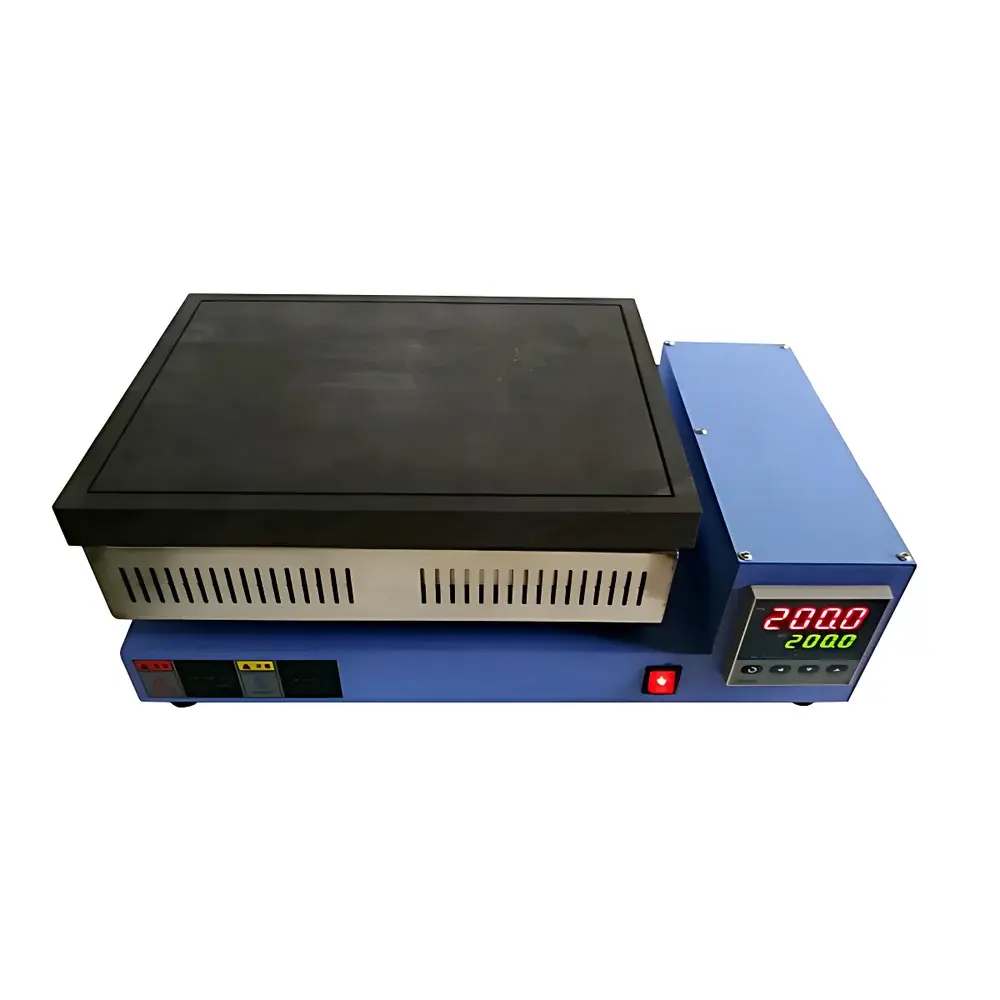
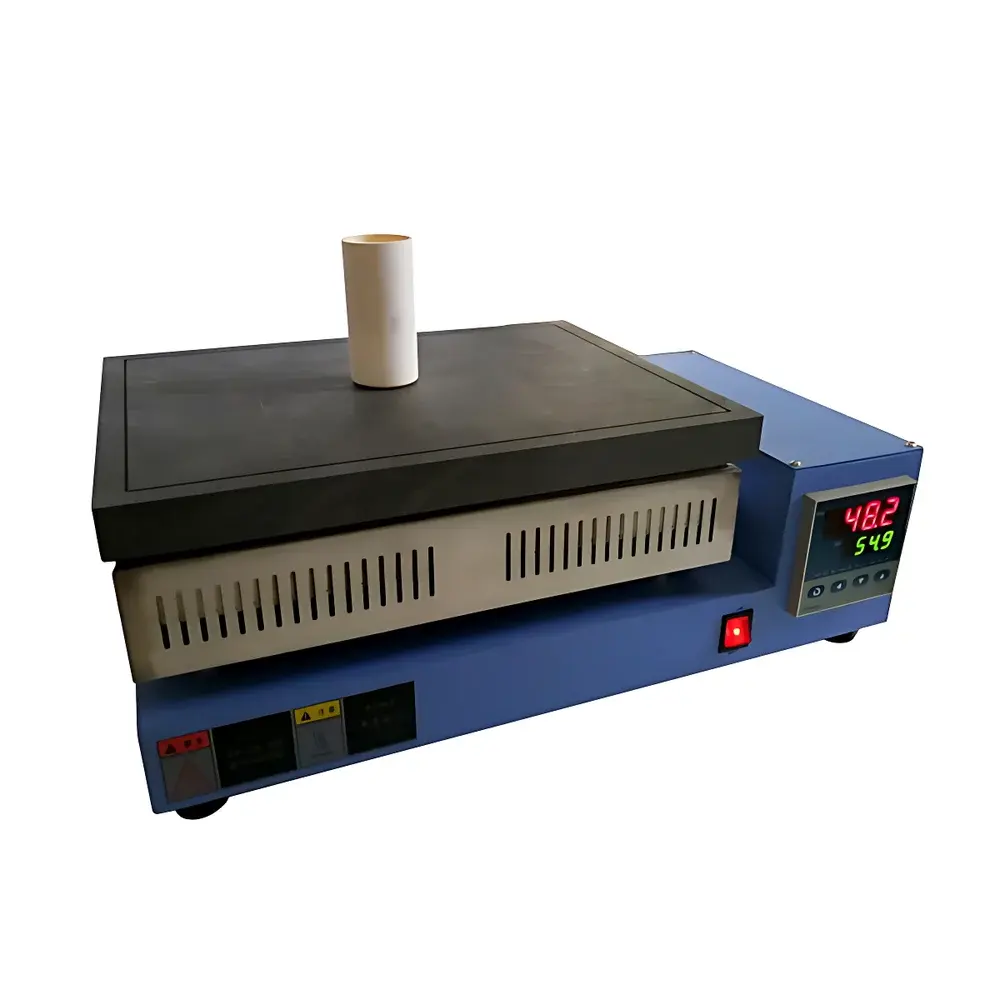
Zhongke Aobo SM Graphite Electric Heating Plate
| Brand | Zhongke Aobo |
|---|---|
| Model | SM35-45 |
| Type | Graphite Electric Heating Plate for Sample Digestion |
| Plate Dimensions | 400 × 300 mm |
| Max Operating Temperature | 450 °C |
| Temperature Uniformity | ±1 °C |
| Heating Power | 3.5 kW |
| Control Method | PID Programmable Digital Temperature Control |
| Plate Material | Isostatically Pressed High-Purity Graphite (≥99.9% C) |
| Plate Thickness | 30 mm |
| Display | LED Digital Display |
| Voltage/Frequency | AC 220 V / 50 Hz |
| Weight | 15 kg |
| External Dimensions (D×W×H) | 300 × 500 × 225 mm |
| Insulation | Dual-Layer (Air Gap + Aluminosilicate Ceramic Fiber) |
Overview
The Zhongke Aobo SM Graphite Electric Heating Plate is a laboratory-grade thermal platform engineered for precise, reproducible, and chemically resistant sample preparation in analytical chemistry workflows. Designed specifically for digestion, acid evaporation (‘acid removal’ or ‘acid fuming’), pre-digestion conditioning prior to microwave-assisted digestion, and temperature-controlled wet-chemical sample dissolution, this instrument operates on resistive heating principles within a monolithic isostatically pressed graphite block. Unlike metal-sheathed or ceramic plate heaters, the high-purity graphite construction provides exceptional thermal mass, low thermal gradient across the surface, and inherent resistance to aggressive reagents—including concentrated HNO₃, HCl, HF, H₂SO₄, and aqua regia—enabling long-term operation under corrosive conditions without degradation of heating performance or surface integrity.
Key Features
- Isostatically pressed high-purity graphite (≥99.9% carbon) heating surface, 30 mm thick, delivering uniform thermal distribution with ≤±1 °C spatial variation across the full 400 × 300 mm active zone.
- PID-based programmable digital temperature controller with real-time LED display, supporting ramp-hold profiles, adjustable heating rate (°C/min), dwell time setting, and automatic power cutoff upon cycle completion.
- Dual-stage thermal insulation architecture: an outer air gap layer combined with an inner aluminosilicate ceramic fiber blanket minimizes heat loss, improves energy efficiency, and maintains external cabinet surface temperatures below 60 °C during continuous operation at 450 °C.
- Electrostatically applied corrosion-resistant epoxy-polyester powder coating on all structural components ensures operational reliability in acidic laboratory environments—including uninterrupted 48-hour exposure to fuming nitric acid vapor per ISO 9227 salt spray test methodology.
- Modular mechanical design supports optional customization of plate dimensions (e.g., 600 × 400 mm), voltage configurations (110/220/240 V), and integration-ready mounting interfaces for automated sample handling systems.
Sample Compatibility & Compliance
The SM Graphite Heating Plate is routinely deployed in laboratories performing sample preparation for atomic spectroscopy (AAS, AFSS, ICP-OES, ICP-MS), trace metal analysis, and regulatory-compliant environmental testing (EPA Methods 3050B, 3051A, 3052; ISO 11466, ISO 17294-2). Its inert graphite surface eliminates metallic contamination risks associated with stainless-steel or aluminum plates—critical for sub-ppq-level quantification. The unit complies with IEC 61010-1:2010 safety standards for electrical equipment used in laboratory environments and meets electromagnetic compatibility requirements per EN 61326-1. While not intrinsically rated for Class I Division 1 hazardous locations, it is suitable for use in fume hoods certified to ANSI/AIHA Z9.5 and EN 14175-3.
Software & Data Management
The standard configuration features standalone hardware control with no embedded software stack. However, the digital controller outputs analog 0–10 V or 4–20 mA process signals (optional) compatible with third-party SCADA, LIMS, or laboratory automation platforms. For GLP/GMP-regulated environments, optional RS-485 Modbus RTU interface enables audit-trail-capable temperature logging when integrated with validated data acquisition systems compliant with FDA 21 CFR Part 11 requirements. All firmware revisions are traceable via serial-number-mapped release notes supplied with calibration documentation.
Applications
- Open-vessel acid digestion of soil, sediment, biological tissue, and polymer matrices prior to elemental analysis.
- Controlled evaporation of hydrochloric or nitric acid residues post-digestion to achieve dry-down or near-dry conditions required for hydride generation or cold vapor AAS.
- Pre-heating and stabilization of Teflon® or quartz digestion vessels in multi-step protocols involving sequential reagent addition and thermal ramping.
- Standardized drying and charring of filter papers or ashless cellulose substrates in gravimetric analysis (e.g., ASTM D2974, ISO 1171).
- Thermal conditioning of reference materials and certified calibration standards under defined time–temperature profiles per ISO/IEC 17025 clause 7.7.
FAQ
What is the maximum recommended continuous operating temperature?
The plate is rated for sustained operation at 450 °C; however, for optimal graphite longevity and thermal stability, prolonged use above 400 °C should be limited to <8 hours per cycle.
Can the heating plate be used with hydrofluoric acid (HF)?
Yes—the isostatically pressed graphite surface exhibits high resistance to HF attack under typical digestion concentrations (<5% v/v); nevertheless, strict adherence to PPE and fume hood protocols is mandatory.
Is temperature calibration traceable to NIST standards?
Each unit ships with a factory calibration certificate referencing Pt100 sensor verification against NIST-traceable dry-block calibrators (±0.3 °C uncertainty at 200 °C). On-site recalibration services are available with accredited metrology providers.
Does the unit support multi-zone independent temperature control?
No—the SM35-45 is a single-zone platform. Multi-zone capability requires custom-engineered variants (e.g., SM-MZ series), which are available upon technical specification review.
What maintenance is required to ensure long-term accuracy?
Routine cleaning with deionized water and lint-free cloths is sufficient; abrasive cleaners or metal scrapers must be avoided. Annual verification of PID loop response and sensor drift is recommended in high-throughput labs processing >200 samples/week.



