
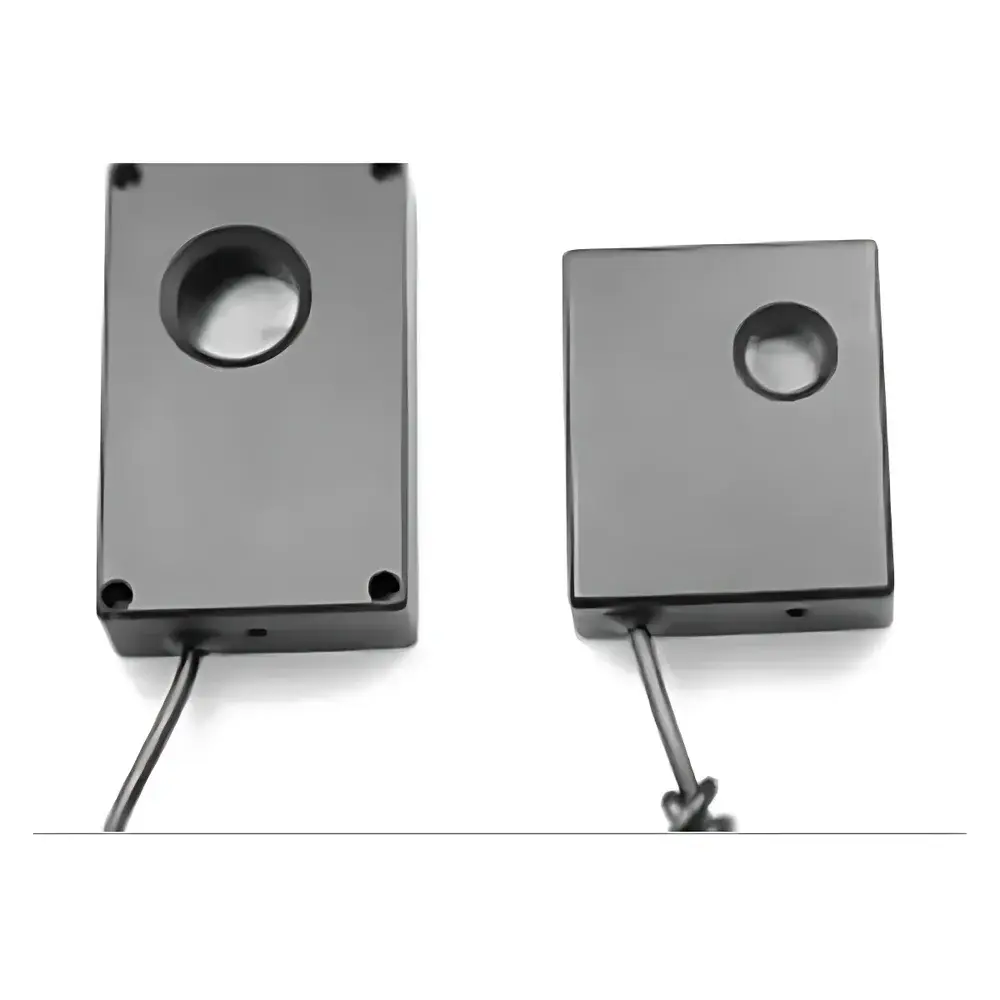
GCl Electronic Shutter (20 mm) – Precision Electronic Controller
| Brand | CNI (China Education Goldsource) |
|---|---|
| Origin | Beijing, China |
| Manufacturer Type | OEM/ODM Manufacturer |
| Origin Category | Domestic (PRC) |
| Model | GCl Electronic Shutter (20 mm) – Precision Electronic Controller |
| Component Category | Optical Component |
| Aperture Diameter | Ø20 mm |
| Timing Range | 1 ms – 27 h |
| Timing Accuracy | ±1 ms |
| Power Supply | AC 220 V, 0.8 A |
| Shutter Operating Voltage | DC 12 V |
| Shutter Operating Current | <200 mA |
| Load Channels | 3 independent channels |
| Interface Options | USB & RS232 |
| Control Modes | Auto-cycle, B-mode, T-mode |
| Trigger Options | Manual push-button, Wireless remote (10 m range), TTL-level input (60 cm cable) |
| External Trigger Cable Length | 90 cm |
| Panel Interface | LCD display + capacitive touch keys |
| Software Support | ASCII command protocol, GUI-based configuration utility |
Overview
The GCl Electronic Shutter (20 mm) – Precision Electronic Controller is a high-reliability optical gating device engineered for demanding laboratory and industrial applications requiring precise temporal control of light transmission. Based on electromagnetic actuation with solid-state drive circuitry, the shutter operates via a fast-response, low-inertia blade mechanism synchronized to an embedded microcontroller with real-time clock architecture. Its core function is to enable deterministic interruption or modulation of optical paths—critical in time-resolved spectroscopy, laser safety interlocks, fluorescence lifetime measurement setups, pump-probe experiments, and automated optical calibration workflows. The controller integrates a dedicated timing engine capable of sub-millisecond resolution and exceptional thermal stability (<50 ppm/°C drift), ensuring repeatable exposure windows across extended operational periods and ambient temperature fluctuations (15–35 °C). Designed for integration into ISO/IEC 17025-compliant optical test benches and GLP-regulated photometric validation systems, it meets fundamental requirements for traceable timing performance in metrology-grade optical instrumentation.
Key Features
- Precision timing engine with 1 ms minimum step resolution and ±1 ms absolute accuracy over full 1 ms–27 h range
- Three independently controllable output channels, each rated for DC 12 V / <200 mA resistive or inductive loads (compatible with standard solenoid-actuated shutters)
- Multi-mode operation: auto-cycling (programmable interval/repetition), B-mode (momentary open-on-press), and T-mode (toggle on successive triggers)
- Triple trigger interface support: tactile push-button panel switch, 433 MHz wireless remote (10 m line-of-sight range), and opto-isolated TTL-compatible input (60 cm shielded cable, 0–5 V logic)
- Human-machine interface featuring backlit LCD and capacitive touch keys for intuitive local configuration without host dependency
- Dual-standard digital interface: USB 2.0 (CDC class, no driver required on Windows/macOS/Linux) and RS232 (TTL/RS232 level selectable via DIP switch)
- Firmware-upgradable architecture supporting ASCII command set (e.g., “OPEN1”, “CLOSE2”, “SETT=5000”)
- Comprehensive software suite included: cross-platform GUI application with real-time status monitoring, scriptable sequence editor, and audit-log export (CSV)
Sample Compatibility & Compliance
The GCl shutter is optimized for use with collimated or moderately convergent beams up to Ø20 mm clear aperture. It maintains wavefront fidelity (λ/10 surface flatness) and minimal scatter (<0.1% at 532 nm) when installed in clean-room-assembled optical trains. Mechanical housing conforms to DIN 4760 mounting standards (M4 threaded holes on 40 mm pitch), enabling direct integration with standard optical rails and post holders. Electrical design complies with IEC 61000-4 immunity standards (ESD, EFT, surge) and meets CE marking requirements for EMC and low-voltage directives. Firmware implements non-volatile parameter storage with write-protection logic to prevent accidental configuration loss during power cycling—a requirement for FDA 21 CFR Part 11–aligned environments where configuration integrity must be preserved across instrument lifecycle audits.
Software & Data Management
The bundled PC software provides full remote control and logging functionality through both USB and RS232 interfaces. It supports timestamped event logging (shutter open/close events, error codes, trigger source identification) with configurable retention policies. All user-defined timing sequences are stored in encrypted XML format with SHA-256 checksums, satisfying basic data integrity requirements for ISO 17025 Clause 7.7 traceability. The ASCII command protocol enables seamless integration into LabVIEW, MATLAB, Python (pySerial), or custom C++ acquisition frameworks—sample drivers and API documentation are supplied. Audit trail records include operator ID (configurable), system timestamp, command string, and execution result—essential for GLP/GMP documentation workflows.
Applications
- Time-gated Raman and fluorescence spectroscopy, where nanosecond-to-second exposure windows isolate prompt vs. delayed emission
- Laser pulse synchronization in ultrafast optics labs (e.g., seeding Ti:sapphire oscillators, cavity dumping control)
- Automated photometric calibration stations requiring reproducible irradiance intervals per NIST-traceable protocols
- Optical safety interlocks in Class 4 laser enclosures compliant with IEC 60825-1 Ed.3
- In-line process monitoring in semiconductor lithography tooling, where shutter timing correlates directly with exposure dose control
- Education laboratories implementing hands-on experiments in photonics, quantum optics, and optical communications
FAQ
What is the maximum optical power density the shutter can withstand without degradation?
The Ø20 mm aperture is rated for continuous-wave illumination up to 5 W/cm² at 400–1100 nm (uncooled operation); pulsed laser compatibility requires individual assessment based on pulse energy, repetition rate, and beam profile.
Can the three output channels drive different shutter models simultaneously?
Yes—each channel is electrically isolated and configurable for independent timing, enabling heterogeneous shutter arrays (e.g., Ø5 mm, Ø12.5 mm, and Ø20 mm units) under unified software control.
Is firmware update capability available in field-deployed units?
Yes—updates are delivered via USB using signed binary packages; the bootloader enforces cryptographic signature verification before flash programming.
Does the system support hardware-triggered synchronization with external oscilloscopes or DAQ devices?
Yes—the TTL input accepts standard 0–5 V logic signals with <10 ns jitter; optional BNC breakout adapter kit (sold separately) provides SMA/TTL conversion and impedance matching.
How is timing calibration verified and documented for quality assurance purposes?
Each unit ships with a factory calibration certificate referencing NIST-traceable timebase standards; users may perform in-house verification using a calibrated photodiode + digital oscilloscope with ≥1 GS/s sampling rate.





