
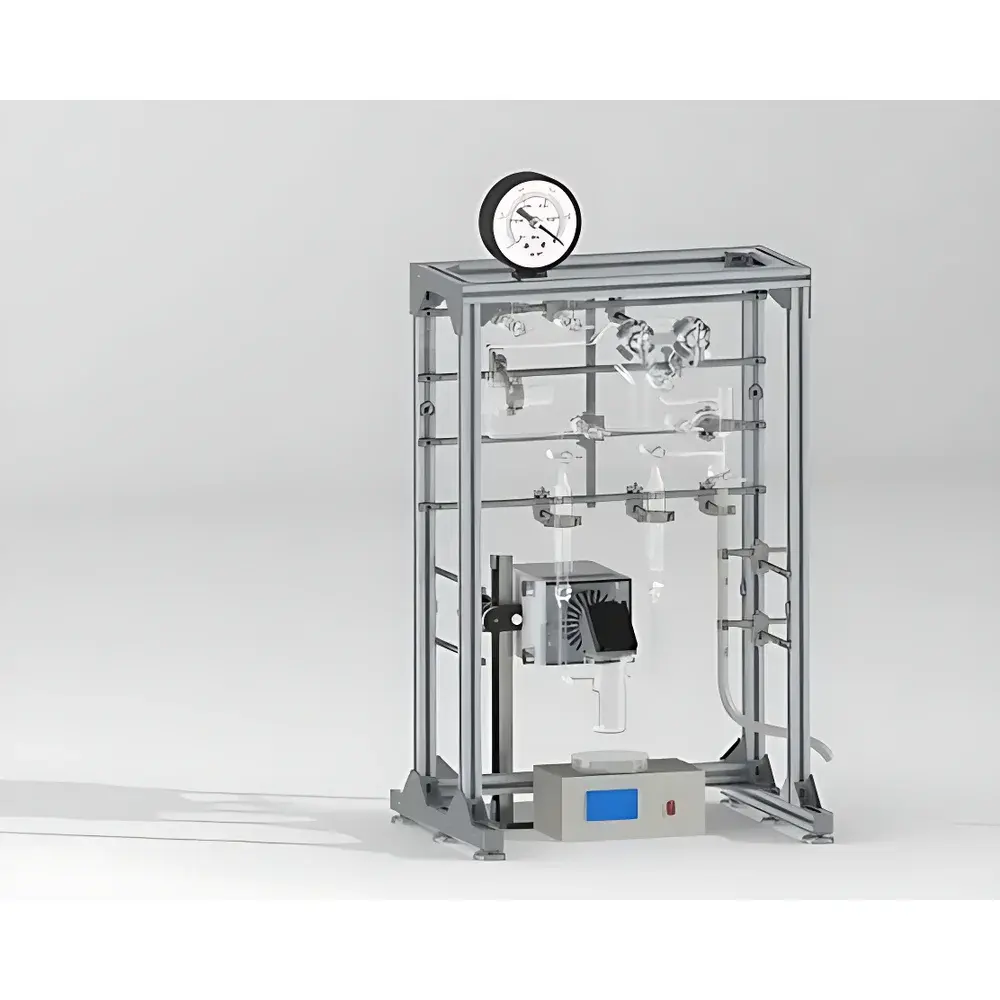
CEL-PAEM-D6 Hand-Automatic Integrated Photocatalytic Activity Evaluation System
| Brand | CEAULIGHT (Zhongjiao Jinyuan) |
|---|---|
| Origin | Beijing, China |
| Manufacturer Type | Direct Manufacturer |
| Model | CEL-PAEM-D6 |
| Reaction Pressure | < 0.1 MPa |
| Reaction Temperature | 25 °C (ambient-controlled) |
| Catalyst Loading Capacity | < 1 g |
| Vacuum Level | –0.1 MPa (72 h dynamic stability) |
| Gas Circulation Rate | 1.8 L/min |
| Reactor Volumes | 50 mL / 100 mL / 250 mL (optional photochemical, gas–solid, or membrane reactors) |
| Detection Limits | H₂/O₂ ≥ 0.001 mL |
| Sampling Modes | Manual & Fully Automatic (patented dual-4-port / proprietary 6-port / automated dual-6-port valve configurations) |
| Control Interval | 0–9999 min |
| Injection Cycles | 0–9999 |
| Vacuum Pump | 2 L/s, with anti-backflow solenoid valve and 12 mm stainless-steel bellows (1.6 m) |
| Frame | Dual-layer aluminum alloy structure (560 × 450 × 880 mm) |
| Light Source Mounting | Rear-positioned with precision gear-rack vertical adjustment stage |
| Optional GC | GC-7920 (CEAULIGHT), Shimadzu GC-2014 |
| Optional Lamps | CEL-PF300-T8, CEL-PE300-3A, HXF300 (Xe) |
| Optional Filters | Quartz metal-coated, 254–940 nm (dozens available) |
| Auxiliary Equipment | H₂ generator, air generator, dedicated pressure regulator |
Overview
The CEL-PAEM-D6 Hand-Automatic Integrated Photocatalytic Activity Evaluation System is an engineered platform for quantitative assessment of photocatalytic performance under controlled ambient conditions. Designed around the principles of closed-loop gas-phase reaction kinetics and product quantification via gas chromatography (GC), the system enables precise monitoring of stoichiometric evolution of gaseous and liquid products—including H₂, O₂, CO, CO₂, CH₄, CH₃OH, HCOOH, CH₃CH₂OH, and CH₃COOH—during light-driven catalytic processes. Its architecture supports both manual intervention and software-driven automation, making it suitable for method development, catalyst screening, and reproducible benchmarking in academic and industrial R&D environments. The system operates at atmospheric pressure (< 0.1 MPa) and maintains a stable 25 °C reaction environment, minimizing thermal drift while facilitating direct correlation between photon flux, surface reaction kinetics, and product yield.
Key Features
- Modular reactor design with interchangeable 50 mL, 100 mL, and 250 mL vessels—including optional photochemical, gas–solid, and membrane-type configurations—to accommodate diverse catalyst morphologies and reaction mechanisms.
- Dual-layer aluminum alloy frame (560 × 450 × 880 mm) offering structural rigidity, compact footprint, and enhanced portability without compromising vacuum integrity or optical alignment stability.
- Integrated vacuum subsystem featuring a 2 L/s oil-free pump, stainless-steel bellows tubing (12 mm ID, 1.6 m length), anti-backflow solenoid valve, and a standard liquid nitrogen cold trap—achieving and sustaining –0.1 MPa over 72 h for rigorous degassing and background suppression.
- Patented multi-port valve architecture supporting manual sampling, semi-automated sequences, and fully autonomous operation via dual-4-port, proprietary 6-port, or automated dual-6-port configurations—ensuring minimal dead volume (< 100 mL total line volume) and high repeatability across injection cycles.
- Rear-mounted light source interface compatible with xenon (CEL-PF300-T8, CEL-PE300-3A, HXF300), high-power LED (CEL-LED100, 16 selectable wavelengths), and quartz-metal-coated bandpass filters (254–940 nm), enabling spectral responsivity mapping and action spectrum analysis.
- USB and RJ45 communication interfaces for bidirectional software control—including real-time status feedback, programmable time intervals (0–9999 min), and customizable injection counts (0–9999)—with full vacuum pump sequencing and safety interlocks.
Sample Compatibility & Compliance
The CEL-PAEM-D6 is routinely deployed for evaluating semiconductor photocatalysts—including TiO₂, g-C₃N₄, CdS, BiVO₄, and emerging metal–organic frameworks—under simulated solar or monochromatic irradiation. Its low catalyst loading capacity (< 1 g) ensures uniform photon absorption and minimizes mass-transfer limitations, aligning with ASTM E2737-21 (Standard Practice for Determining Quantum Yield of Photocatalytic Reactions) and ISO 22197-1 (Photocatalytic Air Purification Materials). While not certified to GLP or GMP by default, the system’s deterministic valve timing, audit-ready execution logs, and traceable GC integration support compliance with internal SOPs and regulatory readiness for preclinical catalyst validation workflows.
Software & Data Management
Proprietary control software provides unified management of vacuum cycling, lamp triggering, valve actuation, GC synchronization, and data acquisition. All operational parameters—including elapsed time, cycle count, valve position, pump status, and temperature—are timestamped and exported in CSV-compatible format. The software supports external GC instrument handshake protocols (e.g., Shimadzu GC-2014, CEAULIGHT GC-7920) for automated peak integration and molar yield calculation. Though not natively compliant with FDA 21 CFR Part 11, the system permits third-party electronic lab notebook (ELN) integration via standardized APIs for metadata capture, user authentication logging, and version-controlled experiment records.
Applications
- Quantitative evaluation of overall water splitting activity (H₂ + O₂ co-evolution) with stoichiometric ratio verification (2:1).
- Selective photocatalytic CO₂ reduction pathways analysis—including methane, methanol, formic acid, and ethanol production—with ppm-level detection sensitivity.
- Structure–activity relationship studies on doped oxides, heterojunctions, and plasmonic hybrids under tunable wavelength excitation.
- Gas–solid interface kinetics modeling using in situ gas circulation (1.8 L/min) and real-time concentration profiling.
- Membrane-integrated photocatalysis for selective product separation and continuous-flow reactor validation.
FAQ
Can the CEL-PAEM-D6 operate under elevated temperature or pressure?
No. The system is designed for ambient-pressure (< 0.1 MPa) and isothermal (25 °C) operation only. Thermal regulation beyond room temperature requires external jacketed reactors not included in the base configuration.
Is the vacuum performance validated per ISO 2859-1 sampling standards?
Vacuum stability (–0.1 MPa over 72 h) is verified via calibrated Pirani gauge and leak-check protocol, but formal statistical acceptance sampling per ISO 2859-1 is not part of factory certification.
Does the system support external trigger signals from laser pulse sources?
Yes—via TTL-compatible input on the control interface, enabling synchronization with pulsed light sources for transient photocurrent or time-resolved gas evolution studies.
What GC detectors are compatible with the automated sampling interface?
TCD and FID detectors are natively supported; PDHID and MS interfaces require custom firmware configuration and are subject to validation testing prior to deployment.
Are calibration certificates provided for gas standards used in quantification?
Calibration gases (NIST-traceable mixtures) are supplied separately; users must perform initial system calibration and periodic verification per internal QA procedures.



