
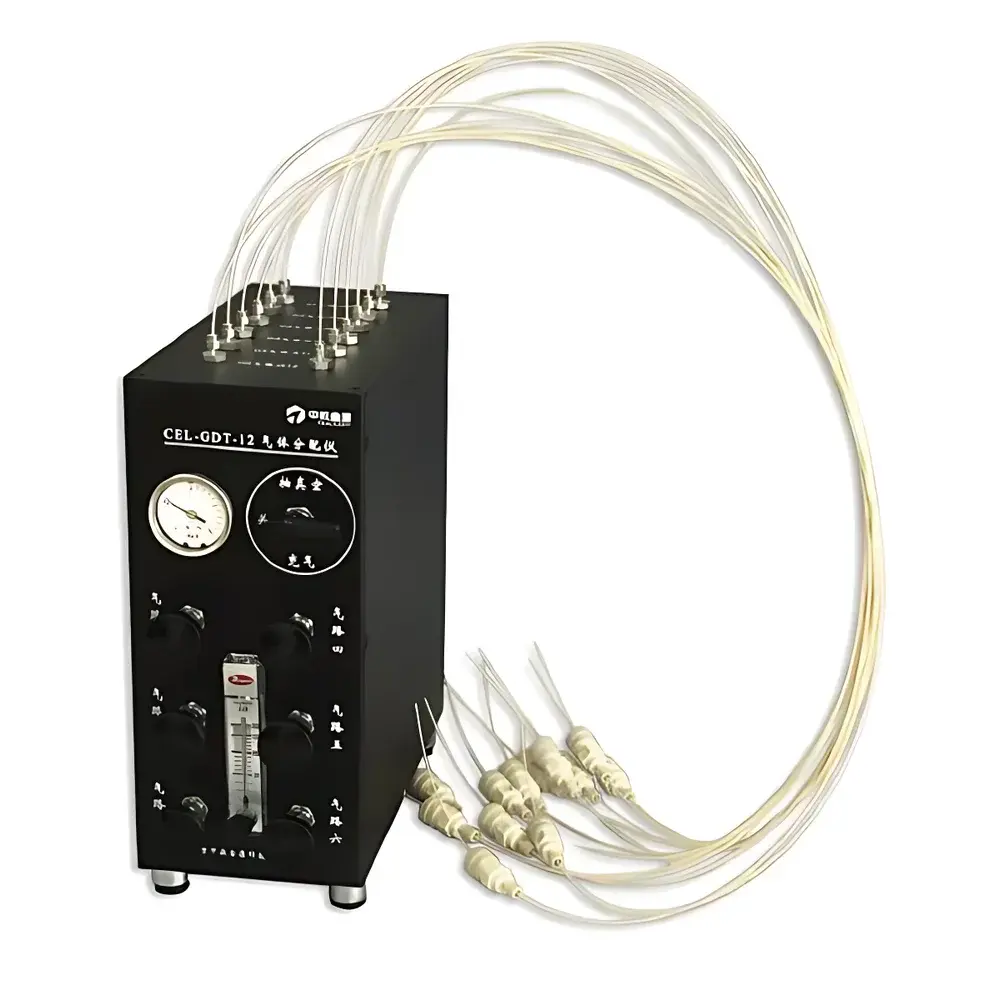
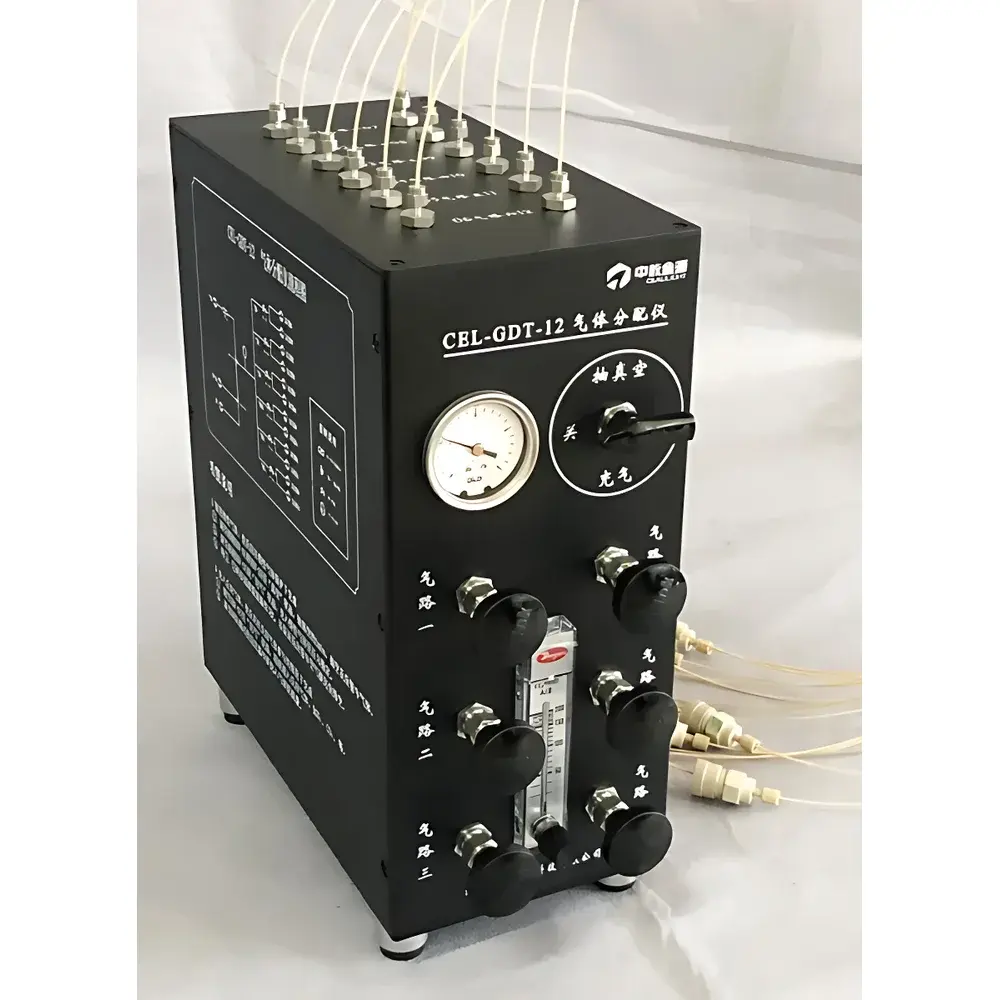
CEL-GDT-12 Gas Distribution Manifold
| Brand | CEL (Zhongjiao Jin Yuan) |
|---|---|
| Model | CEL-GDT-12 |
| Origin | Beijing, China |
| Manufacturer Type | OEM Manufacturer |
| Country of Origin | China |
| Inlet | 1 × 3 mm GB standard port (2 pcs) with integrated pressure regulator valve |
| Outlet | 12 independently controllable ports |
| Port Fitting | 1/16″ PEEK female union (8 mm to 1/16″, 12 pcs) |
| Tubing | 1 m × 12 pcs of 1/16″ PEEK tubing |
| Valves | 6 × U.S.-sourced Anlok stainless steel needle valves, 2 × Anlok stainless steel ball valves |
| Vacuum Interface | Integrated venting ball valve to prevent backflow of vacuum pump oil |
| Flow Control | Dwyer glass-tube rotameters (U.S.-imported) |
| Pressure Range | –0.1 to +0.3 MPa (gauge/vacuum) |
| Vacuum Compatibility | Designed for integration with external vacuum pumps and optional electromagnetic isolation valves |
| Compliance | Compatible with ASTM E2500, ISO/IEC 17025 workflows requiring traceable gas handling |
Overview
The CEL-GDT-12 Gas Distribution Manifold is an engineered solution for precise, parallelized gas handling in photochemical reaction systems. Designed specifically for multi-position irradiation platforms—including photoreactor arrays, LED-based parallel photolysis instruments, and benchtop photocatalytic screening systems—the CEL-GDT-12 implements a centralized yet fully decoupled gas delivery architecture. It operates on the principle of independent pneumatic channel isolation, enabling simultaneous vacuum evacuation, inert gas purging, reactive gas dosing, and liquid-phase sparging across up to twelve reaction vessels. Its core functionality relies on mechanical valve actuation and laminar flow regulation—without electronic solenoid switching—ensuring long-term stability, zero current leakage risk near UV sources, and compatibility with explosion-proof laboratory environments. The manifold does not generate or condition gases; rather, it serves as a passive, high-integrity interface between upstream gas supply/vacuum sources and downstream reaction modules.
Key Features
- Twelve independently controllable outlet channels, each fitted with a U.S.-sourced Anlok stainless steel needle valve for fine-grained manual flow adjustment and leak-tight shutoff.
- Dual stainless steel ball valves for primary inlet isolation and vacuum line venting—integrated with an anti-backflow venting mechanism to protect vacuum pumps from oil contamination during system depressurization.
- Twelve 1/16″ PEEK female union fittings (8 mm to 1/16″) mounted on chemically resistant PEEK manifolds, rated for continuous exposure to halogenated solvents, ozone, and acidic/oxidizing gas streams.
- Twelve 1-meter lengths of 1/16″ PEEK capillary tubing pre-assembled and pressure-tested to 0.4 MPa, suitable for direct immersion into liquid-phase reactors without swelling or permeation.
- Two 3 mm GB-standard inlet ports with integrated precision pressure regulators, enabling stable dual-gas feed (e.g., N₂ + O₂, Ar + CO₂) or redundant supply routing.
- U.S.-imported Dwyer Series 4000 glass-tube rotameters installed per outlet for real-time visual flow verification—calibrated for air at 25°C and 101.3 kPa, with linear response across 1–100 mL/min (adjustable via needle valve).
- Full vacuum compatibility down to ≤5 Pa when used with appropriate external vacuum pumps (e.g., diaphragm or two-stage rotary vane); includes dedicated vacuum port with quick-connect capability.
Sample Compatibility & Compliance
The CEL-GDT-12 supports glass, quartz, and borosilicate reaction tubes ranging from 8 mm to 28 mm outer diameter. Its PEEK fluid path ensures compatibility with aqueous, organic, and corrosive media—including HCl(g), NH₃(g), Cl₂(g), and H₂O₂(aq) solutions—under ambient to 60°C operating conditions. All wetted materials comply with USP Class VI and FDA 21 CFR 177.2440 specifications. While the manifold itself carries no CE or UL certification, its passive mechanical design enables integration into ISO/IEC 17025-accredited laboratories when deployed within validated instrument clusters (e.g., CEL-LAB500E4, CEL-PCRD300-12). It meets functional requirements outlined in ASTM E2500-13 (Guide for Specification, Design, and Verification of Pharmaceutical and Biopharmaceutical Manufacturing Systems) for manual gas distribution subsystems.
Software & Data Management
The CEL-GDT-12 is a manually operated, analog gas manifold with no embedded electronics, firmware, or digital communication interfaces. As such, it requires no driver installation, software licensing, or cybersecurity configuration. Flow settings are recorded manually in lab notebooks or LIMS entries alongside reactor metadata. For audit readiness, users may document valve positions using standardized nomenclature (e.g., “Needle Valve #7: 2.3 turns from closed”) and cross-reference against rotameter readings. When used with electropneumatically controlled vacuum pumps or upstream mass flow controllers (MFCs), the GDT-12 serves as a deterministic termination point—enabling full traceability under 21 CFR Part 11-compliant data acquisition systems where MFC setpoints and vacuum logs are timestamped and user-authenticated.
Applications
- Parallel photocatalytic H₂ evolution screening across 12 identical reactors under controlled N₂/Ar atmospheres.
- In-situ sparging of O₂ or CO₂ into photoelectrochemical cells during transient absorption measurements.
- Sequential vacuum–purge cycles for moisture-sensitive organometallic syntheses in quartz microreactor arrays.
- Multi-channel calibration of gas-phase optical sensors using certified reference mixtures delivered at defined flow rates.
- Method development for ASTM D7213 (Standard Test Method for Determining Photocatalytic Activity of Air-Purifying Materials) requiring reproducible pollutant gas dosing across replicate samples.
- Integration with automated sample changers in high-throughput photoredox catalysis workflows where gas environment must remain static during robotic tube exchange.
FAQ
Can the CEL-GDT-12 be used with corrosive gases such as Cl₂ or SO₂?
Yes—provided all downstream components (tubing, reactors, traps) are also corrosion-rated. PEEK exhibits excellent resistance to Cl₂ (dry), SO₂, and NOₓ up to 60°C; however, humidified or condensed-phase exposure requires additional material review.
Is vacuum level monitoring supported onboard?
No—the manifold lacks integrated vacuum gauges. Users must connect external capacitance manometers or Pirani gauges upstream of the vacuum inlet port.
What vacuum pump specifications are recommended for optimal performance?
A two-stage rotary vane pump capable of ≤1 Pa base pressure and ≥1.5 m³/h pumping speed is recommended for rapid evacuation of 12 × 10 mL reactors; diaphragm pumps suffice for slower, oil-free applications down to ~10 Pa.
Are replacement PEEK fittings and valves available as spare parts?
Yes—all wetted components—including Anlok needle valves, PEEK unions, and rotameter assemblies—are stocked by CEL as catalogued spare parts with documented lot traceability.
Does the manifold support automated control via LabVIEW or PLC?
Not natively. However, it can be retrofitted with third-party pneumatic actuators on Anlok valves and integrated into programmable logic controller (PLC) networks using 24 VDC solenoid manifolds—requiring custom mechanical adaptation and validation.



