
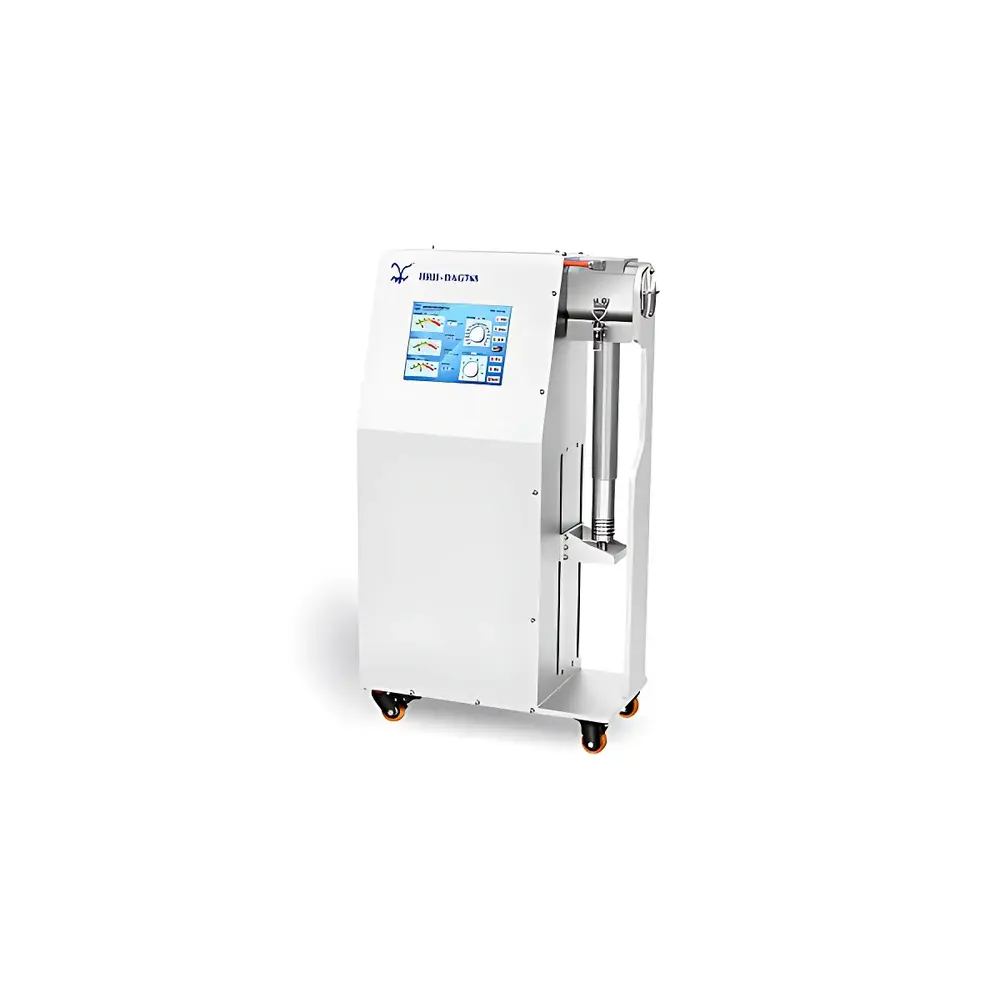
Huiron HRH-DAG768 Rotating Brush Aerosol Generator
| Brand | Huiron |
|---|---|
| Model | HRH-DAG768 |
| Principle | Rotating brush dispersion with controlled shear airflow |
| Particle Size Range | 0–100 µm (sample-dependent) |
| Feed Material | Non-cohesive dry powders and dusts |
| Powder Capacity | 300 mL |
| Mass Flow Rate | 10–65,000 mg/min |
| Volumetric Flow Rate | 2–100 L/min |
| Brush Speed | 200–3,000 rpm |
| Feed Speed | 0.003–5 mm/min |
| Air Supply Pressure | 1–5 bar |
| Power Supply | 220 V / 50 Hz |
| Dimensions (L×W×H) | 455 × 230 × 740 mm |
| Weight | 45 kg |
| Compliance | OECD TG 403, 412, 413, 436 |
Overview
The Huiron HRH-DAG768 Rotating Brush Aerosol Generator is an engineered solution for the reproducible, on-demand generation of stable, monodisperse-to-polydisperse dust aerosols in laboratory-scale inhalation toxicology, filter testing, and instrument calibration applications. It operates on the principle of mechanical dispersion via a high-precision rotating brush system coupled with laminar shear airflow across a calibrated slit nozzle. Powder is fed continuously from a gravity-fed reservoir onto a rotating bristle surface; centrifugal acceleration and controlled air shear at the slit interface disintegrate agglomerates into individual particles or small clusters. This method avoids thermal degradation, solvent residue, or electrostatic aggregation commonly associated with nebulization or thermal vaporization techniques—making it particularly suitable for non-cohesive, thermally sensitive, or hygroscopic particulate materials. The generator is designed to support exposure chambers compliant with OECD Test Guidelines for acute and subchronic inhalation studies, including whole-body and nose-only exposure systems.
Key Features
- Industrial-grade 7-inch capacitive touchscreen HMI with real-time parameter visualization: inlet pressure, volumetric flow rate (2–100 L/min), mass feed rate (10–65,000 mg/min), theoretical aerosol mass concentration (µg/m³ or mg/m³), brush rotational speed (200–3,000 rpm), linear feed speed (0.003–5 mm/min), and estimated remaining operational time.
- Integrated safety interlock system: automatic shutdown triggered by low air supply pressure (<1 bar) or loss of flow continuity, preventing incomplete dispersion and protecting internal components.
- Servo-driven precision feed mechanism with micrometer-level resolution, enabling repeatable dosing control essential for GLP-compliant dose-range finding and exposure level validation.
- Self-diagnostic firmware with event logging: records timestamps for start/stop cycles, fault conditions (e.g., clog detection, motor stall), and user-modified setpoints—supporting audit-ready documentation per FDA 21 CFR Part 11 requirements when paired with validated software.
- Modular airflow path with calibrated orifice and inline mass flow sensor (±1.5% full scale), ensuring traceable gas delivery independent of upstream pressure fluctuations.
- Automatic end-of-sample termination: optical powder-level monitoring initiates graceful shutdown upon reservoir depletion, eliminating operator dependency and minimizing batch-to-batch variability.
Sample Compatibility & Compliance
The HRH-DAG768 is validated for use with non-adhesive, free-flowing dry powders—including metal oxides (e.g., TiO₂, SiO₂), pharmaceutical excipients (lactose, mannitol), coal dust simulants, mineral fibers, and pesticide formulations. It excludes hygroscopic, fibrous, or highly cohesive materials requiring fluidized-bed or ultrasonic dispersion. All operational protocols align with OECD Test Guidelines 403 (acute inhalation toxicity), 412 (28-day subacute), 413 (90-day subchronic), and 436 (acute toxicity stepwise approach). Instrument design incorporates stainless-steel wetted parts and sealed brush housing to meet ISO 14644-1 Class 7 cleanroom compatibility for controlled environment integration. Calibration certificates for mass flow sensors and pressure transducers are supplied with NIST-traceable documentation.
Software & Data Management
The embedded controller supports RS-485 Modbus RTU and optional Ethernet TCP/IP communication for integration into centralized exposure control platforms (e.g., LabVIEW, SCADA, or custom Python-based orchestration). Logged data—including time-stamped flow, pressure, feed rate, and brush speed—is exportable in CSV format with UTC timestamps. When used with Huiron’s optional Aerosol Control Suite (v3.2+), the system enables automated exposure protocol scripting, multi-step concentration ramping, and real-time deviation alerts based on user-defined thresholds. Audit trails include operator ID, parameter changes, and system events—fully compliant with GLP and GMP documentation standards.
Applications
- Inhalation toxicology: Generation of standardized challenge aerosols for OECD-compliant rodent studies, including dose verification prior to chamber exposure.
- Aerosol instrumentation calibration: Reference aerosol source for calibrating optical particle counters (OPCs), beta attenuation monitors (BAM), tapered element oscillating microbalances (TEOM), and cascade impactors (e.g., Andersen, MOUDI).
- Filter media evaluation: Continuous generation of challenge aerosols for dust-holding capacity (dust loading), fractional collection efficiency (via gravimetric or optical downstream sampling), and pressure-drop profiling under realistic loading conditions.
- Fluid dynamics research: Seeding agent for laser Doppler anemometry (LDA) and laser two-focus (L2F) velocimetry in turbulent or boundary-layer flows where particle response time must match carrier-gas dynamics.
- Pharmaceutical aerosol development: Dry powder inhaler (DPI) formulation screening using surrogate lactose blends under controlled dispersion kinetics.
FAQ
What particle size distribution does the HRH-DAG768 produce?
The generator produces polydisperse aerosols ranging from submicron to 100 µm, with median aerodynamic diameter (MMAD) and geometric standard deviation (GSD) dependent on powder properties (density, morphology, cohesion), brush speed, and shear airflow velocity. Representative distributions are characterized using cascade impactors or SMPS systems during qualification runs.
Can the system be integrated with an exposure chamber?
Yes—standard 1/2″ NPT or ISO-KF 25 ports allow direct connection to whole-body or nose-only chambers. Flow-matched operation requires external feedback control of chamber exhaust to maintain constant dilution ratio and residence time.
Is the HRH-DAG768 compliant with GLP requirements?
The hardware meets functional GLP criteria for traceability, reproducibility, and failure-mode detection. Full GLP compliance requires documented IQ/OQ/PQ validation, defined SOPs, and integration with a Part 11–compliant data acquisition system.
What maintenance is required?
Daily visual inspection of brush integrity and powder hopper cleanliness; monthly calibration of mass flow sensor and pressure transducer using certified reference instruments; annual brush replacement recommended after ≥2,000 operating hours.
Does the system support remote monitoring?
Yes—via optional Ethernet module and Huiron RemoteView web interface (HTTPS-secured), enabling real-time parameter viewing, alarm notifications via email/SMS, and secure historical data retrieval without local PC dependency.







