
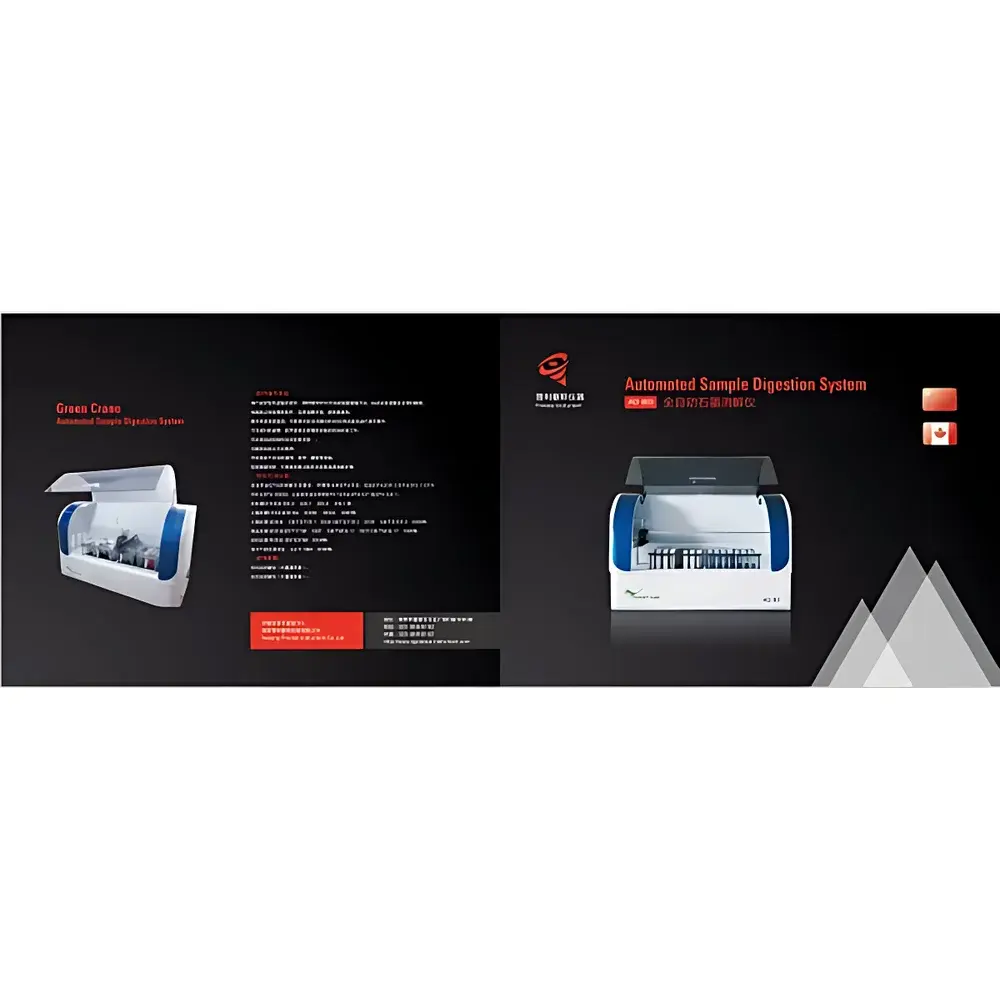
Green Crane AD-80 Fully Automated Graphite Block Digestion System
| Origin | Canada |
|---|---|
| Manufacturer Type | Authorized Distributor |
| Origin Category | Imported |
| Model | AD-80 |
| Instrument Type | Graphite Digestion System |
| Pricing | Available Upon Request |
Overview
The Green Crane AD-80 Fully Automated Graphite Block Digestion System is an engineered solution for high-throughput, trace-metal-grade sample preparation in environmental, food safety, clinical toxicology, and regulatory compliance laboratories. Built upon a modular graphite heating block architecture, the system employs resistive heating with embedded Pt100 sensors and multi-zone PID control to deliver uniform thermal distribution across all 80 digestion positions (standard configuration). Unlike open-vessel hot plates or microwave-assisted digestion systems, the AD-80 utilizes closed-vessel, temperature-controlled graphite digestion—enabling precise, reproducible acid decomposition of organic matrices (e.g., soils, tissues, dairy, cereals) under controlled atmospheric conditions. Its design complies with core method requirements in EPA Method 3050B, ISO 11466, ASTM D5762, and USP , supporting GLP/GMP-aligned workflows where documentation integrity and process repeatability are critical.
Key Features
- Fully automated robotic arm with 6-axis articulation for precise vial handling, cap manipulation, and reagent dispensing—minimizing operator exposure and inter-run variability.
- Integrated reagent delivery module with independent peristaltic pumps and solvent-resistant fluid paths for HNO₃, HCl, HF, and H₂O₂; includes automatic channel priming and post-use wash cycles using deionized water or dilute nitric acid.
- High-stability graphite block with ±0.5 °C temperature uniformity across all wells at setpoints from 30 °C to 280 °C; real-time monitoring via dual-sensor redundancy per zone.
- Motorized vertical lift mechanism enabling synchronized elevation/depression of digestion vessels during heating, cooling, and reagent addition phases—reducing thermal shock and improving digestion efficiency.
- Volumetric finalization system utilizing gravimetric endpoint detection (0.1 mg resolution) combined with programmable dilution protocols to achieve accurate 10–50 mL final volumes post-digestion.
- Multi-layer safety architecture including overtemperature cutoff, pressure-relief venting, door-interlocked operation, real-time vapor monitoring (HNO₃, HF), and emergency stop with hardware-based circuit isolation.
- Electrochemical corrosion mitigation strategy: graphite block coated with proprietary SiC-reinforced ceramic layer; stainless-steel frame electropolished and passivated; fluid-contact components fabricated from PFA, ETFE, and quartz.
- Onboard activated carbon + HEPA filtration unit (EN 1822 H13 rated) continuously recirculating and purifying fumes generated during digestion—eliminating need for external ducted exhaust in most Class II lab environments.
Sample Compatibility & Compliance
The AD-80 accommodates standard 50 mL and 75 mL PFA or quartz digestion tubes, as well as custom-fit borosilicate glass vessels (with optional adapter kit). It supports batch processing of up to 80 samples simultaneously—including heterogeneous solids, viscous slurries, and liquid homogenates—with programmable ramp/hold profiles for sequential acid additions (e.g., HNO₃ → H₂O₂ → HF). All operational parameters—including temperature logs, reagent volume dispensed, lift actuation timestamps, and gravimetric finalization data—are timestamped and stored with user ID attribution. The system supports 21 CFR Part 11-compliant audit trails when paired with Green Crane’s LIMS-integrated ControlSuite™ software (optional module), fulfilling documentation requirements for ISO/IEC 17025-accredited testing labs and FDA-regulated food/environmental monitoring programs.
Software & Data Management
ControlSuite™ v4.2 provides intuitive workflow-driven interface with drag-and-drop method builder, real-time thermal mapping visualization, and remote monitoring via secure HTTPS connection. All method files include embedded metadata (operator, date, instrument ID, calibration status) and support version-controlled revision history. Raw sensor data (temperature, weight, pump RPM, vapor concentration) are exported in .CSV or .CDF format compatible with MATLAB, JMP, and LabWare LIMS. Electronic signatures, role-based access control (RBAC), and configurable electronic logbooks meet ALCOA+ principles for data integrity. Optional integration with Thermo Fisher SampleManager or Agilent OpenLab enables automated result back-propagation to analytical instruments.
Applications
- Heavy metal analysis (As, Cd, Pb, Hg, Cr, Ni) in soil, sediment, and sludge per EPA 6010D and ISO 17294-2.
- Digestion of biological tissues (liver, muscle, hair) for clinical ICP-MS quantification under CLIA and CAP guidelines.
- Food and feed matrix preparation for multi-element screening in accordance with EU Regulation (EC) No 1881/2006 and AOAC 2013.06.
- Pharmaceutical excipient digestion prior to USP and Ph. Eur. 2.4.8 heavy metals testing.
- Plastic and polymer leachate digestion for RoHS compliance verification (Pb, Cd, Hg, Cr⁶⁺).
FAQ
Is the AD-80 compatible with hydrofluoric acid (HF) digestion protocols?
Yes—the system features full-fluid-path compatibility with HF, including PFA tubing, quartz digestion vessels (optional), and HF-rated vapor sensors calibrated to 0–10 ppm range.
Does the AD-80 require external ventilation or ductwork?
No—its integrated dual-stage fume abatement system meets ANSI Z9.5 laboratory air quality standards without external exhaust, though local building codes may require supplemental room-level ventilation.
Can existing digestion methods be imported into ControlSuite™?
Yes—legacy methods from Excel or text files can be mapped via CSV template; temperature ramps, reagent sequences, and lift profiles are auto-converted to executable protocol objects.
What calibration and maintenance documentation is provided?
Each unit ships with NIST-traceable temperature calibration certificate, gravimetric verification report, and a 3-year preventive maintenance schedule aligned with ISO/IEC 17025 Clause 6.4.1 requirements.



