
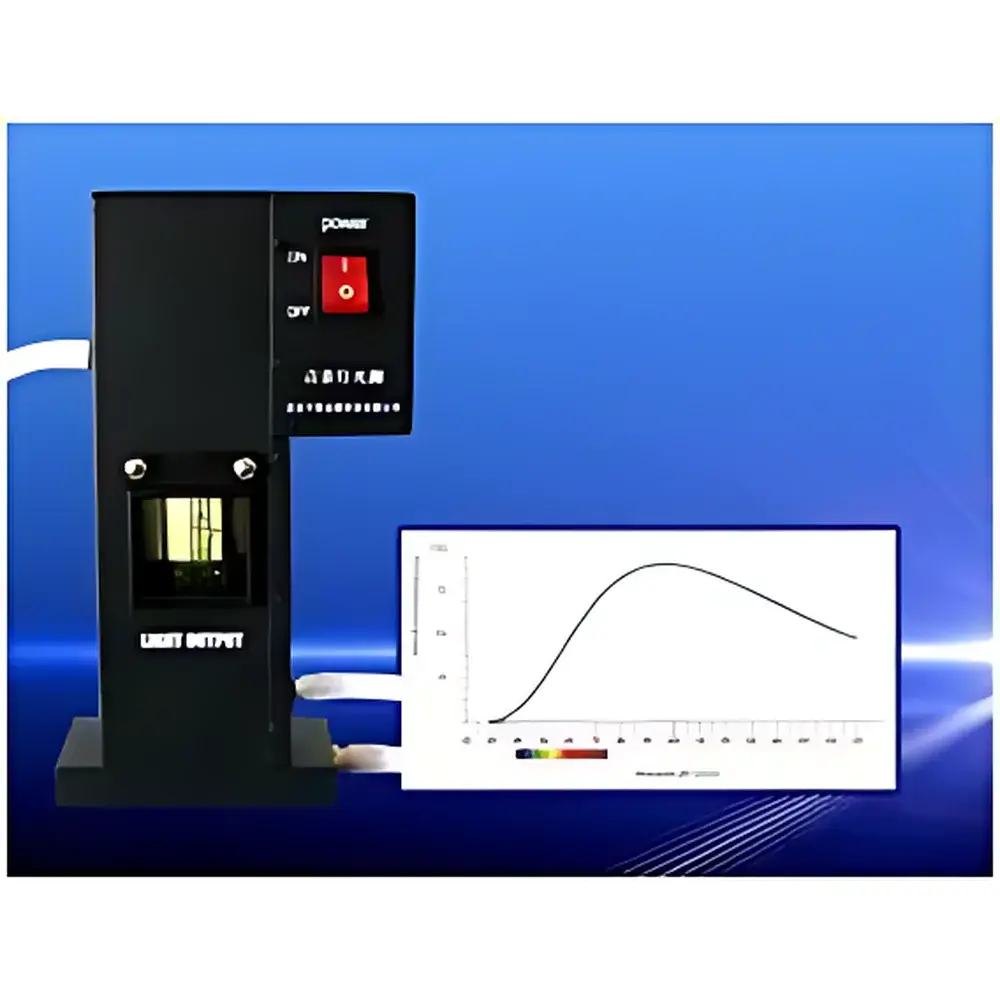
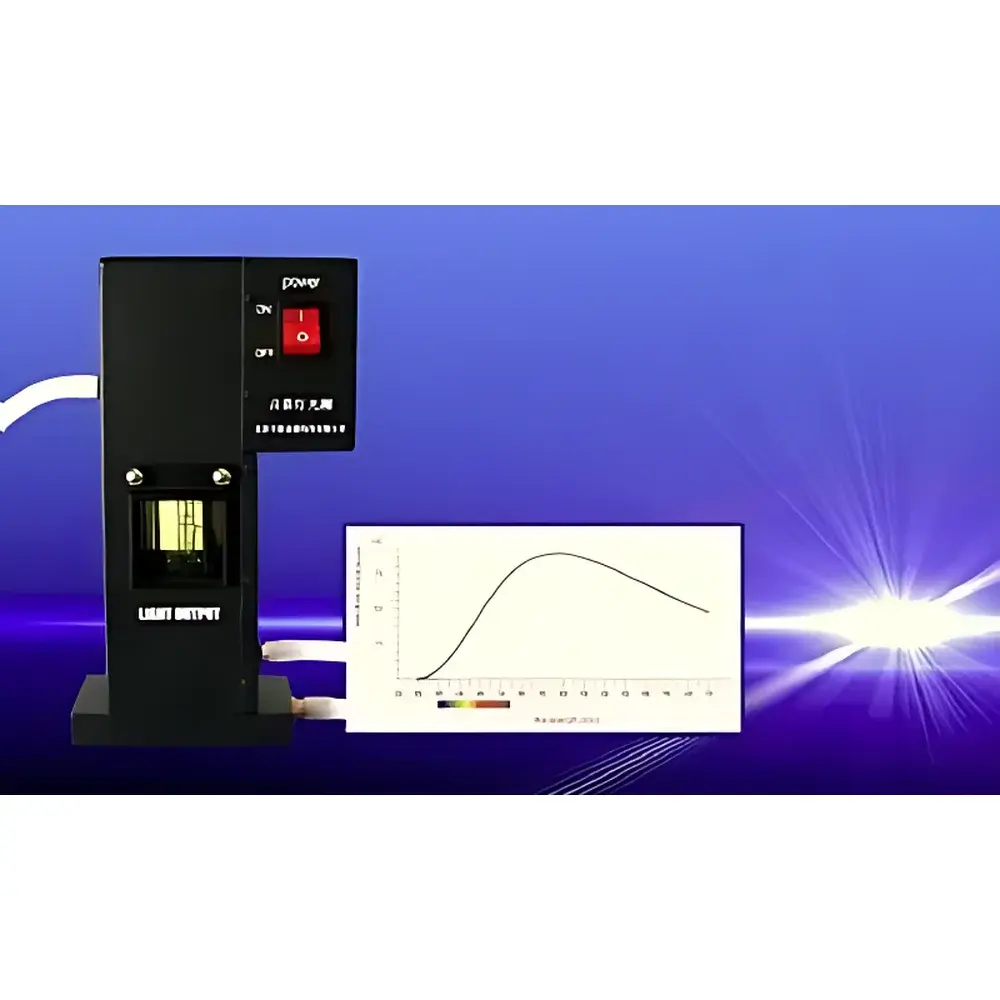
CEL-IW500 Tungsten-Halogen Water-Cooled Broadband Light Source
| Brand | CEL (China Education Goldsource) |
|---|---|
| Model | CEL-IW500 |
| Light Source Type | Tungsten-halogen lamp |
| Cooling Method | Forced water cooling |
| Input Voltage | 220 V AC |
| Operating Lamp Envelope Temperature | 200–1100 °C |
| Luminous Efficacy | 17–33 lm/W |
| Spectral Output Range | 350–2500 nm (continuous, broadband) |
| Rated Lifetime | ≥2000 h |
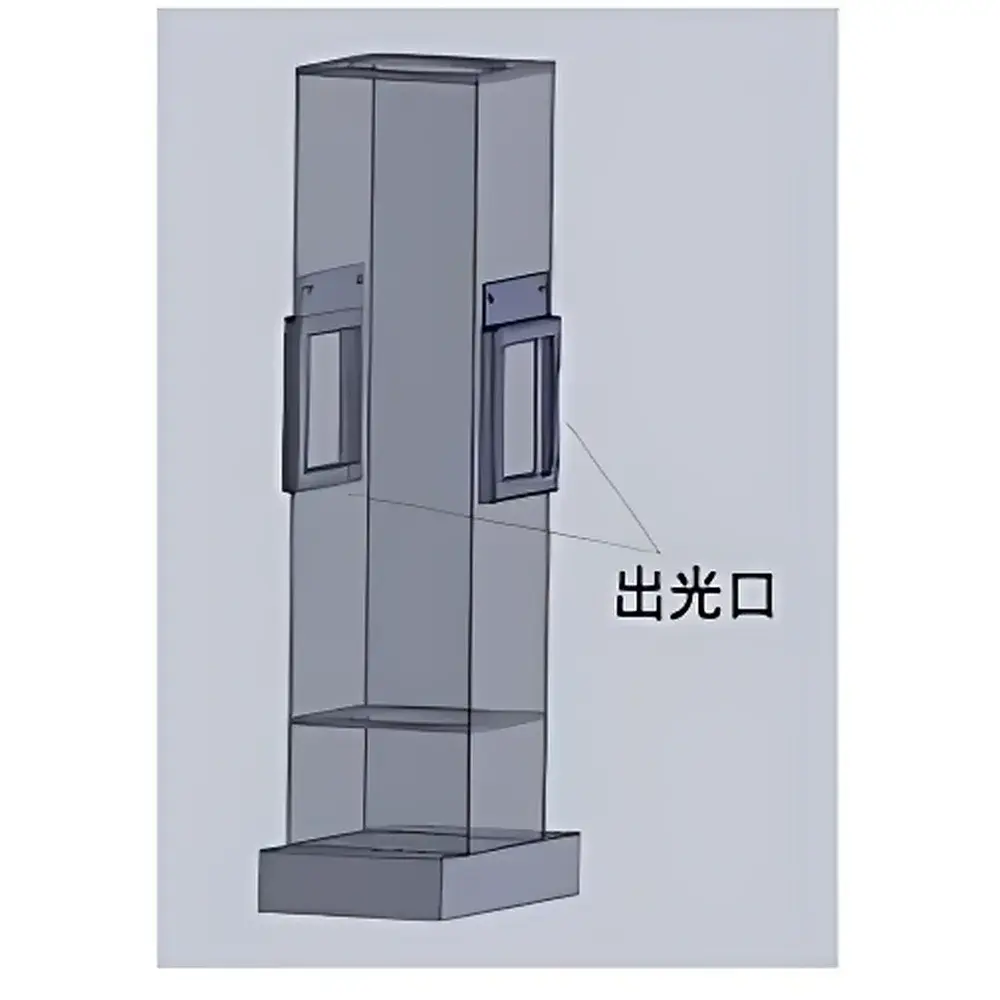
| Output Aperture | 50 mm × 50 mm |
| Illumination Geometry | External irradiation configuration |
| Optional Accessories | Visible-bandpass interference filters (discrete wavelength selection), dedicated light-shielding experimental enclosure with integrated temperature monitoring and remote process control |
Overview
The CEL-IW500 is a high-stability, water-cooled tungsten-halogen broadband light source engineered for precision optical laboratory applications requiring continuous spectral coverage from the near-UV through visible to near-infrared (350–2500 nm). Unlike pulsed or line-emission sources, the CEL-IW500 leverages incandescent thermal radiation physics—governed by Planck’s law and modified by halogen regenerative cycle—to deliver smooth, reproducible spectral irradiance without discrete emission lines. Its forced water-cooling architecture maintains stable filament temperature and envelope thermal equilibrium, minimizing spectral drift and output fluctuation (<±1.5% over 4 h at steady state). Designed explicitly for external irradiation configurations, the system directs collimated broadband output through a standardized 50 mm × 50 mm square aperture, enabling integration with spectrophotometers, photochemical reactors, solar simulator calibration benches, and material reflectance/transmittance test stations.
Key Features
- Water-cooled thermal management system ensuring long-term radiometric stability and extended lamp lifetime (≥2000 h at rated power)
- Broadband spectral output spanning 350–2500 nm—ideal for UV-Vis-NIR spectroscopy, spectral responsivity calibration, and photosensitivity testing
- High-temperature quartz envelope operating between 200 °C and 1100 °C, optimized for halogen cycle efficiency and reduced tungsten deposition
- External irradiation geometry compatible with custom optical trains, integrating seamlessly with monochromators, integrating spheres, and reaction chambers
- Modular filter interface supporting standard 25 mm and 50 mm diameter visible-bandpass interference filters (e.g., 400–450 nm, 500–550 nm, 600–650 nm) for quasi-monochromatic irradiation
- Dedicated control unit with real-time temperature monitoring, dimming capability (0–100% power), and RS-485/USB digital interface for automated experiment sequencing
Sample Compatibility & Compliance
The CEL-IW500 supports irradiation of solid, liquid, and thin-film samples in open-air or controlled-atmosphere environments. Its external illumination design eliminates internal chamber constraints, permitting compatibility with vacuum gloveboxes, humidity-controlled stages, and electrochemical cells. The optional CE-certified experimental enclosure meets IEC 61000-6-3 (EMC emission) and IEC 62471 (photobiological safety) Class 1 requirements—ensuring safe operation under continuous exposure conditions. All electrical components comply with GB/T 18268.1–2010 (equivalent to IEC 61326-1) for laboratory measurement and control equipment. While not an FDA-regulated medical device, its radiometric traceability framework aligns with ISO/IEC 17025–accredited calibration practices for optical power and spectral irradiance.
Software & Data Management
The CEL-IW500 integrates with third-party lab automation platforms via Modbus RTU or ASCII serial protocol. The embedded controller logs operational parameters—including lamp voltage, current, coolant temperature, and runtime—at 1 Hz resolution, exporting timestamped CSV files for GLP-compliant record retention. No proprietary software is required; configuration and monitoring are accessible through a web-based UI (accessible via Ethernet) or terminal emulation. Audit trails support 21 CFR Part 11–compatible electronic signatures when deployed within validated GxP environments using validated middleware (e.g., LabArchives, Benchling). Firmware updates are delivered via secure HTTPS and include cryptographic signature verification.
Applications
- Calibration of spectroradiometers and photodiode-based detectors across UV-Vis-NIR bands
- Photochemical kinetics studies requiring stable broadband excitation (e.g., TiO₂ photocatalysis, dye-sensitized solar cell characterization)
- Material aging tests per ASTM G154 and ISO 4892-3 using simulated daylight spectra
- Spectral responsivity mapping of imaging sensors and multispectral cameras
- Reference source in optical metrology labs performing comparative transmittance/reflectance measurements per ISO 9050
- Teaching laboratories for fundamental optics experiments—blackbody radiation, color temperature analysis, and filter transmission profiling
FAQ
What is the spectral irradiance uniformity across the 50 mm × 50 mm output aperture?
Measured uniformity is ±3.2% (peak-to-peak) at 100 mm working distance, verified with NIST-traceable CCD-based scanning radiometer.
Can the CEL-IW500 be operated continuously for >8 hours without performance degradation?
Yes—when paired with a recirculating chiller maintaining coolant inlet temperature at 15–20 °C, continuous operation up to 12 h meets spectral stability specifications.
Is spectral calibration data provided with each unit?
Each shipment includes a factory-measured relative spectral power distribution (rSPD) report, referenced to a NIST SRM 2241 tungsten-halogen standard lamp.
Does the optional enclosure support integration with gas purging systems?
Yes—the enclosure features dual 6 mm Swagelok ports for inert gas (N₂ or Ar) purging to suppress ozone generation and prevent sample oxidation during UV-rich irradiation.
How is lamp replacement performed, and is alignment recalibration required?
Lamp exchange follows a tool-free, indexed socket mechanism; mechanical repeatability ensures <0.15° angular deviation—no optical realignment is necessary post-replacement.





