
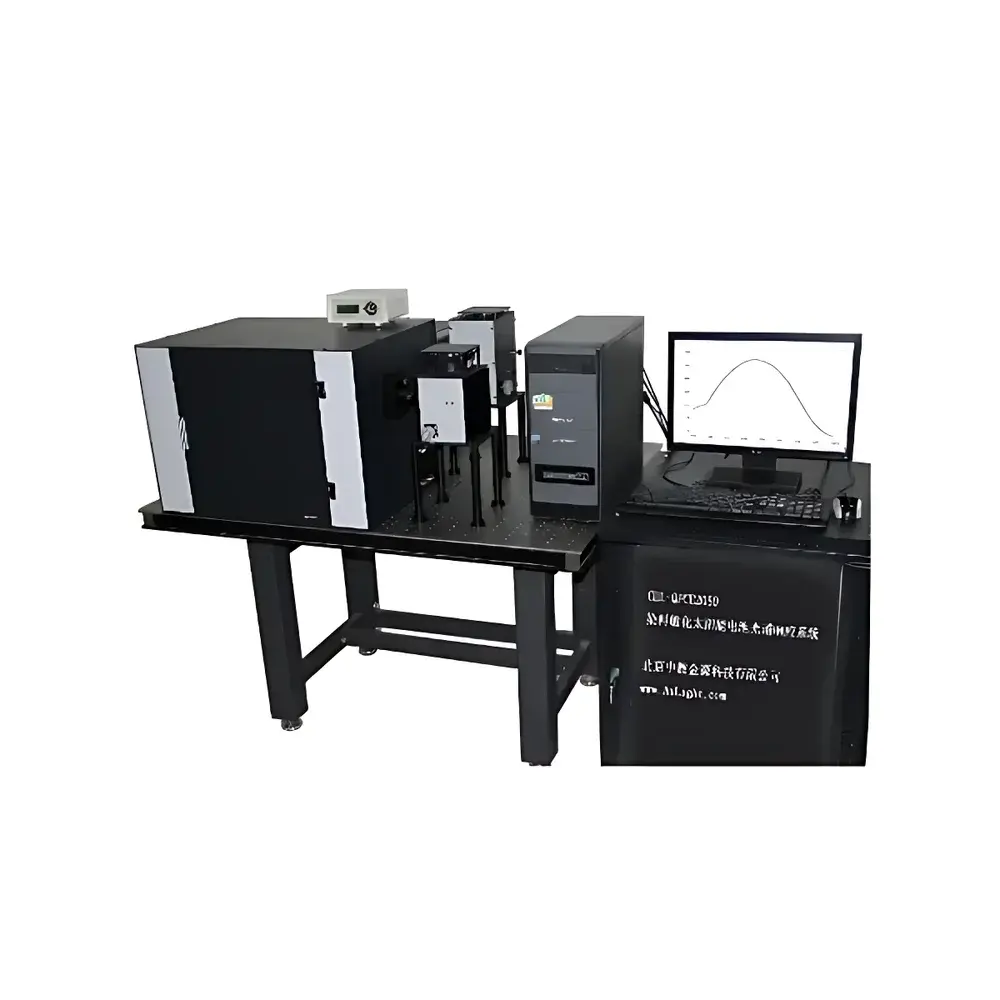
CEL-QPCE2050 Quantum Efficiency / Incident Photon-to-Current Efficiency (QE/IPCE) Measurement System for Perovskite and Dye-Sensitized Solar Cells
| Brand | CEL (Zhongjiao Jinyuan) |
|---|---|
| Origin | Beijing, China |
| Manufacturer Type | Original Equipment Manufacturer (OEM) |
| Product Category | Domestic |
| Model | CEL-QPCE2050 |
| Light Source Type | Monochromatic + Broadband Bias Source |
| Illumination Mode | External Illumination |
| Spectral Range | 200–1100 nm |
| Wavelength Step Resolution | ≥1 nm (continuously adjustable) |
| Scan Mode | Fully Automated Sequential Scanning |
| QE/IPCE Repeatability | <0.3% (J<sub>sc</sub>) |
| Operating Mode | DC (Direct Current) |
| Chopping Frequency | 5–1000 Hz |
| Optional Temperature-Controlled Stage | 5–40 °C (±0.5 °C) |
| Bias Light Source | Standard Single-Channel White Light (Xenon-based, AM1.5G-equivalent, ~0.5 SUN) |
| Monochromator Focal Length | 300 mm (150 mm optional) |
| Compliance | ASTM E1021-12, IEC 60904-8, GB/T 6495.8–2002 |
Overview
The CEL-QPCE2050 is a fully automated, high-precision quantum efficiency (QE) and incident photon-to-current efficiency (IPCE) measurement system engineered specifically for single-junction photovoltaic devices operating under direct current (DC) detection principles. It employs a dual-light-source architecture: a high-stability monochromator-coupled tunable light source for spectral resolution across 200–1100 nm, and a calibrated broadband xenon-based bias lamp delivering a stable 0.5 SUN (AM1.5G) illumination to maintain device operational equilibrium during measurement. Unlike AC-modulated systems—whose low-frequency requirements (<1 Hz) pose practical limitations for dye-sensitized solar cells (DSSCs) and perovskite photovoltaics—the CEL-QPCE2050 utilizes DC-mode operation to accommodate the inherently slow carrier recombination kinetics and redox response times characteristic of these materials. The system’s optical design features a total internal reflection sample chamber that eliminates transmission-based optical artifacts (e.g., multi-reflection errors from lenses or windows), ensuring traceable, artifact-free photocurrent quantification.
Key Features
- Fully automated sequential measurement protocol compliant with ASTM E1021-12, IEC 60904-8, and GB/T 6495.8–2002 — including automatic standard reference cell and DUT (device under test) exchange without manual intervention.
- High-stability monochromatic illumination with <0.3% short-circuit current repeatability over full spectral scan (200–1100 nm), enabled by precision grating monochromators (standard 300 mm focal length; 150 mm optional).
- Dual-source illumination architecture: spectrally resolved monochromatic probe light + spatially uniform, intensity-stabilized white-light bias (xenon arc, AM1.5G spectrum, calibrated to 0.5 SUN).
- Optimized optical path with all-reflective sample chamber geometry — eliminates chromatic aberration, transmission losses, and stray reflections associated with transmissive optics.
- Integrated Keithley digital multimeter (or equivalent high-accuracy source-measure unit) for low-noise, high-speed photocurrent acquisition synchronized with wavelength stepping and chopping control (5–1000 Hz).
- Software-controlled background subtraction, dark-current correction, and spectral responsivity normalization against NIST-traceable silicon or GaAs reference detectors.
Sample Compatibility & Compliance
The CEL-QPCE2050 supports characterization of dye-sensitized solar cells (DSSCs), perovskite solar cells (PSCs), organic photovoltaics (OPVs), and other single-junction semiconductor devices amenable to DC-based external quantum efficiency analysis. Its mechanical and electrical interface accommodates standard 1 cm² active-area substrates mounted on conductive holders with low-inductance connections. All calibration protocols adhere to internationally recognized photovoltaic metrology frameworks, enabling data traceability to national standards bodies. The system satisfies essential requirements for GLP-compliant lab environments, including audit-ready measurement logs, timestamped parameter records, and user-accessible calibration history. While not intrinsically FDA 21 CFR Part 11 certified, its software architecture supports integration with validated LIMS platforms when deployed in regulated R&D or quality assurance settings.
Software & Data Management
The proprietary control suite provides real-time spectral visualization, automated wavelength stepping, and integrated data reduction workflows for deriving absolute spectral responsivity (A/W), external quantum efficiency (%), and IPCE curves. Raw and processed datasets are exported in CSV and HDF5 formats, preserving metadata such as lamp intensity, monochromator slit width, integration time, temperature, and bias irradiance. Each measurement session generates a structured JSON log file containing instrument configuration, environmental conditions, and operator ID — supporting reproducibility verification and regulatory documentation. Optional API access enables programmatic integration with MATLAB, Python (via PyVISA), or LabVIEW for custom automation sequences and batch processing pipelines.
Applications
- Quantitative benchmarking of charge extraction efficiency in mesoporous TiO₂-based DSSCs across visible-NIR spectrum.
- Correlation of perovskite film morphology (e.g., grain size, phase purity) with wavelength-resolved carrier generation yield.
- Evaluation of interfacial recombination losses via comparative IPCE analysis before/after surface passivation treatments.
- Validation of spectral mismatch corrections used in I-V curve translation between different light sources.
- Development and qualification of novel redox mediators and hole-transport layers through their impact on long-wavelength photoresponse.
- Temperature-dependent QE mapping (with optional thermal stage) to assess activation energies of charge transfer processes.
FAQ
What types of solar cells is the CEL-QPCE2050 optimized for?
It is specifically designed for dye-sensitized, perovskite, and other single-junction photovoltaic devices requiring DC-mode quantum efficiency measurement due to slow transient response characteristics.
Does the system support NIST-traceable calibration?
Yes — reference detector calibration follows procedures aligned with NIST SRM 2270 (silicon photodiode) and SRM 2271 (GaAs photodiode), with documented uncertainty budgets available upon request.
Can the monochromator be upgraded to higher resolution?
The standard 300 mm focal length monochromator delivers ≤1.2 nm bandwidth at 500 nm; a 150 mm option is available for faster scanning at moderate resolution trade-offs.
Is temperature control integrated or optional?
A Peltier-based thermal stage (5–40 °C, ±0.5 °C stability) is offered as an optional add-on module with independent PID control and sensor feedback.
How is stray light minimized in the optical path?
Through a combination of double-grating monochromator design, order-sorting filters, and an all-reflective sample chamber that avoids refractive elements entirely.




