
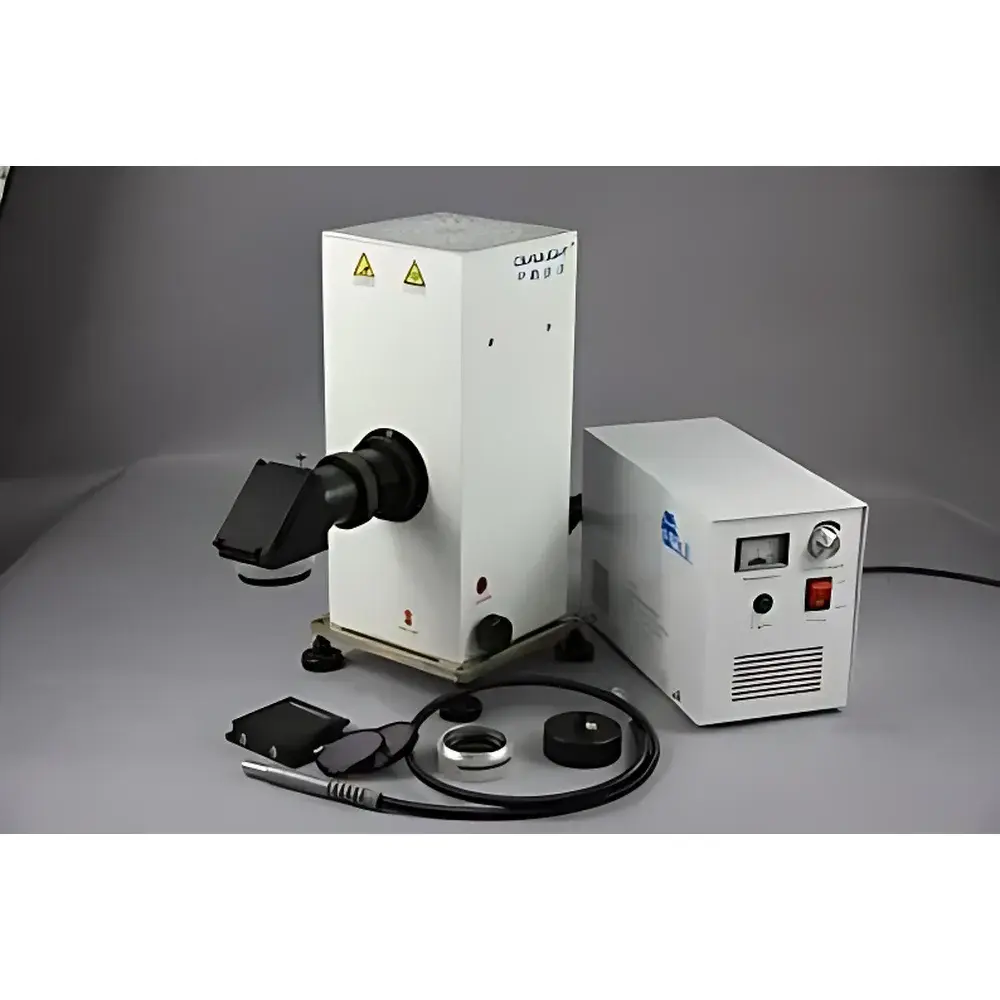
CEL-MXL350 Mercury-Xenon Arc Lamp Light Source System
| Brand | CEL (China Education Goldsource) |
|---|---|
| Origin | Beijing, China |
| Manufacturer Type | Direct Manufacturer |
| Product Category | Domestic |
| Model | CEL-MXL350 |
| Light Source Type | High-Pressure Short-Arc Hg-Xe Lamp |
| Illumination Mode | External Irradiation |
| Input Power | 350 W Max |
| Radiant Output | 15 W |
| Spectral Range | 350–1100 nm |
| Color Temperature | 6000 K |
| AM1.5G Spectral Match | Yes |
| Output Stability | ≤1.0% (RMS, over 8 h) |
| Lamp Lifetime | >800 h |
| Cooling Method | Forced-Air Convection |
| Adjustable Spot Diameter | 3–60 mm |
| Point Source Output Diameter | 2–3 mm |
| Current Regulation Range | 15–25 A |
| Light Intensity Control | 0.5–2 Sun (1 Sun = 1000 W/m²), continuously adjustable via external power supply and calibrated with CEL-NP2000 radiometer |
| Optical Interface Compatibility | Standardized mounts for 25.4 mm, 50.8 mm, M52, M62 optics |
| Optional Accessories | AM1.5G Filter Set, Collimating Lens Kit, Beam Steering Mirror, Fiber Coupling Adapter (SMA905), Variable Aperture Spot Regulator (3–52 mm) |
Overview
The CEL-MXL350 Mercury-Xenon Arc Lamp Light Source System is an engineered optical instrument designed for high-fidelity solar simulation and broadband spectral irradiation in research-grade photonic laboratories. It employs a 350 W high-pressure short-arc mercury-xenon lamp, which—under high-frequency, high-voltage ignition—generates a stable, spatially compact arc plasma (<2 mm effective emission size). This point-source geometry enables precise collimation, efficient fiber coupling, and uniform illumination when integrated with downstream optical components. The system emits a continuous spectrum spanning 350–1100 nm, closely matching the ASTM G173-03 AM1.5G reference solar spectrum across the UV-Vis-NIR range. With a correlated color temperature of 6000 K and radiant output stability ≤1.0% RMS over 8-hour operation, the CEL-MXL350 meets critical requirements for quantitative photoelectrochemical characterization, quantum efficiency mapping, and accelerated aging studies under controlled irradiance conditions.
Key Features
- High-brightness point source: <2.5 mm arc diameter ensures diffraction-limited beam conditioning and minimal étendue for efficient light collection.
- UV-transmitting fused silica condenser lens and ellipsoidal rear reflector jointly achieve >75% optical collection efficiency from arc to output port.
- Integrated high-voltage igniter eliminates external HV cabling between lamp housing and power supply—reducing EMI, arcing risk, and operator exposure per IEC 61000-4-5 surge immunity guidelines.
- Real-time irradiance control: Continuously adjustable output from 0.5 to 2 Sun (1000 W/m²), traceably calibrated using the CEL-NP2000 NIST-traceable radiometer.
- Thermally managed forced-air cooling with dual-speed fan and overtemperature cutoff ensures lamp thermal equilibrium and long-term radiometric repeatability.
- Modular mechanical interface supports industry-standard optical mounts (25.4 mm, 50.8 mm, M52, M62), enabling seamless integration with filters, lenses, monochromators, and fiber launch systems.
Sample Compatibility & Compliance
The CEL-MXL350 is compatible with solid-state photovoltaic devices (Si, CIGS, perovskite, OPV), photocatalytic thin films (TiO₂, g-C₃N₄, MOFs), biological tissue samples under non-thermal photostimulation protocols, and surface defect analysis substrates requiring sub-millimeter spatial resolution. Its spectral fidelity complies with ISO 9050:2003 (optical properties of glazing) for transmittance validation workflows and aligns with ASTM E927-22 specifications for Class AAA solar simulators in irradiance uniformity (±2%) and temporal stability (≤2% drift over 10 min). While not certified as a Class AAA simulator out-of-the-box, its AM1.5G spectral match deviation remains within ±15% across 400–1100 nm—sufficient for R&D-level quantum yield measurement, IPCE analysis, and comparative photocatalytic activity ranking per ISO 25922:2015.
Software & Data Management
The CEL-MXL350 operates as a hardware-controlled analog source and does not include embedded firmware or proprietary software. Irradiance adjustment is performed via analog voltage input (0–5 V or 0–10 V) to the external DC power supply (e.g., CEL-PW300 series), allowing full integration into LabVIEW, Python (PyVISA), or MATLAB-based automated test benches. Radiometric calibration data—including spectral irradiance (W/m²/nm) at 1 Sun and angular intensity distribution—are supplied in CSV and ASCII formats for third-party spectral modeling (e.g., TracePro, Zemax OpticStudio). Audit trails for lamp runtime, current setpoints, and thermal logs are maintained externally via connected DAQ systems compliant with FDA 21 CFR Part 11 when deployed in GLP/GMP-adjacent environments.
Applications
- Photovoltaic device testing: J-V curve acquisition, EQE/IPCE mapping, light-soaking protocols, and degradation kinetics under controlled AM1.5G illumination.
- Photoelectrochemical cell characterization: In-situ transient absorption, photocurrent onset potential determination, and wavelength-resolved action spectra.
- Heterogeneous photocatalysis: Kinetic benchmarking of H₂ evolution, CO₂ reduction, and organic pollutant degradation under standardized photon flux.
- Optical biosensing: Controlled UV-Vis excitation of fluorophores, optogenetic stimulation of channelrhodopsin-expressing cells, and photobiomodulation dose-response studies.
- Materials defect spectroscopy: Surface photovoltage (SPV) and Kelvin probe force microscopy (KPFM) illumination with minimized thermal loading.
- Fiber-delivered phototherapy: Coupling into SMA905-terminated quartz fibers (core Ø 400 µm–1000 µm) for endoscopic or microfluidic irradiation setups.
FAQ
What is the recommended operating current range for optimal lamp lifetime and spectral stability?
The lamp achieves longest service life (>800 h) and minimal spectral drift when operated between 18–22 A DC. Currents above 24 A accelerate electrode sputtering and quartz envelope darkening.
Can the CEL-MXL350 be used with liquid light guides or liquid-core fibers?
No—only solid-core silica or fused silica fibers rated for UV transmission (e.g., Ocean Insight QP400-2-SR-BX) are compatible. Liquid light guides introduce thermal instability and UV absorption below 350 nm.
Is the AM1.5G filter included by default or optional?
The AM1.5G spectral shaping filter is an optional accessory (CEL-AM15G-FIL). The base system delivers native Hg-Xe continuum; spectral filtering must be added externally for strict compliance.
Does the system support TTL or analog modulation for pulsed irradiation experiments?
Yes—the power supply interface accepts 0–5 V analog modulation signals up to 1 kHz bandwidth for intensity modulation, though arc extinction/reignition latency limits true on/off pulsing to ≥100 ms duty cycles.
How is radiometric calibration traceability established?
Calibration is performed against a NIST-traceable thermopile detector (CEL-NP2000) at the output plane. Certificate includes spectral irradiance values at 1 Sun, spatial uniformity map, and angular divergence profile.



