
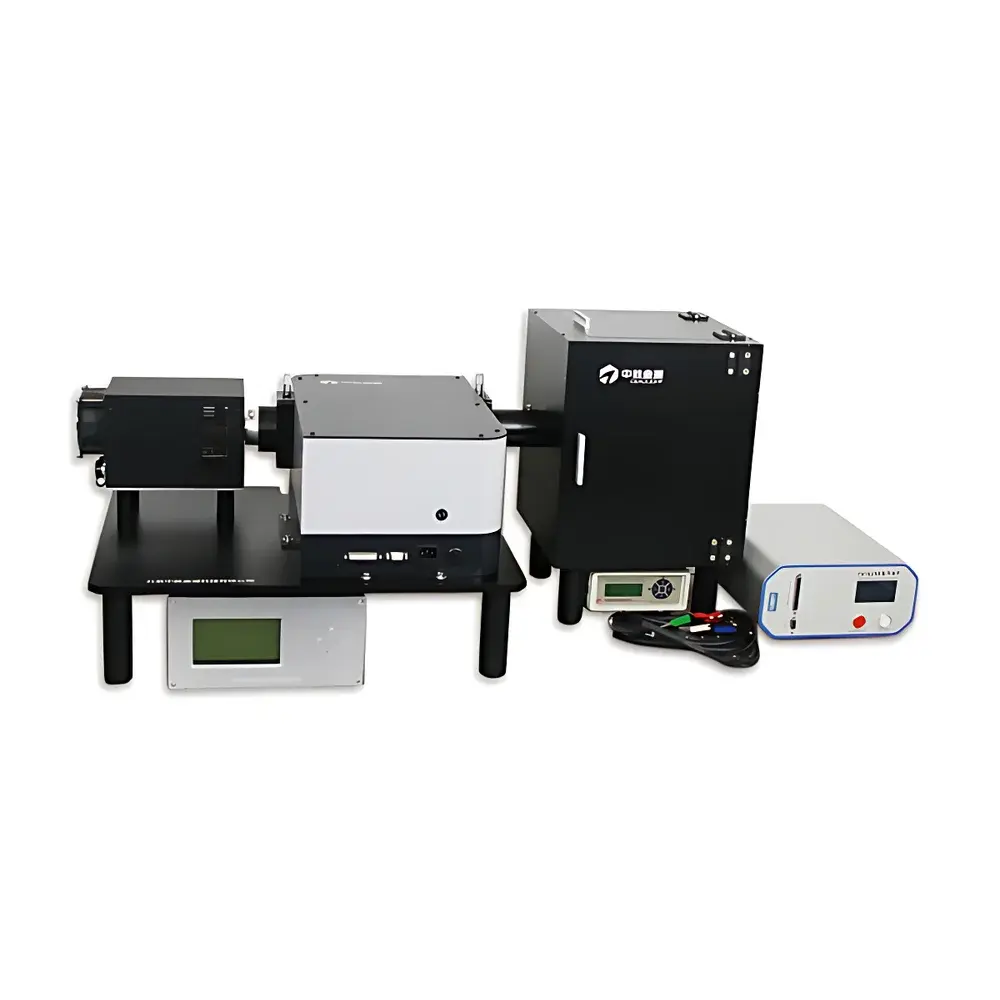
CEL-SLF-Vertex Photoelectrochemical Testing and Analysis System
| Brand | CEL (China Education Goldsource) |
|---|---|
| Model | CEL-SLF-Vertex |
| Origin | Beijing, China |
| Manufacturer Type | OEM Manufacturer |
| Light Source Type | Xenon Arc Lamp |
| Illumination Mode | External Irradiation |
| Spectral Range | 300–1600 nm |
| Bandwidth Tunability | 0.1–30 nm (continuous) |
| Output Stability | < ±0.5% RMS |
| Maximum Irradiance | ≥50 mW/cm² (at sample plane, calibrated) |
| Shutter Response Time | 0.1 ms |
| Dark Chamber Dimensions | 30 × 30 × 35 cm (adjustable height) |
| Monochromator | Dual-grating (CEL-IS151) or Triple-grating (CEL-IS302), N₂-purged optical path |
| Software Control | Integrated real-time synchronization with electrochemical workstations (Admiral Squidstat Plus, Zahner IM6, PINE WaveDriver, CHI760E) |
| Compliance | Designed for ASTM E2583 (IPCE), ISO 15444-2 (photoresponse calibration), and GLP-compliant electrochemical data acquisition per FDA 21 CFR Part 11 audit trail requirements |
Overview
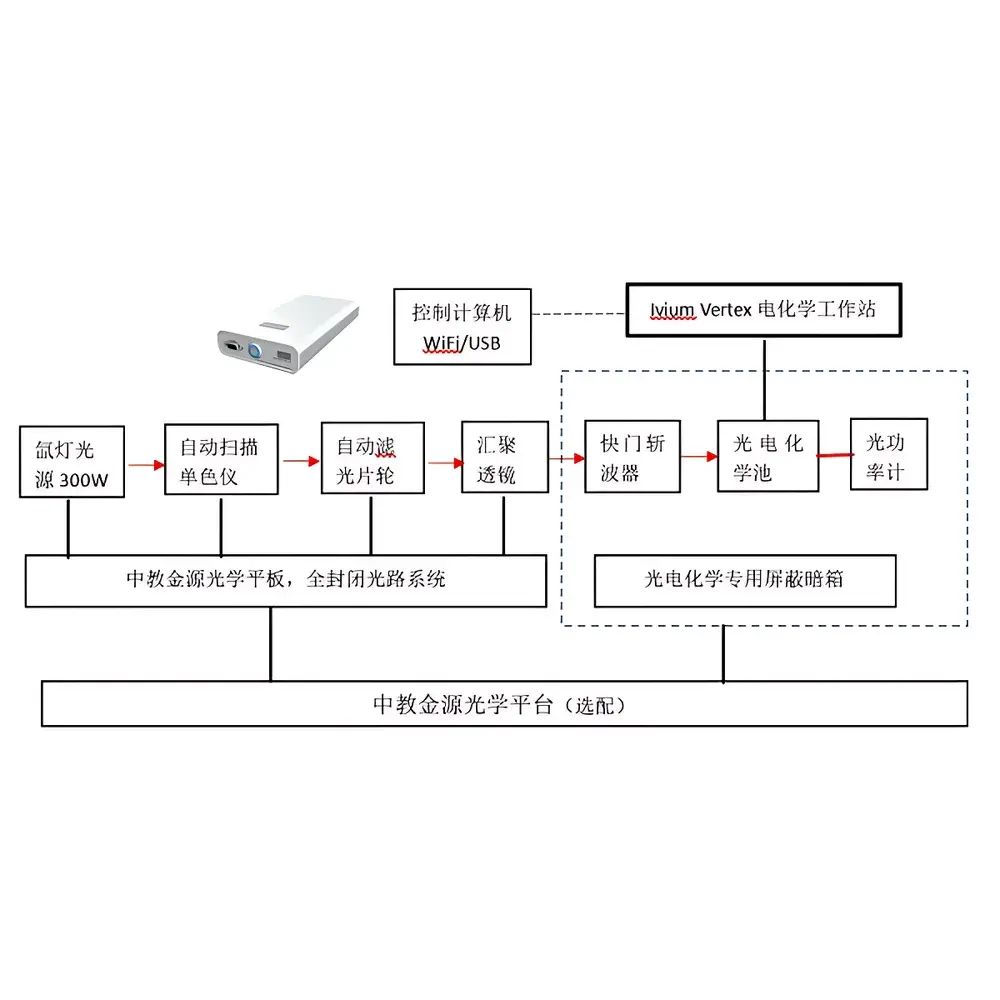
The CEL-SLF-Vertex Photoelectrochemical Testing and Analysis System is a modular, research-grade instrumentation platform engineered for quantitative photoelectrochemical (PEC) characterization of semiconductor-based catalytic materials under controlled illumination and electrochemical bias. It operates on the principle of simultaneous photon absorption and charge-transfer kinetics monitoring at the solid–liquid interface—enabling precise measurement of photocurrent onset potentials, incident photon-to-current efficiency (IPCE), electrochemical impedance spectroscopy (EIS) under illumination, transient photocurrent decay, and wavelength-resolved action spectra. The system integrates a high-stability xenon arc light source, a precision scanning monochromator with nitrogen-purged optical path, motorized filter wheel, microsecond-class shutter control, calibrated photometric monitoring, and synchronized data acquisition with industry-standard bipotentiostats. Its architecture supports both steady-state and time-resolved PEC analysis across the ultraviolet–visible–near-infrared spectrum (300–1600 nm), making it suitable for fundamental studies of charge carrier separation, interfacial recombination dynamics, and catalytic turnover in solar fuel generation, environmental remediation, and advanced optoelectronic material screening.
Key Features
- High-stability xenon lamp (CEL-HXF300/HXUV300 series) delivering <±0.5% irradiance stability over 8-hour continuous operation, with optional deuterium, tungsten-halogen, or mercury lamp integration for spectral extension.
- Dual- or triple-grating monochromator (CEL-IS151/IS302) with continuous bandwidth tuning from 0.1 to 30 nm; optical chamber isolated from mechanical drive components to eliminate stray light and hydrocarbon contamination.
- N₂-purge port enabling stable UV (1100 nm) spectral measurements by suppressing atmospheric O₂ and H₂O absorption bands.
- Real-time software-synchronized control of light source intensity, monochromator wavelength, filter selection, shutter timing (down to 0.1 ms), and photometric feedback via CEL-NP2000 power meter.
- Optically enclosed dark chamber (30 × 30 × 35 cm) with adjustable height, EMI shielding, and black anodized interior to suppress ambient light and electromagnetic interference during low-noise current measurement.
- Modular reaction cell compatibility—including PECK-series quartz/glass electrochemical cells with three-electrode configuration, temperature-controlled variants, and gas-tight designs for in situ H₂/CO₂ evolution quantification.
Sample Compatibility & Compliance
The CEL-SLF-Vertex accommodates a broad range of photoactive samples including metal oxide thin films (TiO₂, WO₃, BiVO₄), perovskite heterostructures, quantum dot assemblies, molecular catalysts immobilized on FTO/ITO substrates, and powder slurries in standard electrochemical cells. All optical and electrical interfaces adhere to IEC 61000-4-3 (EMC immunity) and UL 61010-1 safety standards. Photometric calibration traceability follows NIST-traceable reference detectors (e.g., Hamamatsu S1337-1010BR). Electrochemical data acquisition meets GLP/GMP requirements through configurable audit trails, electronic signatures, and raw-data encryption—fully compliant with FDA 21 CFR Part 11 when paired with Admiral Squidstat Plus or Zahner IM6 workstations running validated firmware versions.
Software & Data Management
The system is controlled via CEL’s proprietary VertexControl software (Windows 10/11 x64), which provides unified scripting (Python API support), hardware abstraction layer (HAL) integration, and bidirectional communication with electrochemical workstations via USB/RS232/Ethernet. All acquired datasets—including time-resolved photocurrent, wavelength-scanned IPCE, Mott–Schottky plots, and EIS Bode/Nyquist spectra—are stored in HDF5 format with embedded metadata (wavelength, power density, electrode potential, scan rate, ambient conditions). Export options include CSV, MATLAB .mat, and Origin-compatible OPJ files. Version-controlled software updates and user-defined protocol templates ensure reproducibility across multi-user laboratory environments.
Applications
- Quantitative IPCE mapping of photoanodes/cathodes for solar water splitting (ASTM E2583–21).
- In situ EIS under chopped illumination to resolve recombination resistance vs. charge transfer resistance at semiconductor/electrolyte interfaces.
- Action spectrum analysis of CO₂ reduction catalysts under tunable monochromatic irradiation.
- Transient photocurrent spectroscopy (TPS) for carrier lifetime estimation in nanostructured photoelectrodes.
- Photocorrosion stability assessment via chronoamperometry under AM 1.5G-equivalent illumination.
- Multi-wavelength photoelectrocatalytic kinetics modeling using coupled optical–electrochemical rate equations.
FAQ
Can the CEL-SLF-Vertex be integrated with third-party electrochemical workstations other than Admiral?
Yes—the system supports standardized SCPI command sets and virtual COM port emulation, enabling seamless integration with Zahner IM6, PINE WaveDriver, CHI760E, BioLogic SP-300, and Metrohm Autolab PGSTAT series.
Is the monochromator calibrated for absolute spectral irradiance?
Calibration is performed using NIST-traceable silicon and extended-range InGaAs photodiodes; full spectral responsivity curves are supplied with each instrument and updated annually via optional recalibration service.
What is the minimum detectable photocurrent under optimized conditions?
With low-noise transimpedance amplification and shielded cabling, the system achieves sub-picoampere resolution (≤0.5 pA RMS) in Faraday cage mode with 1-second integration time.
Does the system support automated long-term stability testing?
Yes—VertexControl includes scheduler modules for unattended 72+ hour chronoamperometric sequences with periodic IPCE verification and real-time degradation trending.
Are optical alignment tools included for beam collimation and focus optimization?
Standard delivery includes alignment laser module, pinhole targets, adjustable optical mounts, and collimated beam profiling kit (with CCD-based beam profiler optional).




