
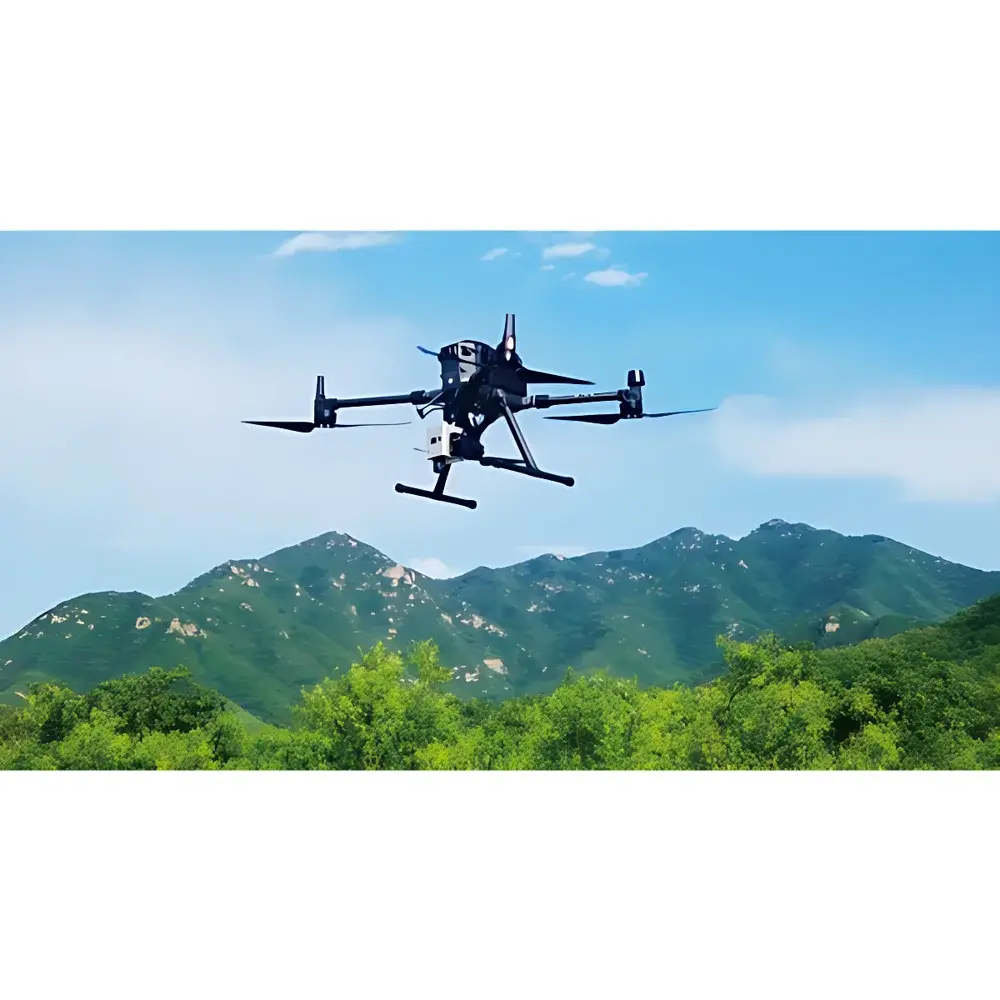
Corning 410Vis Hyperspectral Imaging System
| Brand | Corning |
|---|---|
| Origin | USA |
| Manufacturer Type | Authorized Distributor |
| Import Status | Imported |
| Model | 410Vis |
| Spectral Range | 400–1000 nm |
| Spectral Dispersion Type | Dispersive (Offner Imaging Spectrometer) |
| Detector Configuration | 4000 × 3000 pixel + 1408 spatial-band CMOS/CCD hybrid focal plane array |
| Spatial Resolution (IFOV) | < 0.5 mrad (typical, platform-dependent) |
| Total Field of View (TFOV) | ±40° pitch, ±45° roll |
| Frame Rate | 100–300 Hz (user-selectable, auto-synchronized with platform velocity and swath width) |
| Image Cube Format | 682 × 80,000 pixels per hypercube (sub-cube extraction supported) |
| Onboard Processing | Embedded real-time microcontroller, radiometric calibration engine, MEMS-based tightly coupled GPS/INS |
| Operating Platform | Airborne (UAV/UAS) and ground-based (tripod/mast-mounted) |
| Compliance | Meets ASTM E2792-21 (Standard Practice for Hyperspectral Imaging Data Acquisition), ISO 18587:2017 (Remote Sensing — Hyperspectral Data Quality Assessment) |
Overview
The Corning 410Vis Hyperspectral Imaging System is a field-deployable, dual-mode (airborne and terrestrial) push-broom hyperspectral imager engineered for scientific-grade spectral data acquisition across the visible to near-infrared (VNIR) spectrum (400–1000 nm). It employs a dispersive optical architecture centered on a patented solid-optics Offner imaging spectrometer, integrated with a high-quantum-efficiency (HQE) CMOS focal plane array (FPA) and precision diamond-turned diffraction grating. This configuration ensures high spectral fidelity, minimal smile and keystone distortion, and excellent signal-to-noise ratio (SNR > 650:1 at 550 nm, 100 ms integration). Unlike scanning or snapshot systems, the 410Vis utilizes a true push-broom acquisition geometry—capturing one spatial line per frame across 1408 contiguous spectral bands—with simultaneous geometric referencing via its embedded MEMS-based inertial navigation system (INS) tightly coupled to GNSS. The system delivers calibrated radiance cubes in standard ENVI-compatible BIL format, enabling immediate use in quantitative spectral unmixing, material identification, and biophysical parameter retrieval without proprietary software lock-in.
Key Features
- Patented Offner spectrometer design with diamond-ruled diffraction grating for high throughput (>75% average transmission across 400–1000 nm) and low polarization sensitivity
- Hybrid detector architecture: 4000 × 3000 pixel panchromatic CMOS sensor (12 MP, global shutter) co-aligned with a 1408-band VNIR linear array (682 spatial pixels × 1408 spectral channels)
- Real-time onboard radiometric calibration using integrated non-uniformity correction (NUC) and dark current compensation
- Tightly coupled GPS/INS unit (MEMS-grade IMU, RTK-capable) providing sub-10 cm horizontal and <5 cm vertical positioning accuracy (with base station), plus attitude resolution of <0.01°
- Configurable frame rates from 100 Hz to 300 Hz, automatically synchronized to platform speed and desired ground sampling distance (GSD)
- Ruggedized aluminum chassis (IP54 rated), operational temperature range: −10°C to +50°C, shock/vibration compliant per MIL-STD-810G
Sample Compatibility & Compliance
The 410Vis is designed for non-contact, non-destructive remote sensing of natural and anthropogenic surfaces—including vegetation canopies, soil substrates, mineral outcrops, water bodies, and man-made materials—without sample preparation. Its spectral sampling aligns with key absorption features of chlorophyll-a/b, carotenoids, anthocyanins, cellulose, lignin, iron oxides, and clay minerals. The system complies with ASTM E2792-21 for hyperspectral data acquisition protocols and supports traceable radiometric calibration per NIST-traceable standards. Data provenance, acquisition metadata (GPS time stamps, attitude quaternions, exposure settings), and raw-to-calibrated processing logs are embedded in every data cube, satisfying GLP audit requirements and enabling full reproducibility under ISO/IEC 17025 laboratory accreditation frameworks.
Software & Data Management
The 410Vis ships with Corning Hyperspectral Workbench (CHW) v3.x—a cross-platform (Windows/Linux/macOS) application supporting real-time preview, mission planning, automated georeferencing, and batch radiometric calibration. All raw and calibrated data are stored in open-format HDF5 containers with embedded CF-compliant netCDF metadata. CHW exports fully georeferenced ENVI .hdr/.dat files and supports direct ingestion into ENVI, QGIS (via GDAL), Python (scikit-image, spectral, rasterio), and MATLAB. Audit trails—including operator ID, calibration timestamp, firmware version, and INS/GNSS health status—are maintained per acquisition session in accordance with FDA 21 CFR Part 11 requirements for electronic records and signatures when deployed in regulated environmental monitoring programs.
Applications
- Precision agriculture: Crop health assessment (NDVI, PRI, MCARI), nitrogen status mapping, disease detection (e.g., rust, mildew) at early asymptomatic stages
- Forestry and ecology: Species classification, canopy LAI estimation, post-fire regeneration monitoring, invasive species delineation
- Geological survey: Lithological mapping, alteration zone identification (e.g., kaolinite, smectite), rare earth element (REE) indicator mineral detection
- Environmental monitoring: Harmful algal bloom (HAB) tracking in inland waters, sediment load quantification, wetland vegetation zonation
- Defense & security: Camouflage detection, material discrimination (paints, fabrics, plastics), forensic surface residue analysis
FAQ
Does the 410Vis support real-time onboard spectral classification?
Yes—optional FPGA-accelerated spectral library matching (e.g., USGS, ECOSTRESS, JPL AVIRIS libraries) is available via firmware upgrade.
Can I integrate the 410Vis with third-party UAV autopilots (e.g., Pixhawk, DJI SDK)?
Yes—standard MAVLink and serial TTL interfaces enable bidirectional telemetry exchange including trigger synchronization, GSD control, and INS status reporting.
What level of radiometric calibration is provided out-of-the-box?
Factory-calibrated absolute radiance coefficients (Lλ) are delivered with each unit; user-performed solar/lamp-based vicarious calibration kits are available as accessories.
Is the system compatible with existing GIS workflows?
All output products include full geospatial metadata (WGS84 UTM projection, RPC models, GCPs), enabling seamless import into ArcGIS Pro, QGIS, and ERDAS IMAGINE without manual georegistration.
How is data integrity ensured during high-vibration airborne operation?
Data are written to industrial-grade NVMe SSDs with wear-leveling and power-loss protection; dual-storage redundancy and cyclic redundancy checksums (CRC-32C) are applied per hypercube segment.





