
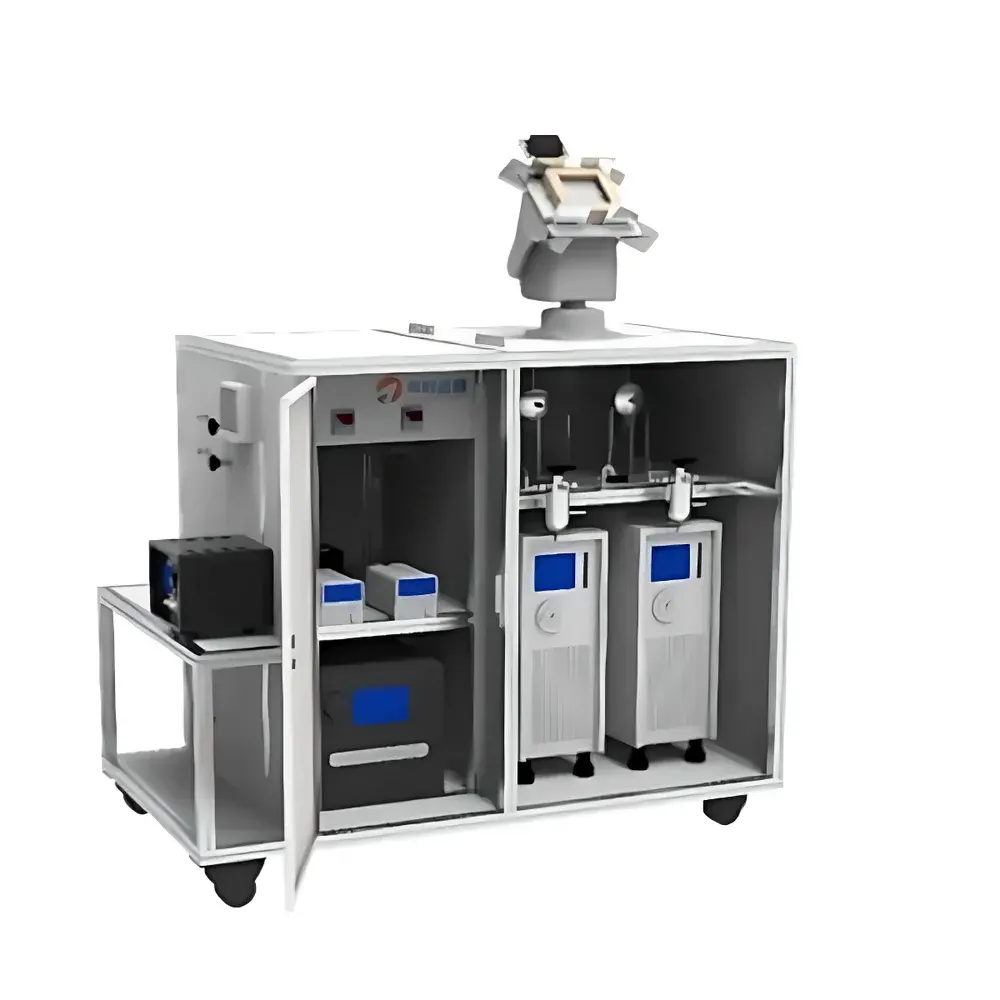
CEL-TCR200 Plate-Type Automatic Solar-Tracking Photoreaction System
| Brand | CEAULIGHT (CEL) |
|---|---|
| Model | CEL-TCR200 |
| Origin | Beijing, China |
| Manufacturer Type | Direct Manufacturer |
| Light Source Type | Broadband Simulated Solar Illumination (Xenon/Mercury-Compatible) |
| Irradiation Mode | External Irradiation |
| Tracking Axes | Dual-Axis (Azimuth: 0–350°, Elevation: −70° to +20°) |
| Max Payload | ≤10 kg |
| Reaction Chamber Window Options | 200 × 200 mm or 100 × 100 mm |
| Reactor Materials | PEEK, PMMA, PTFE, Fused Silica Quartz |
| Optical Window | High-Transmission Fused Silica (≥92% @ 200–2500 nm) |
| Liquid Layer Height Adjustment | 5–10 mm (manual fine-tuning) |
| Temperature Control | External Circulating Chiller (5–35 °C, ±0.3 °C stability) |
| Multi-Point Temperature Monitoring | Integrated RTD sensors (3-point standard) |
| Gas Inlet | Dual 100 mL/min mass flow controllers (±1.5% F.S., optional higher accuracy) |
| Compliance | Designed for ASTM E2648, ISO 105-B02, and IEC 60904-9 spectral match compatibility |
| Optional Accessories | IP65-rated outdoor power module, integrated control cabinet with PLC-based HMI, remote monitoring via Ethernet/RS485 |
Overview
The CEL-TCR200 Plate-Type Automatic Solar-Tracking Photoreaction System is an engineered platform for controlled, high-fidelity photocatalytic experimentation under dynamically aligned illumination. Unlike static irradiation setups, the CEL-TCR200 employs a dual-motorized, two-degree-of-freedom tracking mechanism that continuously reorients the reaction plate to maintain perpendicular incidence of incident light—mimicking optimal solar vector alignment throughout diurnal cycles or simulated sunlight exposure. This system is fundamentally designed for heterogeneous and three-phase (gas–liquid–solid) photocatalysis studies, where photon flux uniformity, angular consistency, and thermal stability directly govern quantum yield reproducibility and kinetic fidelity. The optical architecture supports broadband excitation sources—including 300–2000 W xenon arc lamps and medium-pressure mercury vapor lamps—with spectral output modulated via optional filters (e.g., AM1.5G, UV-cut, VIS-pass). Its external irradiation configuration ensures minimal thermal coupling between lamp housing and reactor, preserving independent thermal management of the catalytic interface.
Key Features
- Dual-axis solar-tracking platform with precision stepper motor control: azimuth rotation (0–350°) and elevation adjustment (−70° to +20°), enabling full-sky coverage simulation and seasonal solar angle compensation.
- Modular plate-mounting interface accommodating standardized reaction plates of 100 × 100 mm and 200 × 200 mm dimensions; mechanical clamping ensures repeatable positioning within ±0.15° angular tolerance.
- Reaction chamber construction from chemically inert, UV-transparent materials—PEEK (glass transition: 143 °C), PMMA (UV cutoff ~300 nm), and PTFE (non-wetting, low outgassing)—with fused silica quartz windows offering >92% transmission across 200–2500 nm.
- Integrated multi-point temperature monitoring using calibrated Pt100 RTDs at catalyst bed, liquid phase, and chamber wall locations—data logged synchronously with irradiance and gas flow parameters.
- External circulating chiller interface (standard 1/4″ compression fittings) supporting stable thermal regulation between 5 °C and 35 °C with ±0.3 °C setpoint stability over 24-hour operation.
- Manual/auto mode toggle, emergency hardware reset, and IR remote control capability—enabling safe operation in fume hoods or outdoor test environments.
Sample Compatibility & Compliance
The CEL-TCR200 accommodates solid-supported photocatalysts (e.g., TiO₂-coated glass, g-C₃N₄ on carbon cloth), suspended nanoparticle slurries, and gas-phase reactants (CO₂, H₂O vapor, NOₓ, VOCs) under ambient pressure conditions. Substrate mounting options include acrylic frames, quartz slides, nonwoven polymer meshes, and custom-machined PEEK carriers. All wetted components comply with USP Class VI biocompatibility standards and are compatible with common organic solvents (acetonitrile, methanol, aqueous buffers). The system architecture adheres to electrical safety requirements per IEC 61010-1 (2012) and electromagnetic compatibility per EN 61326-1. For regulatory traceability, optional audit-ready data logging meets FDA 21 CFR Part 11 requirements when paired with validated software modules.
Software & Data Management
The system operates via an embedded industrial PLC with configurable logic sequences and real-time parameter feedback. Optional PC-based control software (CEL-TrackControl v3.x) provides synchronized acquisition of irradiance (via NIST-traceable photodiode sensor), temperature profiles, gas flow rates, and motor position data at 10 Hz sampling. Export formats include CSV, HDF5, and MATLAB-compatible .mat files. Data integrity safeguards include cyclic redundancy checksums, automatic timestamping with UTC synchronization, and write-once archival mode for GLP-compliant reporting. Remote diagnostics and firmware updates are supported over Ethernet or RS485 Modbus RTU protocol.
Applications
- Quantitative evaluation of photocatalytic CO₂ reduction efficiency under variable solar incidence angles.
- Long-term stability testing of perovskite-based photoelectrodes under thermally decoupled illumination.
- Comparative kinetics of VOC degradation across TiO₂, BiVO₄, and WO₃ thin films under AM1.5G-simulated spectra.
- In situ DRIFTS-coupled photoreactor studies requiring precise angular alignment for consistent probe beam geometry.
- Outdoor accelerated aging of photocatalytic self-cleaning coatings under real-world insolation patterns.
FAQ
Can the CEL-TCR200 be integrated with a commercial solar simulator?
Yes—the external irradiation design accepts collimated or focused beams from Class AAA solar simulators (e.g., OAI, Sciencetech) with adjustable working distance up to 500 mm.
Is vacuum or pressurized operation supported?
The base configuration operates at ambient pressure; however, custom vacuum-tight reactor plates (up to 10⁻² mbar) and pressure-rated quartz windows (up to 5 bar) are available upon engineering review.
What level of irradiance uniformity is achieved across the 200 × 200 mm window?
Measured spatial uniformity is ≥90% (±5%) across the active area when used with a 150 mm focal-length collimator and 300 W xenon source at 300 mm working distance.
Does the system support automated time-resolved experiments?
Yes—programmable irradiation duty cycles (on/off, pulsed, ramped), synchronized with gas switching valves and temperature ramps, are fully scriptable via the PLC ladder logic interface or Python API (SDK available).




