
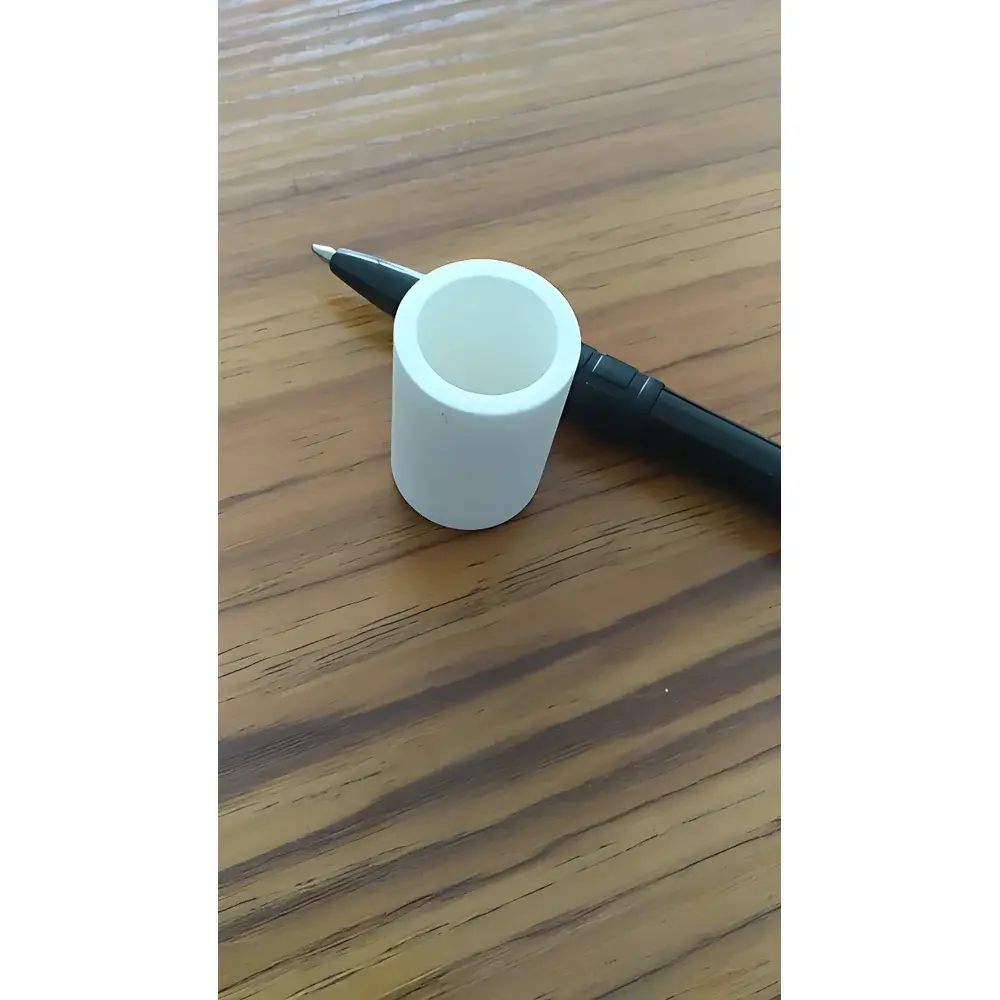
Zirconia Crucible (Yttria-Stabilized Zirconium Dioxide, 99.9% Purity)
| Brand | Zhongke Aobo |
|---|---|
| Origin | Beijing, China |
| Model | 50×50 mm (ID × Height) |
| Max Operating Temperature | 2200 °C |
| Density | 6.00 g/cm³ |
| Material | Y₂O₃-stabilized ZrO₂ (3–5 mol% Y₂O₃) |
| Compliance | ASTM C1478, ISO 13384-2 (refractory ceramics), GB/T 25993–2010 (Chinese national standard for structural zirconia ceramics) |
Overview
The Zirconia Crucible (Yttria-Stabilized Zirconium Dioxide, 99.9% purity) is a high-performance refractory container engineered for extreme-temperature laboratory applications requiring chemical inertness, thermal shock resistance, and dimensional stability. Constructed from fully stabilized zirconia (typically 3–5 mol% yttria), this crucible leverages the intrinsic properties of monoclinic-to-tetragonal phase transformation suppression to eliminate destructive microcracking during thermal cycling. With a theoretical melting point of ~2700 °C and a continuous service temperature up to 2200 °C in air or inert atmospheres, it exceeds the thermal limits of alumina (Al₂O₃) and silicon carbide (SiC) crucibles. Its low thermal conductivity (≈2.5 W/m·K at 1000 °C) minimizes radial heat loss while its near-zero thermal expansion coefficient (≈10.5 × 10⁻⁶ /K between 25–1000 °C) ensures minimal stress accumulation during rapid heating or cooling—critical for reproducible high-temperature synthesis, metal refining, and calibration procedures.
Key Features
- Ultra-high purity zirconia matrix (≥99.9% ZrO₂, trace impurities <100 ppm total metallic oxides)
- Density of 6.00 g/cm³ — indicative of >98% theoretical density and optimized sintering density for mechanical integrity
- Engineered phase stabilization via yttria doping to prevent destructive monoclinic transformation below 1170 °C
- Exceptional resistance to molten noble and refractory metals—including Pt, Pd, Rh, Ir, Ru, Ni-based superalloys, and molten Fe/Co/Ni at >1800 °C
- Chemically inert toward acidic slags (e.g., SiO₂-rich), basic slags (e.g., CaO–MgO), molten borates, and fluorides under non-oxidizing conditions
- Low dielectric loss and high volume resistivity (>10¹² Ω·cm at 1000 °C), enabling use in high-frequency induction furnaces and RF-heated systems
- Available in standardized cylindrical geometry (50 mm ID × 50 mm height); custom dimensions and cross-sectional profiles supported per ASTM C1478 Annex A
Sample Compatibility & Compliance
This crucible is validated for use with samples requiring ultra-clean, non-contaminating containment under oxidizing, reducing, or vacuum environments (10⁻³ Pa minimum). It complies with ASTM C1478 (Standard Specification for Fully Stabilized Zirconia Refractories), ISO 13384-2 (Classification of ceramic refractories by composition and application), and GB/T 25993–2010 (Chinese national specification for structural zirconia ceramics). While not certified for GMP/GLP production environments, its material traceability (batch-specific CoA available upon request), documented sintering history, and absence of organic binders or glazes ensure suitability for ISO/IEC 17025-accredited laboratories conducting metallurgical assay, high-purity oxide synthesis, or reference material preparation. Note: Not recommended for prolonged exposure to molten alkalis (e.g., NaOH, KOH) or phosphoric acid above 800 °C.
Software & Data Management
As a passive refractory component, this zirconia crucible does not incorporate embedded sensors or digital interfaces. However, it is fully compatible with industry-standard thermal process control systems—including Eurotherm 3500 series controllers, Watlow F4T programmable furnaces, and NETZSCH STA 449 F3 thermogravimetric platforms—where precise temperature ramping, dwell consistency, and atmosphere management are critical. Users are advised to log crucible batch numbers, thermal cycle history (max temp, dwell time, atmosphere), and visual inspection records (crack assessment per ASTM C1161) in their LIMS or ELN to support audit readiness under ISO/IEC 17025 Clause 7.7 (Equipment Records) and FDA 21 CFR Part 11 (if used in regulated pharmaceutical or medical device R&D).
Applications
- Melting and casting of platinum-group metals (PGMs) and refractory alloys in induction or resistance-heated furnaces
- High-temperature X-ray fluorescence (XRF) and wavelength-dispersive spectroscopy (WDS) sample fusion with lithium tetraborate/metaborate fluxes
- Synthesis of single-crystal oxides (e.g., YAG, GGG, MgAl₂O₄) via floating-zone or optical floating-zone methods
- Thermal gravimetric analysis (TGA) of high-melting-point ceramics and nuclear fuel precursors
- Calibration of pyrometers and blackbody sources above 1800 °C using fixed-point eutectics (e.g., Re–C, WC–C)
- Liner for graphite crucibles in vacuum arc remelting (VAR) to reduce carbon pickup in titanium and niobium alloys
FAQ
What is the maximum recommended heating rate for this zirconia crucible?
For optimal longevity, limit ramp rates to ≤100 °C/min below 1200 °C and ≤50 °C/min above 1200 °C to mitigate thermal gradient-induced stresses.
Can this crucible be used in hydrogen or vacuum atmospheres?
Yes—fully stabilized zirconia retains structural integrity in H₂, Ar, N₂, and vacuum down to 10⁻⁴ Pa; however, prolonged exposure to reducing atmospheres >1600 °C may induce slight oxygen vacancy formation without compromising mechanical function.
Is post-sintering machining possible?
No—fully sintered zirconia is extremely hard (Vickers hardness ≈1200 HV) and brittle; all dimensional tolerances must be achieved during green-body forming and sintering.
How should I inspect for microcracks before first use?
Perform visual inspection under 10× magnification with oblique lighting; confirm absence of surface spalling or hairline cracks; ultrasonic immersion testing (ASTM E114) is recommended for mission-critical applications.
Does this product include a certificate of conformance?
A batch-specific Certificate of Analysis (CoA) documenting density, impurity profile (ICP-MS), and sintering temperature history is available upon request at no additional cost.
Related Products



