
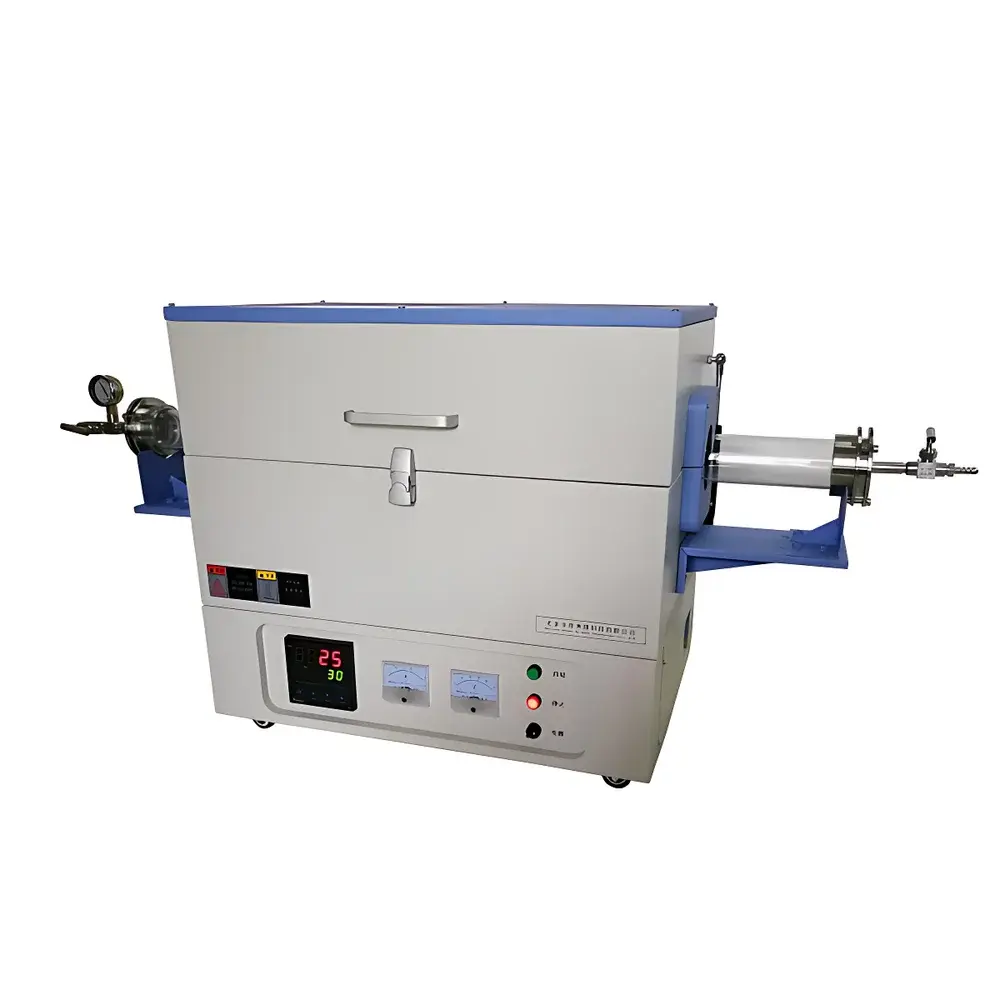
Zhongke Aobo GL0612 Vacuum Tube Furnace
| [Brand | Zhongke Aobo |
|---|---|
| Origin | Beijing, China |
| Model | GL0612 |
| Maximum Temperature | 1200 °C |
| Temperature Control Accuracy | ±1 °C |
| Rated Power | 3000 W |
| Heating Zone Length | 400 mm |
| Constant-Temperature Zone Length | 200 mm |
| Chamber Dimensions (ID) | Φ120 × 400 mm |
| Heating Element | HRE Alloy Wire |
| Tube Material | Fused Quartz (Standard) |
| Control System | 50-Stage Programmable PID Controller with Auto-Tuning & Power-Fail Recovery |
| Sealing | KF Flange with Dual Silicone O-Rings |
| Gas Compatibility | Inert, Reducing, Oxidizing (N₂, Ar, O₂, CO₂), Non-Toxic/Non-Flammable Only |
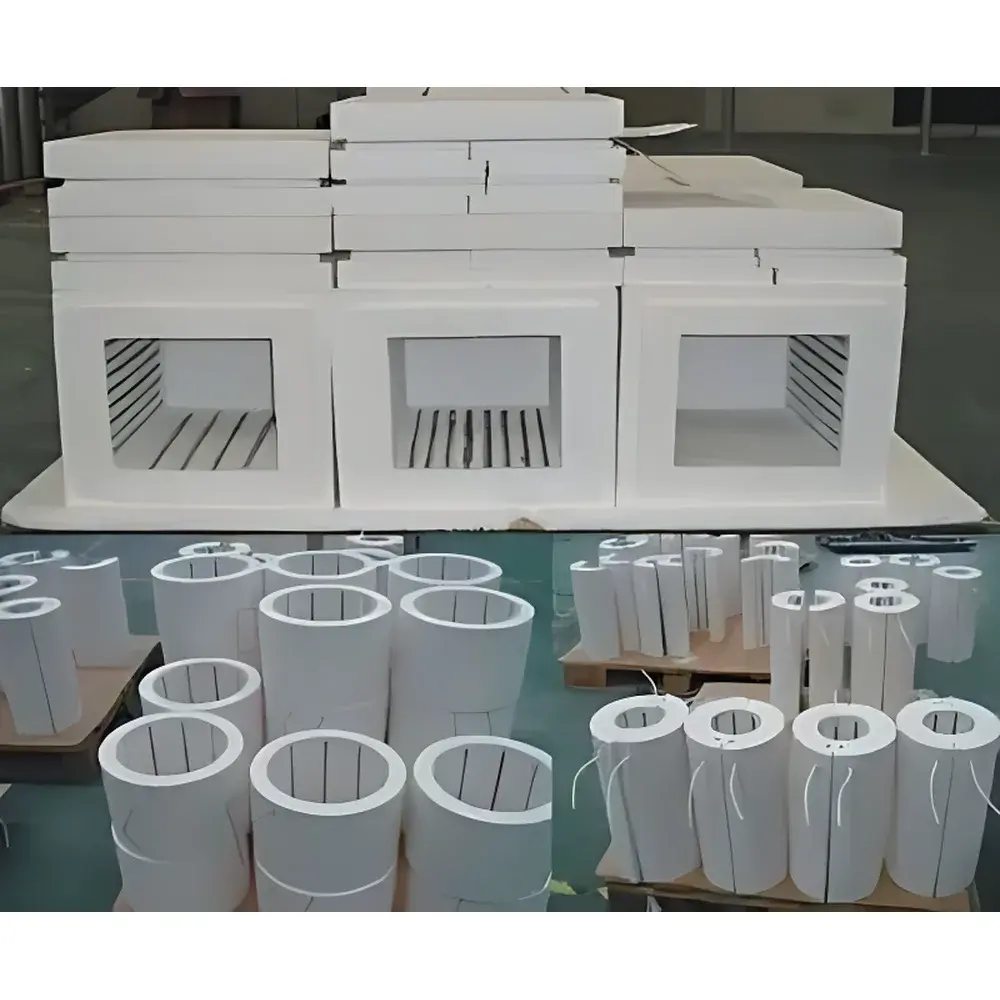
| Insulation | Polycrystalline Mullite Fiber Vacuum-Formed Liner |
| Safety Features | Surface Temperature Interlock (Fan Activation at ≥45 °C), Over-Temperature Alarm, Step-Joint Furnace Body Design] |
Overview
The Zhongke Aobo GL0612 Vacuum Tube Furnace is a precision-engineered horizontal resistive-heating furnace designed for controlled-atmosphere and vacuum thermal processing in research and development laboratories. It operates on the principle of Joule heating via high-stability HRE alloy resistance wire embedded within a polycrystalline mullite fiber insulation matrix, enabling rapid, uniform, and repeatable thermal profiles up to 1200 °C. The furnace integrates a fused quartz tube (standard configuration) sealed with stainless steel KF flanges, supporting both static vacuum and dynamic gas flow environments. Its architecture meets fundamental requirements for materials synthesis, annealing, sintering, reduction, oxidation, and thermal treatment under reproducible thermodynamic conditions—making it suitable for academic labs, national research institutes, and R&D centers working with functional ceramics, nanomaterials, semiconductor precursors, and carbon-based structures.
Key Features
- Compact horizontal design with integrated one-piece furnace body and front-access opening mechanism for simplified sample loading and process monitoring.
- High-efficiency thermal insulation using vacuum-formed polycrystalline mullite fiber—low thermal mass, low heat loss, and excellent thermal shock resistance—enabling typical ramp rates of 10 °C/min to 1200 °C with <2% axial temperature gradient across the 200 mm constant-temperature zone.
- Dual-layer steel housing with forced-air cooling: surface temperature sensor triggers automatic fan activation when external casing exceeds 45 °C, ensuring operator safety and structural integrity during prolonged operation.
- Precision gas handling system featuring KF-25/40 quick-connect flanges, dual silicone O-ring seals, pressure gauge integration, and micro-adjustable inlet/outlet needle valves for accurate atmosphere control and leak-tight operation (<1×10⁻³ mbar base vacuum achievable with optional pump).
- Intelligent 50-segment programmable temperature controller with adaptive PID algorithm, fuzzy logic self-tuning, and power-fail parameter retention—supporting complex multi-step thermal cycles including hold, ramp, and soak sequences.
- Mechanically reinforced stepped-joint furnace shell and monolithic door-frame assembly prevent deformation under thermal cycling, preserving long-term dimensional stability and seal integrity.
Sample Compatibility & Compliance
The GL0612 accommodates cylindrical samples up to Φ120 mm × 400 mm within its fused quartz tube (standard); alternative high-temp tubes—including 99% alumina or silicon carbide—are available for applications exceeding 1200 °C or requiring chemical inertness. The furnace supports ASTM E1113 (Standard Guide for Use of Tube Furnaces in Thermal Analysis), ISO 8501-1 (surface preparation standards for thermal treatment), and aligns with GLP-compliant workflow requirements when paired with validated data logging systems. While not inherently 21 CFR Part 11 compliant, its programmable controller outputs analog/digital signals compatible with third-party audit-trail-capable SCADA platforms used in regulated material qualification processes.
Software & Data Management
The embedded controller provides real-time temperature display, setpoint tracking, and event logging (time-stamped ramp/hold/cool events). Optional RS485 Modbus RTU interface enables integration into LabVIEW, MATLAB, or custom Python-based acquisition frameworks. Raw thermocouple (Type K) output and relay status signals are accessible via terminal block for external DAQ synchronization. All thermal programs can be exported/imported via USB memory stick (FAT32 formatted), facilitating cross-lab protocol standardization and method transfer. No cloud connectivity or proprietary software is required—operation remains fully local and deterministic.
Applications
- Controlled-atmosphere annealing of thin-film metal oxides (e.g., NiO, ZnO) for optoelectronic device fabrication.
- Vacuum pyrolysis of polymer precursors to produce ceramic nanofibers and SiC/C composites.
- Thermal reduction of metal oxide powders (e.g., CuO → Cu, Fe₂O₃ → Fe) under H₂/N₂ mixtures.
- Graphitization and purification of carbon nanotubes and graphene oxide derivatives.
- Calibration and validation of high-temperature sensors and thermocouples per ISO/IEC 17025 traceability protocols.
- Pre-sintering of battery cathode materials (e.g., NMC, LFP) under argon glovebox-integrated workflows.
FAQ
What tube materials are compatible with the GL0612 at 1200 °C?
Fused quartz (SiO₂) is standard and fully rated to 1200 °C in inert or reducing atmospheres. For oxidizing environments above 1000 °C or extended dwell times, high-purity alumina (Al₂O₃) or recrystallized silicon carbide (SiC) tubes are recommended.
Can this furnace operate under high vacuum without modification?
Yes—the KF-flanged quartz tube assembly achieves ≤1×10⁻³ mbar with a standard two-stage rotary vane pump. For ultra-high vacuum (UHV) applications (<1×10⁻⁶ mbar), a turbomolecular pump and metal-sealed feedthroughs are required as add-on configurations.
Is the temperature uniformity verified per industry standards?
Axial uniformity across the 200 mm hot zone is typically ±1.5 °C at 1200 °C (measured per ASTM E220 calibration practice), confirmed during factory acceptance testing with three-point thermocouple mapping.
Does the controller support remote monitoring via Ethernet or Wi-Fi?
No native Ethernet/Wi-Fi; communication is limited to RS485 Modbus RTU or analog voltage output. Third-party industrial gateways may be deployed to bridge to TCP/IP networks.
What maintenance intervals are recommended for long-term reliability?
Inspect O-rings and flange surfaces before each vacuum cycle; replace quartz tubes after ~200 cumulative hours above 1000 °C; verify thermocouple calibration annually or per ISO/IEC 17025 internal procedure.



