
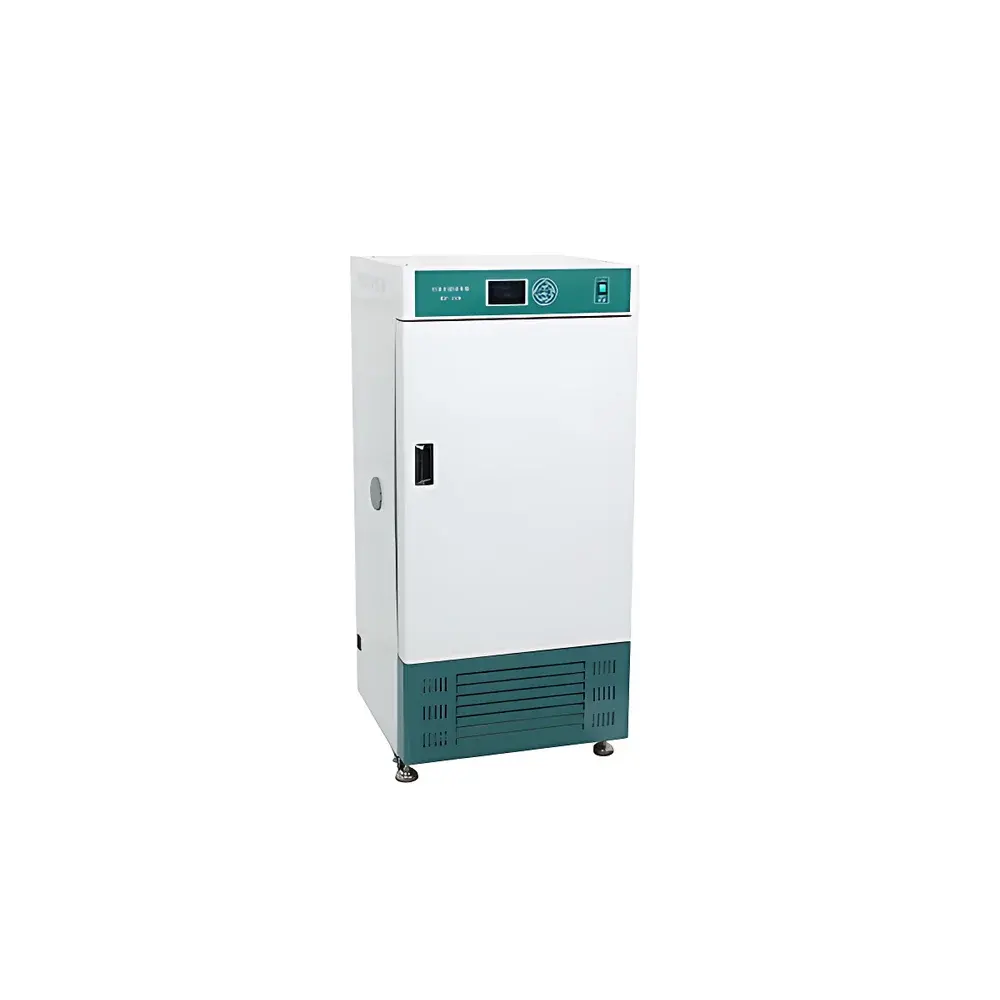
Zhongke Aobo MJX-80 Mold Incubation Chamber
| Brand | Zhongke Aobo |
|---|---|
| Origin | Beijing, China |
| Model | MJX-80 |
| Capacity | 80 L |
| Temperature Range | 5–65 °C |
| Temperature Resolution | 0.1 °C |
| Temperature Uniformity | ±1 °C |
| Power Consumption | 600 W |
| Interior Dimensions (D×W×H) | 400×400×500 mm |
| Exterior Dimensions (D×W×H) | 610×560×1070 mm |
| Net Weight | 54 kg |
| Voltage/Frequency | 220 V / 50 Hz |
| Refrigerant | Eco-friendly non-CFC |
| Control System | Microprocessor-based PID controller with timer, over-temperature alarm, and fault diagnostics |
| Safety Features | Compressor overheat protection, UV sterilization lamp, magnetic door seal, dual-stage thermal cutoff |
| Optional Accessories | RS-485 interface, USB data logging, thermal printer, SMS alarm module |
Overview
The Zhongke Aobo MJX-80 Mold Incubation Chamber is a purpose-engineered environmental test chamber designed for controlled fungal culture, microbial preservation, and long-term stability studies under regulated temperature conditions. Unlike general-purpose incubators, this unit integrates precise thermoregulation with microbiological containment features—including an integrated ultraviolet germicidal irradiation (UVGI) lamp—and optimized air circulation architecture to suppress cross-contamination while maintaining uniform thermal distribution. It operates on the principle of forced-air convection combined with high-efficiency refrigeration and PID-controlled heating, enabling stable operation across a wide working range of 5 °C to 65 °C—critical for cultivating mesophilic and thermotolerant mold strains such as Aspergillus niger, Penicillium chrysogenum, and Cladosporium herbarum. Its stainless-steel interior (304 grade), seamless rounded corners, and magnetic door gasket meet baseline hygiene requirements for GLP-compliant laboratories engaged in pharmaceutical stability testing, environmental microbiology, or food safety validation.
Key Features
- Electropolished 304 stainless-steel inner chamber with radius-rounded corners for enhanced cleanability and corrosion resistance—validated for repeated disinfection cycles using ethanol, hydrogen peroxide vapor, or sodium hypochlorite solutions.
- Microprocessor-based PID temperature controller with real-time digital display, programmable start/stop timing (up to 999 hours), and audible/visual over-temperature alarm (setpoint adjustable from 5 °C to 65 °C in 0.1 °C increments).
- Eco-friendly R134a refrigeration system paired with low-noise axial fans ensures consistent airflow velocity (≥0.3 m/s at shelf level) and minimizes thermal stratification—verified by ISO 14644-1 Class 8 background environment compatibility.
- Double-layer tempered glass observation window with anti-fog coating enables non-intrusive monitoring without compromising thermal integrity or UV shielding during sterilization cycles.
- Dual-level safety architecture: primary thermal cutoff (100 °C mechanical fuse) and secondary electronic over-temperature lockout (adjustable up to 70 °C); compressor overheating protection; and self-diagnostic error codes for rapid troubleshooting.
- Integrated 254 nm UV-C lamp (15 W, 10,000-hour rated life) mounted on the chamber ceiling, operable independently via front-panel switch—compliant with IEC 62471 photobiological safety classification for UV hazard group 1.
Sample Compatibility & Compliance
The MJX-80 accommodates standard Petri dishes (90 mm and 150 mm), multi-well plates (6–96-well), slant tubes, and agar-filled culture flasks without obstruction. Its internal geometry supports up to three adjustable stainless-steel shelves (load capacity: 15 kg/shelf), each perforated to promote laminar airflow. The chamber meets structural and operational criteria referenced in ISO 21527-1 (microbiological methods for molds and yeasts), ASTM D3273 (resistance to fungal growth on interior building materials), and USP / for microbial enumeration and absence-of-pathogens testing. While not certified for IEC 61000-4 electromagnetic immunity or FDA 21 CFR Part 11 out-of-the-box, its RS-485 interface enables integration into validated SCADA systems supporting audit-trail generation when paired with compliant data acquisition software.
Software & Data Management
The MJX-80 supports optional peripheral modules for regulatory-grade data handling: a built-in USB port permits direct export of time-stamped temperature logs (CSV format) onto removable flash drives; an RS-485 serial interface enables Modbus RTU communication with centralized lab information management systems (LIMS); and an optional thermal printer provides hard-copy records for SOP-driven workflows. When equipped with the SMS alarm module, users receive automated notifications upon deviation events (e.g., sustained >±2 °C excursion for >5 minutes), facilitating remote oversight in unattended overnight runs. All firmware revisions are traceable via embedded version stamping and support field-upgrade via secure UART bootloader.
Applications
This incubator serves core functions in environmental monitoring labs performing BOD5 analysis per APHA Standard Methods 5210B; pharmaceutical QC units conducting fungal challenge studies per ICH Q5C; aquaculture research facilities assessing mycotoxin-producing species in feed matrices; and agricultural biotechnology centers evaluating spore germination kinetics under variable hygrothermal regimes. It is routinely deployed in ISO/IEC 17025-accredited facilities for method validation of mold recovery rates (e.g., comparing membrane filtration vs. pour plate techniques), as well as in university teaching laboratories for undergraduate microbiology practica involving selective isolation media such as DG18 and Dichloran Rose Bengal Chloramphenicol Agar (DRBC).
FAQ
Is the MJX-80 suitable for aerobic or anaerobic mold cultivation?
It is configured for aerobic incubation only. For strict anaerobes, supplemental gas mixing (N2/CO2/H2) and sealed jar systems must be used externally.
Can the UV lamp operate simultaneously with temperature control?
No—UV sterilization mode disables heating and cooling circuits automatically to prevent thermal degradation of quartz sleeves and ensure operator safety per IEC 60335-2-60.
What calibration standards does the temperature sensor comply with?
The PT100 sensor is factory-calibrated against NIST-traceable dry-block calibrators (±0.15 °C uncertainty at 25 °C); user recalibration requires external reference thermometer and documented procedure per ISO/IEC 17025 Clause 6.5.
Does the unit include validation documentation for GxP environments?
Factory IQ/OQ protocols are available upon request; PQ execution requires site-specific mapping per Annex 15 and must be performed by qualified personnel using calibrated thermocouple arrays.
How often should the UV lamp be replaced to maintain germicidal efficacy?
Annual replacement is recommended based on cumulative exposure time logged by the internal hour meter; output verification via radiometer measurement is advised every six months.



