
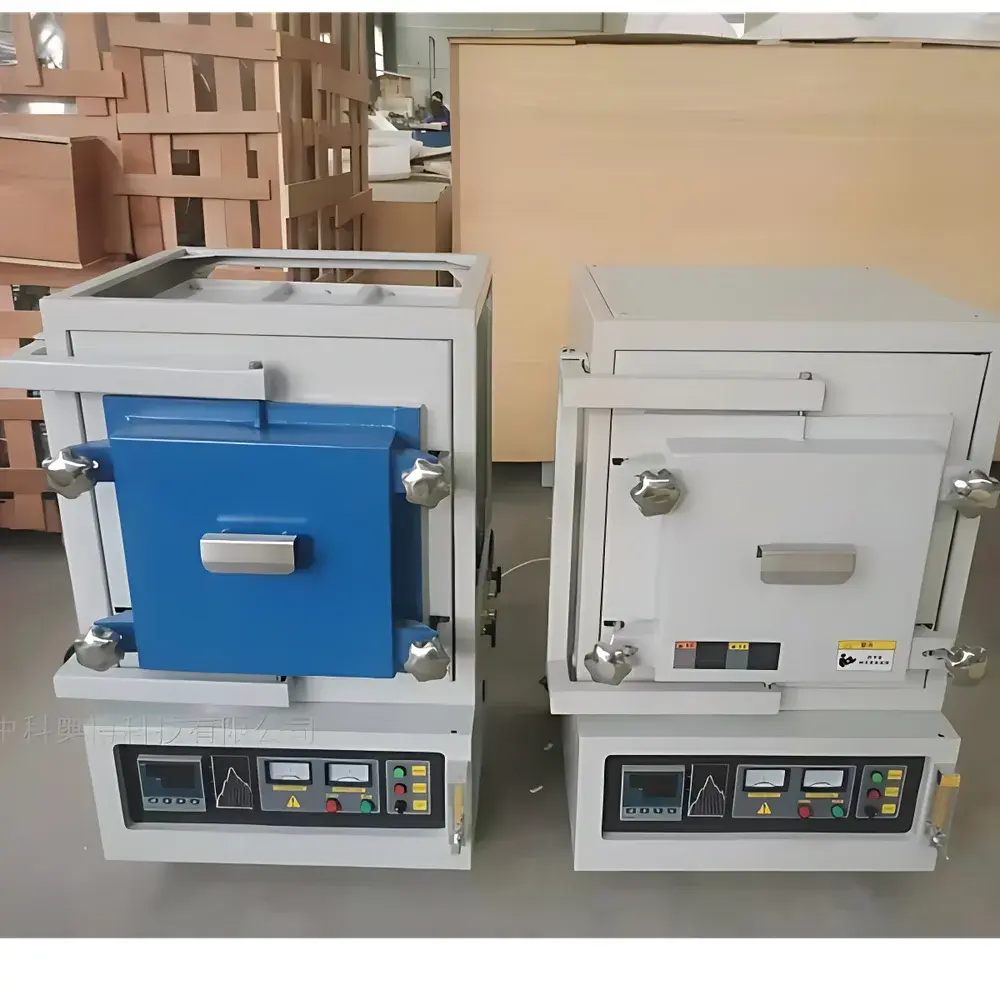
Zhongke Aobo QE0414 Vacuum & Atmosphere Box-Type Muffle Furnace
| Brand | Zhongke Aobo |
|---|---|
| Origin | Beijing, China |
| Model | QE0414 |
| Instrument Type | Box Furnace |
| Max Temperature | 1400 °C |
| Temperature Control Accuracy | ±1 °C |
| Max Power | 4000 W |
| Heating Time to Max Temp | 60 min |
| Heating Element | Silicon Carbide Rods |
| Internal Chamber Dimensions | 200 × 150 × 150 mm |
| Chamber Material | 1600°C-rated Polycrystalline Mullite Alumina Ceramic Fiber |
| Sealing | Full-perimeter High-Temp Silicone Gasket with Four-Point Manual Clamping |
| Atmosphere Compatibility | Inert (N₂, Ar), Reducing (H₂, CO), Vacuum (≤10⁻² mbar typical with optional pump) |
| Control System | 30-Stage Programmable PID Controller with Auto-Ramp/Soak |
| Optional Interface | RS-485 for PC-based operation and data logging |
Overview
The Zhongke Aobo QE0414 Vacuum & Atmosphere Box-Type Muffle Furnace is a precision-engineered thermal processing system designed for controlled-atmosphere and vacuum sintering, annealing, calcination, and heat treatment applications in research laboratories and pilot-scale production environments. Operating up to 1400 °C, the furnace employs a robust dual-mode architecture—capable of maintaining high vacuum (when integrated with an external vacuum pump) or precisely regulated gas atmospheres (including inert, reducing, or reactive mixtures)—to ensure material integrity during thermally sensitive processes. Its core measurement and control principle relies on closed-loop feedback via Type S thermocouples, coupled with a 30-segment programmable PID algorithm that dynamically adjusts power delivery to minimize thermal overshoot and stabilize temperature within ±1 °C across the entire working zone. The furnace’s uniformity is validated per ASTM E220 and ISO 9001-compliant thermal mapping protocols, delivering ≤±5 °C radial and axial uniformity at 1300 °C under steady-state conditions.
Key Features
- High-purity polycrystalline mullite alumina ceramic fiber chamber rated to 1600 °C—lightweight, low thermal mass, excellent thermal shock resistance, and minimal particle shedding to prevent sample contamination
- Silicon carbide (SiC) heating elements mounted on durable ceramic insulators, providing stable radiant heating and extended service life beyond 2000 operational hours at 1400 °C
- Full-perimeter high-temperature silicone gasket sealed with four-point manual clamping mechanism, achieving leak rates <5×10⁻³ mbar·L/s under vacuum and maintaining pressure integrity up to 0.02 MPa gauge
- Intelligent 30-stage programmable controller with auto-tuning PID, ramp/soak functionality, and real-time deviation alarm; supports both standalone operation and remote supervision
- RS-485 serial interface (optional) compatible with standard Modbus RTU protocol, enabling integration into LabVIEW, MATLAB, or custom SCADA systems for automated process recording and audit trail generation
- Ergonomic side-opening door design with reinforced stainless-steel frame and high-temp enamel-coated exterior housing—resistant to oxidation, corrosion, and UV-induced discoloration over extended service life
Sample Compatibility & Compliance
The QE0414 accommodates diverse sample geometries and chemistries, including ceramic green bodies, metal oxide precursors, battery cathode materials, catalyst supports, and refractory composites. Its inert chamber lining and low-outgassing construction meet ISO 8502-3 cleanliness requirements for high-purity thermal processing. When operated under nitrogen or argon purge, the system complies with ASTM C865 for sintering of advanced ceramics and USP environmental controls for pharmaceutical excipient thermal sterilization validation. Vacuum operation supports ASTM F2622 for residual gas analysis in metallurgical pre-sintering. All electronic controllers conform to IEC 61000-6-3 EMC standards and carry CE marking for laboratory use within EU regulatory frameworks. Data logging functions support 21 CFR Part 11-compliant electronic records when paired with validated software platforms.
Software & Data Management
While the base unit operates via its embedded touchscreen controller, the optional RS-485 interface enables bidirectional communication with Windows-based host software. This permits full remote orchestration—including initiation, pausing, and termination of thermal cycles—as well as real-time graphing of temperature vs. time profiles. Historical datasets are stored in CSV format with timestamps, operator ID fields, and cycle metadata (e.g., setpoint sequence, actual ramp rates, dwell durations). Audit trails record all parameter modifications, user logins, and alarm events with immutable timestamps—essential for GLP/GMP-aligned quality documentation. Raw thermocouple voltage outputs can also be logged at 1 Hz resolution for post-hoc calibration verification against NIST-traceable reference standards.
Applications
- Sintering of oxide and non-oxide ceramics (Al₂O₃, SiC, ZrO₂) under vacuum or Ar/N₂ to suppress grain growth and enhance density
- Reductive annealing of metal oxides (e.g., CuO → Cu, NiO → Ni) using controlled H₂/N₂ mixtures for catalyst synthesis
- Thermal decomposition studies of MOFs, perovskites, and layered double hydroxides under inert atmosphere
- Heat treatment of lithium-ion battery cathode precursors (NMC, LFP) to optimize crystallinity and cation ordering
- Pre-oxidation of silicon carbide components prior to CVD coating in semiconductor packaging R&D
- Calibration and aging tests of thermoelectric materials requiring precise soak stability at >1200 °C
FAQ
What vacuum level can the QE0414 achieve?
With a compatible two-stage rotary vane pump (e.g., Edwards RV8), the furnace typically reaches 1×10⁻² to 5×10⁻³ mbar after 30 minutes of pumping. Ultimate vacuum depends on gasket condition, chamber cleanliness, and pump specifications.
Can hydrogen be used safely in this furnace?
Yes—provided appropriate safety interlocks (H₂ concentration monitoring, automatic purge sequencing, flame arrestors) are externally installed per NFPA 55 and local hazardous gas handling regulations. The furnace itself is rated for non-explosive reducing atmospheres only.
Is the temperature uniformity certified?
Uniformity is characterized per ASTM E220 Annex A3 using nine-point thermocouple mapping. Certificate of Conformance (CoC) with measured uniformity data at 1000 °C and 1300 °C is available upon request.
What maintenance is required for long-term reliability?
Annual inspection of gasket elasticity, thermocouple calibration (traceable to NIST), and visual assessment of SiC rod emissivity degradation. No lubrication or consumable replacement is needed under normal operating conditions.
Does the furnace support automated cooling protocols?
Yes—the 30-stage controller includes programmable cooling ramps (down to 10 °C/min) and forced-air assisted cooldown options via optional external blower integration.



