
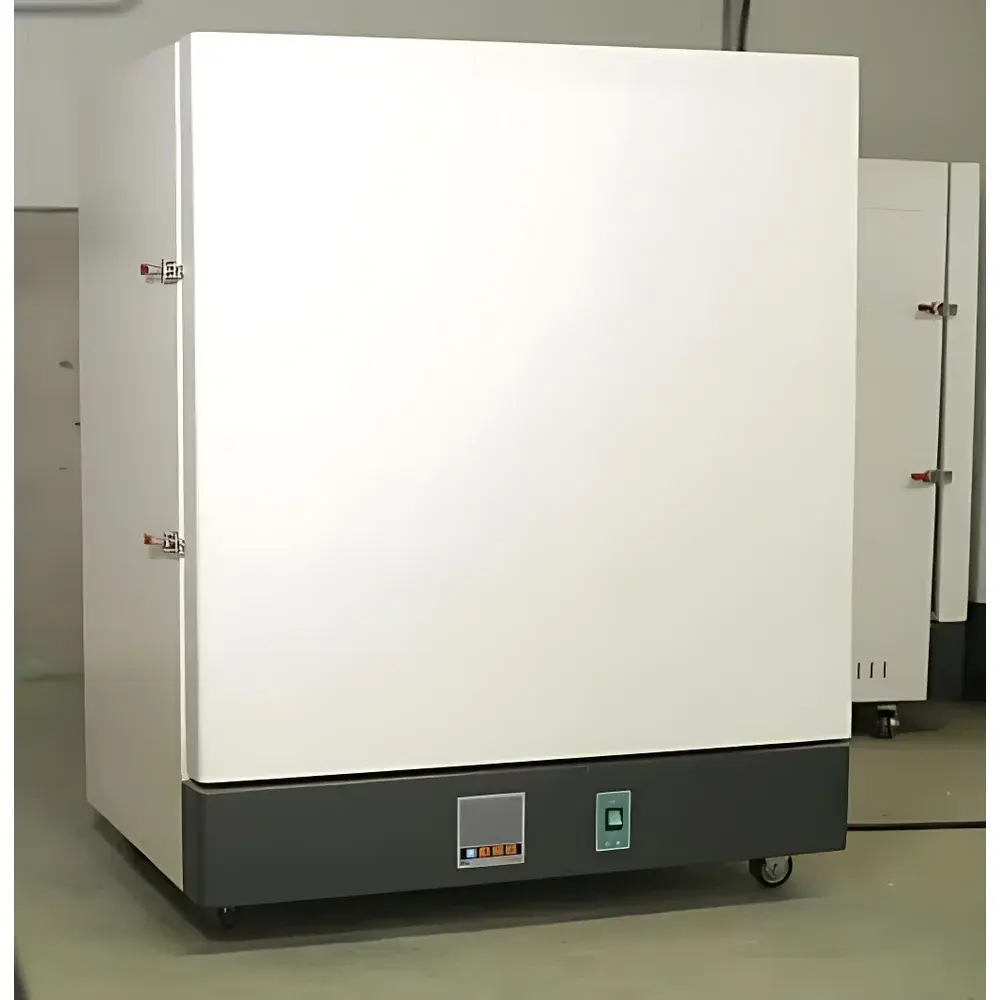
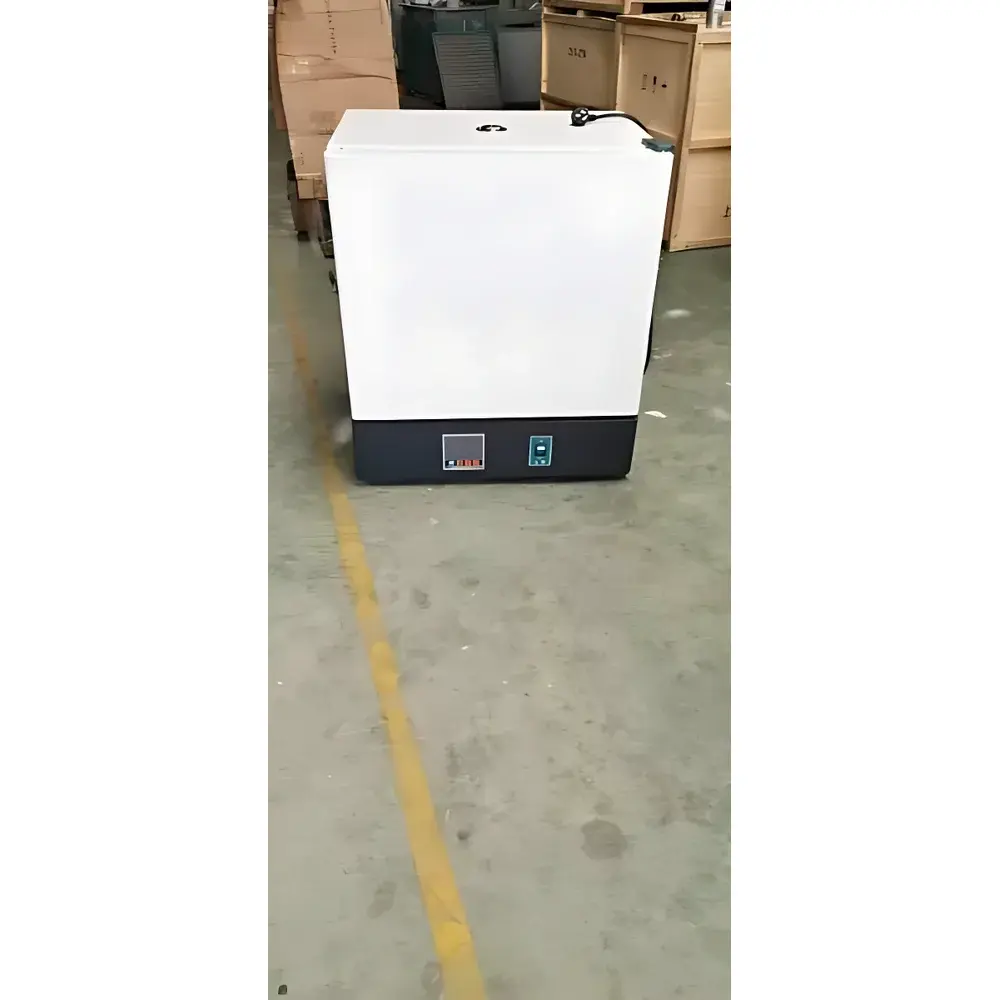
Zhongke Aobo GW-50 High-Temperature Drying Oven
| Brand | Zhongke Aobo |
|---|---|
| Origin | Beijing, China |
| Model | GW-50 |
| Temperature Range | Ambient to 500°C |
| Temperature Uniformity | ±1°C |
| Chamber Dimensions (W×D×H) | 350×350×350 mm |
| External Dimensions (W×D×H) | 510×650×750 mm |
| Chamber Material | AISI 304 Stainless Steel |
| Heating Method | Electric Alloy Wire with Forced-Air Circulation |
| Power Supply | 220 V, 50 Hz |
| Rated Power | 3000 W |
| Temperature Resolution | 0.1°C |
| Control System | Intelligent PID Controller with Timer, Over-Temperature Alarm, and Auto-Tuning Functionality |
Overview
The Zhongke Aobo GW-50 High-Temperature Drying Oven is an engineered thermal testing system designed for precise, stable, and repeatable operation across demanding laboratory and industrial quality assurance environments. Based on convection-driven heat transfer principles, the oven utilizes a robust forced-air circulation architecture—comprising a high-temperature centrifugal blower and optimized internal airflow channels—to ensure uniform thermal distribution throughout the working chamber. Its operational range extends from ambient temperature up to 500°C, making it suitable for applications requiring accelerated aging, moisture removal, thermal stability evaluation, stress-relief annealing of metallic components, and pre-conditioning of ceramic or composite substrates prior to coating or bonding processes. The unit complies with fundamental thermal safety and performance expectations aligned with IEC 61000-6-3 (EMC emissions) and GB/T 5170.2–2017 (Chinese national standard for temperature test equipment verification), and its construction supports routine GLP-compliant documentation workflows.
Key Features
- Double-walled chamber construction with AISI 304 stainless steel inner lining and cold-rolled steel outer casing finished with electrostatic epoxy powder coating for corrosion resistance and mechanical durability.
- High-temperature silicone rubber gasket rated to 1000°C, ensuring long-term sealing integrity under sustained thermal load and minimizing heat loss during extended dwell cycles.
- Intelligent PID temperature controller featuring programmable timer, real-time deviation correction, auto-tuning capability, and audible/visual over-temperature alarm with independent safety cut-off circuitry.
- Optimized heating assembly: enclosed electric alloy wire heating elements integrated into an air-jacketed duct system, coupled with a high-efficiency axial fan operating continuously during thermal ramping and soak phases.
- Thermal insulation layer composed of high-density ceramic fiber board (≥1260°C refractory rating), strategically placed between chamber walls to reduce surface temperature rise and improve energy efficiency.
- Modular expansion interface supporting optional upgrades including RS-485 communication port, USB data logging module, thermal printer output, and LCD touch-panel operator interface with multi-segment ramp-soak programming.
Sample Compatibility & Compliance
The GW-50 accommodates standard laboratory sample formats including petri dishes, crucibles, metal coupons, polymer sheets, and electronic component assemblies—provided dimensional constraints (max. 350 mm × 350 mm × 350 mm internal volume) and material compatibility with continuous 500°C exposure are observed. It is routinely deployed in R&D labs conducting ASTM E145 (Standard Specification for Gravity-Convection and Forced-Ventilation Ovens), ISO 2812-3 (paint drying behavior assessment), and GB/T 2423.2 (environmental testing—high-temperature tests) procedures. While not certified to UL 61010-1 or CE Machinery Directive out-of-the-box, the unit’s electrical architecture—including grounded chassis, dual-stage thermal protection, and Class H insulation on all internal wiring—facilitates third-party conformity assessment for integration into ISO/IEC 17025-accredited testing facilities.
Software & Data Management
The base configuration includes local control via front-panel membrane keypad and LED display; however, optional digital modules enable seamless integration into centralized lab management systems. The RS-485 interface supports Modbus RTU protocol for bidirectional communication with SCADA platforms or LIMS software, enabling remote parameter setting, real-time temperature logging, and event-triggered alerts (e.g., door-open detection, setpoint deviation >±2°C). U盘 (USB flash drive) data export functionality allows time-stamped CSV-formatted records—including timestamp, setpoint, actual chamber temperature, and alarm status—to be archived for audit trails required under FDA 21 CFR Part 11 when used in pharmaceutical stability studies or medical device validation protocols.
Applications
- Pre-baking of PCBs and semiconductor wafers prior to solder paste application or thin-film deposition.
- Thermal desorption of adsorbed moisture from hygroscopic powders (e.g., lithium cobalt oxide, zeolites) before XRD or BET analysis.
- Post-curing of high-performance adhesives and thermoset composites in aerospace component manufacturing.
- Calibration reference oven for thermocouple and RTD sensor verification per ISO/IEC 17025 Clause 6.5.2.
- Accelerated oxidation testing of stainless steel grades per ASTM G174 methodology.
- Drying of geological core samples prior to geochemical assay preparation.
FAQ
What is the maximum continuous operating temperature of the GW-50?
The chamber is rated for uninterrupted operation at 500°C, provided ambient conditions remain within 5–35°C and relative humidity does not exceed 80% RH non-condensing.
Does the oven support programmable temperature ramps?
Yes—when equipped with the optional programmable controller module, it supports up to 32 segments with independent ramp rates (0.1–10.0°C/min), soak durations (1 min–99 h 59 min), and cycle repeats.
Is the interior lighting compatible with high-temperature operation?
No built-in illumination is included; external borosilicate viewport-compatible lighting fixtures may be mounted externally if visual monitoring is required during operation.
Can the unit be validated for IQ/OQ/PQ protocols?
Yes—the consistent temperature uniformity (±1°C), traceable calibration inputs, and configurable data logging make it suitable for installation, operational, and performance qualification under GMP/GLP frameworks.
What maintenance intervals are recommended for optimal thermal accuracy?
Annual verification of sensor calibration against NIST-traceable references and biannual inspection of door seal compression force and fan bearing lubrication are advised.



