
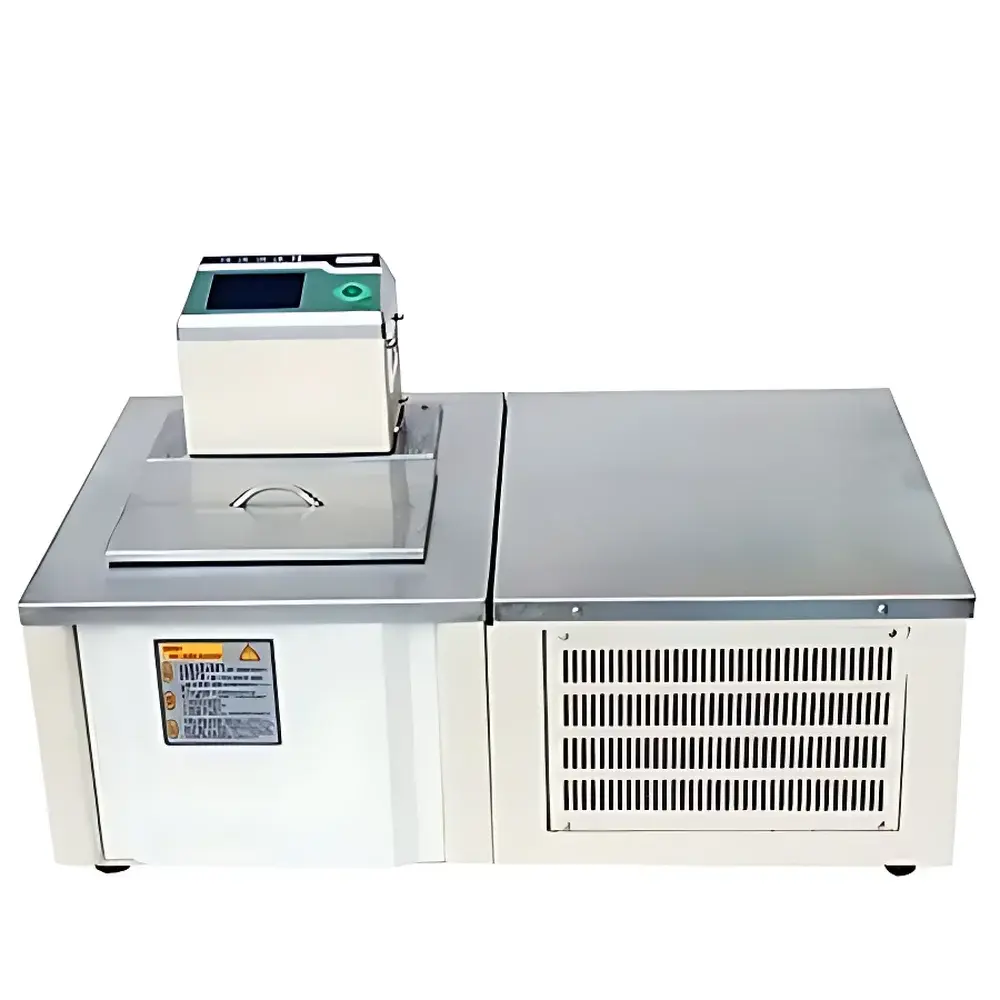
Zhongke Aobo DC Series Low-Temperature Constant Temperature Bath
| Brand | Zhongke Aobo |
|---|---|
| Origin | Beijing, China |
| Model | DC |
| Type | Circulating Refrigerated/Heated Bath |
| Temperature Range | −40 °C to 100 °C |
| Stability | ±0.05 °C (typical) |
| Reservoir Volume | 6–35 L |
| Circulation Mode | Internal & External |
| Pump Flow Rate | 4–12 L/min |
| External Port | Ø10 mm |
| Display Resolution | 0.01 °C |
| Safety Features | Over-Temp Alarm, Low-Level Detection, Dry-Run Protection |
| Dimensions (W×D×H, mm) | Up to 400×325×230 (tank only) |
| Total height with casters | +80 mm |
Overview
The Zhongke Aobo DC Series Low-Temperature Constant Temperature Bath is a precision-engineered circulating thermal bath system designed for stable, reproducible temperature control across demanding laboratory and industrial applications. Utilizing a hermetically sealed refrigeration compressor coupled with PID-controlled electric heating, the DC bath delivers bidirectional thermal regulation—from −40 °C up to 100 °C—with high thermal uniformity and minimal drift. Its dual-mode circulation architecture supports both internal bath homogenization and external heat exchange via a calibrated peristaltic or centrifugal pump, enabling seamless integration as a remote temperature source for ancillary instrumentation—including rotary evaporators, viscometers, electrophoresis units, cryogenic medical devices, and vacuum system chillers (e.g., diffusion pumps, ion pumps, and electron microscopes). The system operates on a robust stainless-steel reservoir platform with corrosion-resistant internal wetted surfaces, ensuring long-term reliability in aqueous, ethylene glycol, or silicone oil media.
Key Features
- Wide operational temperature range: −40 °C to 100 °C, selectable by model variant (DC-40xx, DC-30xx, etc.)
- High-precision digital temperature control with 0.01 °C display resolution and microprocessor-based offset correction
- Thermal stability of ±0.05 °C (at steady state, measured at sensor location; compliant with ISO 17025 calibration traceability requirements)
- Dual-circulation capability: independent internal mixing + externally routed flow (Ø10 mm quick-connect ports, rated for continuous duty)
- Integrated safety systems: programmable over-temperature cutoff, liquid-level monitoring with audible/visual alarm, and dry-run prevention logic
- Tactile membrane keypad with intuitive parameter navigation and real-time dual-display (setpoint vs. actual bath temperature)
- Modular tank geometry: multiple reservoir volumes (6 L to 35 L) and depth configurations to accommodate diverse sample vessel footprints and immersion requirements
Sample Compatibility & Compliance
The DC bath accommodates standard laboratory glassware (e.g., jacketed reactors, U-tube viscometers, cuvette holders) and OEM equipment interfaces requiring external coolant supply. Its fluid path is compatible with water, 30–50% aqueous ethylene glycol solutions, and low-volatility silicone oils—enabling extended low-temperature operation without freezing or excessive viscosity rise. All electrical components conform to IEC 61010-1:2010 for laboratory equipment safety. The unit supports GLP/GMP-aligned workflows through configurable logging intervals and non-volatile event memory (e.g., alarm triggers, setpoint changes). While not FDA 21 CFR Part 11–certified out-of-the-box, audit-ready data export (via RS232 or optional USB) enables integration into validated environments when paired with compliant LIMS or ELN platforms.
Software & Data Management
The DC series includes embedded firmware with real-time temperature logging (up to 10,000 data points), user-defined alarm thresholds, and password-protected parameter locking. Optional PC connectivity (RS232 interface, ASCII protocol) allows remote monitoring, script-driven ramp/soak profiles, and CSV-formatted data export for post-acquisition analysis in MATLAB, Python, or Excel. Firmware updates are delivered via secure vendor portal and applied via USB flash drive—ensuring version traceability and compliance with change-control documentation standards. No cloud dependency or proprietary runtime environment is required; all functionality remains fully operational in air-gapped lab networks.
Applications
- Calibration of temperature-sensitive sensors (thermistors, RTDs, thermocouples) per ASTM E74–22
- Viscosity measurement support for rotational and capillary viscometers under ISO 3219 and ASTM D445
- Cooling of high-power analytical instruments: SEM/TEM cold stages, laser Doppler vibrometers, and RF amplifiers
- Controlled-rate crystallization studies in pharmaceutical development (ICH Q5C stability protocols)
- Electrophoresis buffer temperature management per ISO 13057 and CLSI EP17-A2 guidelines
- Material testing under thermal stress: tensile modulus evaluation (ASTM D638), coefficient of thermal expansion (ASTM E831), and dielectric property mapping
FAQ
What refrigerant is used in the DC-series compressors?
R-404A or R-507A, selected for low global warming potential (GWP) relative to legacy R-22 and full compatibility with hermetic scroll compressors.
Can the bath maintain temperature stability during continuous external flow?
Yes—flow-compensated PID algorithms dynamically adjust heater/refrigeration output based on real-time load feedback from the integrated temperature sensor array.
Is the reservoir volume adjustable or modular?
No; each model (e.g., DC-4020) has a fixed stainless-steel tank. However, interchangeable lid inserts and accessory baffles allow partial volume restriction for small-sample experiments.
Does the system meet CE or UL certification requirements?
CE marking is applied per Machinery Directive 2006/42/EC and EMC Directive 2014/30/EU. UL listing is available upon request for specific regional deployments (UL 61010-1).
How often does the system require maintenance?
Compressor oil and filter inspection every 24 months under continuous operation; annual verification of sensor calibration against NIST-traceable reference standards is recommended.
Related Products



