
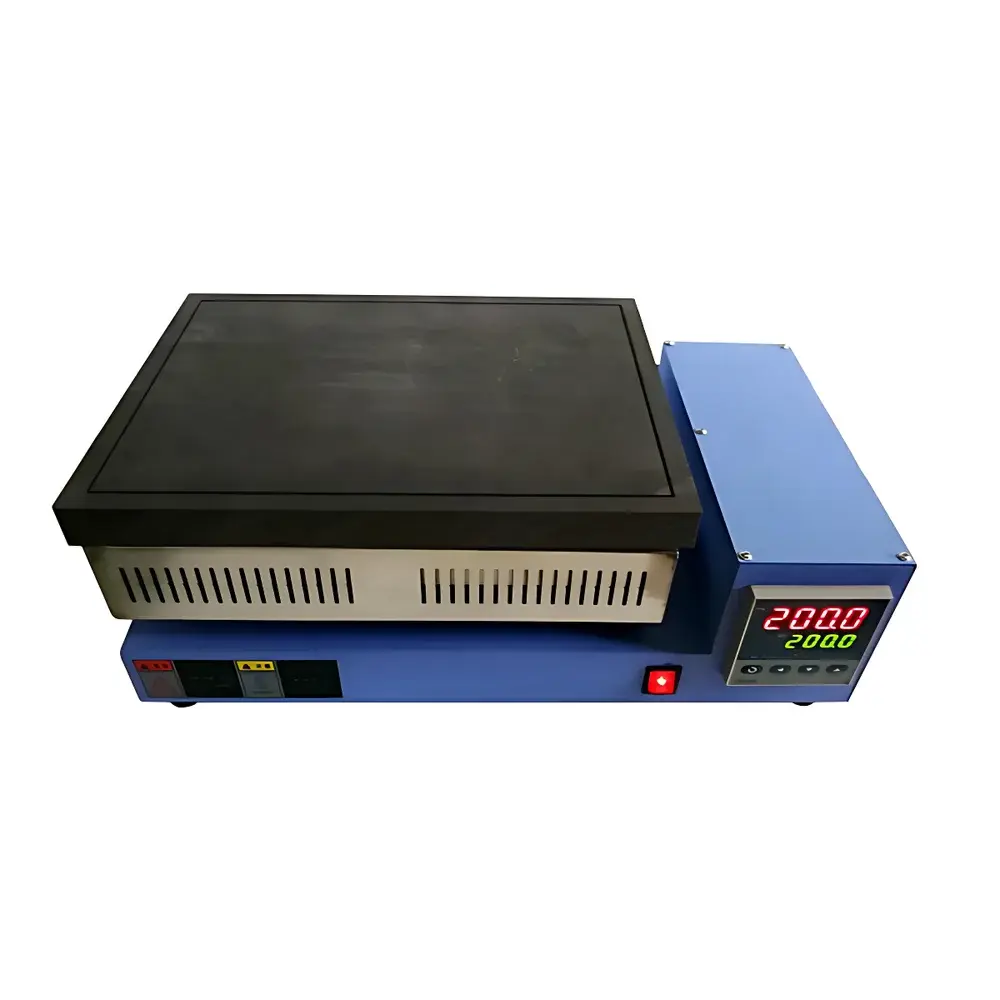
Zhongke Aobo SM35-45 Graphite Heating Block for Sample Digestion and Acid Evaporation
| Brand | Zhongke Aobo |
|---|---|
| Model | SM35-45 |
| Origin | Beijing, China |
| Heating Power | 3500 W |
| Max Operating Temperature | 450 °C |
| Temperature Uniformity | ±2 °C across heating surface |
| Heating Surface Dimensions | 300 × 400 mm |
| Graphite Block Thickness | 30 mm |
| Control Method | PID-based Programmable Temperature Controller |
| Temperature Accuracy | ±1 °C |
| Input Voltage | AC 220 V, 50 Hz |
| Overall Dimensions (D×W×H) | 300 × 500 × 225 mm |
| Weight | 15 kg |
| Material | Isostatically Pressed High-Purity Graphite (≥99.9% carbon) |
| Surface Finish | Acid-resistant epoxy-powder coated housing |
Overview
The Zhongke Aobo SM35-45 Graphite Heating Block is an engineered thermal platform designed for reproducible, high-temperature sample preparation in analytical laboratories. Unlike conventional ceramic or aluminum hotplates, this unit employs a monolithic isostatically pressed high-purity graphite block as the primary heat transfer medium—offering superior thermal conductivity (≥120 W/m·K), exceptional chemical inertness, and long-term dimensional stability under aggressive acid digestion conditions. The device operates on the principle of conductive heating, where uniform thermal energy is transferred directly from the graphite mass to reaction vessels (e.g., PTFE, quartz, or borosilicate glass digestion tubes), minimizing thermal gradients and ensuring consistent kinetics during open-vessel acid digestion, acid evaporation (‘gassing off’), or pre-microwave digestion conditioning. Its 450 °C maximum operating temperature supports HNO₃–HCl–HF–H₂O₂ multi-acid protocols per EPA Method 3050B and ASTM D5683, while the integrated air-and-ceramic-fiber dual insulation architecture reduces ambient heat loss by >40% compared to single-layer designs.
Key Features
- Isostatically pressed high-purity graphite (≥99.9% C) heating block—resistant to concentrated HNO₃, HCl, HF, H₂SO₄, and aqua regia at elevated temperatures; validated for continuous operation in acidic fume environments for ≥48 hours.
- PID-based programmable temperature controller with ramp-soak programming: users define up to 10 temperature segments, including heating rate (°C/min), target setpoint, and dwell time—enabling method-driven digestion sequences compliant with ISO/IEC 17025 workflow requirements.
- Temperature uniformity of ±2 °C across the full 300 × 400 mm heating zone, verified per ASTM E220 calibration practices using NIST-traceable surface thermocouples.
- Dual-stage thermal insulation: outer steel enclosure with 25 mm air gap + inner 15 mm calcium silicate board—reducing surface casing temperature to <60 °C at 450 °C setpoint, enhancing operator safety and lab energy efficiency.
- Epoxy-powder coated corrosion-resistant chassis; non-porous graphite surface easily cleaned with dilute sodium hydroxide or deionized water—no residue retention between runs.
Sample Compatibility & Compliance
The SM35-45 accommodates standard digestion vessels including 50–100 mL PFA, quartz, and borosilicate glass tubes, as well as custom-sized crucibles up to 300 mm in length. It is routinely deployed in workflows aligned with USP , EPA 3050B/3051A, ISO 11466, and GB/T 22919.2–2008 for heavy metal determination in soils, sediments, biological tissues, and food matrices. The instrument’s thermal stability and repeatability support GLP-compliant data generation when paired with audit-trail-enabled LIMS integration (via optional RS-485 output). All electrical components meet IEC 61010-1:2010 safety standards for laboratory equipment.
Software & Data Management
While the SM35-45 operates via standalone front-panel interface, optional RS-485 serial communication enables remote monitoring and parameter logging through third-party SCADA or laboratory informatics systems. Temperature profiles—including real-time setpoint, actual block temperature, elapsed time, and stage completion status—can be timestamped and exported in CSV format. When used in regulated environments, the system supports 21 CFR Part 11-compliant electronic record integrity when integrated with validated software platforms that enforce user authentication, audit trails, and electronic signatures.
Applications
- Open-vessel acid digestion for trace metal analysis prior to ICP-OES, ICP-MS, AAS, and HG-AFS quantification.
- Controlled acid evaporation (‘gassing’) to reduce digestate volume and concentrate analytes without volatile loss.
- Pre-treatment for microwave-assisted digestion—standardizing initial temperature and acid concentration across samples.
- Constant-temperature drying, ashing support, and solvent reflux pre-conditioning in environmental and food safety testing labs.
- Routine calibration of thermocouples and RTDs using fixed-point graphite reference blocks (traceable to NIST SRM 1750).
FAQ
What materials are compatible with the graphite heating surface?
PTFE, PFA, quartz, borosilicate glass, and quartz-fiber crucibles are fully compatible. Avoid direct contact with metals (e.g., stainless steel tongs) above 300 °C to prevent localized carburization.
Can the SM35-45 be used for HF-based digestions?
Yes—the isostatically pressed graphite block demonstrates no visible degradation after 72 hours of continuous exposure to 40% HF at 200 °C, as confirmed by SEM surface morphology analysis.
Is temperature calibration traceable to national standards?
The unit includes a factory calibration certificate referencing NIST-traceable thermocouples; users may perform in-house verification using calibrated surface probes per ISO/IEC 17025 Section 6.6.
Does it support multi-step digestion methods?
Yes—its 10-segment PID program allows precise control over ramp rates (0.1–20 °C/min), hold durations (1–999 min), and final cooldown profiles—essential for EPA 3051A and GB/T 5009.12 protocols.
What maintenance is required?
No routine mechanical maintenance. Clean graphite surface weekly with 1% NaOH solution followed by DI water rinse; inspect powder-coated housing for chip damage annually.



