
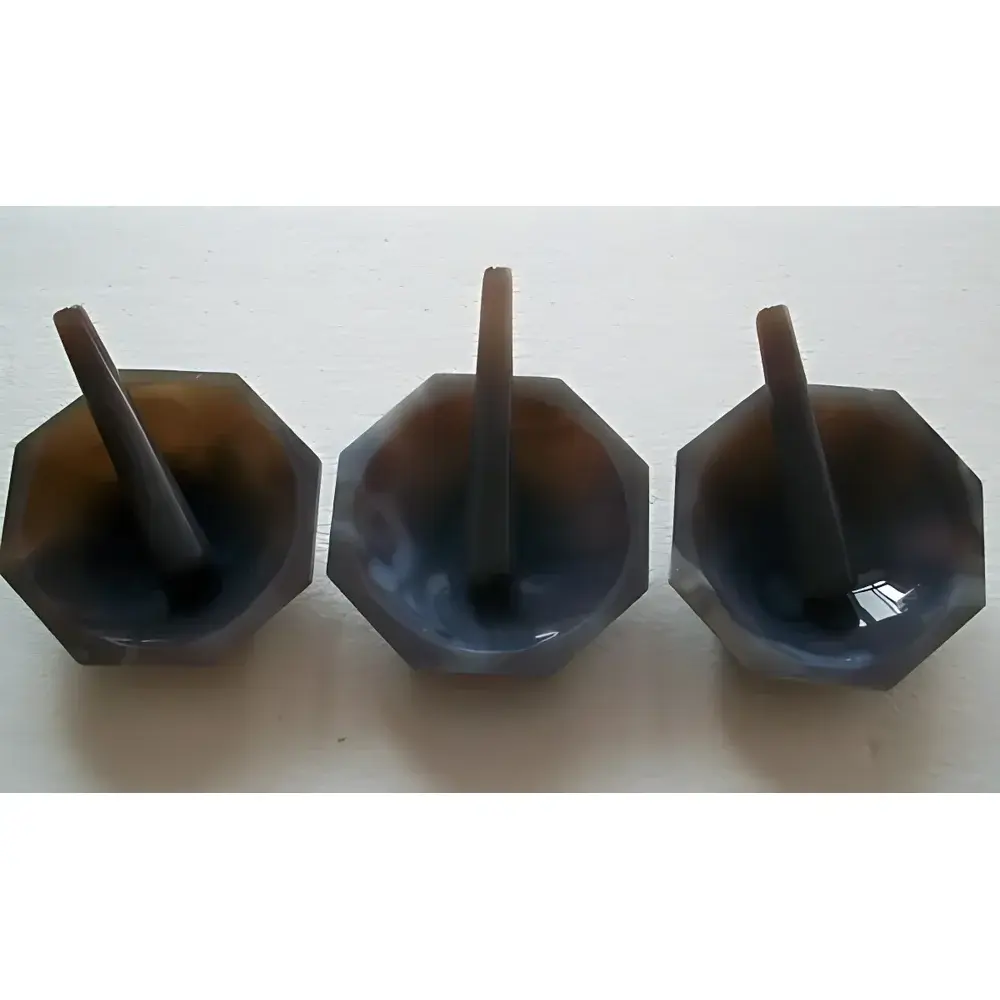
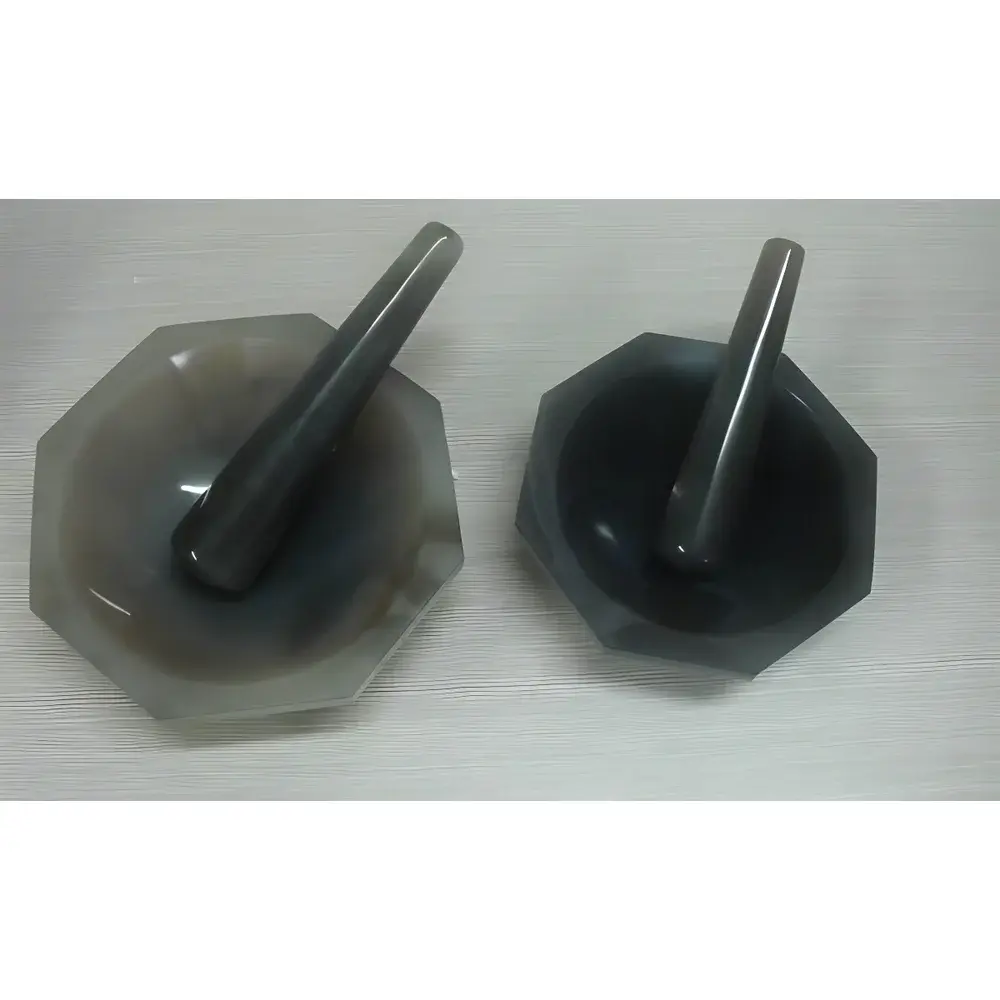
Agate Mortar by Zhongke Aobo – 40–300 mm Diameter, High-Purity Brazilian Raw Material
| Brand | Zhongke Aobo |
|---|---|
| Origin | Beijing, China |
| Manufacturer Type | Authorized Distributor |
| Origin Category | Domestic (China) |
| Model Range | 40–300 mm internal diameter |
| Price | USD 92 (approx. ¥660) |
| Material | Natural Brazilian Agate (SiO₂ ≥ 97.26 wt%) |
| Mohs Hardness | 7.2–7.5 |
| Density | 2.65 g/cm³ |
| Acid Resistance | Excellent (except HF) |
| Max Operating Temp | Ambient only (non-heat-treatable) |
| Compliance | Meets GB/T 10722–2008 (General Specifications for Agate Labware) and ISO 8549-2:1996 (Laboratory Equipment — Mortars and Pestles — Part 2: Requirements) |
Overview
The Agate Mortar by Zhongke Aobo is a precision-grade laboratory mortar crafted from natural Brazilian agate, engineered for high-fidelity sample preparation in analytical, geochemical, pharmaceutical, and materials science laboratories. Its operational principle relies on mechanical attrition and shear force transmission between the concave mortar bowl and pestle surface—enabling controlled particle size reduction, homogenization of powders, and gentle mixing of reactive or acid-sensitive compounds. Unlike steel or ceramic alternatives, agate’s exceptional chemical inertness (particularly toward HCl, HNO₃, and H₂SO₄), combined with its high Mohs hardness (7.2–7.5) and low contamination risk, makes it indispensable for trace-element analysis, X-ray fluorescence (XRF) sample pressing, and ICP-MS calibration standard preparation where metallic leaching must be avoided.
Key Features
- Natural Brazilian agate raw material with SiO₂ content ≥97.26 wt%, verified via XRF spectroscopy per ASTM E1361–22; minimal MgO/CaO/Mn₂O₃ impurities ensure spectral purity in elemental analysis.
- Optically uniform structure: free of microfractures, voids, or laminar discontinuities—validated by ultrasonic pulse-echo inspection per ISO 12715:2020 (Non-destructive testing of labware ceramics).
- Surface finish polished to Ra ≤0.05 µm, minimizing sample retention and enabling quantitative recovery of sub-milligram samples.
- Thermal stability limited to ambient conditions only; no thermal cycling or oven drying permitted—consistent with ISO 8549-1:1996 requirements for non-heat-treated agate labware.
- Geometric consistency across size range: inner diameters from 40 mm to 300 mm maintain standardized depth-to-diameter ratio (0.45 ± 0.03), ensuring reproducible grinding kinetics per batch.
Sample Compatibility & Compliance
This mortar is compatible with non-explosive, non-hydrofluoric-acid-based solid samples including oxides, carbonates, silicates, pharmaceutical APIs, and geological reference materials (e.g., NIST SRM 278). It is explicitly incompatible with fluorides, anhydrous HF, molten alkalis, and materials exceeding Mohs hardness 7 (e.g., tungsten carbide, corundum). All units comply with GB/T 10722–2008 (Chinese National Standard for Agate Laboratory Ware) and align with ISO 8549-2:1996 dimensional tolerances (±0.2 mm for diameters ≤100 mm; ±0.3 mm for >100 mm). Documentation includes material certification, batch-specific XRF composition report, and conformity statement for GLP-compliant environments.
Software & Data Management
As a passive mechanical tool, this agate mortar does not incorporate embedded electronics or software interfaces. However, it integrates seamlessly into digital lab workflows governed by FDA 21 CFR Part 11 and EU Annex 11 requirements: each unit is assigned a unique alphanumeric identifier engraved on the base, supporting traceability in LIMS (Laboratory Information Management Systems). Usage logs—including operator ID, sample ID, grinding duration, and post-cleaning verification—can be recorded manually or via barcode-scanned SOP checklists compliant with ISO/IEC 17025:2017 clause 7.5.2 (Control of records).
Applications
- Preparation of pressed pellets for XRF and XRD analysis without binder-induced matrix effects.
- Homogenization of certified reference materials (CRMs) prior to subsampling for proficiency testing.
- Low-contamination grinding of high-purity quartz, feldspar, and zircon standards in geochronology labs.
- Manual dispersion of nanomaterials in inert media for TEM grid loading—avoiding catalytic metal interference from stainless-steel mortars.
- Pharmaceutical excipient blending under cGMP Annex 15 guidelines, where extractables testing confirms absence of agate-derived particulates.
FAQ
Can this mortar be autoclaved or baked in a muffle furnace?
No. Agate undergoes irreversible microstructural stress and potential spalling above 60 °C. Sterilization must be performed via ethanol wipe or UV-C exposure only.
Is hydrofluoric acid contact permissible during cleaning?
Absolutely not. HF etches SiO₂ at ambient temperature, causing rapid surface degradation and silicic acid leaching—voiding all quality certifications.
What is the maximum recommended sample volume relative to mortar capacity?
No more than one-third of internal volume, as specified in ISO 8549-2:1996 section 5.3.1, to prevent splashing and ensure effective shear transfer.
How is dimensional accuracy verified for custom sizes (e.g., 275 mm ID)?
Each custom unit undergoes coordinate measuring machine (CMM) verification per ISO 10360-2:2009, with full calibration certificate provided.
Does the natural banding pattern affect performance or analytical validity?
No. Banding reflects Fe/Mn oxide distribution inherent to geological formation and has no impact on hardness, density, or chemical resistance—confirmed by ASTM C242–21 inter-laboratory studies.



