
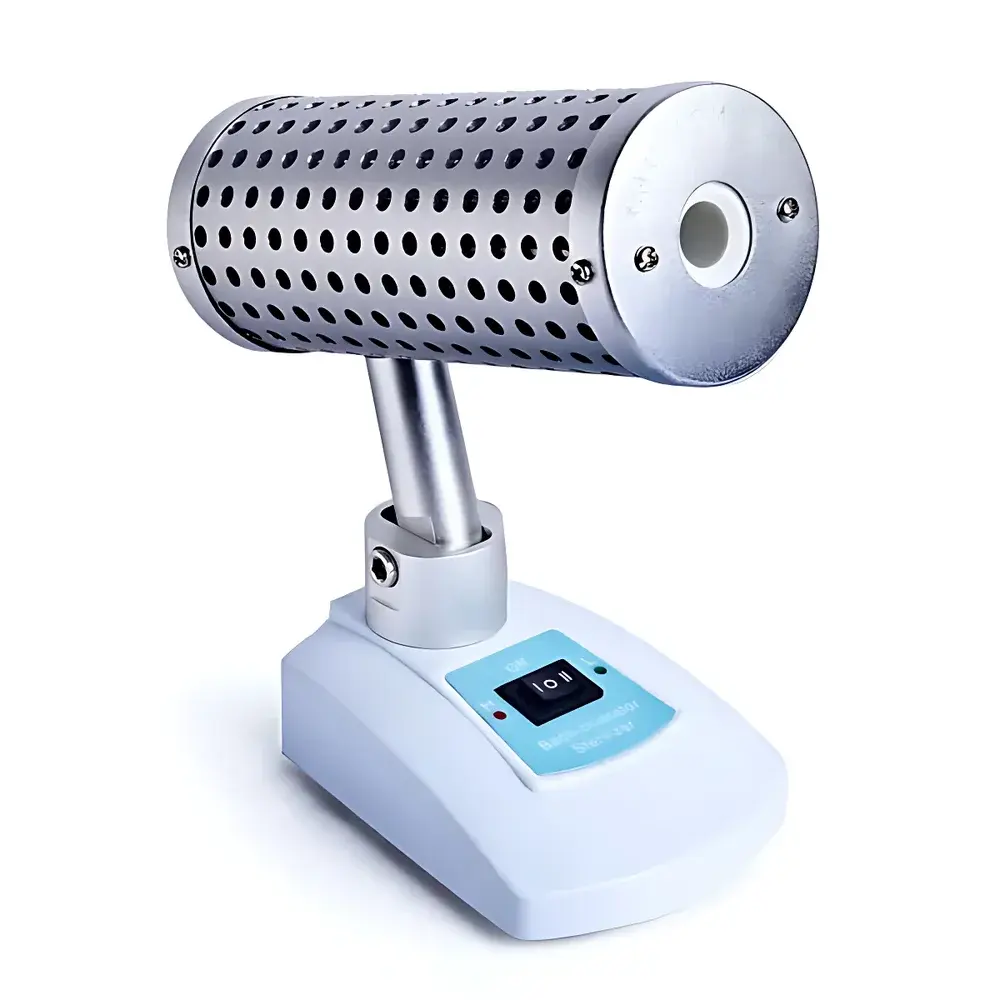
Zhongke Aobo 800A Dry Heat Sterilizer
| Brand | Zhongke Aobo |
|---|---|
| Origin | Beijing, China |
| Model | 800A |
| Heating Method | Radiant Heat |
| Max Operating Temperature | 825 °C |
| Temperature Control Accuracy | ±1 °C |
| Temperature Uniformity | ±2 °C |
| Heating Power | 200 W |
| Chamber Dimensions (W×D×H) | 14 mm × 140 mm (bore diameter × heating zone length) |
| Max Insertable Item Diameter | 14 mm |
| Standby Temperature | 480 °C |
| Power Supply | AC 220 V ±10%, 50 Hz ±1 Hz |
| Weight | 1.3 kg |
| Operating Ambient | 10–50 °C, ≤90% RH, unlimited altitude |
Overview
The Zhongke Aobo 800A Dry Heat Sterilizer is a compact, precision-engineered benchtop instrument designed for rapid, flame-free sterilization of microbiological tools—primarily inoculation loops, needles, and small metal instruments—in biosafety cabinets, anaerobic chambers, and routine laboratory workflows. Unlike moist-heat or chemical methods, this unit employs radiant dry heat generated by a high-emissivity ceramic heating element housed within a thermally insulated borosilicate glass or alumina ceramic bore. The principle relies on thermal denaturation of microbial proteins and nucleic acids at elevated temperatures (>160 °C), with validated sterility assurance achieved at ≥800 °C for exposure durations ≥5 seconds per item. Its design eliminates open flames, volatile solvents, and aerosolized bioaerosols—making it compliant with ISO 14644-1 Class 5 cleanroom practices and suitable for use in oxygen-limited environments such as anaerobic workstations.
Key Features
- Radiant heat architecture with high-temperature ceramic core enabling stable operation up to 825 °C ±50 °C at the center of the heating zone;
- Precision digital temperature control system delivering ±1 °C setpoint accuracy and ±2 °C uniformity across the 140 mm active heating length;
- Adjustable-angle heating head for ergonomic access and optimal insertion angle during repeated use;
- Self-contained, low-power (200 W) design minimizing thermal load on laminar flow hoods and reducing facility energy demand;
- Smooth-surface ceramic bore and stainless steel housing facilitating wipe-down decontamination and adherence to GLP cleaning protocols;
- Standby mode maintains 480 °C—sufficient to prevent microbial colonization between uses while extending heater lifespan through reduced thermal cycling;
- No consumables, no exhaust ducting, and no validation-required steam generators or pressure vessels—reducing lifecycle compliance overhead.
Sample Compatibility & Compliance
The 800A accommodates cylindrical metallic implements with outer diameters ≤14 mm—including standard platinum/nichrome loops, straight/angled needles, forceps tips, and microspatulas. It is not intended for plastic, coated, or heat-sensitive materials. The device complies with general safety requirements outlined in IEC 61010-1:2010 for electrical equipment used in laboratory environments. While not certified to EN 285 or ISO 17665 for steam sterilization, its dry-heat performance aligns with microbiological validation benchmarks described in USP Sterility Assurance and ISO/TS 11139:2018 (Sterilization—Vocabulary). Routine verification may be performed using biological indicators (e.g., Bacillus atrophaeus spores) placed at the bore’s geometric center and exposed for 7 seconds at 825 °C.
Software & Data Management
This model operates via a dedicated analog-digital hybrid controller with LED display and push-button interface—no embedded software, firmware updates, or network connectivity. As a Class I non-programmable device, it requires no 21 CFR Part 11-compliant audit trail, electronic signatures, or data export functionality. Temperature logging must be conducted externally using calibrated handheld thermocouple probes (e.g., Type K, 0.5 mm sheath) inserted to depth during qualification. All operational parameters—including time-at-temperature profiles—are manually recorded per institutional SOPs for GLP/GMP traceability.
Applications
- Routine sterilization of inoculation tools in clinical microbiology, pharmaceutical QC labs, and academic teaching laboratories;
- Decontamination of reusable metal instruments inside anaerobic glove boxes where flammable gas mixtures prohibit open flames;
- Pre-sterilization conditioning of sample holders prior to SEM/TEM specimen preparation;
- Thermal ashing of organic residues from pipette tips or microcentrifuge tubes within fume hoods (when used with appropriate containment);
- Complementary use alongside autoclaves in multi-tiered sterilization strategies for critical-path processes requiring both moist- and dry-heat modalities.
FAQ
Can the 800A sterilize plastic or coated instruments?
No. Only metallic instruments with continuous thermal conductivity and no polymer coatings are compatible. Plastic, silicone, or Teflon-coated items will melt or decompose.
Is calibration required before first use?
Yes. Users must verify bore-center temperature using a NIST-traceable thermocouple probe prior to initial operation and at least annually thereafter, per ISO/IEC 17025 clause 6.5.2.
Does the unit meet FDA or EU MDR requirements for medical device reprocessing?
It is not classified as a medical device under 21 CFR 820 or Regulation (EU) 2017/745. Its use is limited to laboratory tool decontamination—not patient-contact device reprocessing.
How often should the ceramic heating element be replaced?
Under normal usage (≤50 cycles/day), the element typically exceeds 5,000 operating hours; visual inspection for cracking or discoloration is recommended quarterly.
Can it be operated continuously?
Yes—continuous operation is permitted within ambient conditions of 10–50 °C and ≤90% RH; however, extended standby at 480 °C is advised over repeated full-cycle heating to minimize thermal stress.



