
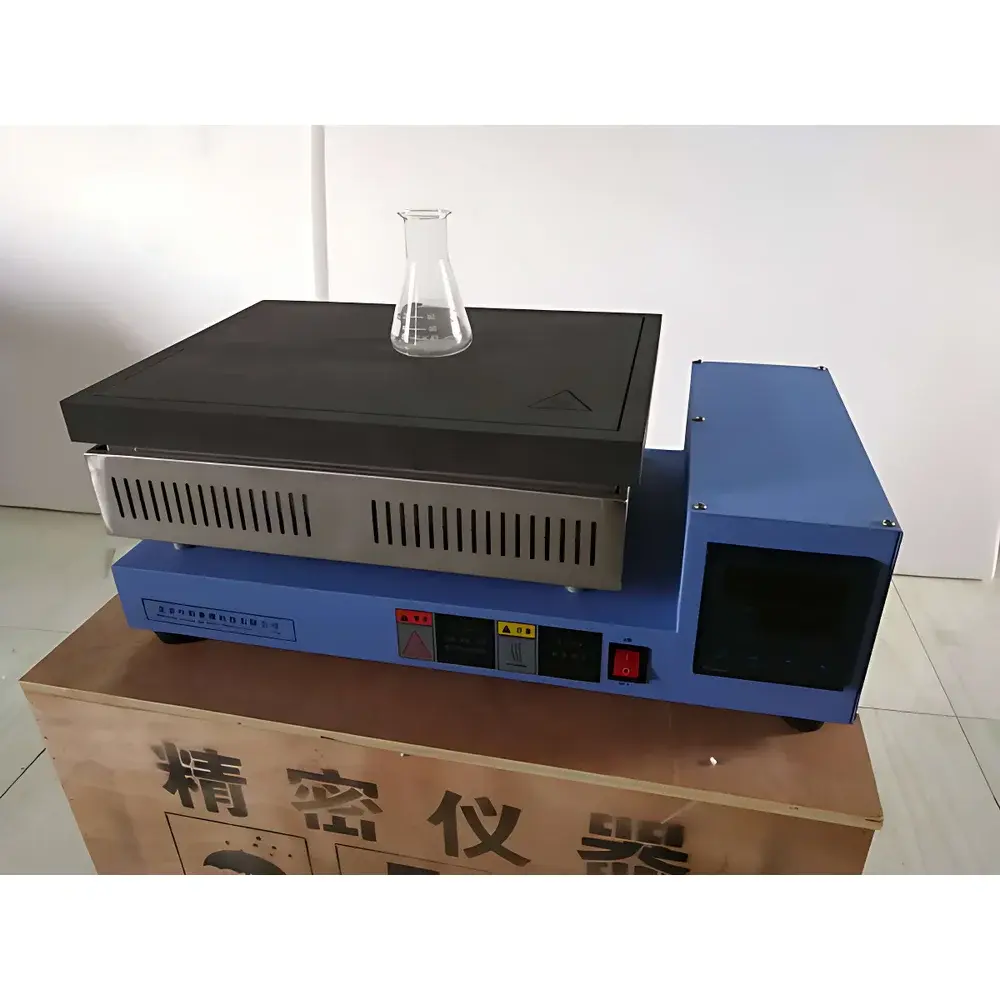
Zhongke Aobo SM35-45 High-Precision Graphite Electric Heating Block
| Brand | Zhongke Aobo |
|---|---|
| Origin | Beijing, China |
| Model | SM35-45 |
| Heating Power | 3.5 kW |
| Max Operating Temperature | 450 °C |
| Temperature Uniformity | ±1–2 °C |
| Plate Dimensions | 400 × 300 mm |
| Heating Zone Dimensions | 400 × 300 mm |
| Control Interface | Intelligent PID Programmable Controller |
Overview
The Zhongke Aobo SM35-45 High-Precision Graphite Electric Heating Block is a laboratory-grade thermal platform engineered for reproducible, contamination-free sample preparation in analytical chemistry workflows. Unlike conventional metal-surface hotplates, this unit employs a monolithic block of isostatically pressed, high-purity graphite (≥99.99% carbon) as the heating medium—selected for its exceptional thermal conductivity (≥150 W/m·K), low coefficient of thermal expansion, and intrinsic resistance to aggressive chemical environments. The device operates on resistive heating principles: embedded high-stability alloy heating elements transfer energy uniformly into the graphite mass, which then delivers stable, radiant-conductive heat across the entire surface. This architecture eliminates hot spots and ensures spatial temperature consistency critical for digestion protocols requiring strict thermal homogeneity—such as EPA Method 3050B, ISO 11466, and ASTM D3682. Designed for integration into regulated laboratories, it supports trace-metal analysis workflows including acid digestion prior to ICP-OES, ICP-MS, AAS, and HG-AFS.
Key Features
- Isostatically pressed ultra-high-purity graphite plate (30 mm thick) with certified low heavy-metal background and inert surface chemistry
- PID-based programmable temperature controller with ramp-soak programming, adjustable heating rate (0.1–10 °C/min), and auto-hold functionality
- Temperature accuracy of ±1 °C across full range (room temperature to 450 °C), verified per ASTM E220 calibration protocol
- Dual-layer thermal insulation: air gap + ceramic fiber (silica-alumina) barrier, reducing surface casing temperature to <60 °C at max setpoint
- Electrostatically applied epoxy-polyester anti-corrosion coating on housing; validated for continuous operation under fuming HNO₃/HCl/HF vapor exposure (>48 h)
- Integrated over-temperature cut-off and ground-fault circuit interrupter (GFCI) compliant with IEC 61000-4-5 surge immunity standards
Sample Compatibility & Compliance
The SM35-45 accommodates standard digestion vessels—including PTFE, PFA, quartz, and borosilicate glass beakers (up to 1000 mL)—across its full 400 × 300 mm active zone. Its uniform thermal profile enables parallel processing of up to 12 × 50-mL Teflon vessels or 6 × 100-mL quartz crucibles without inter-vessel temperature deviation exceeding ±1.5 °C (measured per ISO/IEC 17025 clause 5.4.2). The system complies with GLP documentation requirements: all temperature programs are timestamped and stored locally with non-volatile memory retention. Optional RS-485 Modbus RTU interface supports audit-trail logging compatible with FDA 21 CFR Part 11–compliant LIMS environments when paired with validated data acquisition software.
Software & Data Management
While the base unit features an embedded LCD interface with tactile membrane keypad, optional USB-to-RS485 converter enables connection to Windows-based control software (supplied separately). This application provides real-time temperature graphing, multi-step program export/import (.csv), and electronic signature-enabled method locking. All session logs—including setpoints, actual readings, ramp durations, and fault events—are time-stamped and exportable in .xlsx format for QA review. Firmware adheres to IEC 62443-3-3 cybersecurity baseline for laboratory instruments, with password-protected administrator mode and configurable user access levels.
Applications
- Open-vessel acid digestion (HNO₃/HCl/HF/H₂O₂) for soil, sediment, biological tissue, and polymer matrices
- Post-microwave digestion acid evaporation (“gassing off”) to near-dryness prior to ICP analysis
- Standard reference material (SRM) preparation per NIST SP 260 guidelines
- Calibration standard dilution and holding at precise temperatures (e.g., 95 °C for hydride generation)
- Pre-concentration of environmental water samples via gentle evaporation under laminar flow hoods
- Thermal conditioning of catalyst supports and geochemical samples prior to XRD/XRF analysis
FAQ
What is the maximum recommended operating temperature for continuous use?
The graphite block is rated for sustained operation at 450 °C; however, for optimal longevity and minimal outgassing, routine use above 400 °C should be limited to ≤2 hours per cycle.
Can the heating plate be calibrated externally?
Yes—NIST-traceable PT100 probes inserted into designated calibration ports (depth: 15 mm) allow third-party verification per ISO/IEC 17025 Annex A.2.
Is the unit suitable for Class 100 cleanroom environments?
The enclosure meets ISO 14644-1 Class 8 particulate limits when operated with HEPA-filtered ventilation; graphite surface requires pre-use solvent wipe (IPA) to minimize carbon particulate shedding.
Does the controller support multi-stage temperature profiles?
Yes—up to 10 independent ramp-soak segments can be programmed, each with defined rate, target, and dwell duration.
What maintenance is required for long-term stability?
Annual inspection of graphite surface integrity (crack/erosion assessment), recalibration of internal thermocouple against reference probe, and verification of GFCI trip threshold (≤5 mA) per IEC 61008-1.



