
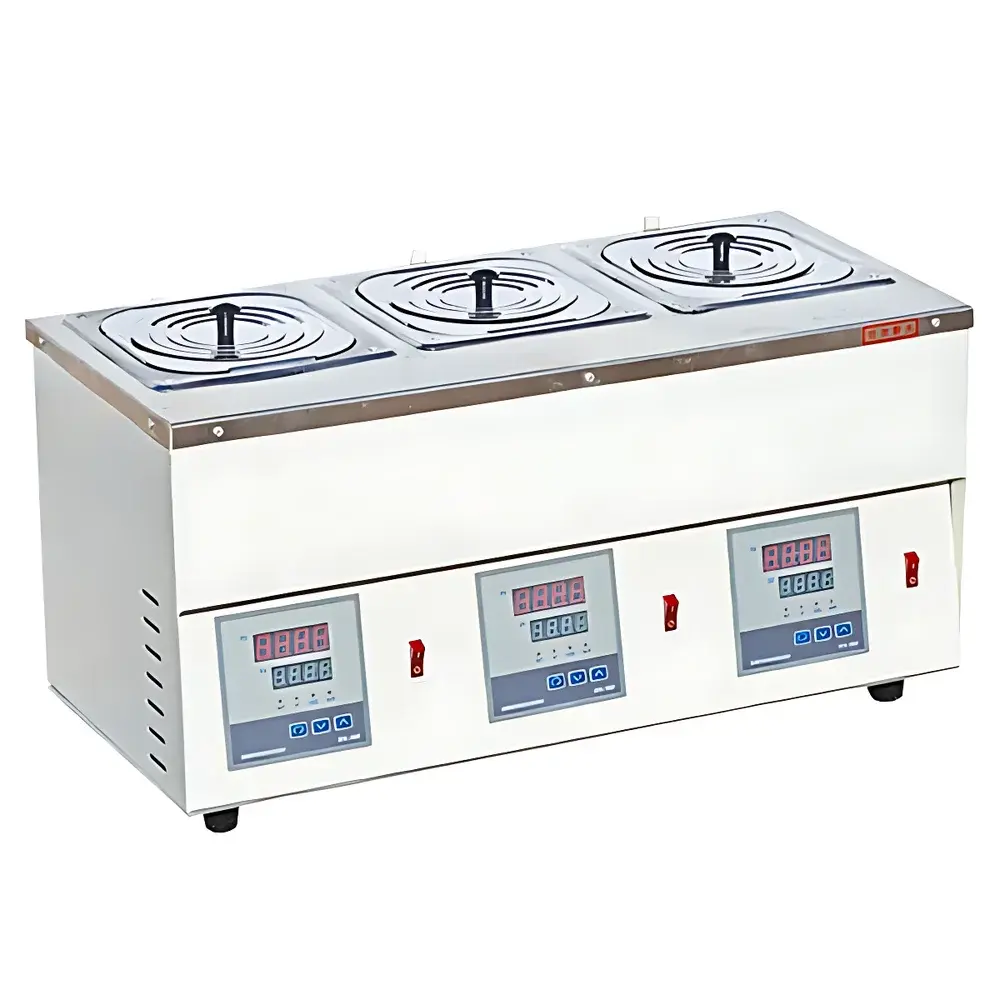
Precision Electric Heated Constant-Temperature Water Bath (Zhongke Aobo DZKW-2)
| Brand | Zhongke Aobo |
|---|---|
| Origin | Beijing, China |
| Model | DZKW-2 |
| Heating Power | 500 W (for single-row dual-hole configuration) |
| Temperature Range | Ambient +10 °C to 100 °C |
| Temperature Stability | ±1 °C |
| Construction | Transparent engineering plastic housing and inner chamber |
| Control System | Digital PID temperature controller with LED display and touch-sensitive keypad |
| Compliance | Designed for general laboratory use under ISO/IEC 17025-aligned environments |
Overview
The Zhongke Aobo DZKW-2 Precision Electric Heated Constant-Temperature Water Bath is an entry-tier, benchtop thermal conditioning system engineered for reliable, uniform heat transfer via water-mediated convection. Operating on the principle of liquid-phase thermal equilibration, it maintains stable bath temperatures across defined setpoints using a resistive heating element immersed in a stainless-steel or polymer-lined reservoir, coupled with a feedback-controlled PID algorithm. This architecture ensures consistent thermal energy delivery to samples contained in glassware or vessels placed directly in the water medium—making it ideal for applications demanding gentle, non-contact, and spatially homogeneous heating without direct flame or dry-heat exposure.
Key Features
- Robust transparent engineering plastic construction for both exterior casing and interior chamber—enabling real-time visual monitoring of sample status, water level, and immersion geometry without lid removal.
- Digital PID temperature controller with high-brightness 4-digit LED display and capacitive touch-key interface—supporting intuitive setpoint entry, real-time temperature readout, and rapid stabilization response.
- Steam containment design minimizes vapor loss during prolonged operation at elevated temperatures (up to 100 °C), reducing refilling frequency and improving lab safety in shared workspaces.
- Thermally insulated housing and optimized heater placement ensure low external surface temperature rise (<35 °C above ambient at steady state), enhancing operator safety and minimizing ambient thermal interference.
- Modular platform compatibility: The DZKW-2 is part of a scalable series—including single-, double-, and multi-well configurations—allowing users to select capacity based on throughput requirements while maintaining identical control logic and calibration traceability.
Sample Compatibility & Compliance
The DZKW-2 accommodates standard laboratory glassware including beakers (up to 1000 mL), Erlenmeyer flasks, test tubes, and reaction vials. Its open-bath geometry supports simultaneous processing of multiple discrete samples under identical thermal conditions. While not certified for sterile or regulated pharmaceutical manufacturing, the unit meets general-purpose laboratory equipment requirements per GB/T 28962–2012 (Chinese national standard for electric water baths) and aligns with foundational thermal stability expectations referenced in ASTM E2252 (Standard Specification for Laboratory Water Baths). It is routinely deployed in academic teaching labs, QC testing environments, and R&D settings where reproducible, low-risk thermal treatment is required—such as enzyme incubation, solvent evaporation, reagent warming, and viscosity pre-conditioning prior to rheological analysis.
Software & Data Management
The DZKW-2 operates as a standalone analog-digital hybrid instrument with no embedded data logging or network connectivity. Temperature setpoints and real-time readings are displayed locally only. For laboratories requiring audit-ready records, integration with external USB or RS-232 data loggers (e.g., Omega OM-DAQPRO-5300 or equivalent) is feasible via optional analog voltage output (0–5 V proportional to temperature). When used within GLP or GMP frameworks, manual logbook entries—including operator ID, date/time, setpoint, observed bath temperature, and duration—are recommended to satisfy basic traceability requirements per FDA 21 CFR Part 11 Annex A guidance for non-computerized systems.
Applications
- Controlled evaporation of solvents from analytical samples prior to gravimetric or spectroscopic analysis.
- Pre-warming of culture media, buffers, and enzymatic reagents to physiological or assay-specific temperatures.
- Accelerated drying of thin-film coatings or printed circuit board substrates in electronics prototyping.
- Thermal conditioning of polymer solutions and adhesives to reduce viscosity prior to casting or dispensing.
- Supporting ASTM D1250 (Petroleum Measurement Tables) procedures requiring precise bath temperature maintenance during density determination.
- Teaching laboratory demonstrations of heat transfer kinetics, phase-change behavior, and Arrhenius-based reaction rate dependence on temperature.
FAQ
What is the maximum operating temperature of the DZKW-2?
The unit is rated for continuous operation from ambient +10 °C up to 100 °C, with optimal stability achieved between 30 °C and 95 °C.
Is the water bath compatible with corrosive solutions such as acidic or saline media?
The internal chamber is constructed from chemically resistant engineering plastic; however, prolonged exposure to strong acids, halides, or oxidizers may degrade material integrity. Use of inert liners or glass inserts is advised for aggressive chemistries.
Does the DZKW-2 include over-temperature protection?
Yes—it features a redundant mechanical high-limit cut-off switch that interrupts power if the bath exceeds 105 °C, independent of the primary PID controller.
Can this unit be calibrated in accordance with ISO/IEC 17025 requirements?
While the device itself is not supplied with a calibration certificate, its temperature sensor and controller are amenable to third-party calibration using NIST-traceable reference thermometers (e.g., Fluke 1523 or equivalent), supporting compliance with laboratory accreditation standards.
What maintenance is required to ensure long-term accuracy?
Routine cleaning of the water reservoir with deionized water and periodic inspection of the heating element and sensor mounting are recommended. Descaling with diluted acetic acid solution is necessary if operated with hard tap water over extended periods.



