
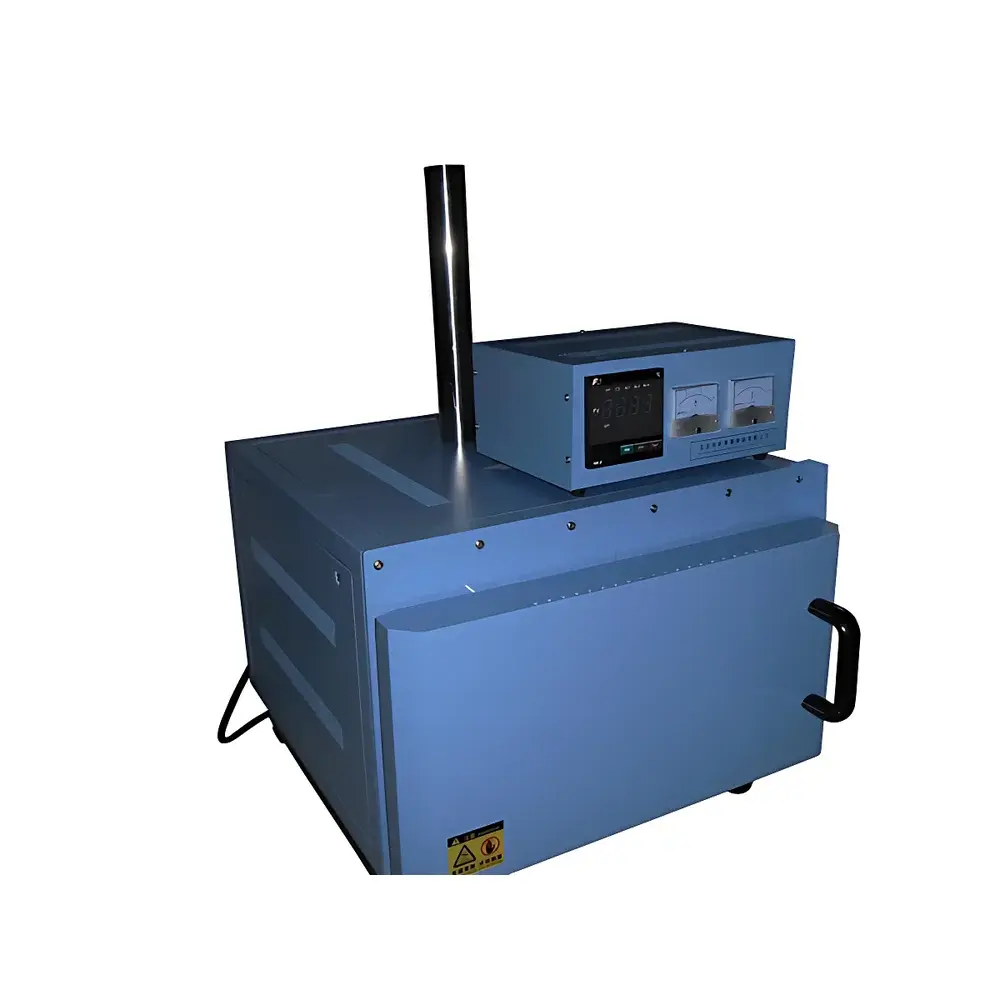
Zhongke Aobo TL3012 Split-Body Intelligent Muffle Furnace
| Brand | Zhongke Aobo |
|---|---|
| Origin | Beijing, China |
| Model | TL3012 Split-Body |
| Instrument Type | Box-Type Muffle Furnace |
| Max Temperature | 1200 °C |
| Temperature Control Accuracy | ±1 °C |
| Max Power | 7.5 kW |
| Heating Rate to Max Temp | ≤60 min |
| Heating Method | Resistance Wire (High-Temperature Alloy) |
| Internal Chamber Dimensions | 400 × 300 × 250 mm (L×W×H) |
| Chamber Volume | 30 L |
Overview
The Zhongke Aobo TL3012 Split-Body Intelligent Muffle Furnace is a high-performance laboratory box furnace engineered for precise thermal processing across analytical, materials science, and quality control applications. Designed around a robust ceramic fiber insulation architecture and dual-zone resistive heating elements, it operates on the principle of radiant and conductive heat transfer within a fully isolated muffle chamber—ensuring uniform temperature distribution, minimal thermal lag, and negligible cross-contamination between sample and heating components. Its split-body configuration physically separates the furnace chamber from the intelligent controller unit, reducing thermal coupling to the electronics, improving long-term calibration stability, and facilitating modular maintenance. The furnace meets fundamental design requirements for controlled-atmosphere thermal treatment, supporting optional inert gas purging via configurable inlet/outlet ports, and is routinely deployed in accredited laboratories performing ASTM E119, ISO 5660, USP <281>, and GB/T 212–2008 compliant procedures.
Key Features
- Split-body architecture with independent furnace chamber and digital controller—enhances serviceability, reduces electromagnetic interference, and improves operator safety during extended high-temperature operation.
- Ceramic fiber insulation (density: ~128 kg/m³) provides exceptional thermal retention; surface temperature remains ≤55 °C at 1200 °C internal setpoint after 1 h stabilization—significantly reducing ambient heat load and energy consumption.
- Dual-side mounted heating elements (high-temperature Fe-Cr-Al alloy wire) ensure symmetrical heat flux and rapid, reproducible ramp rates—achieving ≤60 minutes from ambient to 1200 °C under no-load conditions.
- Intelligent PID temperature controller with 0.1 °C resolution, programmable multi-segment ramp/soak profiles, and auto-tuning capability—minimizes overshoot and stabilizes within ±1 °C of setpoint over full operating range.
- Side-hinged door with high-temperature ceramic fiber gasket ensures tight sealing and consistent thermal integrity during cycling; integrated mechanical interlock prevents operation when door is unlatched.
- Comprehensive safety system includes over-temperature cut-off (independent of main controller), grounded chassis, short-circuit protection, and real-time heater fault detection.
- Standard exhaust port (M12 threaded) allows connection to fume hoods or gas delivery systems; optional N₂/Ar inlet kits available for controlled-atmosphere sintering or ashing.
Sample Compatibility & Compliance
The TL3012 accommodates a wide range of sample forms—including crucibles (alumina, quartz, platinum), powders, granules, filters, biological tissues, coal pellets, and ceramic green bodies—within its 30 L chamber (400 × 300 × 250 mm). Its muffle design isolates samples from direct contact with heating elements and combustion byproducts, making it suitable for gravimetric ash content determination (ASTM D3174, ISO 1171), loss-on-ignition (LOI) analysis, catalyst calcination, and pre-treatment of environmental matrices prior to ICP-OES or XRF. The furnace conforms to general electrical safety standards (IEC 61010-1), carries CE marking for EMC and LVD compliance, and supports GLP/GMP documentation workflows through optional audit-trail-enabled software logging (see Software section). It is not certified for Class I Div 1 hazardous locations but may be operated in ventilated lab environments per OSHA 1910.1200 and local fire codes when used with appropriate exhaust management.
Software & Data Management
The integrated controller features RS485 communication interface (Modbus RTU protocol) for integration into centralized lab automation systems. Optional PC-based software enables remote monitoring, real-time graphing of temperature vs. time, profile upload/download, and CSV-formatted data export—including timestamps, setpoints, actual readings, and alarm events. When configured with optional data-logging firmware, the system maintains tamper-resistant event logs compliant with FDA 21 CFR Part 11 requirements (user authentication, electronic signatures, and audit trail generation). All recorded data are stored locally on non-volatile memory and can be exported via USB flash drive without requiring continuous PC connection—supporting standalone operation in regulated QC/QA labs.
Applications
- Ash Content & Volatile Matter Analysis: Standardized thermal decomposition of coal, biomass, foodstuffs, and pharmaceutical excipients per ASTM D3174, ISO 1171, and USP <281>.
- Thermal Gravimetric Preconditioning: Controlled oxidation of filter media, activated carbon, or catalyst supports prior to BET surface area measurement or pore structure analysis.
- Materials Processing: Sintering of oxide ceramics (e.g., Al₂O₃, ZrO₂), annealing of metal oxides, and binder burnout in investment casting shell molds.
- Environmental Testing: High-temperature digestion of soil/sediment samples prior to heavy metal extraction (EPA Method 3050B); LOI quantification in wastewater sludge characterization.
- Research & Development: Kinetic studies of solid-state reactions, phase transformation screening, and thermal stability assessment of battery cathode materials (e.g., LiCoO₂, NMC).
FAQ
What power supply is required for the TL3012 model?
The TL3012 operates on a 380 V AC, three-phase, 50 Hz supply with 16 A circuit protection. Single-phase 220 V configurations are not supported due to its 7.5 kW rated power draw.
Can this furnace be used under inert or reducing atmospheres?
Yes—standard models include a 10 mm exhaust port and optional 8 mm gas inlet port; compatible with N₂, Ar, or forming gas (5% H₂/95% N₂) when equipped with pressure-regulated mass flow controllers and leak-tested tubing.
Is the temperature uniformity specified across the working zone?
At 1200 °C, radial and axial uniformity is ±5 °C within a 150 mm × 150 mm × 150 mm central zone, verified per ASTM E220 calibration methodology using three-point thermocouple mapping.
Does the furnace support programmable multi-step heating profiles?
Yes—the controller supports up to 30 segments with independent ramp rates (0.1–30 °C/min), soak durations (1 s to 99 h 59 min), and loop repetition (1–99 cycles).
What maintenance is recommended for long-term reliability?
Annual inspection of door gasket integrity, visual check of heating element continuity, and verification of thermocouple calibration against a traceable reference standard (e.g., Fluke 724) are advised. Ceramic fiber insulation requires no routine replacement under normal operating conditions.



