
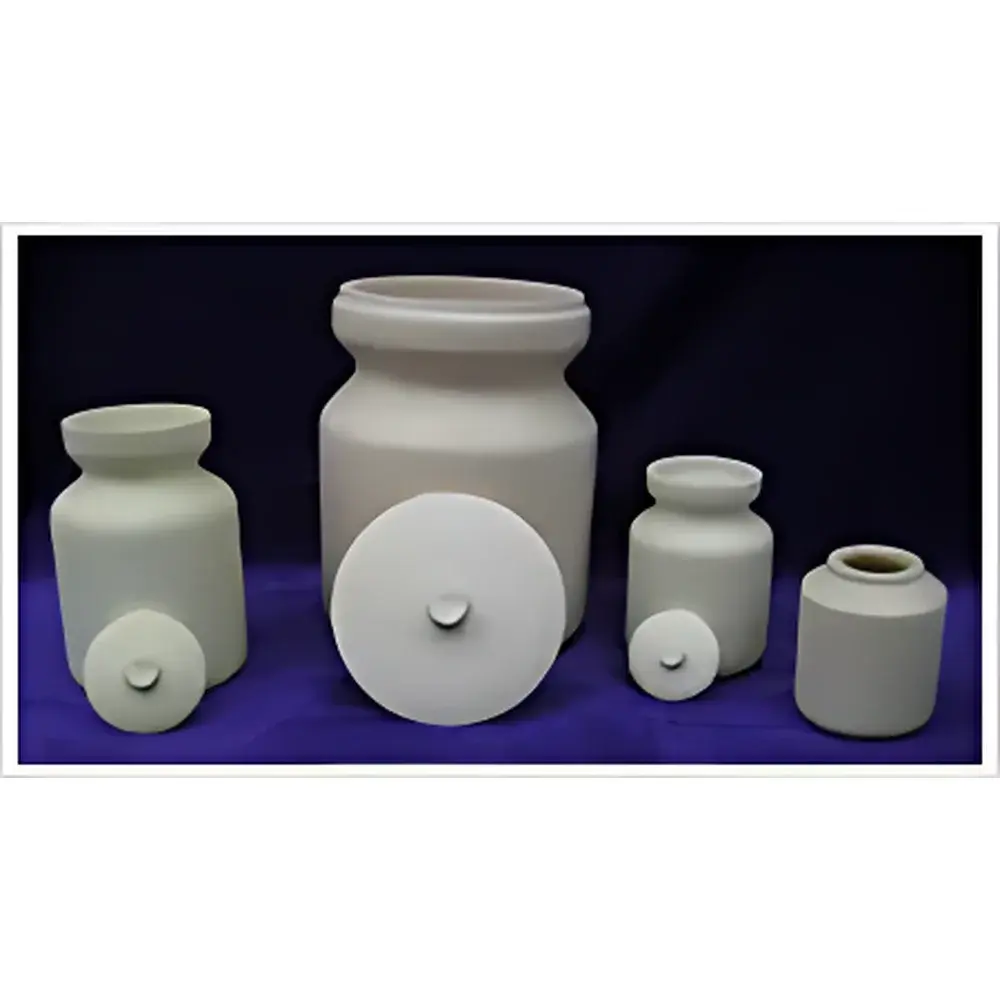
Zhongke Aobo ZKAB-Alumina Ball Mill Jar
| Brand | Zhongke Aobo |
|---|---|
| Origin | Beijing, China |
| Type | High-Purity Alumina (99% Al₂O₃) Ceramic Ball Mill Jar |
| Volume Range | 500–12,000 mL |
| Inner Diameter | 105–245 mm |
| Height | 200–300 mm |
| Wall Thickness | 7–10 mm |
| Bulk Density | ≥3.80 g/cm³ |
| Apparent Porosity | <1% |
| Flexural Strength | >350 MPa |
| Compressive Strength | >12,000 MPa |
| Dielectric Constant (1 MHz) | ~9.8 |
| Vickers Hardness (HV10) | ~1,600 |
| Chemical Composition | Al₂O₃ ≥99 wt%, R₂O ≤0.2 wt%, Fe₂O₃ ≤0.1 wt%, SiO₂ ≤0.2 wt% |
| Feed Size | ≤1,000 µm |
| Final Particle Size | ≥100 µm (typical output after standard milling cycles) |
| Batch Capacity | 1–10 kg (material-dependent, based on jar fill ratio and media loading) |
Overview
The Zhongke Aobo ZKAB-Alumina Ball Mill Jar is a high-performance, monolithic ceramic grinding vessel engineered for use in planetary ball mills, horizontal rotating mills, and vibratory mills. Constructed from sintered 99% aluminum oxide (Al₂O₃), it operates on the principle of impact and attrition grinding—where rotational or vibrational energy transfers kinetic force from grinding media (e.g., alumina or zirconia balls) to solid samples confined within the sealed jar. Its inert composition ensures minimal contamination during comminution of sensitive materials, making it suitable for applications demanding trace-level purity, such as catalyst precursor synthesis, pharmaceutical intermediate processing, and high-purity ceramic powder preparation. Unlike stainless-steel or polymeric jars, this alumina variant eliminates metal leaching and thermal degradation risks under extended mechanical stress.
Key Features
- Ultra-High Purity Matrix: Sintered α-alumina with ≥99 wt% Al₂O₃ content, certified low impurity levels (Fe₂O₃ ≤0.1%, SiO₂ ≤0.2%), minimizing cross-contamination in analytical-grade sample preparation.
- Exceptional Mechanical Robustness: Flexural strength exceeding 350 MPa and compressive strength >12,000 MPa enable reliable operation at high rotational speeds (up to 400 rpm in planetary configurations) without deformation or microcracking.
- Thermal & Chemical Stability: Stable up to 1,600°C in air; resistant to strong acids (HCl, HNO₃), alkalis (NaOH), and organic solvents—validated per ISO 8486-2 for corrosion resistance in aggressive milling environments.
- Precision Geometry & Dimensional Consistency: CNC-machined inner surface finish (Ra ≤0.8 µm); tight tolerances on wall thickness (±0.3 mm) and concentricity ensure uniform stress distribution and reproducible energy transfer across batches.
- Electrical Insulation Integrity: Dielectric constant of ~9.8 at 1 MHz supports safe operation in electromagnetic-sensitive setups (e.g., simultaneous in-situ XRD or Raman monitoring).
Sample Compatibility & Compliance
This jar accommodates hard, brittle, and moderately abrasive feedstocks—including rare-earth oxides (e.g., Y₂O₃, Nd₂O₃), pharmaceutical actives (e.g., ibuprofen, paracetamol), silicon carbide precursors, feldspar, quartz, and battery cathode materials (LiCoO₂, NMC). It complies with ISO 13320:2020 for laser diffraction particle size analysis sample prep and meets USP requirements for non-metallic contact surfaces in pharmaceutical milling. When used in GLP-compliant laboratories, its lot-specific material certification (traceable to sintering batch and density verification) supports audit readiness per FDA 21 CFR Part 11 for electronic records generated during process validation.
Software & Data Management
While the jar itself is a passive consumable component, its performance metrics are fully integratable into digital lab workflows. Compatible with mill control systems (e.g., Retsch MM 500, Fritsch Pulverisette 7) that log real-time parameters—rotational speed, time, acceleration, temperature—via RS-232/USB. Material certification data (density, porosity, hardness) is supplied in PDF format with embedded metadata compliant with ASTM E2098-21 for ceramic component documentation. All certificates include unique batch IDs enabling traceability through LIMS integration using standard HL7 or CSV export protocols.
Applications
- Preparation of sub-100 µm ceramic powders for tape casting and hot isostatic pressing (HIP).
- Mechanochemical synthesis of metal-organic frameworks (MOFs) and layered double hydroxides (LDHs) without solvent-mediated side reactions.
- Homogenization of heterogeneous catalyst blends prior to BET surface area and pore size distribution analysis (ASTM D3663).
- Grinding of pharmaceutical excipients and APIs under cGMP-aligned conditions where metallic contamination must remain below ICH Q3D Stage 1 limits.
- Processing of geological reference materials (e.g., NIST SRM 278) for geochemical XRF calibration standards.
FAQ
Can this jar be used in cryogenic ball milling?
Yes—alumina retains mechanical integrity down to −196°C (liquid nitrogen temperatures); however, thermal shock must be avoided by gradual cooling and pre-chilling of both jar and media.
What is the recommended maximum fill level for optimal grinding efficiency?
For planetary ball mills, maintain 30–50% jar volume as total charge (sample + grinding media); overfilling reduces impact energy and increases wear rate.
How often should the jar be inspected for microcracks or wear?
Visual inspection under 10× magnification and dye-penetrant testing (per ASTM E165) are recommended after every 200 operational hours or before critical high-value batches.
Is sterilization possible for biopharmaceutical applications?
Autoclaving at 121°C/15 psi for 20 minutes is permissible; however, repeated cycles may accelerate surface microfissuring—validation per ISO 17665-1 is advised for process-critical use.



