
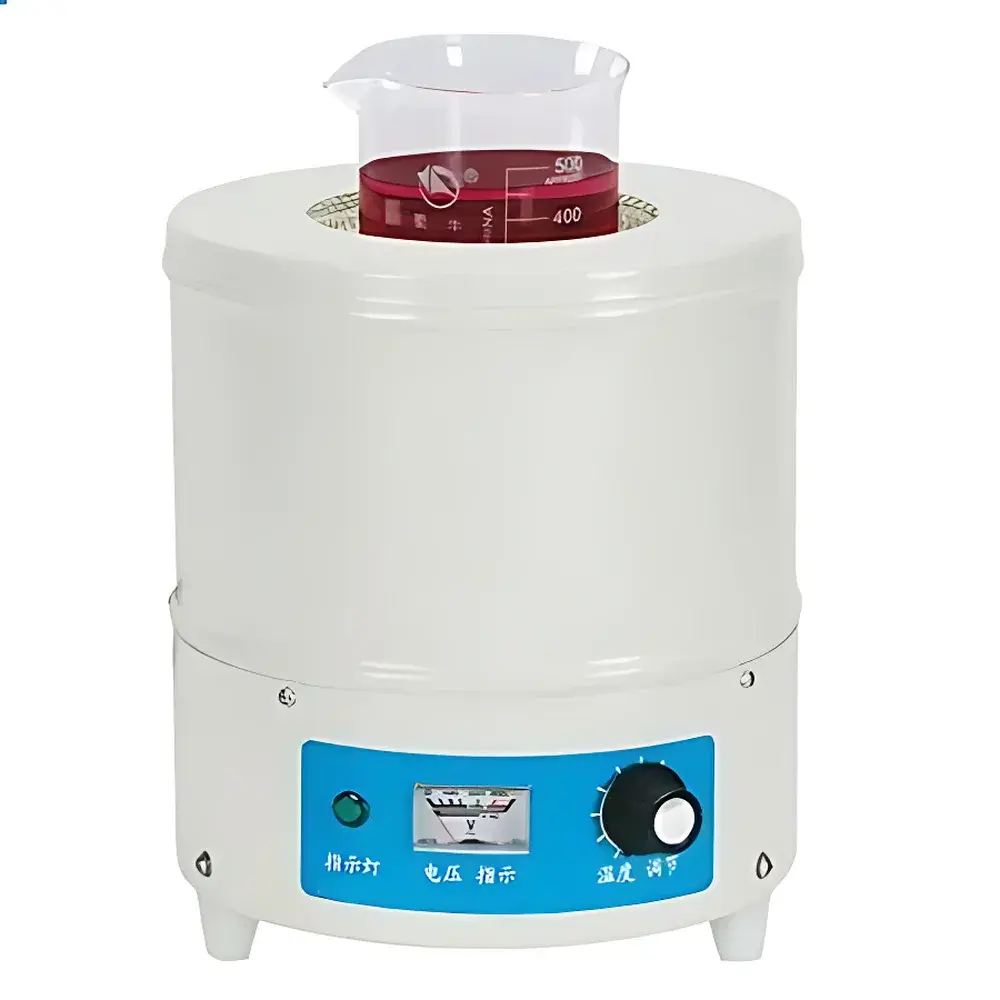
Digital Display Beaker-Specific Heating Mantle
| Brand | Zhongke Aobo |
|---|---|
| Origin | Beijing, China |
| Manufacturer Type | General Distributor |
| Product Origin | Domestic |
| Model | SJ |
| Price | USD 145 (approx.) |
| Heating Element Surface Temp | 380°C |
| Input Voltage | 220 V ±10%, 50 Hz |
| Enclosure | Cold-Rolled Steel with Electrostatic Powder Coating |
| Insulation | High-Temperature Alkali-Free Glass Fiber |
| Heating Element | Sealed Ni-Cr Resistance Wire |
| Control Options | Electronic Variable-Temp or Intelligent Digital PID Controller |
| Available Capacities | 100–5000 mL |
| Inner Chamber Dimensions (Ø × H, mm) | φ53×45 to φ180×180 |
| Power Rating | 100–1000 W |
Overview
The Zhongke Aobo SJ Series Digital Display Beaker-Specific Heating Mantle is an engineered solution for precise, safe, and repeatable conductive heating of laboratory glassware—primarily standard-form beakers—under controlled thermal conditions. Unlike open-heating plates or hotplates with exposed elements, this mantle employs a conformal semi-spherical geometry that wraps around the lower curvature of the beaker, ensuring optimal thermal coupling and minimizing radial temperature gradients across the vessel wall. The heating principle relies on resistive Joule heating of a sealed Ni-Cr alloy wire embedded within high-purity alkali-free glass fiber insulation—eliminating oxidation, moisture ingress, and electrical leakage risks common in conventional ceramic or coil-based mantles. Designed for continuous-duty operation at up to 380°C surface temperature (measured at the inner heating layer), the SJ series supports both analog electronic variable control and digital PID-regulated modes, enabling stable setpoint maintenance within ±3°C under typical ambient lab conditions (20–25°C, still air).
Key Features
- Conformal semi-spherical design optimized for standard ASTM E288 and ISO 6706 beaker profiles—ensuring >92% surface contact area coverage for improved heat transfer efficiency.
- Dual control architecture: selectable electronic dial-based variable output (for rapid ramp-up) or intelligent digital PID controller with real-time temperature display (0.1°C resolution) and programmable ramp/soak cycles.
- Robust mechanical construction: cold-rolled steel outer shell with electrostatic powder coating (RAL 7035 matte light gray) for corrosion resistance and long-term dimensional stability.
- Thermally inert insulation system: alkali-free glass fiber (ASTM C547 Class 1) rated to 650°C, fully encapsulating the resistance element to prevent delamination, arcing, or outgassing during prolonged use.
- No open flame, no radiant spillage, no direct electrical exposure—compliant with IEC 61010-1:2010 safety requirements for laboratory electrical equipment.
- Seven standardized capacity variants (100–5000 mL), each with geometrically matched inner cavity dimensions to minimize air gap conduction losses and maximize thermal uniformity.
Sample Compatibility & Compliance
The SJ heating mantle is validated for use with borosilicate 3.3 glass beakers (e.g., Pyrex®, Kimax®) and compatible with low-thermal-expansion quartz beakers up to 500°C service temperature. It is not intended for use with plastic, metal, or non-cylindrical vessels. All models meet CE marking requirements per Directive 2014/30/EU (EMC) and 2014/35/EU (LVD). Electrical safety testing follows IEC 61010-1 Annex BB (dielectric strength, creepage/clearance, protective earthing). For GLP/GMP environments, the digital PID variant supports audit-trail-capable data logging when integrated with optional RS-485/Modbus RTU interface modules (sold separately), facilitating compliance with FDA 21 CFR Part 11 electronic record requirements.
Software & Data Management
The intelligent PID controller (SJ-D series) features a backlit 4-digit LED display with dual-parameter readout (setpoint / actual temperature), intuitive push-button navigation, and non-volatile memory for up to 5 user-defined temperature programs. While standalone operation requires no software, optional PC connectivity via USB-to-RS485 adapter enables integration with LabVIEW™, MATLAB® Data Acquisition Toolbox, or custom SCADA systems using standard Modbus RTU protocol (function codes 03h/06h). Logged data (timestamped temp, power %, alarm status) exports to CSV for traceability in quality documentation systems.
Applications
- Controlled solvent evaporation and concentration in analytical sample preparation (EPA Method 1664, ASTM D5291).
- Pre-heating reagents prior to titration, distillation, or reflux setups in QC/QA laboratories.
- Temperature conditioning of viscosity standards (ISO 2555, ASTM D1084) before rheometer calibration.
- Sustained thermal activation in polymer synthesis, catalyst testing, and hydrolysis kinetics studies.
- Environmental labs: digestion of aqueous samples prior to ICP-MS or AAS analysis (EPA 3015A, 3050B).
- Academic teaching labs: safe demonstration of Arrhenius kinetics, phase transition behavior, and heat transfer principles.
FAQ
Is the SJ heating mantle compatible with magnetic stirrers?
Yes—models SJ-100 through SJ-1000 feature a central aperture (diameter ≥12 mm) allowing simultaneous insertion of standard PTFE-coated stirring bars and external stirrer motors.
What is the maximum recommended beaker wall thickness for optimal performance?
For best thermal response and uniformity, use beakers with wall thickness ≤1.5 mm (standard ASTM E288 Grade B). Thicker-walled or heavy-duty beakers may reduce ramp rate by up to 30% and increase steady-state gradient variance.
Can the mantle be used in fume hoods with continuous airflow?
Yes—its sealed construction and lack of convective cooling dependence make it suitable for hood-mounted applications; however, ambient airflow >0.5 m/s may require +5–10°C setpoint compensation to maintain target bulk liquid temperature.
Does the digital controller support external temperature probe input?
No—the built-in sensor measures mantle surface temperature only. For solution-phase temperature feedback, integrate a separate Pt100 probe into the beaker and use external PID controllers with cascade mode.
What maintenance is required for long-term reliability?
Annual visual inspection of insulation integrity and terminal tightness; no lubrication or recalibration needed. Avoid immersion, steam cleaning, or abrasive cleaners on the outer shell.



