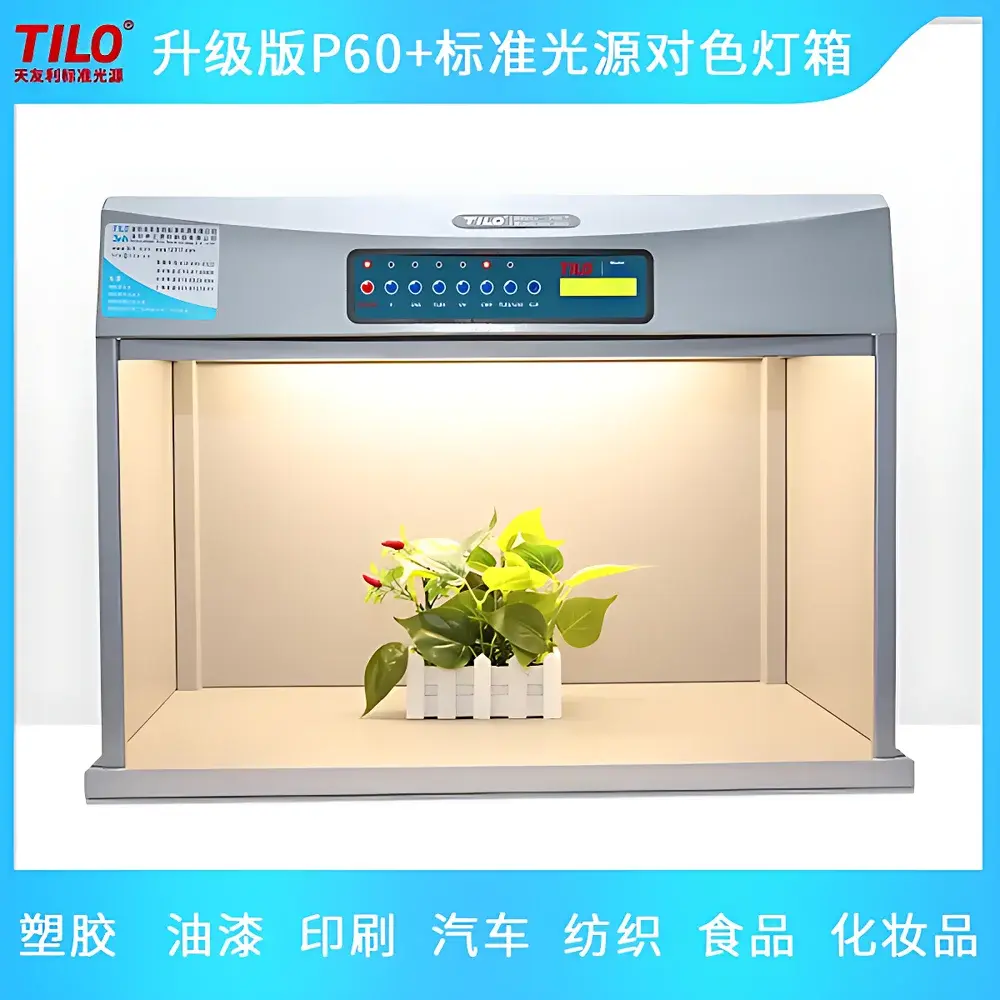
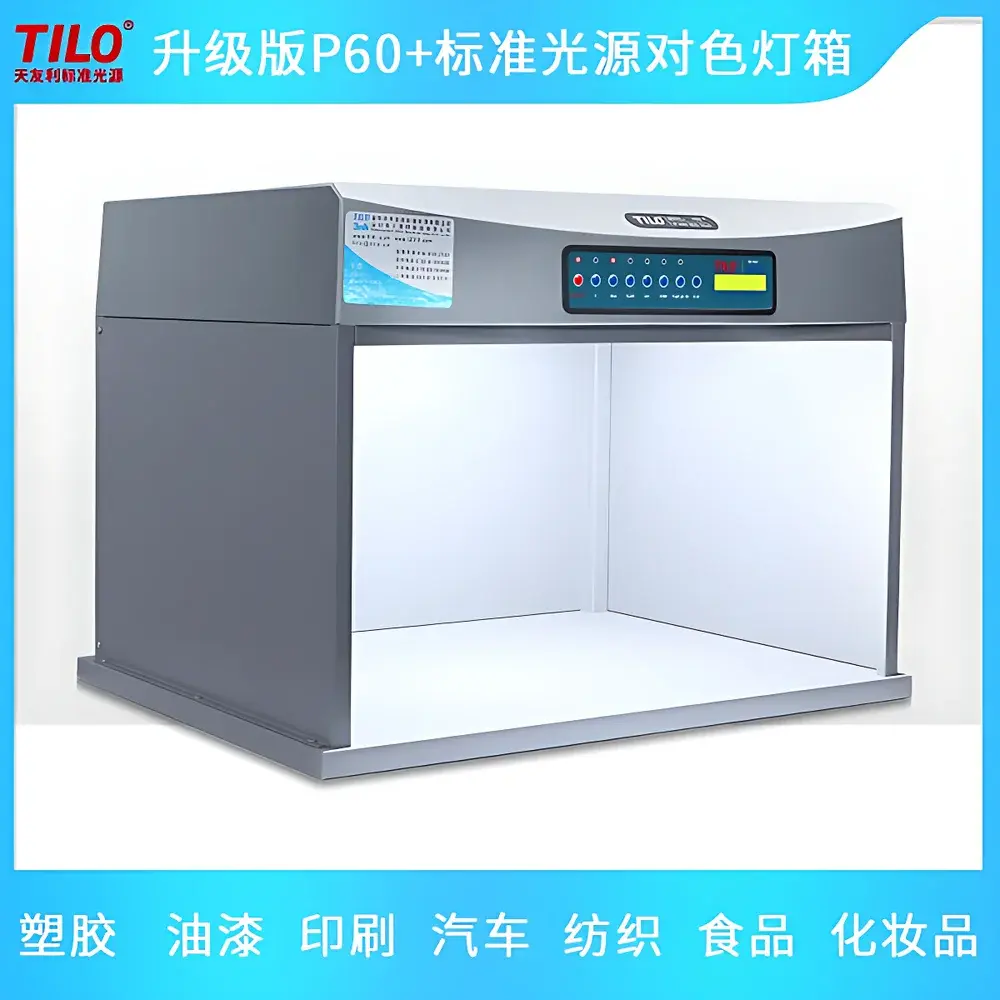
TILO P60+ Advanced 5-Source Standard Light Booth
| Brand | TILO |
|---|---|
| Origin | Guangdong, China |
| Model | P60+ |
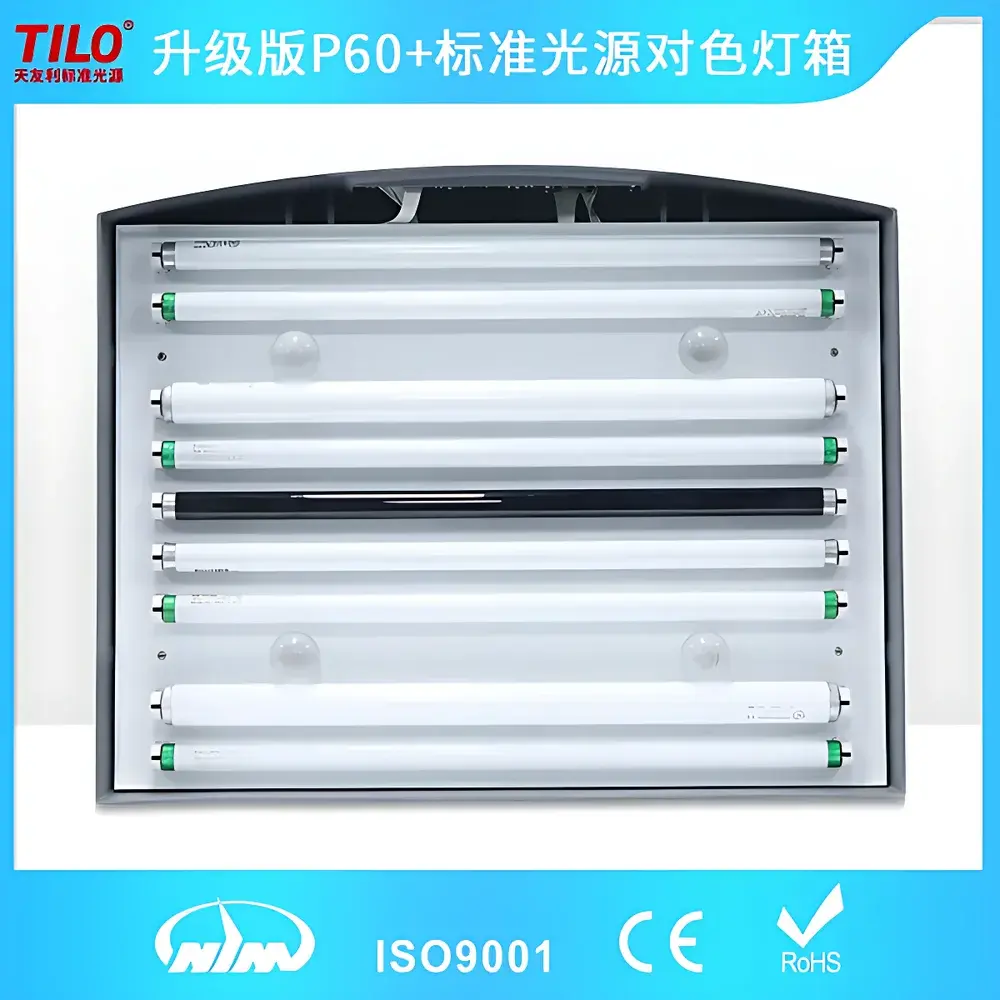
| Light Sources | D65, TL84, F/A, UV, CWF |
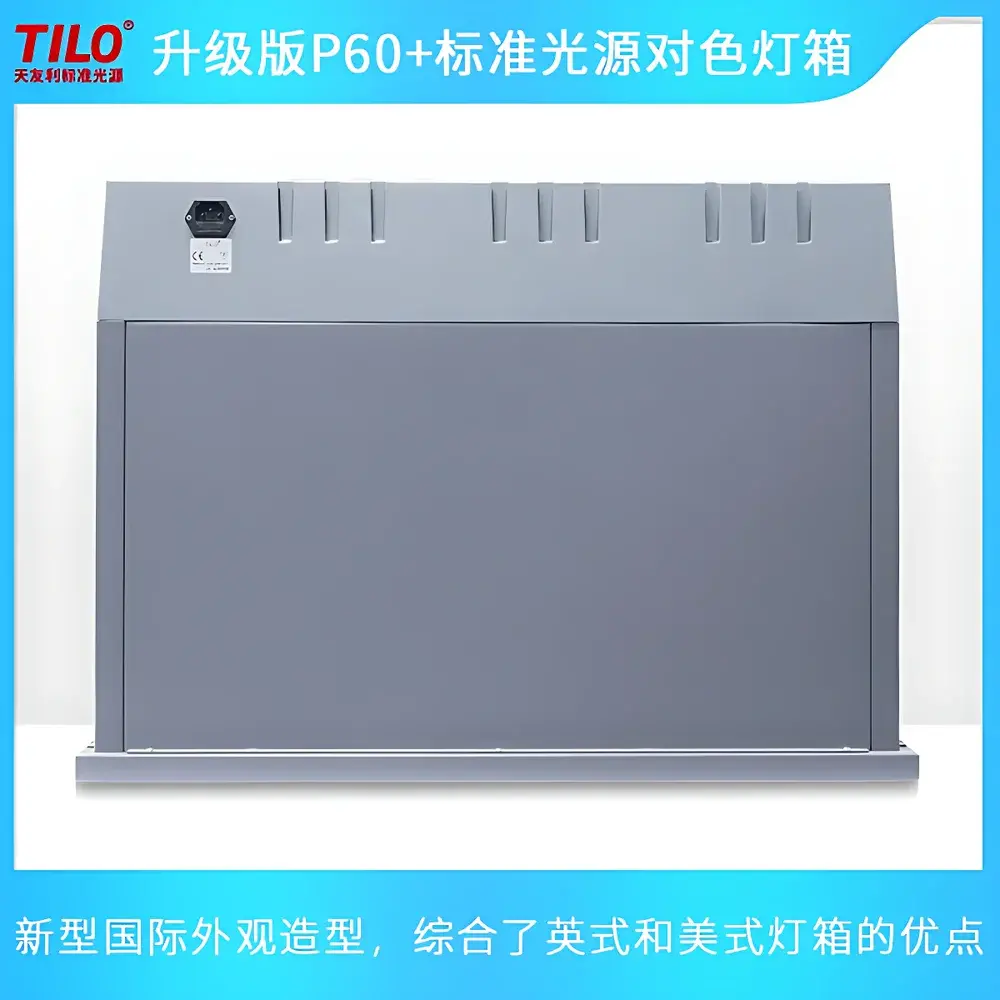
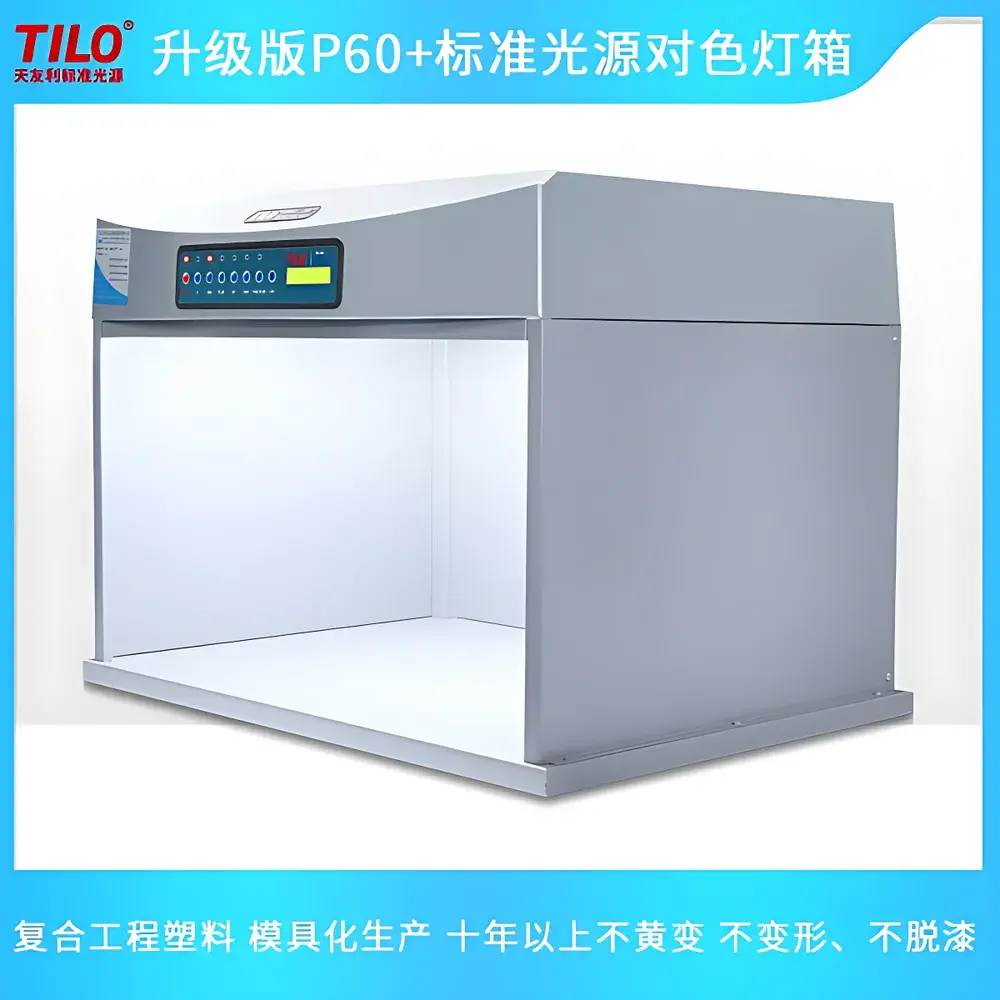
| Construction | Seamless molded engineering-grade ABS housing |
| Light Stability | Instant-on, flicker-free operation |
| UV Source | 365 nm peak wavelength |
| Compliance | Meets ISO 3664:2009, ASTM D1729, DIN 6173-2, and GB/T 3979–2008 requirements for color evaluation environments |
| Software Interface | None (standalone hardware) |
| Power Consumption | ≤120 W |
| Operating Temperature Range | 15–30 °C |
| Dimensions (W×D×H) | 600 × 400 × 500 mm |
| Weight | 18.5 kg |
Overview
The TILO P60+ Advanced 5-Source Standard Light Booth is an engineered color evaluation instrument designed for consistent, repeatable visual color assessment under controlled illumination conditions. It operates on the principle of standardized metamerism evaluation—enabling users to detect and quantify color matching discrepancies across spectrally distinct light sources. The booth integrates five precisely calibrated light sources: D65 (simulated daylight, 6500 K), TL84 (cool white fluorescent, used in retail lighting), F/A (warm white fluorescent, common in North American offices), CWF (cool white fluorescent, specified in ASTM standards), and a dedicated 365 nm ultraviolet source for fluorescence excitation. Its optical architecture eliminates inter-source leakage through a fully sealed, seamless enclosure, ensuring spectral purity during multi-light comparisons. Designed for laboratories, quality control departments, textile mills, paint manufacturers, and packaging facilities, the P60+ meets the foundational requirements of ISO 3664:2009 for graphic technology and photography, as well as ASTM D1729 for color matching in industrial applications.
Key Features
- Seamless molded ABS housing with UV-stabilized polymer formulation—guarantees no yellowing, warping, or paint delamination over 10+ years of continuous use.
- Integrated UV source (365 nm) enables detection of optical brightening agents (OBAs) in textiles, paper, plastics, and coatings—critical for compliance with ISO 105-J03 and AATCC Test Method 110.
- Flicker-free, instant-on electronic ballasts eliminate warm-up delays and photometric instability—ensuring immediate, reproducible assessments without luminance drift.
- Independent source activation with real-time usage logging: each lamp’s cumulative operating hours, switch cycles, and label name are displayed via integrated LED interface.
- Auto-switching function allows sequential or side-by-side illumination comparison, facilitating rapid metamerism analysis per ISO 11664-6 and CIE Technical Report 204-2013.
- Ergonomic design includes adjustable non-slip elastomeric feet—protects work surfaces and minimizes vibration-induced parallax errors during visual inspection.
- Full-spectrum diffuser panel ensures uniform illuminance (>750 lux at sample plane) and angular consistency per ISO/CIE viewing geometry specifications (2° standard observer, 0/45° illumination/viewing).
Sample Compatibility & Compliance
The P60+ accommodates flat, rigid, and semi-flexible samples up to 300 × 300 mm in dimension, with optional sample holders for standardized positioning. Its spectral output conforms to the relative spectral power distributions (SPDs) defined in ISO 3664:2009 Annex A for D65, TL84, and CWF; UV irradiance complies with ISO 105-B02 for fluorescent whitening agent assessment. The booth supports GLP-aligned workflows through manual logbook integration and is routinely validated using NIST-traceable photometers (e.g., Konica Minolta CS-2000A) for illuminance and chromaticity verification. While not FDA 21 CFR Part 11–certified (as it lacks digital audit trail functionality), its mechanical reliability and stable photometric performance make it suitable for GMP-adjacent environments where visual inspection forms part of release criteria per USP and ICH Q5E.
Software & Data Management
The TILO P60+ operates as a standalone hardware platform with no embedded software, network interface, or data export capability. All operational parameters—including source selection, usage tracking, and timer functions—are managed via tactile membrane switches and an integrated monochrome LCD display. This architecture prioritizes long-term reliability, electromagnetic compatibility (EMC Class B), and immunity to firmware obsolescence. For labs requiring digital integration, third-party spectrophotometers (e.g., X-Rite Ci7800, Konica Minolta CM-3700A) may be synchronized externally using standardized trigger signals to correlate instrumental measurements with visual assessments conducted inside the booth.
Applications
- Textile and apparel QC: Verification of dye lot consistency under retail (TL84) and daylight (D65) conditions; OBA detection in bleached cotton and synthetics.
- Packaging prepress and print proofing: Validation of CMYK and spot color matches across viewing environments per ISO 12647-2.
- Automotive interior trim evaluation: Assessment of plastic and leather components for metamerism between showroom (F/A) and outdoor (D65) lighting.
- Paint and coating formulation: Identification of pigment interactions that manifest only under UV exposure—critical for architectural and OEM finishes.
- Plastics and consumer electronics: Color uniformity checks across injection-molded housings under multiple illuminants to prevent field complaints.
- Academic research in color science: Controlled stimulus presentation for psychophysical experiments on color constancy and observer variability.
FAQ
Does the P60+ support custom light source profiles beyond the five factory-installed options?
No—the P60+ does not permit spectral reconfiguration or user-defined SPD loading. Its light sources are fixed-wavelength, pre-calibrated modules compliant with international standard definitions.
Is calibration documentation provided with the unit?
Each unit ships with a factory conformance report listing measured CCT, CRI (Ra ≥92 for D65 and TL84), and UV irradiance values at time of shipment. Full recalibration services are available through TILO-authorized service centers.
Can the UV source be used independently without activating other lamps?
Yes—the UV channel operates independently and may be engaged alone or simultaneously with any combination of visible sources for fluorescence superposition analysis.
What is the expected service life of the lamp modules?
D65, TL84, F/A, and CWF lamps are rated for 3,000 hours at nominal voltage; UV lamps are rated for 1,500 hours. Replacement modules are identified by TILO part numbers and require no alignment tools.
Is the P60+ suitable for ISO/IEC 17025-accredited laboratories?
Yes—when operated within documented environmental controls (temperature, humidity, ambient light suppression) and maintained per TILO’s scheduled verification protocol, it satisfies Clause 6.4.6 (Equipment) and Clause 7.7 (Sampling and handling) of ISO/IEC 17025:2017.