
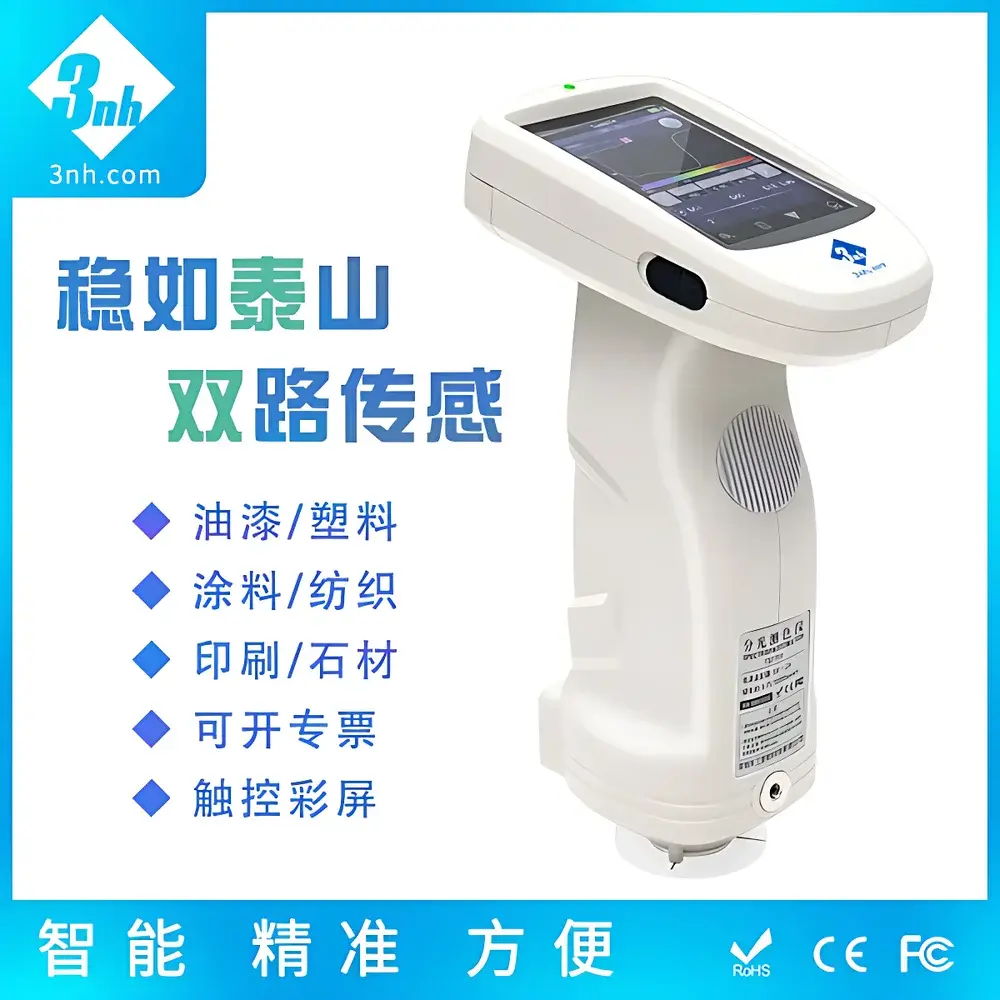
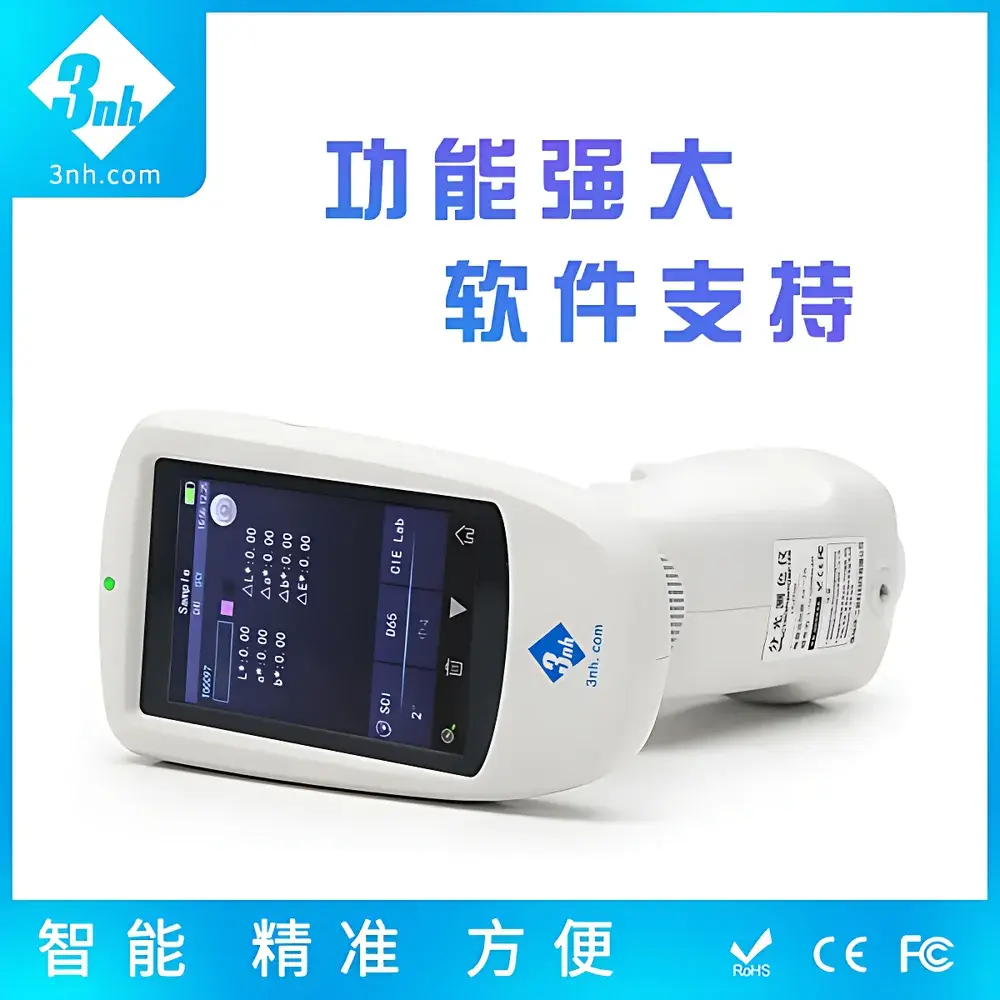
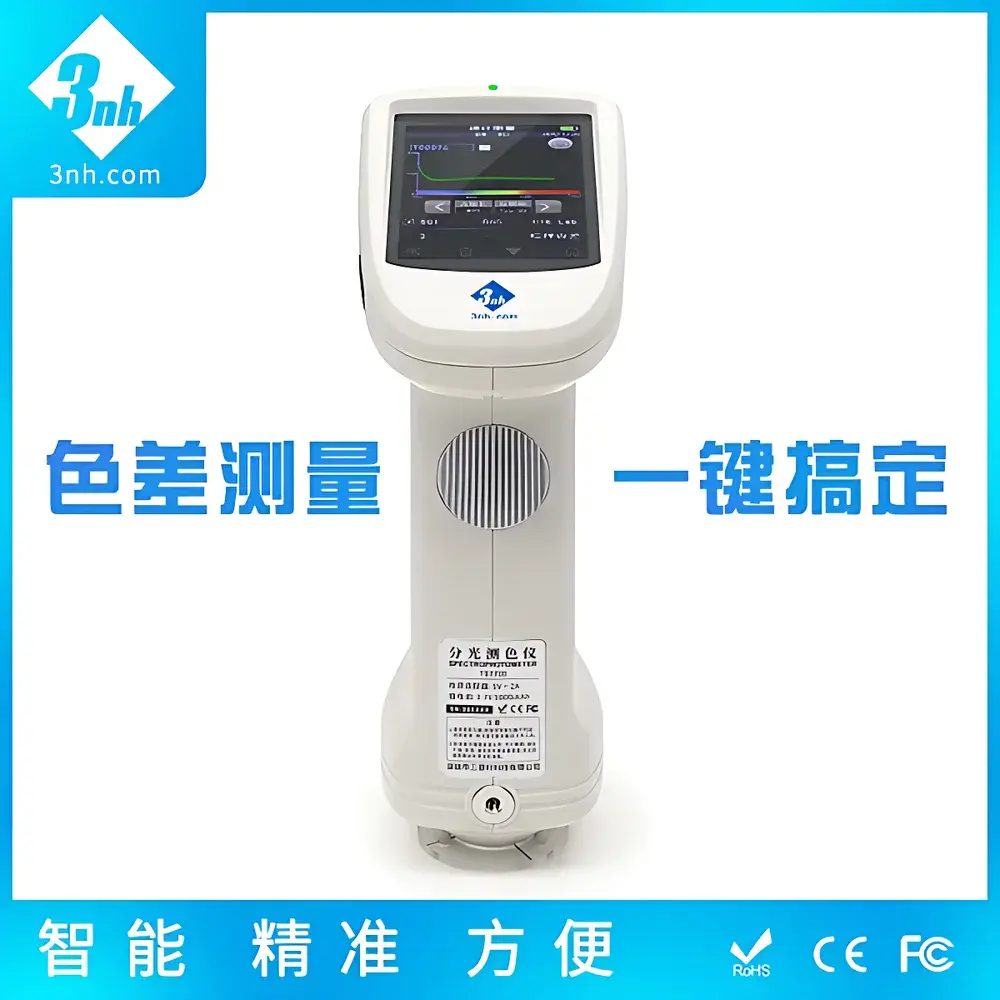
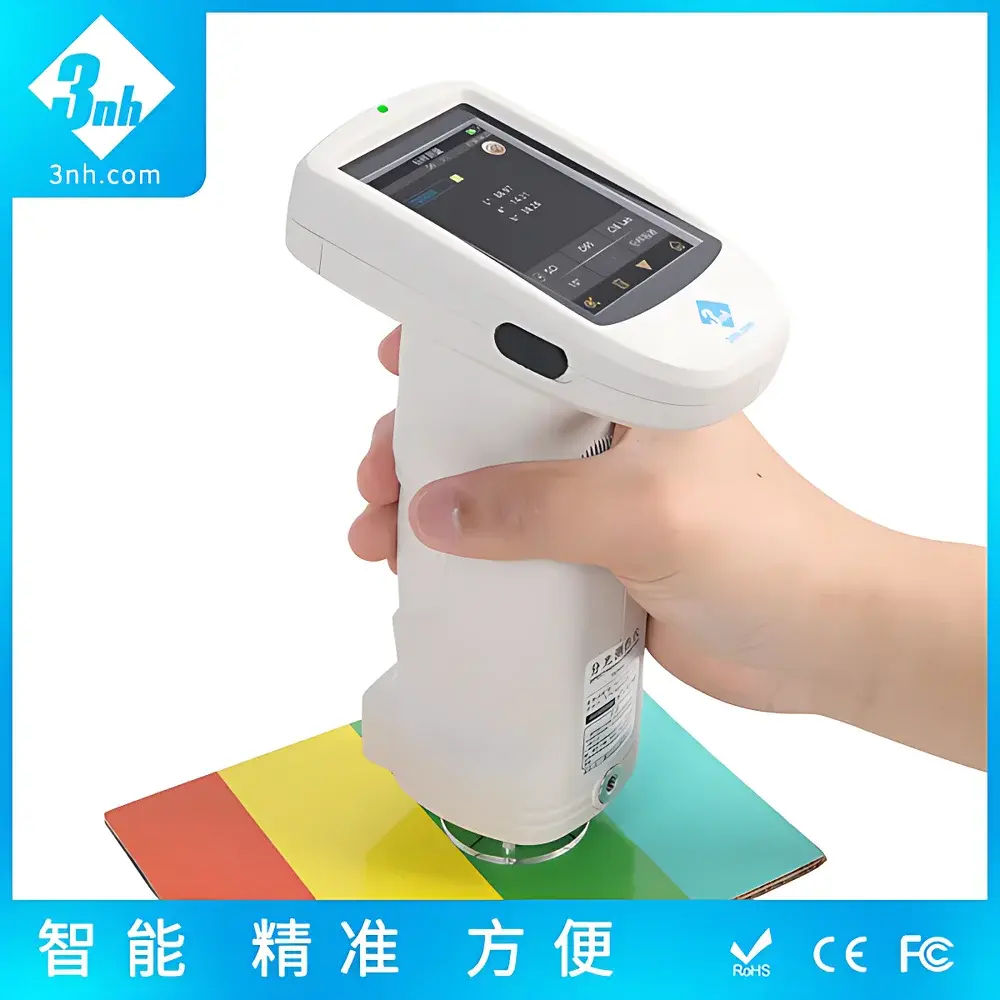
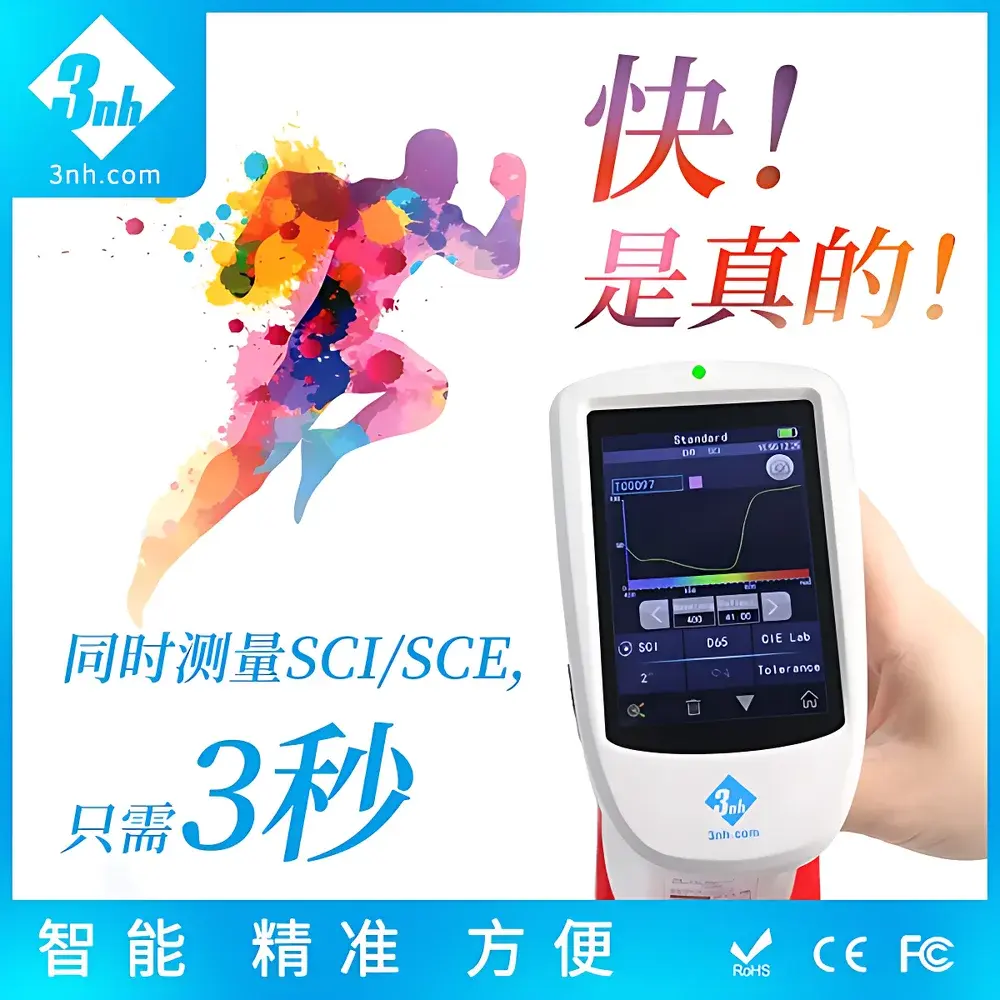
3nh TS7700 Flagship Portable Spectrophotometer
| Brand | 3nh |
|---|---|
| Origin | Guangdong, China |
| Manufacturer Type | Manufacturer |
| Product Origin | Domestic (China) |
| Model | TS7700 |
| Product Category | Spectrophotometer |
| Instrument Type | Portable |
| Optical Geometry | d/8° integrating sphere |
| Light Source | Full-spectrum LED |
| Spectral Range | 400–700 nm |
| Repeatability | ΔE*ab ≤ 0.03 (mean, after 20 measurements on white tile) |
Overview
The 3nh TS7700 is a high-precision portable spectrophotometer engineered for industrial color measurement and quality control in demanding production and laboratory environments. Based on CIE-compliant d/8° geometry with integrated sphere optics, the instrument employs a 1000-line precision blazed grating as its core dispersive element and a large-area silicon photodiode array detector to ensure high signal-to-noise ratio and spectral fidelity across the visible spectrum (400–700 nm). Its full-spectrum LED illumination source delivers stable, repeatable output with no warm-up delay and extended operational lifetime—critical for shift-based manufacturing and field deployment. The optical resolution is <10 nm across the visible range, enabling accurate discrimination of narrow spectral features and reliable quantification of both standard and fluorescent samples under SCI (Specular Component Included) and SCE (Specular Component Excluded) modes. Designed for traceable color data acquisition, the TS7700 supports dual-mode reflectance measurement and conforms to fundamental metrological requirements outlined in ISO 13655:2017 (Spectral Measurement and Colorimetric Computation) and ASTM E308-22 (Standard Practice for Computing the Colors of Objects by Using the CIE System).
Key Features
- Portable, battery-powered design with ergonomic handheld form factor for on-site, in-line, and lab-based measurements
- d/8° integrating sphere configuration compliant with ISO/CIE standards for diffuse reflectance measurement
- High-resolution spectral engine: 1000-line blazed grating + linear silicon photodiode array (256 pixels)
- Full-spectrum LED light source with calibrated spectral power distribution and >50,000-hour service life
- ΔE*ab repeatability ≤ 0.03 (mean over 20 readings on certified white tile per CIE 15:2018)
- SCI/SCE simultaneous measurement capability with motorized port shutter and UV calibration control
- Integrated 3.5-inch capacitive touchscreen with multilingual UI (English, Chinese, Spanish, French, German)
- Onboard memory for up to 20,000 measurements with timestamp, operator ID, and sample ID tagging
Sample Compatibility & Compliance
The TS7700 accommodates flat, curved, textured, and translucent samples ranging from 8 mm to ∞ in diameter (with optional aperture masks: Ø4 mm, Ø8 mm, Ø16 mm, and Ø25 mm). It supports measurement of non-fluorescent and optically brightened materials—including plastics, coatings, textiles, paper, ceramics, and food surfaces—under standardized illuminants (D65, A, F2, F7, F11) and observer angles (2° and 10°). All color calculations adhere to CIE 1976 L*a*b*, L*C*h°, XYZ, Yxy, and Hunter Lab spaces, with support for industry-specific indices (e.g., whiteness index ASTM E313, yellowness index ASTM D1925, metamerism index MI). The instrument meets CE marking requirements, RoHS Directive 2011/65/EU, and fulfills essential performance criteria referenced in ISO 9001 color management processes. Calibration traceability is maintained via NIST-traceable ceramic tiles and factory-certified verification protocols.
Software & Data Management
The TS7700 operates seamlessly with 3nh’s proprietary ColorExpert software (Windows/macOS), enabling advanced spectral analysis, tolerance setting (ellipsoidal or rectangular ΔE limits), batch reporting, and statistical process control (SPC) charting. The software supports audit trail functionality compliant with FDA 21 CFR Part 11 requirements—including electronic signatures, user access levels, and immutable log records for GLP/GMP-regulated environments. Export formats include CSV, Excel, PDF, and XML; spectral data can be imported into third-party platforms such as MATLAB, JMP, and Minitab for multivariate modeling. Firmware updates are delivered via USB or Wi-Fi, and remote diagnostics are supported through secure cloud-assisted maintenance channels.
Applications
The TS7700 serves as a primary color verification tool across regulated and high-volume manufacturing sectors. In automotive OEM supply chains, it validates paint film consistency across body panels and interior trims. Within pharmaceutical packaging QA, it verifies label color fidelity against Pantone references and monitors batch-to-batch ink stability. In textile dye houses, it supports shade matching under multiple illuminants to assess metamerism risk. Electronics manufacturers use it to quantify anodized aluminum hue shifts and OLED display filter uniformity. Food processors apply it to monitor natural pigment degradation in dried fruits and dairy powders. Research institutions deploy it for pigment dispersion studies, spectral library development, and cross-platform inter-instrument correlation validation per ASTM D2244.
FAQ
What is the calibration interval recommendation for the TS7700?
Annual recalibration using certified reference tiles is recommended; however, daily zero and white calibration checks are required before measurement sessions per ISO 13655.
Does the TS7700 support measurement of transparent or liquid samples?
Yes—with optional transmission attachment (TS7700-TA) and cuvette holder, enabling absorbance and transmittance analysis in accordance with ISO 11664-7.
Can the TS7700 be integrated into automated production lines?
It supports RS-232, USB-C, and Bluetooth 5.0 interfaces for PLC-triggered measurement and real-time data streaming to MES/SCADA systems.
Is spectral data export available in raw format?
Yes—CSV files include wavelength (nm) and reflectance (%) at 10-nm intervals from 400–700 nm, with metadata headers for instrument ID, date/time, and measurement mode.
How does the TS7700 handle fluorescent samples?
It includes UV-adjustable LED excitation and built-in fluorescence correction algorithms aligned with CIE 15:2018 Annex D for quantitative fluorescing material assessment.




