
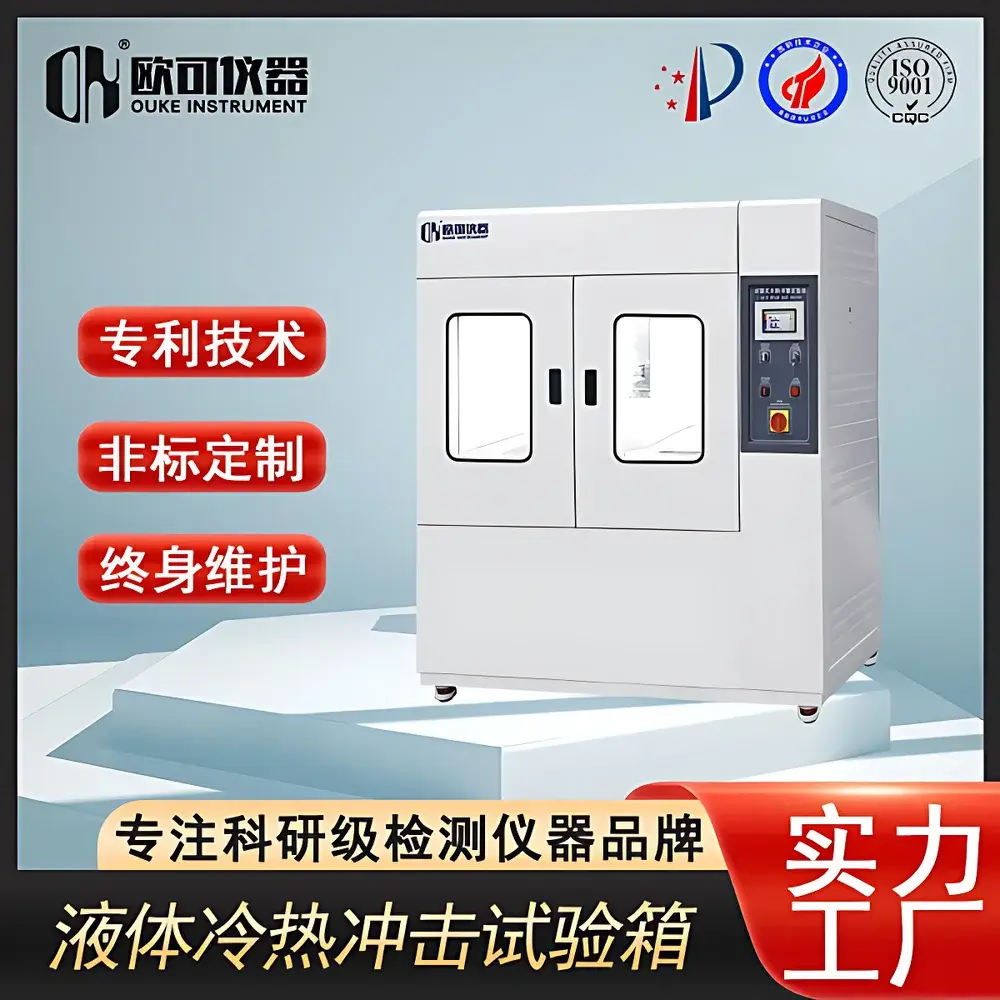
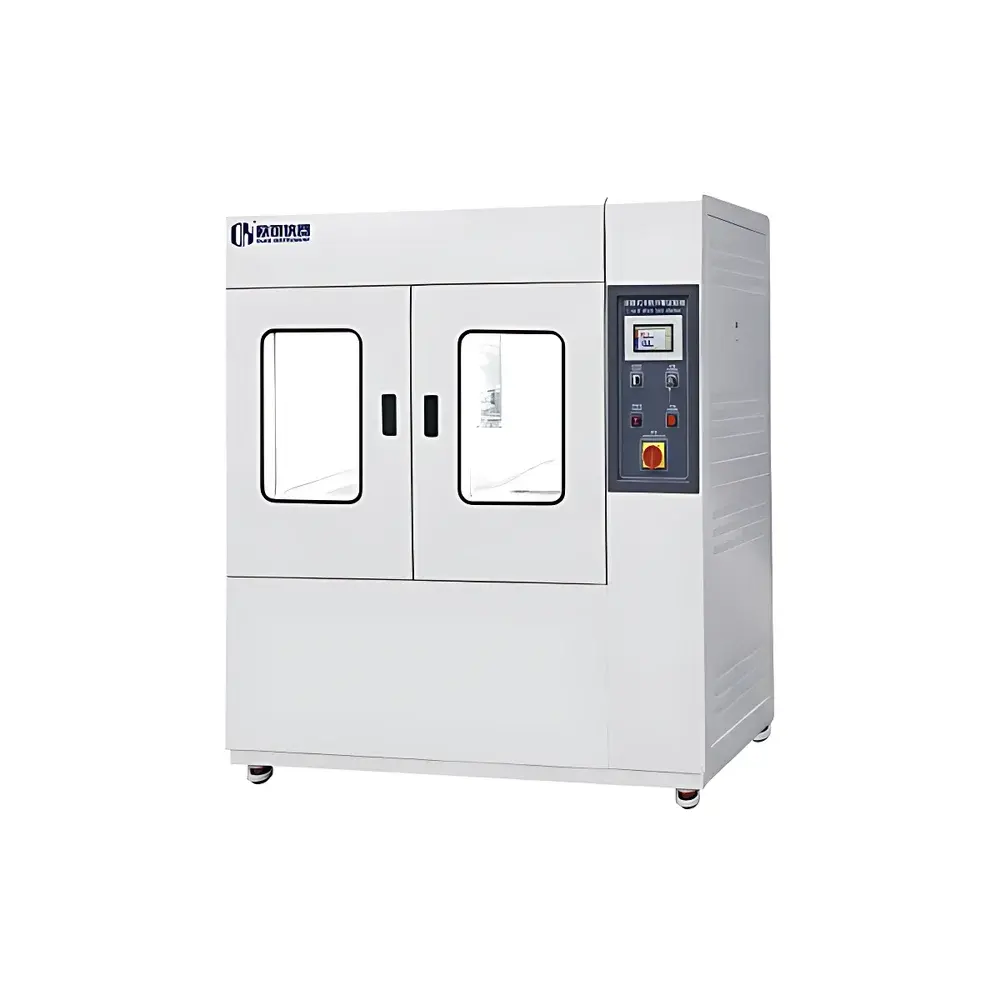
OK-YT-015 Liquid-Medium Thermal Shock Test Chamber
| Brand | OK Instruments |
|---|---|
| Origin | Guangdong, China |
| Manufacturer Type | Direct Manufacturer |
| Model | OK-YT-015 |
| High-Temperature Range | +150 °C |
| Low-Temperature Range | −45 °C |
| Thermal Shock Range | −45 °C to +150 °C |
| Temperature Stability | ±2 °C |
| Heating Rate | ≥30 °C/min (liquid immersion) |
| Cooling Rate | ≥30 °C/min (liquid immersion) |
| Transfer Time | <10 s |
Overview
The OK-YT-015 Liquid-Medium Thermal Shock Test Chamber is an engineered environmental reliability system designed for accelerated thermal stress evaluation using direct liquid immersion. Unlike gas-based (three-chamber) thermal shock systems, this two-bath configuration employs high-thermal-conductivity media—silicone oil in the hot bath and anhydrous ethanol or low-temperature synthetic fluid in the cold bath—to achieve rapid, reproducible temperature transitions. The chamber operates on the principle of forced convective heat transfer via full-sample submersion, enabling thermal ramp rates exceeding 30 °C/min—significantly higher than air-based alternatives. This physical mechanism subjects test specimens to intense, transient thermal gradients that closely replicate real-world operational extremes, such as aerospace avionics transitioning from desert ground temperatures to stratospheric ambient conditions, or automotive ECUs undergoing repeated hot-soak/cold-start cycles. Its architecture complies with fundamental thermodynamic requirements for controlled thermal shock exposure defined in IEC 60068-2-14 (Test N), MIL-STD-810G/H Method 503 (Temperature Shock) and 510 (Vibration/Thermal Combined), and GJB 150.5A.
Key Features
- Two independent, thermostatically controlled liquid baths: hot bath (up to +150 °C, silicone oil medium) and cold bath (down to −45 °C, low-viscosity ethanol-based fluid)
- High-speed pneumatic lift-and-transfer mechanism with ≤10-second basket transition time between baths
- Submersible sample basket constructed from corrosion-resistant 316 stainless steel with optional custom fixtures
- Dual PID-controlled heating/cooling circuits ensuring ±2 °C temperature stability during dwell phases
- Integrated safety interlocks: liquid-level monitoring, over-temperature cutoff, emergency basket elevation, and vapor detection for flammable media
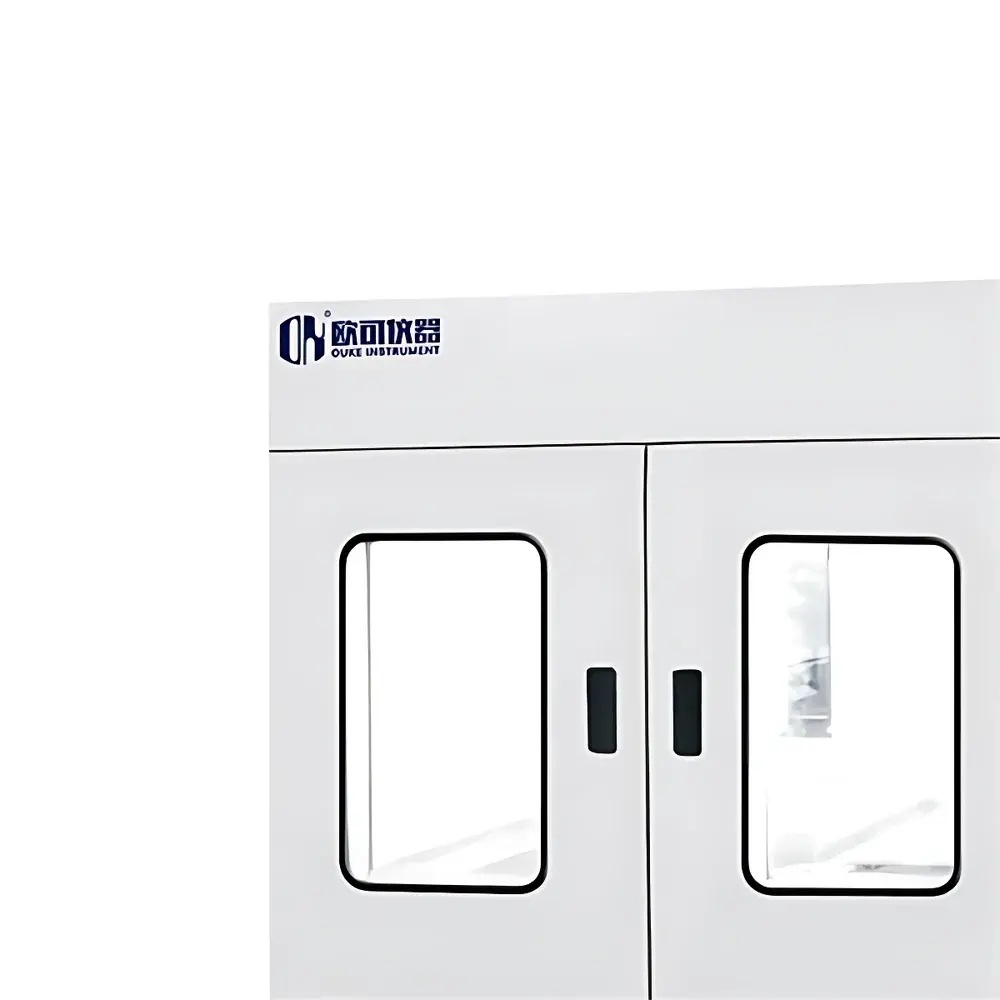
- Front-access viewing window with anti-fog coating and internal LED illumination for real-time process observation
Sample Compatibility & Compliance
This system is intended for specimens compatible with short-term immersion in non-aqueous, non-oxidizing thermal media. Samples must be either hermetically sealed, conformally coated, or housed in inert, pressure-balanced test enclosures to prevent fluid ingress or chemical interaction. It is widely deployed in qualification testing of aerospace-grade PCBAs, BGA-packaged ICs, MEMS sensors, and battery management modules under MIL-STD-810H, JESD22-A104 (Temperature Cycling), and EIA-364-32 protocols. All operational parameters—including dwell times, transition durations, and cycle counts—are programmable and auditable per GLP/GMP and FDA 21 CFR Part 11 requirements when paired with compliant data acquisition software. Calibration traceability follows ISO/IEC 17025 guidelines, with annual verification against NIST-traceable reference thermometers immersed at standardized probe locations in both baths.
Software & Data Management
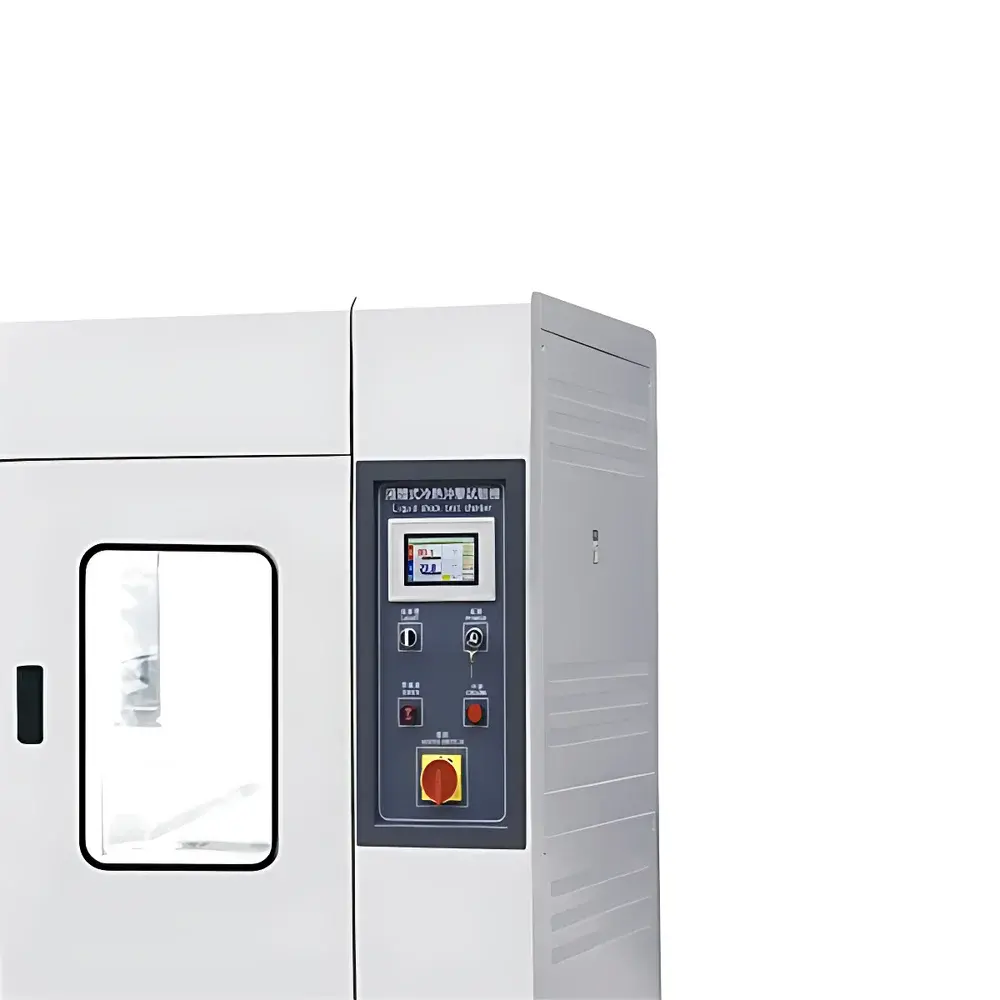
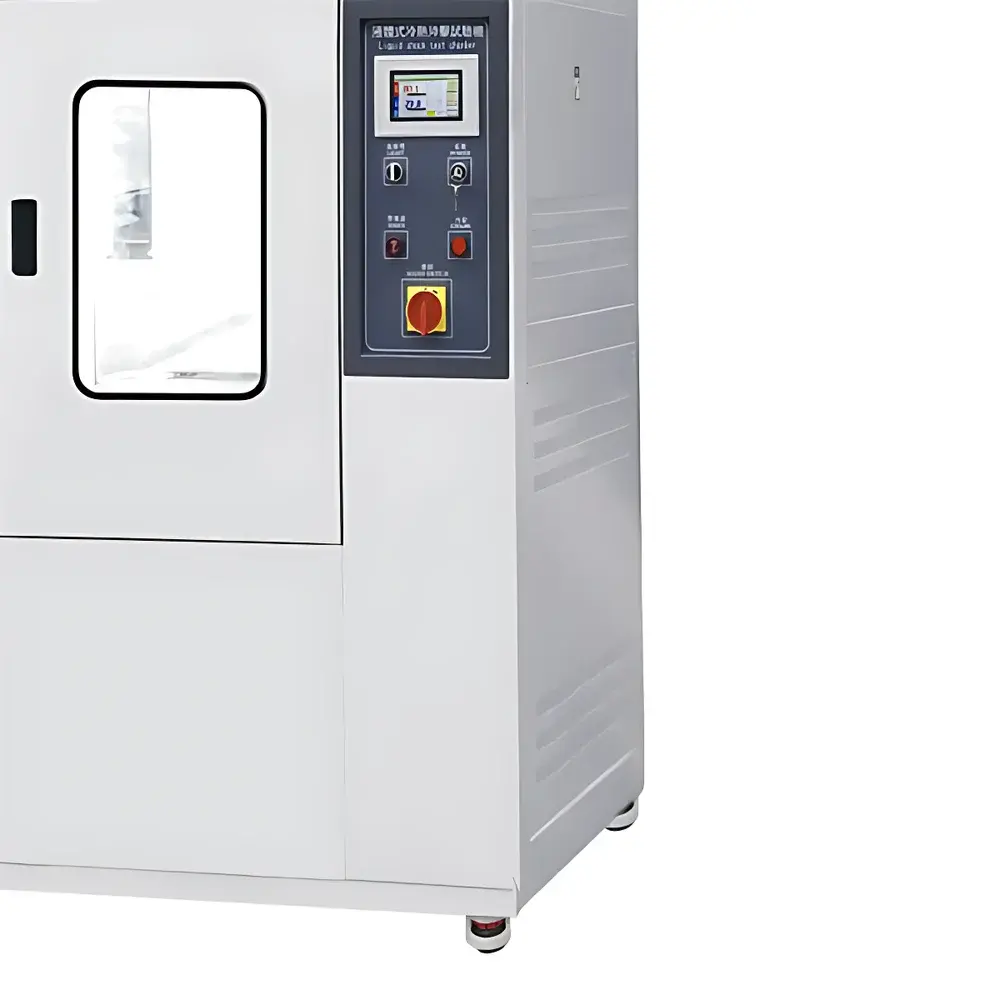
- Embedded touchscreen HMI with intuitive cycle programming interface supporting up to 99 user-defined profiles
- Real-time logging of bath temperatures, basket position status, and elapsed cycle count with timestamped CSV export
- Optional Ethernet-enabled data server module for remote monitoring, alarm notification (SMTP/SNMP), and integration into centralized LIMS or MES platforms
- Compliance-ready audit trail: records all parameter changes, operator logins, and system events with immutable timestamps
- Exportable reports include thermal profile graphs (°C vs. time), statistical summaries (min/max/mean deviation per dwell), and pass/fail compliance flags aligned with selected test standards
Applications
The OK-YT-015 serves critical roles in failure mode analysis, design validation, and production lot screening across regulated industries. In aerospace, it accelerates fatigue assessment of satellite thermal control materials and flight-critical connectors exposed to orbital thermal cycling. Automotive suppliers use it to verify solder joint integrity in ADAS radar modules and traction inverter gate drivers under JASO D001 and ISO 16750-4. Electronics manufacturers apply it for early-life defect screening of ceramic capacitors, RF filters, and optoelectronic transceivers per JEDEC J-STD-020 and IPC-9701. Research institutions employ it to quantify microstructural evolution in aluminum-lithium alloys and carbon-fiber composites subjected to repeated thermal strain. Its high-fidelity thermal transients make it particularly valuable for identifying latent interfacial delamination, coefficient-of-thermal-expansion (CTE) mismatch failures, and time-dependent dielectric degradation not observable in slower air-based tests.
FAQ
Is the OK-YT-015 suitable for testing lithium-ion battery packs?
Yes—provided cells or modules are fully encapsulated in non-reactive, pressure-equalized housings certified for immersion in silicone oil and ethanol. Optional integrated gas venting and flame arrestor kits are available for UN 38.3-compliant battery thermal shock evaluation.
What maintenance is required for the liquid media?
Silicone oil requires periodic filtration (every 500 hours) and replacement every 2,000–3,000 operating hours; ethanol-based coolant must be replenished after each 100–150 cycles due to volatility and moisture absorption. Both fluids require annual spectroscopic analysis to confirm thermal stability and oxidation resistance.
Can the system be validated per IQ/OQ protocols?
Yes. Factory-installed validation packages include Installation Qualification (IQ) documentation, Operational Qualification (OQ) test scripts with acceptance criteria, and a certified temperature mapping report (±0.5 °C uniformity across active bath volume).
Does the chamber support automated data export to LabVIEW or Python?
Yes. RS-232, Modbus TCP, and OPC UA communication interfaces are standard. SDKs and example scripts for LabVIEW 2020+ and Python 3.8+ are provided for custom integration.
How does its thermal performance compare to three-chamber air-based systems?
It achieves >2× faster ramp rates (≥30 °C/min vs. typical 10–25 °C/min), eliminates thermal lag associated with air convection, and delivers superior repeatability (±0.3 °C cycle-to-cycle) due to direct conductive coupling—critical for detecting marginal thermal fatigue limits.



