
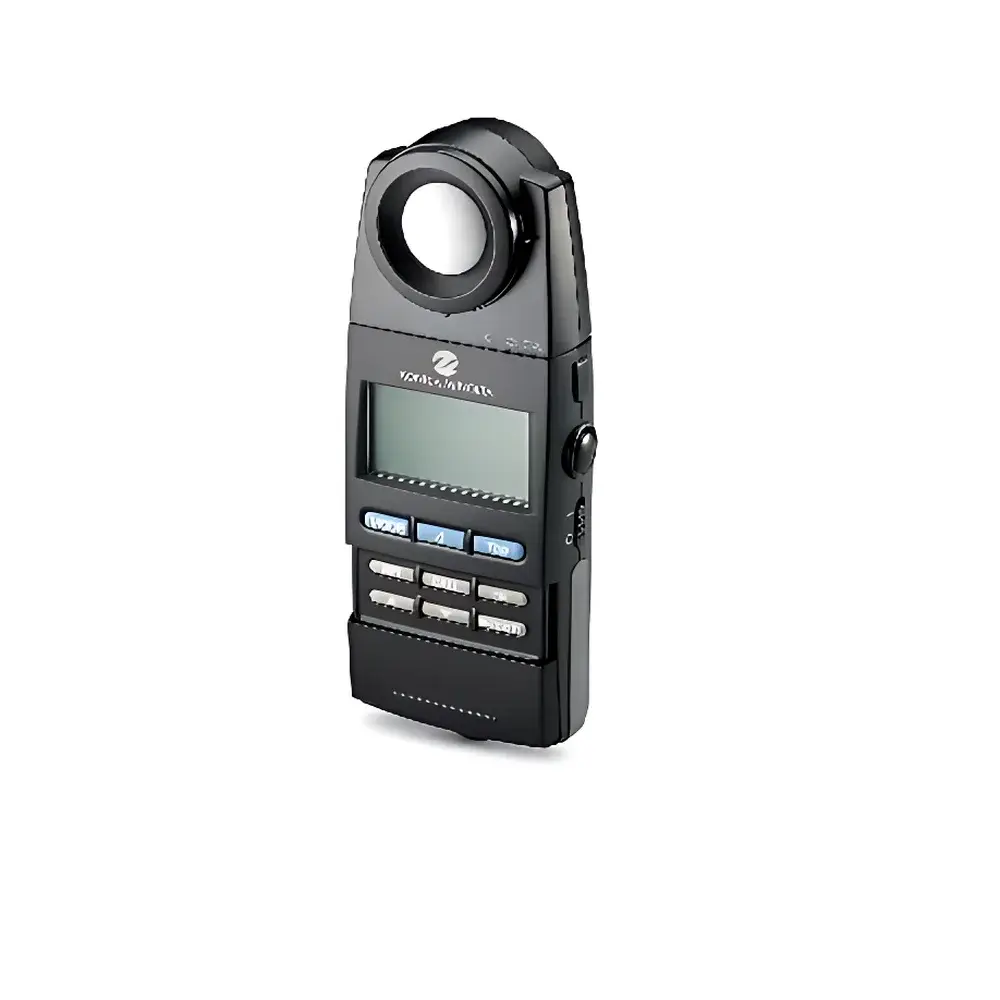
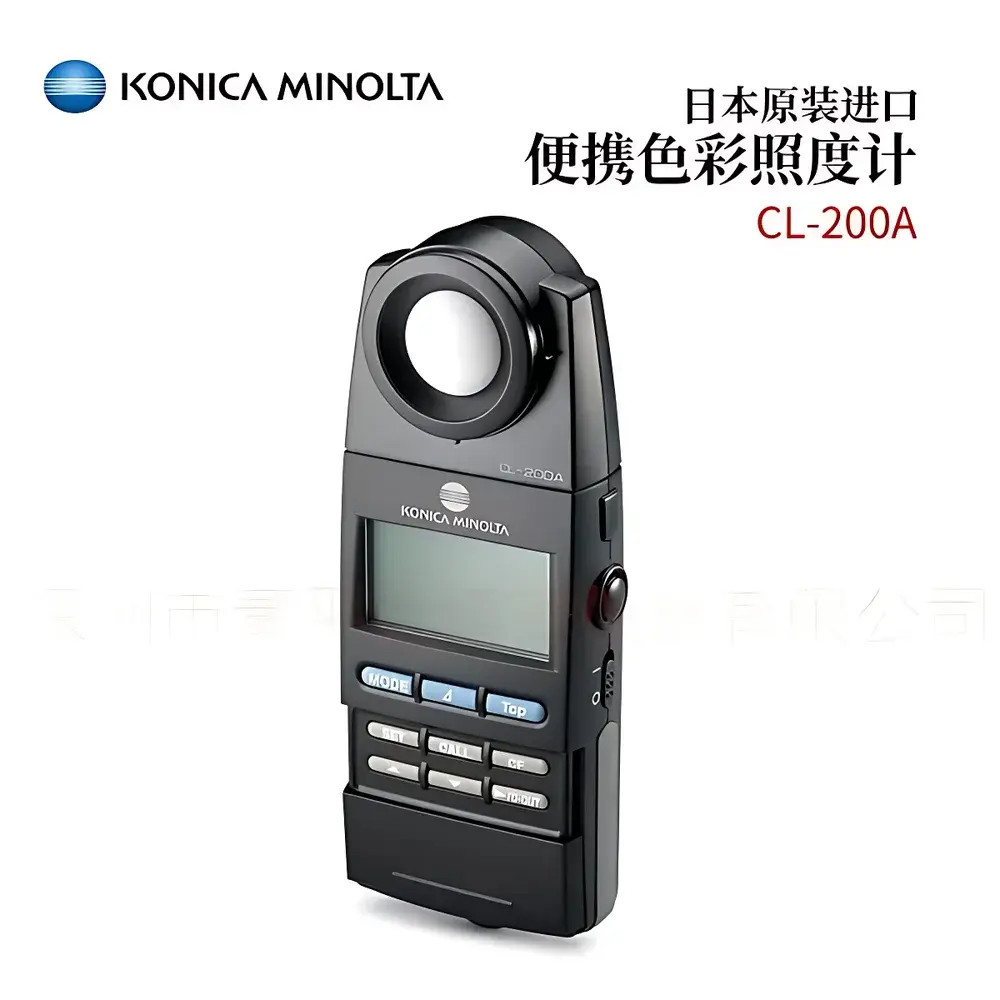
Konica Minolta CL-200A Chroma Meter and Illuminance Meter
| Brand | Konica Minolta |
|---|---|
| Origin | Japan |
| Model | CL-200A |
| Luminance Accuracy Class | JIS C 1609-1:2006 AA Grade |
| Illuminance Spectral Match Error (f₁') | <6% |
| Cosine Correction Error (f₂) | <3% |
| Illuminance Range | 0.1–99,990 lx |
| Luminance Range | 0.01–9,999 fcd |
| Chromaticity Accuracy (xy) | ±0.002 at 800 lx (Standard Illuminant A) |
| Repeatability (xy) | ±0.0005 (2σ) |
| Response Time | 0.5 s (continuous measurement) |
| Operating Temp. | −10–40°C, RH ≤85% (non-condensing) |
| Battery Life | >72 h (alkaline, continuous use) |
| Dimensions | 69 × 174 × 35 mm |
| Weight | 215 g (without batteries) |
Overview
The Konica Minolta CL-200A is a handheld chroma meter and illuminance meter engineered for high-fidelity photometric and colorimetric evaluation in laboratory, production, and field environments. It operates on the fundamental principles of CIE 1931 standard observer spectral sensitivity and tristimulus colorimetry, with its silicon photodiode sensor precisely filtered to match the CIE photopic luminosity function (V(λ)) and color-matching functions (x̄(λ), ȳ(λ), z̄(λ)). The instrument meets JIS C 1609-1:2006 AA-grade accuracy requirements for luminance measurement—among the highest classification available for portable optical instruments—and achieves spectral mismatch error (f₁′) below 6% and cosine correction error (f₂) under 3%, ensuring traceable, reproducible data across diverse lighting geometries and source types (including LEDs, fluorescent, incandescent, and OLEDs). Designed for compliance-critical workflows, the CL-200A delivers calibrated XYZ tristimulus values, CIE 1931 xy and CIE 1976 u′v′ chromaticity coordinates, correlated color temperature (Tcp), Duv, dominant wavelength, excitation purity, and ΔE*ab/ΔE*uv color difference metrics relative to user-defined standards.
Key Features
- AA-grade luminance accuracy per JIS C 1609-1:2006, validated against national metrology institute traceable standards
- CIE-compliant spectral response with f₁′ < 6% and f₂ < 3%, enabling reliable measurements under non-ideal angular or spectral conditions
- Four auto-ranging illuminance scales (0.1–99,990 lx) and luminance scales (0.01–9,999 fcd), eliminating manual range selection errors
- Real-time chromaticity calculation including Evxy, Evu′v′, Tcp (JIS method), and spectral purity—fully compatible with CL-S10w software for extended analysis
- On-device user calibration capability using reference light sources, supporting lab-specific traceability protocols
- Multi-point measurement mode (2–30 points) with statistical summary (min/max/avg/SD), ideal for uniformity mapping of displays, architectural lighting, and backlight panels
- USB interface compliant with USB 2.0 full-speed protocol; no external drivers required on supported Windows platforms
- Backlit LCD with 4-digit resolution, optimized for low-light and high-glare environments
Sample Compatibility & Compliance
The CL-200A is suitable for measuring planar, diffuse, and moderately directional light sources—including LED modules, OLED panels, automotive interior lighting, retail display illumination, and general ambient lighting installations. Its compact probe geometry (69 × 174 × 35 mm) and lightweight design (215 g) enable ergonomic operation during extended field surveys or benchtop QA/QC inspections. The device conforms to ISO/IEC 17025-relevant measurement uncertainty frameworks when used with documented calibration procedures and environmental controls. While not inherently 21 CFR Part 11 compliant as a standalone hardware unit, its integration with CL-S10w software—when deployed on validated Windows systems—supports audit-trail generation, electronic signatures, and secure data archiving aligned with GLP and GMP documentation expectations. All specifications are verified under controlled temperature (23 ± 2°C) and humidity (50 ± 10% RH) per JIS Z 8015.
Software & Data Management
The CL-S10w data management software provides comprehensive post-acquisition analysis, reporting, and database integration. Built as a native Windows application with embedded Microsoft Excel® functionality, it supports direct import of CL-200A measurement logs, automated calculation of spatial uniformity indices (e.g., max deviation, % uniformity), batch ΔE comparison against master references, and customizable report templates (PDF, XLSX). CL-S10w enforces structured metadata capture—including operator ID, location tag, timestamp, instrument serial number, and calibration certificate ID—to support ISO 9001 and IATF 16949 quality record retention. Software validation packages—including IQ/OQ documentation—are available upon request for regulated manufacturing environments. CL-S10w is compatible with Windows 7 through Windows 10 (32-/64-bit) and Excel 2007–2016, with multilingual UI support (English, Japanese, Simplified/Traditional Chinese).
Applications
- LED product development: CCT binning, chromaticity shift monitoring over thermal cycling, and MacAdam ellipse verification
- Display manufacturing: Backlight uniformity assessment, white point tuning, and gamut validation for LCD, microLED, and QD-OLED panels
- Architectural lighting design: In-situ illuminance mapping, daylight harvesting system commissioning, and circadian lighting verification
- Automotive lighting QA: Headlamp beam pattern analysis, interior ambient light consistency, and regulatory compliance testing per ECE R128 or SAE J1383
- Photobiology & horticulture: PAR-weighted irradiance estimation (via user-defined weighting curves), and spectral quality indexing for growth chamber validation
- Regulatory testing labs: Supporting EN 12464-1, IES RP-27, and JIS Z 9112 compliance documentation for workplace lighting assessments
FAQ
Does the CL-200A support NIST-traceable calibration?
Yes—Konica Minolta offers factory calibration services with NIST-traceable certificates (ISO/IEC 17025 accredited), including uncertainty budgets per ANSI/NCSL Z540-1.
Can the CL-200A measure pulsed or modulated light sources?
It is optimized for steady-state measurements; for PWM-driven LEDs or flickering sources, use the optional CL-500A or spectroradiometer-based solutions.
Is CL-S10w validated for use in FDA-regulated environments?
CL-S10w itself is not pre-validated, but Konica Minolta provides validation support documentation (URS, FRS, test scripts) for customer-led 21 CFR Part 11 implementation.
What is the recommended recalibration interval?
Annual recalibration is recommended under normal use; more frequent calibration is advised in high-use or thermally unstable environments.
Can multiple CL-200A units be synchronized for array-based measurements?
No native synchronization; however, time-stamped data from multiple units can be co-registered in CL-S10w using external GPS or network time protocol (NTP) references.




