
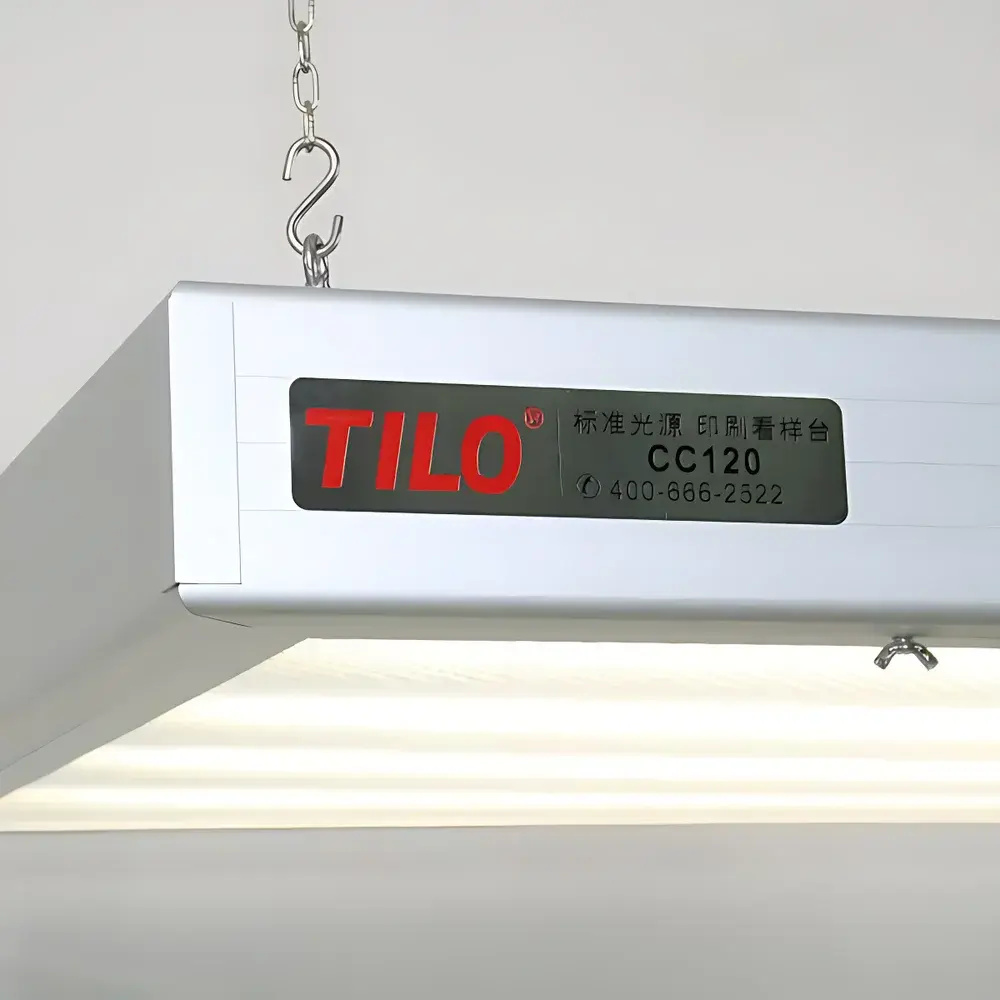
TILO CC120-W-3 Suspended Tri-Source Standard Light Booth
| Brand | TILO |
|---|---|
| Origin | Guangdong, China |
| Model | CC120-W-3 |
| Light Sources | D65, D50, TL84 |
| Compliance | ISO 3664:2009, ASTM D1729, CIE No. 51, GB/T 3978–2008 |
| Viewing Area | 1200 × 600 mm |
| Lamp Life | 2000–3000 h |
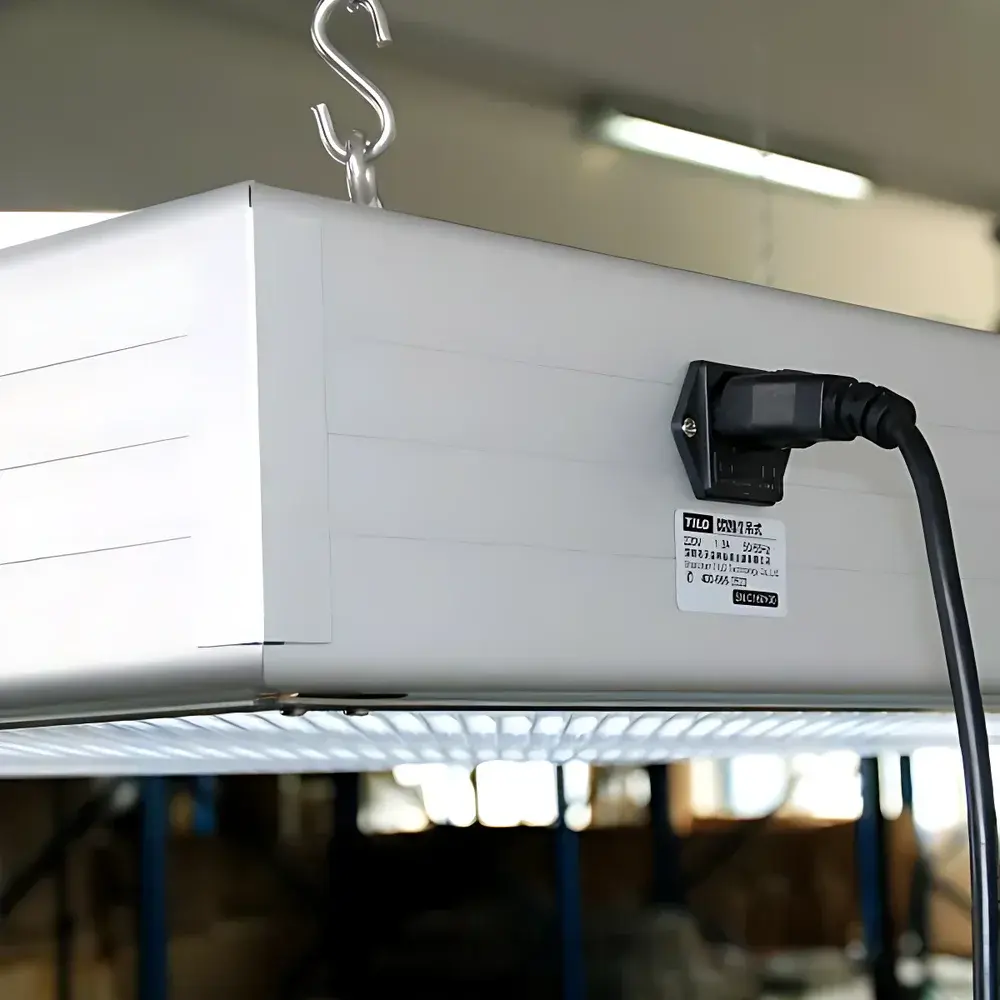
| Power Input | AC 220 V ±10%, 50/60 Hz |
Overview
The TILO CC120-W-3 Suspended Tri-Source Standard Light Booth is an engineered optical evaluation system designed for precise color assessment under controlled, standardized illumination conditions. It operates on the principle of spectral simulation—reproducing defined CIE standard illuminants (D65, D50, and TL84) via high-stability fluorescent or LED-based lamp modules calibrated to meet ISO 3664:2009 requirements for graphic technology and photography. This booth eliminates subjective color judgment errors caused by ambient lighting variability, enabling consistent visual evaluation across shifts, locations, and supply chain partners. Its suspended mounting configuration optimizes ergonomic access and minimizes shadow interference during side-by-side sample comparison—a critical requirement in prepress proofing, textile batch matching, paint formulation, and packaging quality control. The device is not a spectrophotometric instrument; rather, it serves as a foundational visual reference platform aligned with international color management workflows.
Key Features
- Suspended structural design with adjustable height mounting hardware, enabling integration into production line inspection stations or QC laboratories without floor footprint constraints.
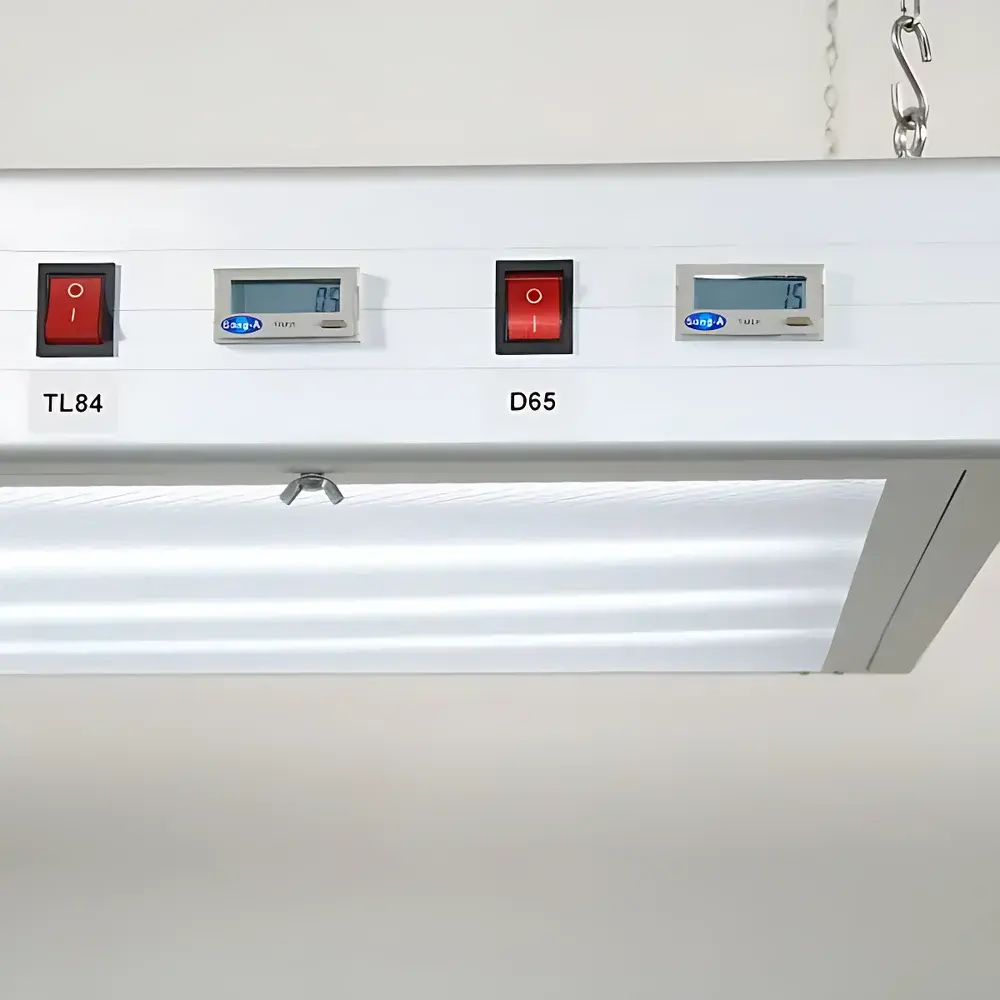
- Three independently switchable CIE-compliant light sources: D65 (simulated daylight, 6500 K), D50 (printing industry standard, 5000 K), and TL84 (cool white fluorescent, commonly used in retail environments).
- Integrated digital timer activated upon lamp ignition—provides objective tracking of cumulative lamp operating hours for preventive maintenance scheduling.
- Uniform illumination field over a 1200 × 600 mm viewing area, achieved through diffuser panel geometry and lamp positioning optimized per ISO 3664:2009 spatial uniformity criteria.
- Front-access lamp replacement mechanism: two captive white cap screws secure the translucent acrylic front panel, allowing tool-free access to lamp holders while maintaining alignment integrity.
- Thermal-stabilized ballast circuitry ensures minimal color drift during warm-up; lamps reach photometric equilibrium within 30 minutes of ignition, as specified in ASTM D1729 Annex A1.
Sample Compatibility & Compliance
The CC120-W-3 accommodates rigid and flexible substrates up to 10 mm thickness, including printed sheets, fabric swatches, plastic films, coated metal samples, and laminated packaging. Its viewing chamber geometry supports simultaneous evaluation of up to four A4-sized specimens arranged in a linear or 2×2 configuration. All light sources are certified to meet ISO 3664:2009 chromaticity tolerances (±0.002 Δuv for D50/D65), CIE Publication 51 spectral power distribution fidelity, and GB/T 3978–2008 national standard requirements for colorimetric viewing conditions. The unit complies with electromagnetic compatibility (EMC) Class B limits per GB 4824–2019 and carries CE marking for conformity with EU Low Voltage and EMC Directives. While not FDA 21 CFR Part 11–validated, its operational logs and lamp-hour tracking support GLP-aligned documentation practices in regulated R&D environments.
Software & Data Management
This model operates as a standalone optical reference system with no embedded firmware or network interface. Lamp activation, timing, and source selection are managed via tactile mechanical switches—ensuring deterministic response, zero firmware vulnerability surface, and long-term operational reliability without software updates or licensing. The integrated hour meter provides non-volatile storage of total lamp-on time per channel, accessible visually through the front-panel LCD display. For traceability in auditable workflows, users may manually record lamp installation dates and cumulative usage against ISO 3664’s recommended 2000–3000 hour service interval. Optional external data loggers (e.g., USB-connected lux meters with timestamping) can be deployed to validate irradiance stability per ASTM E308–22 Annex A3 protocols.
Applications
- Print & Packaging: Verification of press proofs against digital proofs under D50; detection of metamerism between ink formulations viewed under D65 vs. TL84.
- Textiles & Apparel: Batch-to-batch shade consistency checks across dye lots using D65 for daylight assessment and TL84 for store-light simulation.
- Automotive Interiors: Evaluation of trim component color harmony under multiple illuminants to prevent consumer-reported mismatch under varying environmental lighting.
- Plastics & Coatings: Visual validation of pigment dispersion homogeneity and gloss-level consistency across molded parts prior to instrumental measurement.
- Academic Research: Teaching tool for color science curricula demonstrating illuminant-dependent hue shifts and CIE 1931 chromaticity diagram mapping.
FAQ
What is the recommended warm-up time before color evaluation begins?
A minimum of 30 minutes is required for all lamps to achieve thermal and photometric stability, per ISO 3664:2009 Clause 6.2.1.
Can D65 and TL84 be operated simultaneously?
Yes—the control panel supports concurrent activation of any combination of installed sources, enabling direct metamerism testing without manual lamp swapping.
How often should lamps be replaced?
Lamp replacement is advised after 2000–3000 hours of cumulative operation, as chromaticity shift and luminous flux decay exceed ISO 3664 tolerance thresholds beyond this point.
Is calibration certification included with purchase?
Each unit ships with a factory-issued conformance report verifying initial chromaticity coordinates and irradiance uniformity per ISO 3664 Annex B. Third-party NIST-traceable calibration is available as an optional service.
Does the booth support CWF or U30光源?
The CC120-W-3 is configured exclusively for D65, D50, and TL84. CWF and U30 require hardware modification and are not supported in this variant.




