
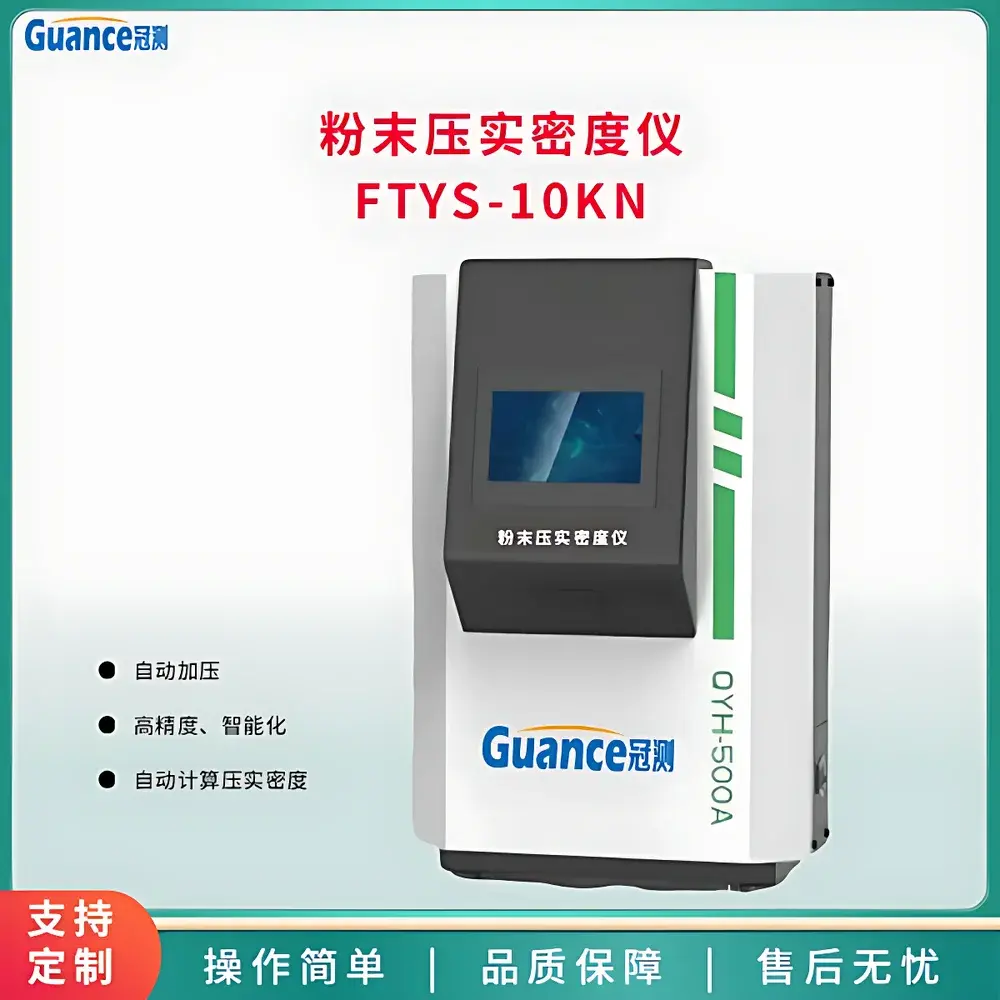
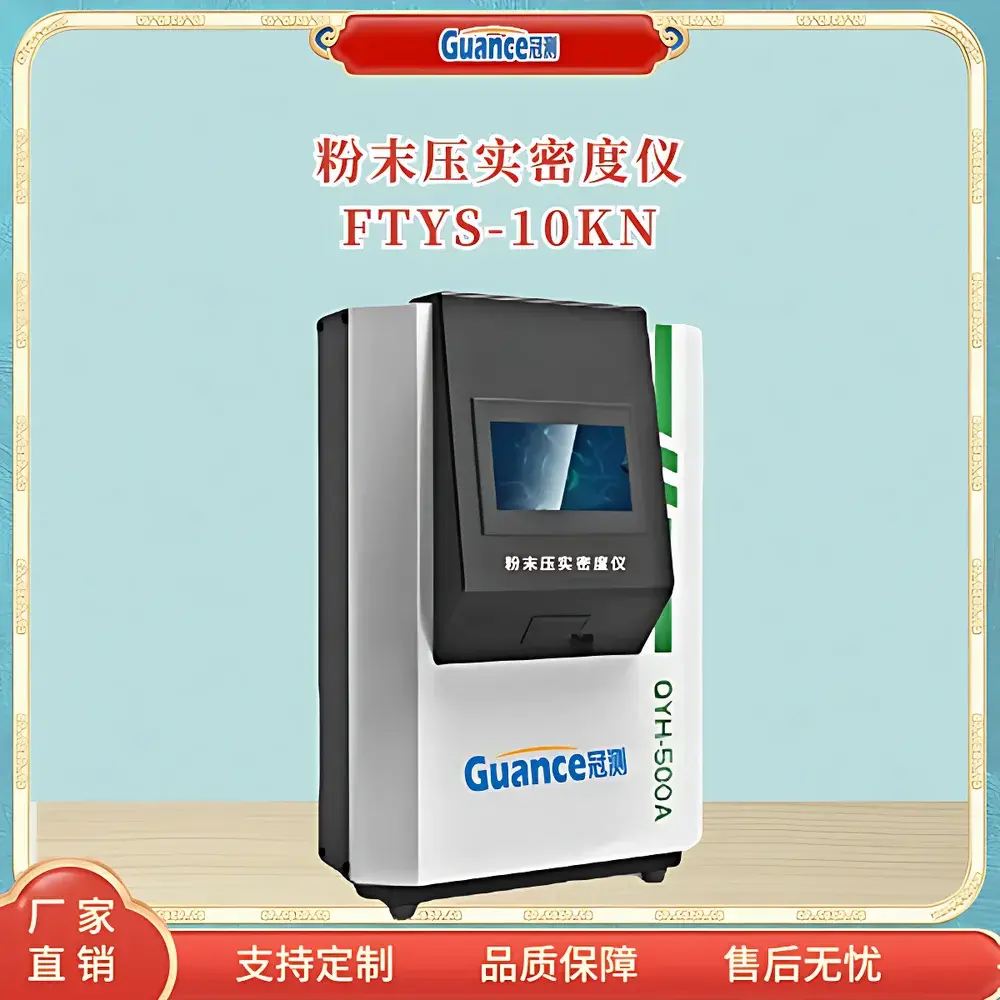
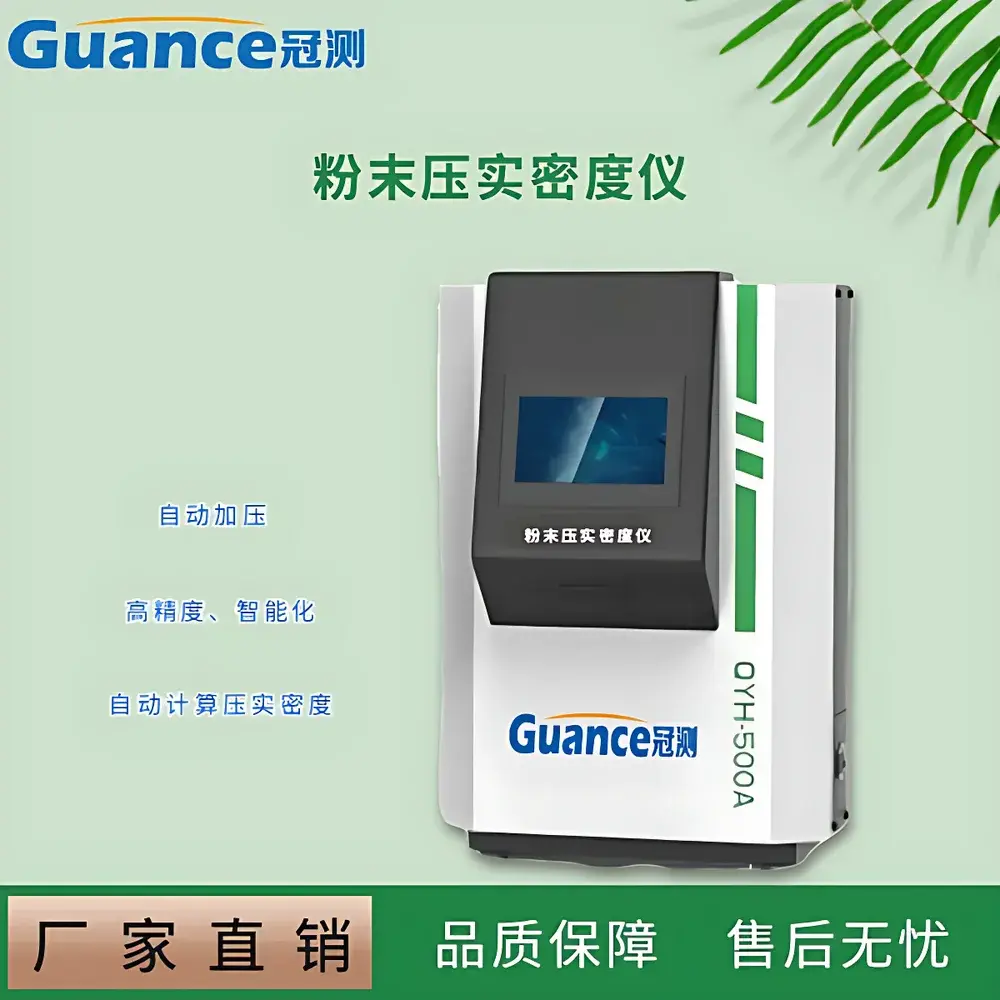
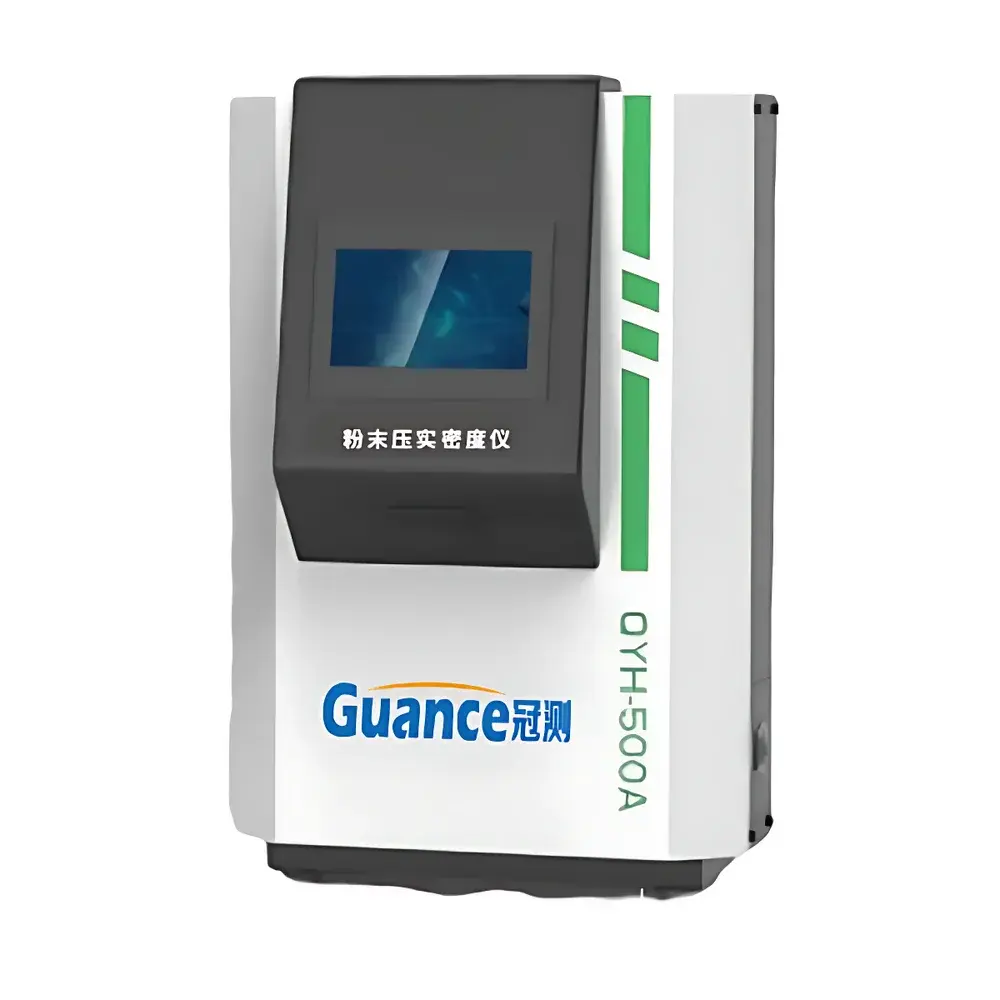
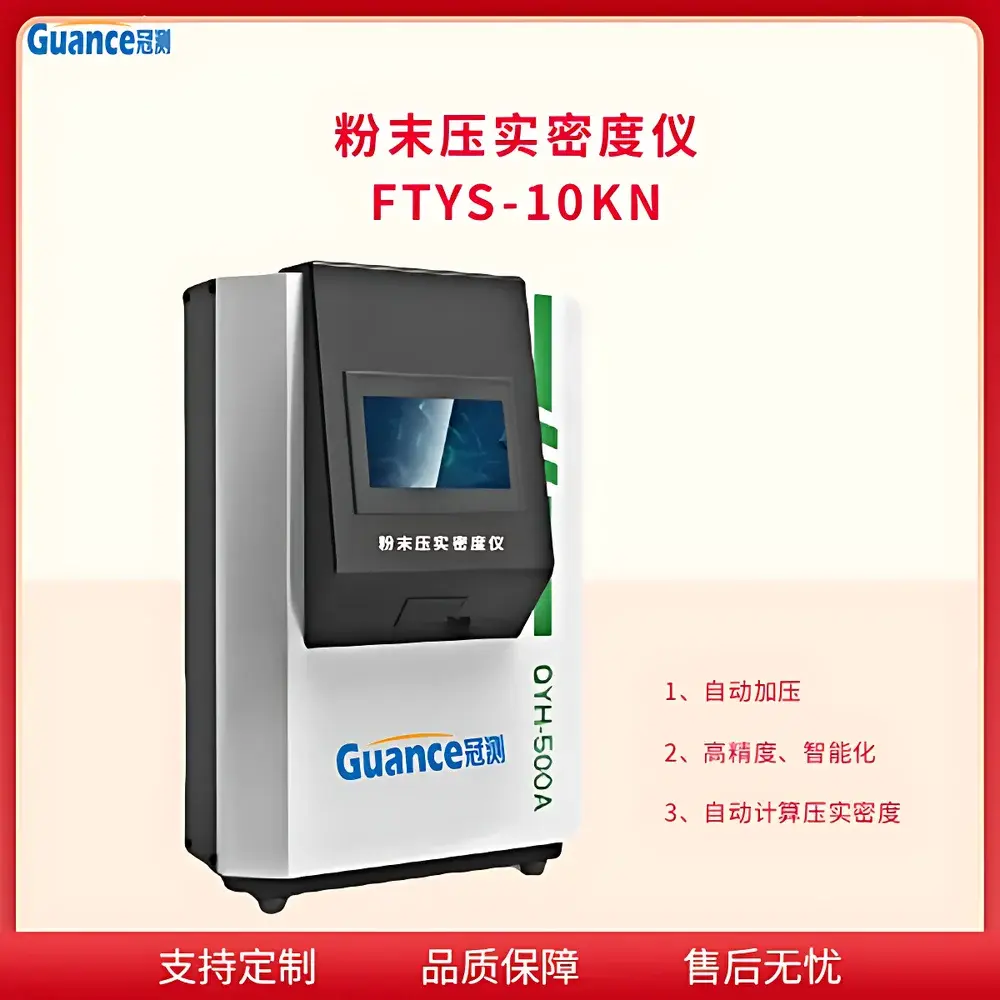
GuanCe Instruments FTYS-10 Powder Compaction Density Tester
| Brand | GuanCe Instruments |
|---|---|
| Origin | Beijing, China |
| Manufacturer Type | Authorized Distributor |
| Country of Origin | China |
| Model | FTYS-10 |
| Instrument Type | True Density Tester |
| Form Factor | Portable |
| Sample Type Compatibility | Solid Powders & Liquids |
| Density Measurement Range | 0–10 g/cm³ |
| Maximum Load Capacity | 10 kgf |
| Density Accuracy | ±3% |
| Display | Digital LCD (7-inch Touchscreen) |
| Temperature Range | 20–50 °C |
| Humidity Range | 20–98% RH |
| Repeatability | ±0.1% |
| Resolution | 0.01 g/cm³ |
| Minimum Sample Mass | 0.1 g |
| Compliance Standard | GB/T 24533–2009 (Lithium-ion Battery Graphite Anode Materials — Test Method for Powder Compaction Density) |
Overview
The GuanCe Instruments FTYS-10 Powder Compaction Density Tester is an engineered solution for quantifying the compaction density of fine particulate materials—particularly graphite anode powders used in lithium-ion battery electrode manufacturing. It operates on the principle of controlled uniaxial compression under programmable load and dwell time, enabling precise determination of bulk density after mechanical consolidation. Unlike conventional pycnometric or gas displacement methods, the FTYS-10 measures true compaction density—the mass per unit volume of a powder bed subjected to defined compressive stress—making it indispensable for electrode process development where volumetric energy density, porosity control, and interparticle bonding directly influence electrochemical performance.
Key Features
- Programmable hydraulic loading system with real-time force feedback and closed-loop pressure control (range: 0–10 kgf)
- Integrated high-resolution displacement sensor (0.01 mm resolution) for accurate thickness measurement during compaction
- 7-inch industrial-grade capacitive touchscreen interface supporting both manual operation and automated test sequences
- Dual-mode operation: standalone mode for rapid field testing; PC-connected mode for full data acquisition and curve analysis
- Onboard environmental monitoring: simultaneous temperature (20–50 °C) and relative humidity (20–98% RH) logging synchronized with compression events
- Multi-channel 24-bit AD acquisition for concurrent capture of load, displacement, time, temperature, and humidity—ensuring traceable, timestamped datasets
- Bilingual software interface (English/Chinese) compliant with laboratory documentation requirements
Sample Compatibility & Compliance
The FTYS-10 is validated for use with free-flowing and cohesive powders—including synthetic graphite, silicon-based anodes, NMC, LFP, and conductive carbon additives—across particle size distributions typical of battery slurry formulations (D50 ≈ 5–25 µm). Its design adheres to the metrological framework specified in GB/T 24533–2009, which defines standardized procedures for determining compaction density of lithium-ion battery anode materials via calibrated die geometry and defined pre-load conditioning. While not certified to ISO/IEC 17025, the instrument’s repeatability (±0.1%) and accuracy (±3%) meet internal QC thresholds for R&D labs and pilot-line process validation. Environmental operating conditions are aligned with ISO 17025 Annex A3 for stable metrological performance in non-climate-controlled production environments.
Software & Data Management
The included PC software enables comprehensive post-test analysis: generation of stress–density curves, time-dependent densification profiles, yield strength estimation via Heckel or Kawakita modeling, and comparative statistical reporting across batches. All raw data files (.csv) include embedded metadata (operator ID, timestamp, ambient conditions, calibration status), supporting audit readiness under GLP and GMP frameworks. Software logs retain full audit trails—including parameter edits, test start/stop events, and firmware version—satisfying basic FDA 21 CFR Part 11 requirements for electronic records when deployed with user authentication and electronic signatures enabled. Export options include PNG vector plots, Excel-compatible tabular outputs, and PDF test reports with digital signature fields.
Applications
- Electrode formulation optimization: correlating binder content, solvent ratio, and milling intensity with achievable compaction density
- Batch-to-batch consistency verification for anode/cathode active materials prior to slurry mixing
- Process window definition for calendering: mapping roll pressure vs. final electrode density and porosity
- Material substitution studies: evaluating alternative graphite morphologies or surface treatments for improved packing efficiency
- Academic research on powder rheology, granular mechanics, and solid-state sintering precursors
- Quality control in cathode/anode material manufacturing facilities requiring routine compaction density certification per OEM specifications
FAQ
What standards does the FTYS-10 comply with?
It implements the test methodology and reporting structure defined in GB/T 24533–2009 for lithium-ion battery graphite anode materials.
Can the FTYS-10 measure true density (helium pycnometry) or only apparent compaction density?
It measures compaction density exclusively—i.e., mass divided by geometric volume after applied pressure—not skeletal (true) density. For true density, a separate gas pycnometer is required.
Is calibration traceable to national standards?
Load cell and displacement sensor calibrations are performed using NIST-traceable reference weights and gauge blocks; calibration certificates are provided with each unit.
Does the system support automated sequence programming for multi-step compression cycles?
Yes—up to five sequential stages (pre-load, ramp, hold, relaxation, unload) can be programmed with independent setpoints for force, duration, and dwell tolerance.
What sample preparation steps are required before testing?
Powders must be dried to consistent moisture content (typically <200 ppm H2O), sieved to remove agglomerates >100 µm, and loaded into the standardized die cavity without vibration or tapping—per GB/T 24533–2009 Section 6.2.



