
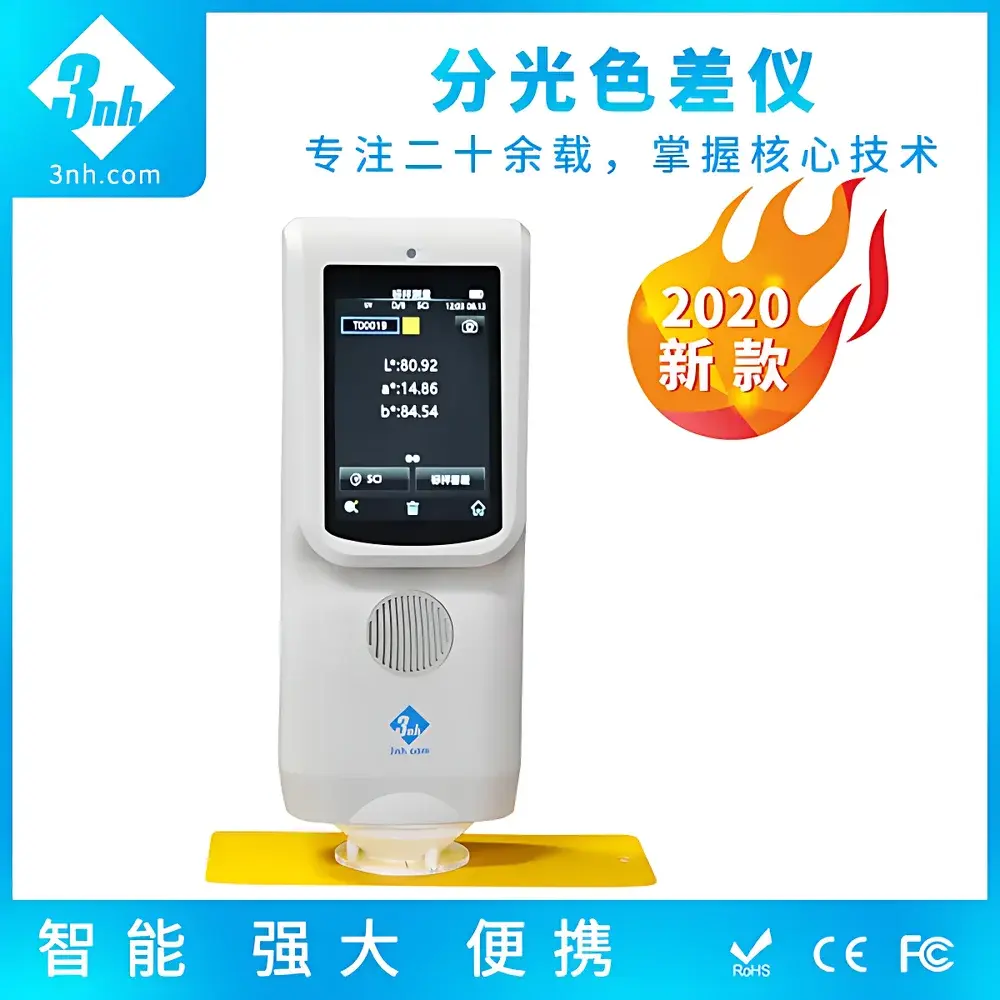
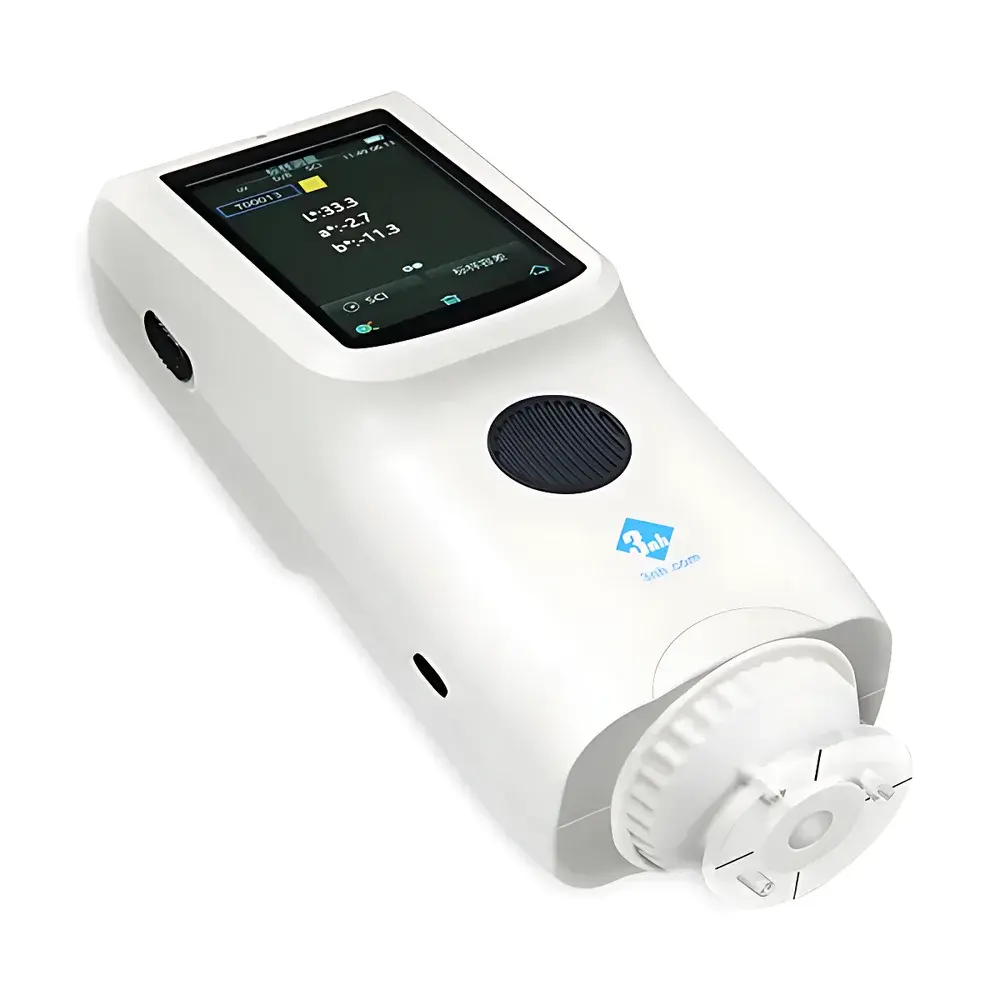
3nh TS20 Portable Spectrophotometric Color Difference Meter
| Brand | 3nh |
|---|---|
| Origin | Guangdong, China |
| Manufacturer Type | Manufacturer |
| Product Category | Domestic |
| Model | TS20 |
| Product Type | Color Difference Meter |
| Instrument Type | Portable |
| Optical Geometry | d/8° Integrating Sphere |
| Illuminants | D65, A, F2 (CWF) |
| Spectral Range | 400–700 nm |
| Repeatability | ΔE*ab ≤ 0.08 (MAV/SCI, after warm-up and calibration |
Overview
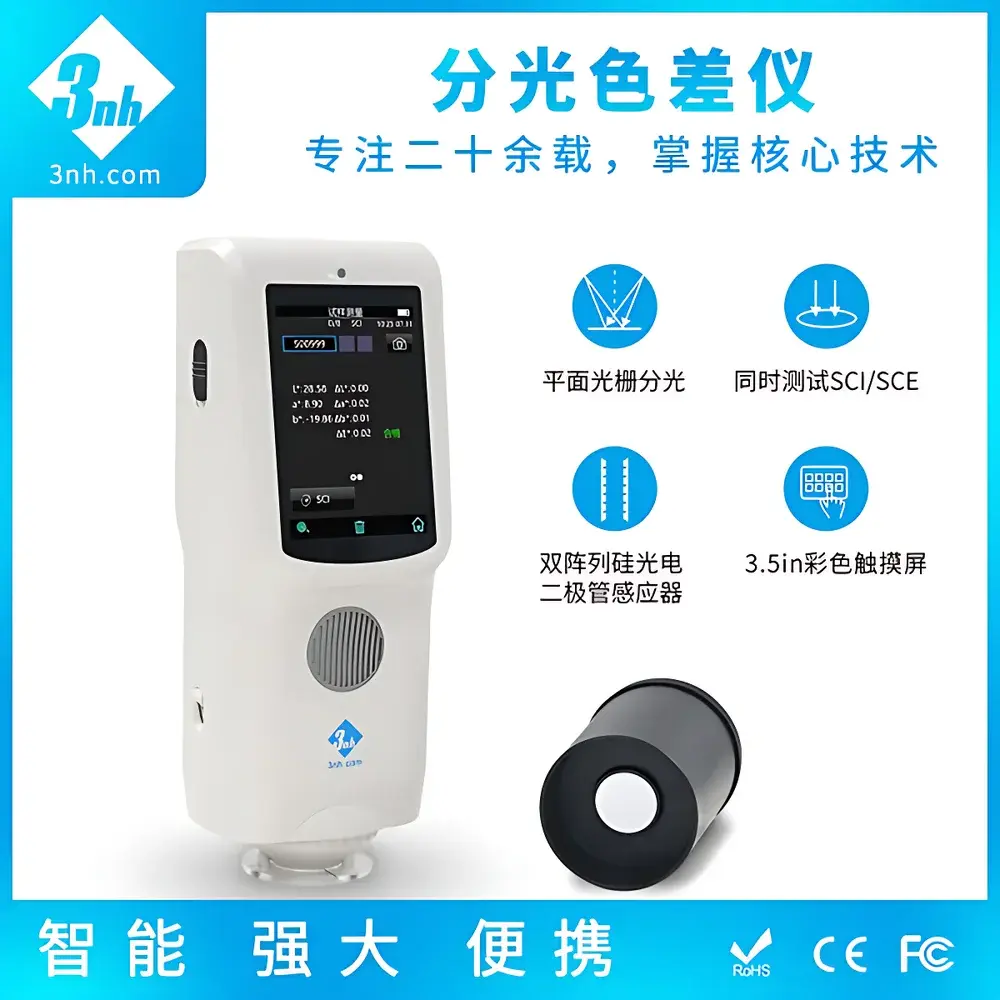
The 3nh TS20 Portable Spectrophotometric Color Difference Meter is an engineered solution for high-fidelity color measurement in production and quality control environments where portability, metrological traceability, and long-term stability are critical. Based on a true spectrophotometric architecture—utilizing planar grating dispersion and a dual-row 24-element silicon photodiode array—the TS20 captures full spectral reflectance data across the visible spectrum (400–700 nm, 10 nm resolution), enabling CIE-compliant computation of absolute colorimetric coordinates (L*, a*, b*, XYZ, Yxy, LCh) and multiple color difference metrics (ΔE*ab, ΔE00). Unlike tristimulus-based meters, its d/8° integrating sphere optical design with diffuse illumination and 8° viewing ensures robustness against surface texture, gloss, and directional effects—making it suitable for heterogeneous materials including molded plastics, coated metals, textiles, ceramics, and printed substrates. The instrument meets international standard requirements for spectral colorimetry per CIE Publication No. 15, ISO 7724-1, ASTM E1164, DIN 5033 Teil 7, GB/T 3978, and GB/T 18833, supporting compliance-driven workflows in regulated manufacturing sectors.
Key Features
- Φ8 mm measurement aperture with 10° standard observer angle—optimized for industrial sampling consistency across diverse material classes.
- Integrated full-spectrum LED illuminant system (D65, A, F2/CWF) with >3 million measurement cycles and 5-year service life—eliminating lamp replacement and spectral drift concerns.
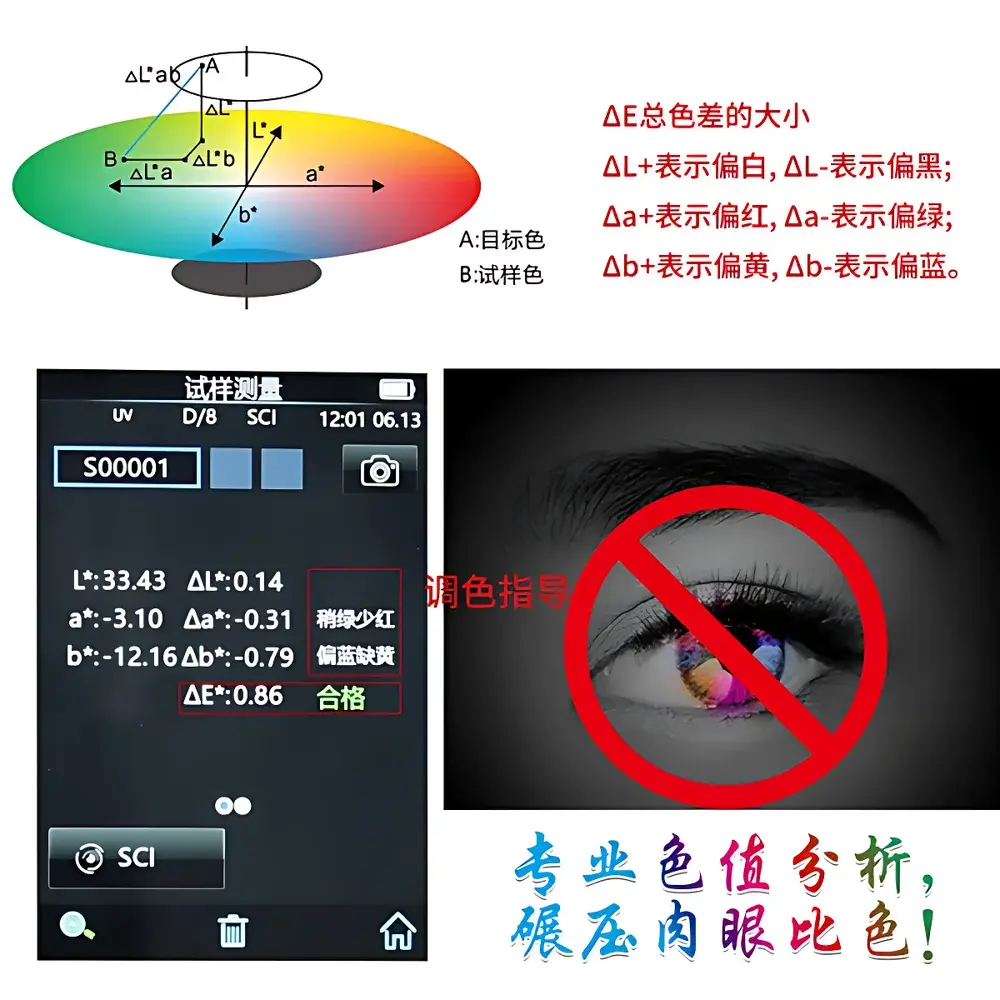
- High-resolution 3.5-inch capacitive TFT touchscreen display with real-time color simulation, pass/fail judgment, and directional color deviation indicators (e.g., +a* = red shift, −b* = blue shift).
- Dual-row 24-channel silicon photodiode array sensor delivering 0.01-unit display resolution and exceptional short-term repeatability (ΔE*ab ≤ 0.08 under MAV/SCI mode, post-calibration).
- Rechargeable lithium-ion battery enabling up to 6,000 measurements per charge (8-hour operational endurance)—designed for uninterrupted field use and shop-floor deployment.
- Onboard memory stores 500 standard references and 10,000 sample records with timestamping, batch ID tagging, and rapid search/filter functions via alphanumeric or color-space criteria.
Sample Compatibility & Compliance
The TS20 accommodates flat, curved, textured, and semi-gloss surfaces without auxiliary fixtures—leveraging its stable base plate and integrated aperture guard for consistent geometry control. It supports reflectance measurement at user-defined wavelengths (default: 440 nm, 550 nm, 600 nm), facilitating spectral signature verification beyond tristimulus evaluation. Its metrological performance has been validated against BCRA Series II ceramic tiles (inter-instrument agreement: ΔE*ab ≤ 0.4 under MAV/SCI), ensuring compatibility with multi-site color management systems. The device complies with GLP-relevant operational safeguards—including mandatory white/black calibration before each session—and supports audit-ready data export formats (CSV, XML) compatible with enterprise QMS platforms. While not FDA 21 CFR Part 11-certified out-of-the-box, its deterministic measurement logic, immutable timestamped logs, and software-controlled access permissions enable validation pathways for regulated industries.
Software & Data Management
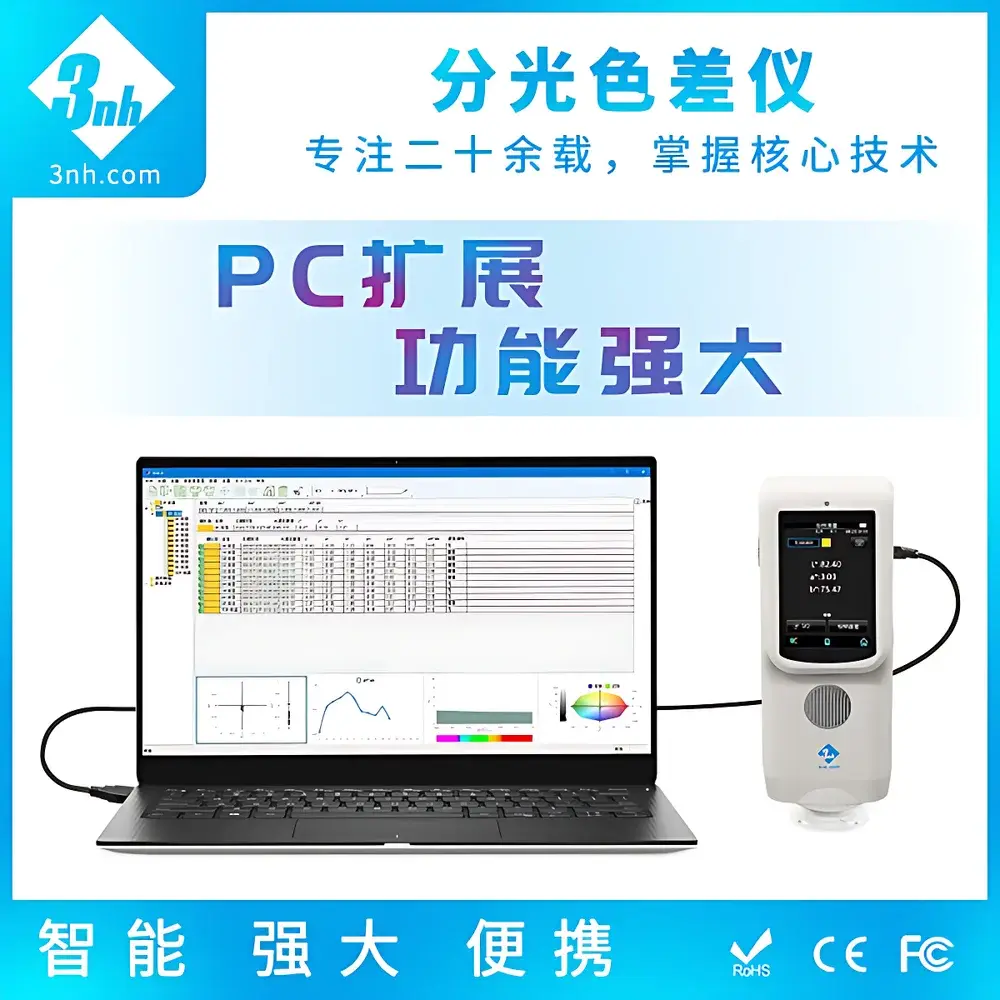
The TS20 interfaces seamlessly with 3nh’s SQCX Quality Control Software (Windows-based, downloadable from official domain), providing advanced statistical process control (SPC) tools: X-bar/R charts, capability indices (Cp/Cpk), tolerance band visualization, and automated report generation (PDF/Excel). All measurements retain raw spectral data, allowing retrospective re-evaluation using updated illuminants or observer functions without re-measurement. Data synchronization preserves hierarchical metadata—operator ID, location tag, environmental conditions (ambient temperature/humidity logged during acquisition), and calibration history—enabling full traceability per ISO/IEC 17025 documentation requirements. Firmware updates are delivered via USB and include version-locked calibration coefficients to prevent unauthorized parameter modification.
Applications
- Plastics & Electronics: In-line color verification of injection-molded housings, PCB solder masks, and elastomeric seals under D65 daylight simulation.
- Paints & Inks: Batch-to-batch consistency monitoring for automotive OEM coatings and packaging gravure inks, with spectral deviation alerts at critical absorption bands.
- Textiles & Apparel: Shade matching across dye lots using CMC(2:1) or ΔE00 tolerances aligned with AATCC Evaluation Procedure 1.
- Printing & Packaging: Spot-checking CMYK spot colors and substrate-dependent gamut shifts on corrugated board, flexible films, and metallized foils.
- Ceramics & Tiles: Glaze color uniformity assessment across kiln runs, referencing NIST-traceable ceramic standards.
FAQ
What is the recommended calibration frequency for routine use?
White and black calibration should be performed before each measurement session or after ambient temperature shifts exceeding ±5°C. For high-precision applications, recalibration every 2 hours is advised.
Does the TS20 support measurement under custom illuminants?
No—only pre-programmed CIE-standard illuminants (D65, A, F2/CWF) are supported. Custom spectral power distributions require post-processing via SQCX software using exported reflectance curves.
Can spectral data be exported for third-party analysis?
Yes—full 400–700 nm reflectance spectra (10 nm intervals) are exportable as CSV files, retaining wavelength, reflectance (%), and metadata for integration with MATLAB, Python, or commercial color science toolkits.
Is the TS20 suitable for measuring transparent or translucent samples?
Not without optional accessories—the standard configuration measures only opaque or diffusely reflecting surfaces. Transmission measurement requires the TS20-T add-on module (sold separately) with backlit sample holder.
How is inter-instrument agreement maintained across a fleet of TS20 units?
Each unit ships with factory-applied characterization coefficients traceable to NIM (China National Institute of Metrology). Users may perform inter-instrument verification using BCRA Series II tiles and generate offset correction matrices within SQCX.





