
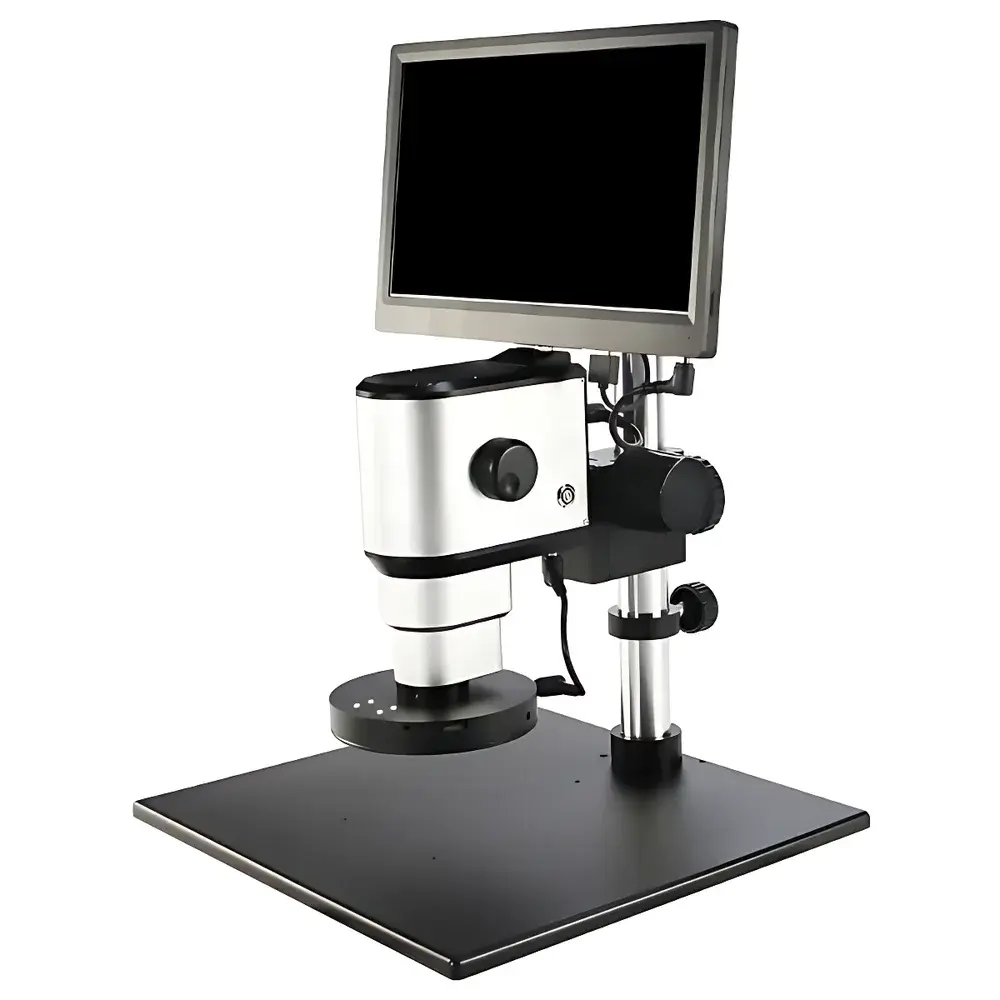
LEI-TECH LK-4K660AM Electric Zoom 4K Smart Measurement Video Microscope
| Brand | LEI-TECH |
|---|---|
| Origin | Tianjin, China |
| Manufacturer Type | Direct Manufacturer |
| Model | LK-4K660AM |
| Optical Magnification | 0.3–3.0× |
| Total Magnification Range | 10–99.8× |
| Zoom Ratio | 10:1 |
| Working Distance | 86 mm |
| Field of View | 25.6 × 14.4 mm to 2.56 × 1.44 mm |
| Sensor Size | 1/1.8″ |
| Pixel Size | 2.0 µm × 2.0 µm |
| Resolution | 3840 × 2160 (4K UHD) |
| Frame Rate | 60 fps |
| Output Interface | HDMI + UVC-compliant USB 3.0 |
| Network Interface | 1 GbE |
| Storage | Local SD/USB + Network (SMB/NFS) |
| Measurement Modes | Point-to-point, line, arc, angle, polygon, auto-edge detection |
| Focus Mechanism | Coarse/Fine Manual + Motorized Zoom |
| Illumination Options | LED, Ring Light, Coaxial Light |
| Display | Integrated 10″ HD touchscreen |
| Base Dimensions | 330 × 300 mm |
| Column Height | 318 mm |
Overview
The LEI-TECH LK-4K660AM Electric Zoom 4K Smart Measurement Video Microscope is an integrated optical metrology platform engineered for high-precision, non-contact dimensional analysis in quality control, electronics inspection, precision machining, and R&D environments. Unlike conventional analog or HD video microscopes, the LK-4K660AM employs a calibrated opto-mechanical zoom system coupled with a scientific-grade 1/1.8″ CMOS sensor delivering true 4K UHD (3840 × 2160) resolution at 60 fps. Its measurement capability is grounded in real-time pixel-to-dimension calibration, traceable to NIST-traceable standards via factory-certified lens distortion correction and motorized zoom position feedback. The system operates on a fixed optical path architecture with a constant 86 mm working distance across the full 0.3×–3.0× optical zoom range—ensuring repeatable focus geometry and eliminating parallax-induced measurement drift during magnification changes.
Key Features
- Motorized continuous zoom with dual-control interface: programmable electric actuation via software or tactile manual ring—enabling seamless transition between rapid overview scanning and fine-detail interrogation;
- Real-time on-screen overlay of calibrated magnification value, synchronized with encoder feedback from the zoom mechanism for metrological integrity;
- Dual-path digital output: HDMI for low-latency display monitoring and UVC-compliant USB 3.0 for direct integration with Windows/Linux host systems without proprietary drivers;
- Integrated 10-inch capacitive touchscreen with embedded measurement UI—supporting point-and-click geometry tools including chord-length arc fitting, inscribed circle detection, and angular deviation quantification;
- Modular illumination system compatible with LED base lighting, 360° adjustable ring light, and coaxial illuminator—optimized for contrast enhancement on reflective, translucent, or low-relief surfaces;
- Robust mechanical construction: cast-aluminum base (330 × 300 mm), 318 mm vertical column, and precision-ground coarse/fine focus stage with backlash-compensated lead screws.
Sample Compatibility & Compliance
The LK-4K660AM accommodates samples up to 200 mm in height and 300 mm in width, making it suitable for PCB assemblies, semiconductor wafers, medical device components, and miniature mechanical parts. Its fixed working distance and telecentric-compatible optical design minimize perspective error—critical for ISO 10360-compliant dimensional verification. While not certified to ISO/IEC 17025 as a standalone metrology instrument, the system supports GLP/GMP documentation workflows through timestamped image/video export with embedded metadata (magnification, exposure, lens position, calibration ID). Measurement algorithms comply with ISO 1101 geometric tolerancing principles for profile, orientation, and location evaluation. All firmware and calibration data are stored internally with SHA-256 checksum validation to ensure audit trail integrity.
Software & Data Management
The microscope ships with LEI-Vision Pro v3.x—a cross-platform application supporting Windows 10/11 and Ubuntu LTS. It provides full DICOM-compliant image archiving, CSV/XLSX export of measurement logs with uncertainty estimates, and batch-processing macros for repetitive inspection routines. Network connectivity enables remote configuration, firmware updates over HTTPS, and centralized storage via SMB or NFS protocols. For regulated industries, optional 21 CFR Part 11 compliance modules include electronic signatures, role-based access control, and immutable audit trails recording every measurement action—including operator ID, timestamp, parameter settings, and image hash values. Raw sensor data is preserved in lossless TIFF format; compressed exports use H.265 encoding with configurable GOP structure for long-duration recording.
Applications
- PCB solder joint inspection (IPC-A-610 Class 2/3 defect classification);
- Wafer-level metrology of bond pad dimensions, die alignment, and scribe lane width;
- Dimensional verification of microfluidic channel depth and width per ASTM F3021;
- Surface defect mapping on coated optics and thin-film substrates;
- Reverse engineering of legacy mechanical components using multi-angle image stitching and orthographic projection;
- Educational labs requiring reproducible, digitally documented microscopy experiments compliant with ABET accreditation criteria.
FAQ
Does the LK-4K660AM support third-party measurement software?
Yes—it presents as a UVC 1.5-compliant video device and exposes raw YUV422 frames; SDKs for C++/Python are available under NDA for OEM integration.
Is calibration traceable to national standards?
Factory calibration includes NIST-traceable step gauges and grid targets; users receive a certificate listing residual distortion (<0.08% TVD) and magnification linearity error (<±0.15%).
Can the system be integrated into automated production lines?
Yes—digital I/O ports (opto-isolated) support trigger synchronization with PLCs; RESTful API enables command-and-control via HTTP POST requests.
What is the maximum measurable feature size at 3.0× optical zoom?
At full optical zoom (3.0×), the field of view is 2.56 × 1.44 mm, enabling sub-5 µm resolution limited by diffraction and pixel sampling—validated per ISO 12233 slanted-edge MTF analysis.
How is thermal drift managed during extended operation?
The optical head incorporates passive copper heat sinks and thermally stable BK7/BaF₂ lens elements; internal temperature is monitored continuously and used to adjust white balance and gain tables dynamically.





