
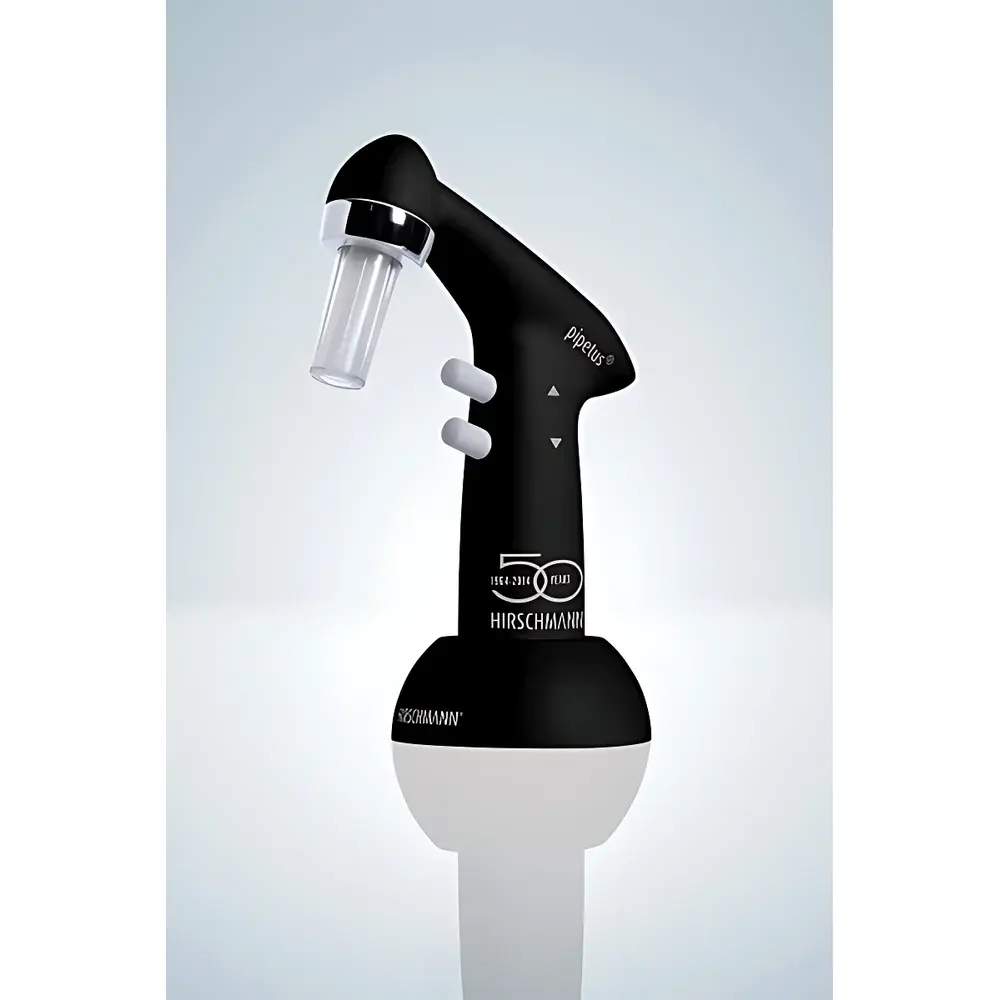
Hirschmann Pipetus Electromagnetic Induction Pipette Controller
| Brand | Hirschmann (Germany) |
|---|---|
| Origin | Germany |
| Model | Pipetus Electromagnetic Induction Pipette Controller |
| Type | Single-Channel Electric Pipette Controller |
| Volume Range | 0.1–200 mL |
| Max Capacity | 200 mL |
| Accuracy | ±0.5% |
| Weight (Handheld Unit) | 240 g |
| Housing Material | Polyamide 6 (PA6) |
| Filter | 0.2 µm PTFE hydrophobic membrane |
| Power Source | Rechargeable NiMH battery (Cd-free) |
| Charging | Electromagnetic induction base, hot-swap capable |
| Operating Time per Charge | Up to 7 days (typical lab usage) |
| Speed Control | 5-step adjustable aspiration/dispense rate, displayed on color LCD screen |
| Compliance | ISO 9001, GLP, GMP, DIN EN ISO 9000, DIN 12650, ASTM E2380 |
Overview
The Hirschmann Pipetus Electromagnetic Induction Pipette Controller is an ergonomically engineered single-channel electric pipetting aid designed for precise, fatigue-reduced manual liquid handling across research laboratories, QC/QA environments, and regulated production settings. Unlike conventional mechanical or air-displacement pipette controllers, the Pipetus employs contactless electromagnetic induction for both power delivery and motor actuation—eliminating physical charging contacts, reducing wear, and enhancing long-term reliability. Its core operating principle relies on a brushless DC motor coupled with a high-torque planetary gear system, enabling smooth, pulse-free aspiration and dispense across its full 0.1–200 mL range. The controller interfaces exclusively with standard glass or plastic volumetric and graduated pipettes (including Mohr, Serological, and TC/TD types), converting them into digitally assisted, repeatable liquid transfer tools without requiring proprietary consumables.
Key Features
- Ergonomic handheld design (240 g) with balanced weight distribution and non-slip PA6 polymer housing, minimizing wrist strain during extended use.
- Integrated 0.2 µm hydrophobic PTFE filter upstream of the motor chamber—prevents aerosol ingress, protects internal components from corrosive solvents (e.g., acetone, DMSO, concentrated acids/bases), and ensures cross-contamination-free operation.
- Universal silicone adapter with optical clarity and chemical resistance—seals seamlessly against pipette barrels of varying diameters (10–18 mm), maintaining consistent vacuum integrity across all volume ranges.
- Electromagnetic induction charging station enables maintenance-free power replenishment; no exposed contacts, no oxidation risk, and full operational continuity during charging (hot-swap functionality).
- Ceramic-tipped control lever—engineered from wear-resistant composite ceramic—provides tactile feedback and micron-level meniscus positioning accuracy during fine-tuning of aspiration endpoints.
- Color LCD interface displays real-time battery level, selected speed mode (1–5), active function (aspirate/dispense), and system status—enabling intuitive, glance-based operation without interrupting workflow.
Sample Compatibility & Compliance
The Pipetus supports all standard Class A and Class B glass and polypropylene pipettes conforming to DIN 12650 and ISO 648 specifications—including volumetric (TD/TC), graduated (Mohr, Serological), and Ostwald-Folin types—across the full 0.1–200 mL span. Each unit undergoes individual calibration verification at the German manufacturing facility and ships with a traceable Certificate of Conformance bearing a unique serial number, fully embeddable in ISO 9001 quality documentation systems. The device complies with GLP and GMP requirements for instrument qualification: it supports audit-ready usage logs (via optional software integration), meets electrical safety standards per IEC 61010-1, and incorporates hardware-level safeguards including overcurrent protection, thermal cutoff, and battery cell balancing. Its PTFE filtration and chemically inert wetted path satisfy USP criteria for analytical instrument qualification in regulated pharmaceutical environments.
Software & Data Management
While the Pipetus operates as a standalone controller, its firmware architecture supports optional PC connectivity via USB-C for firmware updates and configuration backup. When deployed in validated environments, the device integrates with laboratory information management systems (LIMS) through standardized ASCII command protocols. Audit trail functionality—including timestamped start/stop events, speed mode selections, and battery cycle history—is accessible via secure export for FDA 21 CFR Part 11–compliant review. All calibration data and service records are stored internally with write-protection enabled by default, ensuring integrity during GLP/GMP inspections.
Applications
- High-precision volumetric preparation of standards and reference solutions in analytical chemistry labs (e.g., HPLC, ICP-MS sample dilution).
- Cell culture media dispensing and reagent aliquoting in biosafety cabinets—reducing repetitive motion injury risk in biomanufacturing cleanrooms.
- QC testing in food, beverage, and environmental laboratories where regulatory traceability (ISO/IEC 17025) mandates documented pipetting consistency.
- Teaching laboratories requiring robust, low-maintenance instrumentation that introduces students to GLP-aligned liquid handling practices.
- Pharmaceutical stability studies where multi-day continuous operation (enabled by 7-day battery life) minimizes workflow interruption.
FAQ
Does the Pipetus require proprietary pipettes or adapters?
No—it works with any standard glass or plastic pipette meeting DIN 12650 dimensional tolerances. The transparent silicone adapter ensures universal fit without modification.
Can the device be used with corrosive or volatile solvents?
Yes—the 0.2 µm PTFE filter and PA6 housing provide broad chemical compatibility; however, prolonged exposure to strong oxidizers (e.g., concentrated nitric acid) or halogenated solvents should be validated per application-specific risk assessment.
Is calibration traceable to national standards?
Each unit is factory-calibrated using gravimetric methods traceable to PTB (Physikalisch-Technische Bundesanstalt, Germany); calibration certificates include uncertainty budgets compliant with ISO/IEC 17025.
How is user training and qualification supported?
Hirschmann provides IQ/OQ documentation templates, operator training checklists, and video-based SOPs aligned with ISO 23530 and CLSI EP15-A3 guidelines—available upon request for regulated users.
What maintenance is required beyond routine filter replacement?
The electromagnetic induction system has no moving contacts; only annual verification of filter integrity and battery health is recommended. No lubrication or internal servicing is needed under normal operating conditions.



