Rotameter Flow Meter
| Origin | Beijing |
|---|---|
| Manufacturer Type | Distributor |
| Origin Category | Domestic (China) |
| Model | 100 mL/min Full-Scale |
| Pricing | Upon Request |
Overview
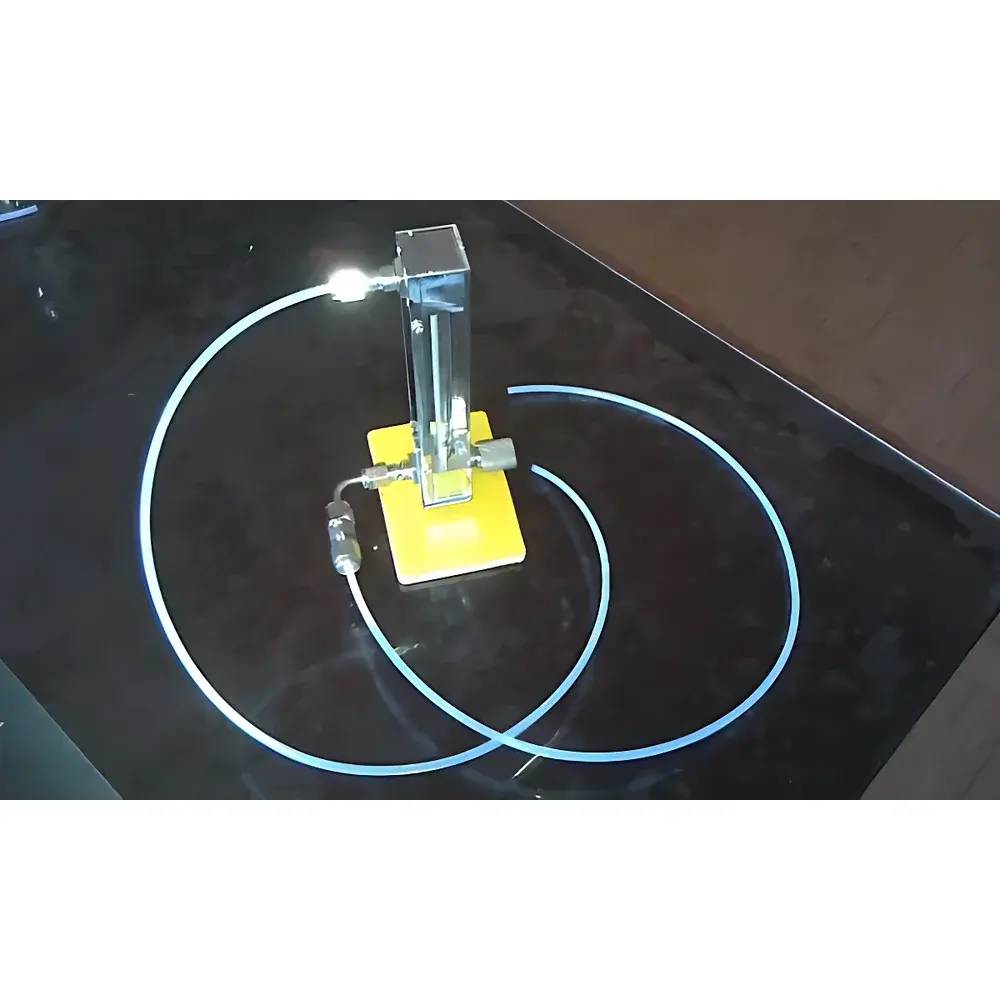
The Rotameter Flow Meter is a mechanical, variable-area flow measurement instrument engineered for continuous, real-time monitoring of low-to-moderate flow rates in clean, non-viscous liquids and gases. Operating on the principle of buoyancy and gravity balance, it consists of a vertically oriented, tapered glass or acrylic tube and a freely suspended float (rotor). As fluid passes upward through the tube, the float rises until the annular area between the float and tube wall generates sufficient drag to balance the float’s weight. The stabilized float position corresponds directly to the volumetric flow rate—calibrated linearly along the tube scale. This design delivers immediate visual indication without external power, making it ideal for local process observation, pilot-scale systems, and educational laboratories where simplicity, reliability, and cost-effectiveness are prioritized.
Key Features
- Direct visual flow indication with no electrical power required
- Tapered transparent tube (borosilicate glass or chemically resistant acrylic) for clear float visibility and chemical compatibility
- Stainless steel or PTFE-coated float options for corrosion resistance and density matching across diverse media
- Standard outlet port: 1/8″ NPT (National Pipe Thread) for universal integration into tubing and manifold systems
- Mounting flexibility: compatible with base-mounted, magnetic-adhesive, or double-sided tape installation—enabling rapid deployment on panels, benches, or irregular surfaces
- Full-scale range calibrated to 100 mL/min (at specified reference conditions: 20 °C water or air at 101.3 kPa), with optional custom calibration available for other fluids and temperatures
- Robust mechanical architecture with minimal moving parts—ensuring long-term stability and low maintenance requirements
Sample Compatibility & Compliance
This rotameter is suitable for laminar-to-transitional flow regimes in clean, particle-free fluids. It is commonly deployed for monitoring deionized water, compressed air, nitrogen, oxygen, and low-viscosity solvents in laboratory synthesis, gas chromatography carrier lines, environmental chamber purging, and small-scale bioreactor sparging. While not intended for abrasive slurries, high-viscosity oils, or steam applications, its material configuration can be adapted per ISO 3969 (rotameter calibration standards) and conforms to general industrial metrology practices for analog flow indication. For regulated environments, documentation of calibration traceability to national standards (e.g., CNAS-accredited labs in China) is available upon request. Note: Not certified for SIL, ATEX, or IECEx hazardous area use unless explicitly configured and labeled by the end-user’s qualified safety engineer.
Software & Data Management
The standard Rotameter Flow Meter operates as an analog, stand-alone device and does not incorporate embedded electronics or digital output. However, for integration into data acquisition systems, third-party vision-based optical readers or laser displacement sensors may be mounted externally to capture float position and convert it to 4–20 mA or RS-485 signals via compatible transmitters. When used in GLP/GMP-aligned workflows, users are advised to maintain manual logbooks or electronic records (e.g., LIMS-integrated entries) documenting calibration dates, reference fluid conditions, and operator verification—consistent with FDA 21 CFR Part 11 principles for attributable, legible, contemporaneous, original, and accurate (ALCOA+) data handling.
Applications
- Flow verification in analytical instrument gas supply lines (e.g., GC, ICP-OES)
- Controlled reagent dosing in microfluidic and batch synthesis setups
- Calibration reference for digital mass flow controllers during startup and periodic verification
- Teaching tool for fluid mechanics fundamentals—including Reynolds number estimation, buoyancy forces, and laminar flow behavior
- Leak testing and purge validation in vacuum and inert-atmosphere gloveboxes
- Low-cost monitoring of coolant or rinse solution circulation in benchtop equipment
FAQ
What fluids can this rotameter measure accurately?
It is calibrated for water at 20 °C or air at standard temperature and pressure (STP). Accurate measurement of other fluids requires correction using the fluid’s specific gravity and viscosity relative to the calibration medium—reference ASTM D1217 and ISO 3104 for methodology.
Is the 100 mL/min range adjustable or field-calibratable?
No—the full-scale range is fixed by tube geometry and float density. Range adjustment requires physical replacement of either the float or the tube assembly, which must be performed under controlled calibration conditions.
Can it be installed horizontally?
No. Rotameters require strict vertical orientation (±2° tolerance) to ensure gravitational alignment of the float; horizontal mounting invalidates measurement accuracy.
Does it meet any international quality standards?
The unit complies with dimensional and functional expectations outlined in ISO 2548 and DIN 19523 for variable-area flowmeters. Calibration certificates traceable to national metrology institutes can be supplied separately.
What maintenance is required?
Periodic inspection for tube clarity, float freedom of movement, and absence of particulate adhesion. Cleaning with appropriate solvents (e.g., isopropanol for organic residues) is recommended before recalibration intervals—typically every 6–12 months depending on operating environment and fluid cleanliness.