
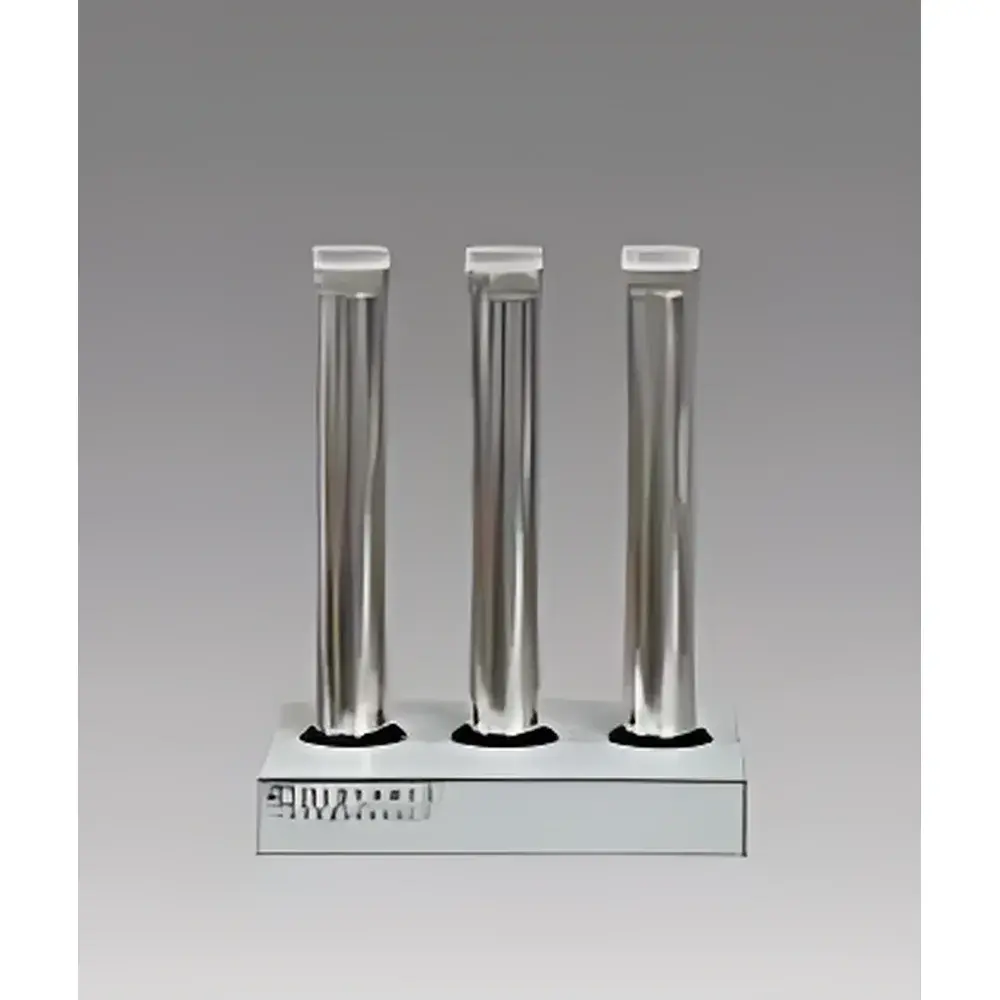
TF-1 Triple-Channel Gas Purifier
| Origin | Beijing, China |
|---|---|
| Manufacturer Type | Authorized Distributor |
| Model | TF-1 |
| Pricing | Upon Request |
| Filtration Channels | 3 independent |
| Max Operating Pressure | 1 MPa |
| Filter Media Compatibility | Molecular Sieve, Color-Indicating Silica Gel, Activated Carbon |
| Housing Material | Stainless Steel (316 SS) |
| Sealing Material | Low-Sulfur Silicone O-Rings |
| Configuration Options | Parallel or Series Operation |
Overview
The TF-1 Triple-Channel Gas Purifier is an engineered solution for high-integrity gas stream conditioning in analytical laboratories. Designed around Couette-flow–compatible gas handling architecture, it implements a modular, three-channel parallel filtration system that enables selective removal of trace contaminants from carrier, make-up, and detector gases used in gas chromatography (GC), elemental analysis (e.g., ICP-MS, EA), environmental monitoring, food safety testing, and materials characterization workflows. Each channel operates as a physically isolated, pressure-rated purification stage—capable of housing distinct adsorbent media—to address specific impurity classes: moisture (H₂O), hydrocarbons (C₁–C₆), oxygen (O₂), sulfur compounds (e.g., H₂S, SO₂), and particulates. The unit functions on the principle of dynamic adsorption under controlled flow conditions, where residence time, bed depth, and media selection are optimized to achieve consistent breakthrough capacities per ISO 8573-1 Class 2 (for moisture) and ASTM D1946-compliant hydrocarbon removal thresholds.
Key Features
- Three independent stainless steel (316 SS) filter housings rated to 1 MPa working pressure, with front-panel pressure gauges and needle valves for individual flow regulation
- Modular media cartridges compatible with industry-standard desiccants (4A/13X molecular sieves, color-indicating silica gel), activated carbon (mesh 20–40), copper-based oxygen scavengers, and sulfur-specific metal oxides
- Low-sulfur silicone O-rings compliant with ASTM F104 Class A specifications, minimizing background sulfur contamination critical for sulfur-sensitive detectors (e.g., PFPD, SCD)
- Configurable gas routing: channels may operate in parallel for high-throughput multi-gas conditioning or in series for cascaded, multi-stage purification (e.g., moisture → hydrocarbons → oxygen)
- Integrated leak-tested manifold with Swagelok®-compatible 1/4″ NPT and 6 mm compression fittings; no internal plastic or epoxy-wetted surfaces
- Front-access service design enabling rapid cartridge replacement without system depressurization or tooling
Sample Compatibility & Compliance
The TF-1 accommodates all common laboratory-grade gases—including helium, hydrogen, nitrogen, argon, synthetic air, and zero air—at flow rates ranging from 10 mL/min to 2 L/min per channel. It meets mechanical integrity requirements per ASME B31.3 Process Piping Code and is routinely deployed in GLP- and GMP-regulated environments where gas purity directly impacts method validity (e.g., USP , EPA Method 8260/8270, ISO 17025-accredited GC labs). Its construction avoids halogenated polymers and zinc-plated components, ensuring compatibility with ultra-high-purity (UHP) gas supply systems. Documentation includes material certifications (EN 10204 3.1), pressure test reports, and traceable media lot data upon request.
Software & Data Management
The TF-1 is a hardware-only purification platform with no embedded electronics or firmware. It is designed for integration into instrument control ecosystems via external loggers or facility-wide gas monitoring networks (e.g., connected to Siemens Desigo CC or Honeywell Experion PKS via 4–20 mA analog outputs from optional inline dew point/hydrocarbon sensors). While the base unit does not support FDA 21 CFR Part 11 electronic signatures, its mechanical configuration and maintenance logs (filter change dates, media lot numbers, pressure drop trends) are fully auditable within standard laboratory quality management systems (QMS) such as LabWare LIMS or Veeva Vault QMS.
Applications
- Carrier gas polishing for capillary GC and GC-MS systems requiring sub-ppb hydrocarbon and sub-0.1 ppm moisture levels
- Pretreatment of combustion gases in elemental analyzers (CHNS/O) to prevent catalyst poisoning and baseline drift
- Conditioning of calibration gas standards used in ambient air monitoring (e.g., EPA TO-14/TO-15) and stack emission testing
- Protecting sensitive vacuum components (e.g., ion pumps, quadrupole mass filters) from residual organics and water vapor ingress
- Supporting inert atmosphere gloveboxes and synthesis reactors requiring O₂ & H₂O < 1 ppm
FAQ
What types of adsorbent media are validated for use with the TF-1?
Molecular sieves (3A, 4A, 13X), color-indicating silica gel, granular activated carbon (acid-washed, low-ash), copper-based oxygen scavengers, and zinc oxide–impregnated alumina for sulfur capture.
Can the TF-1 be used with hydrogen carrier gas at elevated pressures?
Yes—rated to 1 MPa and constructed with helium-leak-tested 316 SS manifolds, it is suitable for high-pressure H₂ applications when paired with hydrogen-compatible media (e.g., palladium-doped carbon).
Is documentation provided for regulatory audits?
Material test reports (MTRs), pressure test certificates, and media CoAs are supplied with each unit; full traceability packages are available under NDA for regulated clients.
How often should filter cartridges be replaced?
Replacement frequency depends on inlet gas quality and flow rate; typical service intervals range from 3–12 months—monitored via pressure differential (>0.1 MPa ΔP indicates media saturation).



