
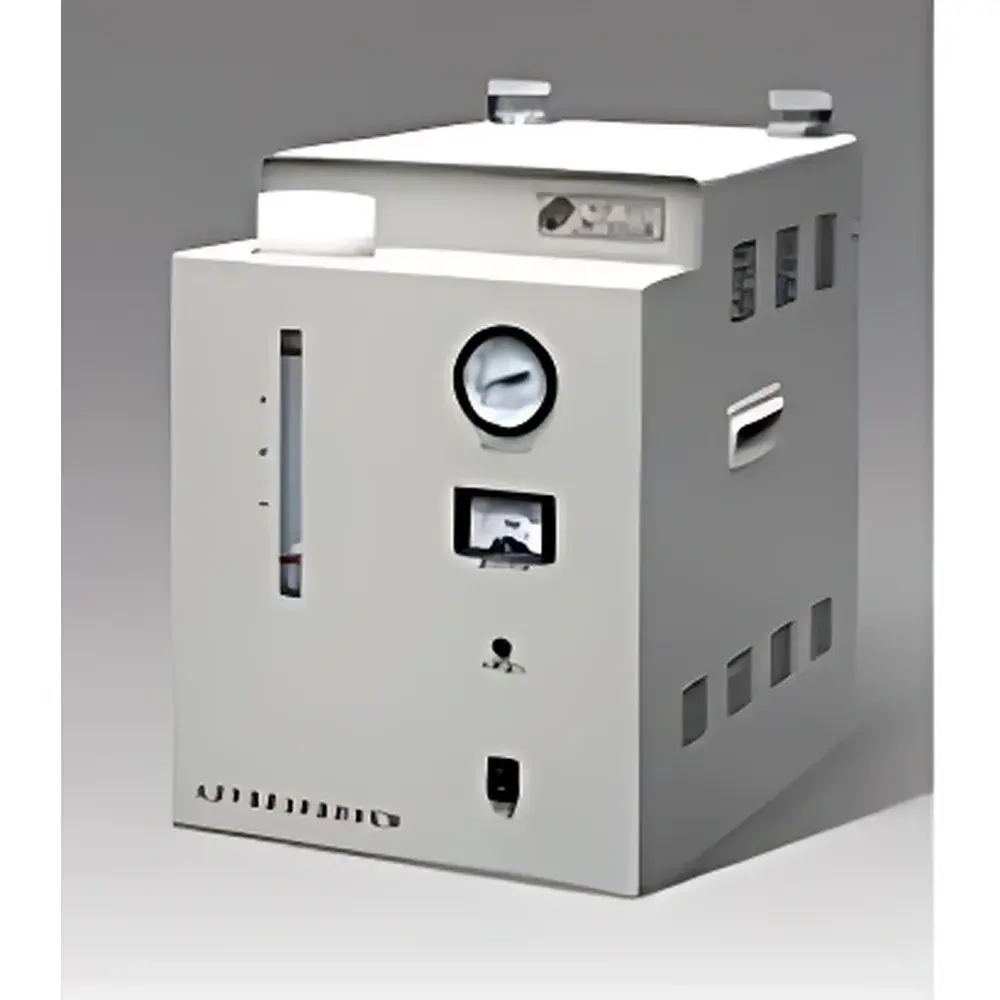
GCD-1000 High-Purity Hydrogen Generator
| Origin | Beijing, China |
|---|---|
| Manufacturer Type | Authorized Distributor |
| Origin Category | Domestic (PRC) |
| Model | GCD-1000 |
| Quotation | Upon Request |
| Purity | 99.999% H₂ |
| Flow Rate | 0–1000 mL/min |
| Output Pressure | 0–0.4 MPa |
| Pressure Stability | < 0.001 MPa |
| Power Supply | 220 V ±10%, 50 Hz |
| Power Consumption | 400 W |
| Dimensions (W×D×H) | 460 × 370 × 360 mm |
| Net Weight | ~20 kg |
Overview
The GCD-1000 High-Purity Hydrogen Generator is an on-demand, membrane-based electrolytic hydrogen source engineered for continuous, reliable operation in analytical laboratories—particularly as a carrier and fuel gas for gas chromatography (GC), GC–MS, and trace-level hydrogenation applications. It employs a proton exchange membrane (PEM) electrolysis cell to generate high-purity hydrogen from deionized water, eliminating the need for high-pressure gas cylinders and associated safety, logistics, and regulatory overhead. The system delivers ultra-high-purity hydrogen (≥99.999%) with tightly controlled flow (0–1000 mL/min) and pressure (0–0.4 MPa), meeting stringent requirements for baseline stability in flame ionization detection (FID), thermal conductivity detection (TCD), and pulsed discharge helium ionization detection (PDHID). Its closed-loop pressure regulation architecture ensures long-term stability (<0.001 MPa drift), minimizing retention time variability and improving method robustness across multi-day analyses.
Key Features
- Real-time digital display of output pressure and hydrogen flow rate, with fully automated pressure- and flow-regulation via integrated PID-controlled solenoid valves and back-pressure regulators.
- Dual-stage stainless-steel filtration system incorporating proprietary low-sulfur silicone O-rings and pre-packed oxygen scavenging media—requiring no periodic activation or regeneration—to maintain consistent ≤0.1 ppm O₂ and ≤0.1 ppm H₂O residual levels.
- Integrated anti-backflow alkaline protection circuitry that detects and prevents electrolyte migration into the gas stream under transient load or shutdown conditions—ensuring uninterrupted instrument compatibility and column integrity.
- Compact benchtop footprint (460 × 370 × 360 mm) with vibration-damped chassis and EMI-shielded power electronics, suitable for placement adjacent to GC ovens or within enclosed instrument cabinets.
- Compliance-ready design featuring non-volatile memory logging of operational hours, pressure/flow setpoints, and fault events—supporting audit trails required under GLP and ISO/IEC 17025 laboratory accreditation frameworks.
Sample Compatibility & Compliance
The GCD-1000 is compatible with all major GC platforms requiring ultra-high-purity hydrogen—including Agilent, Thermo Fisher Scientific, Shimadzu, and PerkinElmer systems—as both carrier gas (for capillary columns) and detector fuel (for FID, NPD, and FPD). It meets ASTM D7217–22 specifications for hydrogen purity in hydrocarbon analysis and aligns with USP and EP 2.2.27 guidelines for pharmaceutical gas quality. The generator’s internal wetted materials (316L SS, PTFE, and low-sulfur silicone elastomers) are certified per FDA CFR 21 Part 177.2600 for indirect food contact, ensuring absence of sulfur compounds that could poison noble-metal catalysts or elevate GC baseline noise. No external cooling or compressed air supply is required; operation is validated over ambient temperatures of 15–35 °C and relative humidity ≤80% non-condensing.
Software & Data Management
While the GCD-1000 operates autonomously via front-panel controls, optional RS-232 or USB-to-serial interface enables integration with laboratory information management systems (LIMS) or centralized monitoring dashboards. Logged parameters—including cumulative runtime, average flow deviation, and pressure fluctuation amplitude—are exportable as CSV files for trend analysis and preventive maintenance scheduling. All firmware updates are performed offline via secure USB stick, preserving data integrity during revision cycles. Audit trail records comply with FDA 21 CFR Part 11 requirements when deployed with validated electronic signature protocols and role-based access control (RBAC) on connected host systems.
Applications
- Carrier gas for capillary GC and GC–MS analyses of volatile organic compounds (VOCs), residual solvents, and environmental pollutants.
- Fuel gas for flame ionization detectors (FID), nitrogen–phosphorus detectors (NPD), and flame photometric detectors (FPD), enabling stable, low-noise response with extended detector lifetime.
- Hydrogen source for online catalytic microreactors and hydride generation atomic absorption spectrometry (HG-AAS).
- Lab-scale reducing atmosphere generation for catalyst testing, material synthesis, and electrochemical cell conditioning where cylinder-derived impurities (e.g., CO, CH₄, O₂) must be excluded.
- Backup or primary hydrogen supply in regulated pharmaceutical QC labs performing dissolution testing, extractables/leachables studies, or stability-indicating assays per ICH Q2(R2).
FAQ
What type of water feed does the GCD-1000 require?
Deionized water with resistivity ≥15 MΩ·cm and total organic carbon (TOC) < 50 ppb. A dedicated DI water loop or point-of-use purification unit is recommended.
Is routine maintenance required beyond water refills?
Yes—annual replacement of the dual-stage filter cartridge and biannual inspection of PEM stack performance via built-in diagnostic mode are advised to sustain 99.999% purity specification.
Can the GCD-1000 be integrated into a GC auto-sampler sequence?
Yes, via dry-contact relay outputs triggered by GC start/stop signals or programmable TTL pulses synchronized to method run initiation.
Does the generator support remote monitoring via Ethernet or Wi-Fi?
No—remote connectivity is limited to RS-232/USB serial interfaces. Ethernet or IoT-capable variants are available under custom OEM configuration.
What safety certifications does the GCD-1000 hold?
CE marking per EN 61010-1:2019 (Safety Requirements for Electrical Equipment), RoHS 2011/65/EU compliance, and UL recognition pending final third-party validation at time of publication.



