
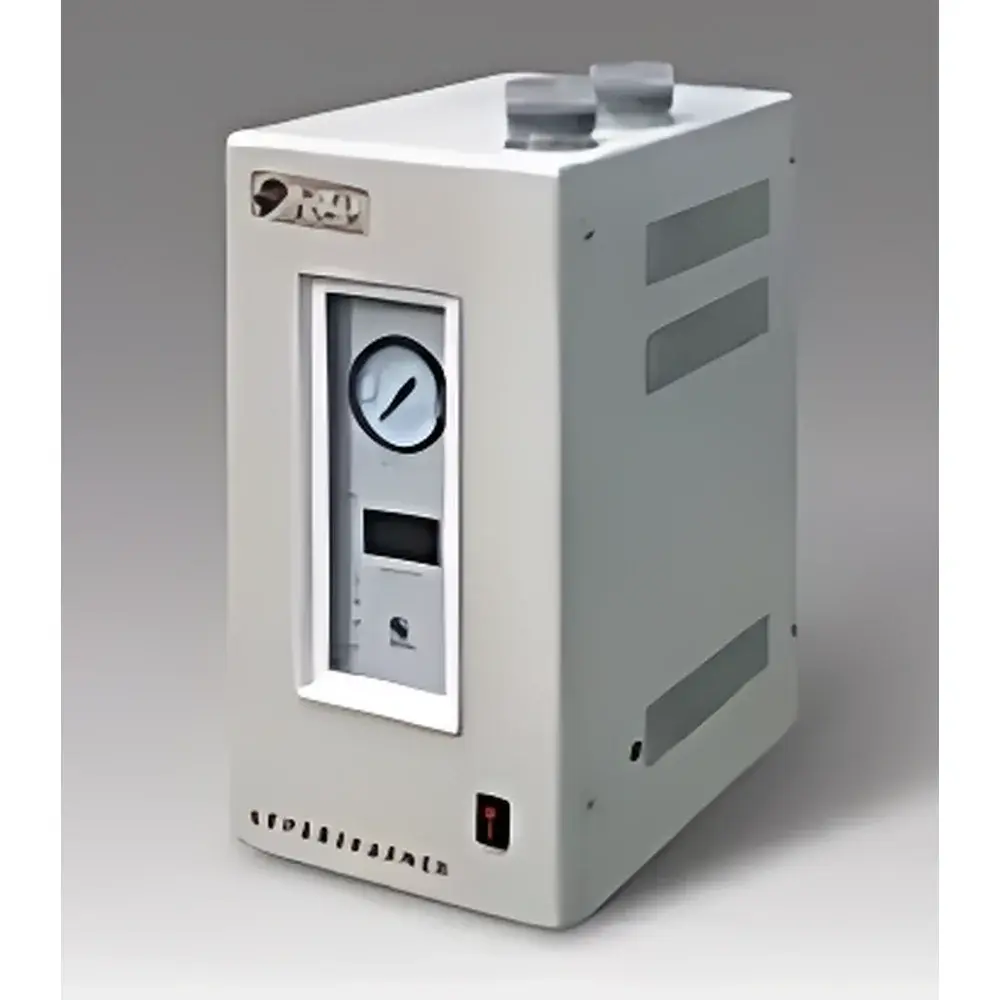
SPH-300 High-Purity Hydrogen Generator
| Origin | Beijing, China |
|---|---|
| Manufacturer Type | Authorized Distributor |
| Origin Category | Domestic (China) |
| Model | SPH-300 |
| Price | Upon Request |
| Hydrogen Purity | 99.999% |
| Flow Rate | 0–300 mL/min |
| Output Pressure | 0–0.4 MPa / 0–0.6 MPa (dual-range selectable) |
| Pressure Stability | < 0.001 MPa |
| Power Supply | 220 V ±10%, 50 Hz |
| Power Consumption | 150 W |
| Dimensions (W×D×H) | 370 × 330 × 180 mm |
| Net Weight | ~11 kg |
Overview
The SPH-300 High-Purity Hydrogen Generator is an electrolysis-based gas generation system engineered for continuous, on-demand production of ultra-high-purity hydrogen (≥99.999%) in analytical laboratory environments. It employs a proton exchange membrane (PEM) or alkaline electrolytic cell architecture—optimized for stable operation under variable load conditions—to supply carrier and fuel gas for gas chromatography (GC), GC–MS, and other hydrogen-dependent instrumentation. Unlike cylinder-based alternatives, the SPH-300 eliminates logistical constraints, safety risks associated with high-pressure storage, and batch-to-batch purity variability. Its design prioritizes long-term operational reliability, minimal maintenance intervals, and seamless integration into existing lab infrastructure via standard 220 V AC input and regulated gas outlet ports.
Key Features
- Real-time digital display of output pressure and flow rate, enabling precise monitoring and traceable operational logging.
- Intelligent auto-regulation system maintains constant pressure or constant flow mode—user-selectable—ensuring consistent gas delivery across fluctuating instrument demand.
- Dual stainless-steel filtration stages: primary particulate removal followed by catalytic oxygen scavenging (pre-loaded, non-regenerable, sulfur-free deoxygenation media), achieving ≤0.1 ppm O₂ residual in final output.
- Low-sulfur silicone elastomer seals throughout the gas path prevent sulfur contamination—a critical requirement for sulfur-sensitive detectors (e.g., PFPD, SCD) and extended column lifetime in GC applications.
- Configurable dual-pressure output (0–0.4 MPa and 0–0.6 MPa ranges), supporting both standard GC carrier gas requirements and higher-pressure applications such as micro-GC or hydrogen-powered fuel cells.
- Integrated safety architecture includes automatic alkali backflow prevention, over-pressure shutoff, dry-run protection, and thermal cutoff—fully compliant with IEC 61010-1 for laboratory electrical equipment safety.
Sample Compatibility & Compliance
The SPH-300 is designed exclusively for purified water feedstock (deionized or distilled, resistivity ≥1 MΩ·cm). It does not require chemical reagents, KOH solution replenishment, or periodic catalyst activation—reducing operator dependency and procedural variability. All wetted materials—including electrolytic cell components, tubing, and fittings—are certified compatible with high-purity hydrogen service per ASTM F1241 and ISO 8573-1 Class 1 (for particles) and Class 2 (for moisture and oil). The generator meets electromagnetic compatibility (EMC) requirements per EN 61326-1 and is suitable for use in GLP-compliant laboratories where audit-ready documentation of gas source integrity is required.
Software & Data Management
While the SPH-300 operates as a standalone hardware unit without embedded firmware-based data logging, its analog pressure and flow outputs (0–5 V or 4–20 mA optional upon request) are compatible with third-party laboratory information management systems (LIMS) and building automation platforms. Users may integrate operational status signals into centralized monitoring dashboards for preventive maintenance scheduling and compliance reporting. For labs operating under FDA 21 CFR Part 11 requirements, external data acquisition modules with electronic signature capability can be deployed to capture timestamped pressure/flow events, supporting audit trails during regulatory inspections.
Applications
- Carrier gas supply for capillary and packed-column gas chromatography (including FID, TCD, and ECD detectors).
- Fuel gas for flame ionization detection (FID) and reduction gas in chemiluminescence NOx analyzers.
- Hydrogen source for portable GC systems, field-deployable environmental monitors, and hydrogenation reaction support in synthetic chemistry labs.
- Calibration gas generation in metrology laboratories requiring traceable, stable H2 flow standards.
- Backup or primary hydrogen source in facilities transitioning from cylinder-based logistics to sustainable, just-in-time gas generation.
FAQ
What feed water quality is required for optimal performance?
Deionized or distilled water with resistivity ≥1 MΩ·cm and total organic carbon (TOC) < 50 ppb is recommended. Use of tap water or low-resistivity water will accelerate electrolyte degradation and compromise purity.
Does the SPH-300 require periodic catalyst regeneration or consumable replacement?
No. The oxygen removal media is pre-charged and non-regenerable; typical service life exceeds 12 months at nominal flow (200 mL/min). Filter elements are replaced annually or per usage log—no user activation or conditioning is needed.
Can the SPH-300 be used in explosion-hazardous areas?
No. It is rated for general laboratory use only (non-classified environment) and must be installed in well-ventilated, non-confined spaces per NFPA 55 and local hydrogen safety codes.
Is remote monitoring or Ethernet connectivity supported?
Not natively. However, analog signal outputs allow integration with PLCs, SCADA systems, or LIMS via standard industrial I/O interfaces.
How does the SPH-300 ensure compliance with ISO 8573-1 for compressed air/gas purity classes?
While ISO 8573-1 primarily addresses compressed air, its particle/moisture/oil classification framework is adapted for hydrogen by referencing ASTM D7612 and CGA G-5.1. The SPH-300’s dual filtration and low-sulfur material set meet equivalent Class 1 particulate and Class 2 moisture specifications when operated within specified ambient humidity limits (<60% RH).



