
Restek GC-Specific Thermal Conductivity Gas Leak Detector
| Brand | Restek |
|---|---|
| Model | GC-Specific Thermal Conductivity Gas Leak Detector |
| Detection Principle | Thermal Conductivity Differential Sensing |
| Detectable Gases | He, H₂, N₂, Ar, CO₂ |
| Minimum Detectable Leak Rate | 1.0 × 10⁻⁶ atm·cc/sec (H₂), 1.0 × 10⁻⁵ atm·cc/sec (He), 1.0 × 10⁻⁴ atm·cc/sec (Ar/CO₂), 1.4 × 10⁻³ atm·cc/sec (N₂) |
| Response Time | ≤2 seconds |
| Power Supply | Rechargeable NiMH battery (6 h typical operation) with low-battery and charging indicators |
| Operating Temperature | 0–48 °C (32–120 °F) |
| Relative Humidity | 0–97 % RH |
| Enclosure Rating | CE, Ex (ATEX/IECEx compliant for non-incendive use), Japan PSE |
| Compliance | RoHS, WEEE |
| Auto-Zero Function | One-button activation |
| Probe Design | Ruggedized, flexible-tip, cleanable, position-switch enabled |
| Housing | Ergonomic handheld chassis with side-grip reinforcement |
| Auto-Shutdown | Enabled after 5 minutes of inactivity |
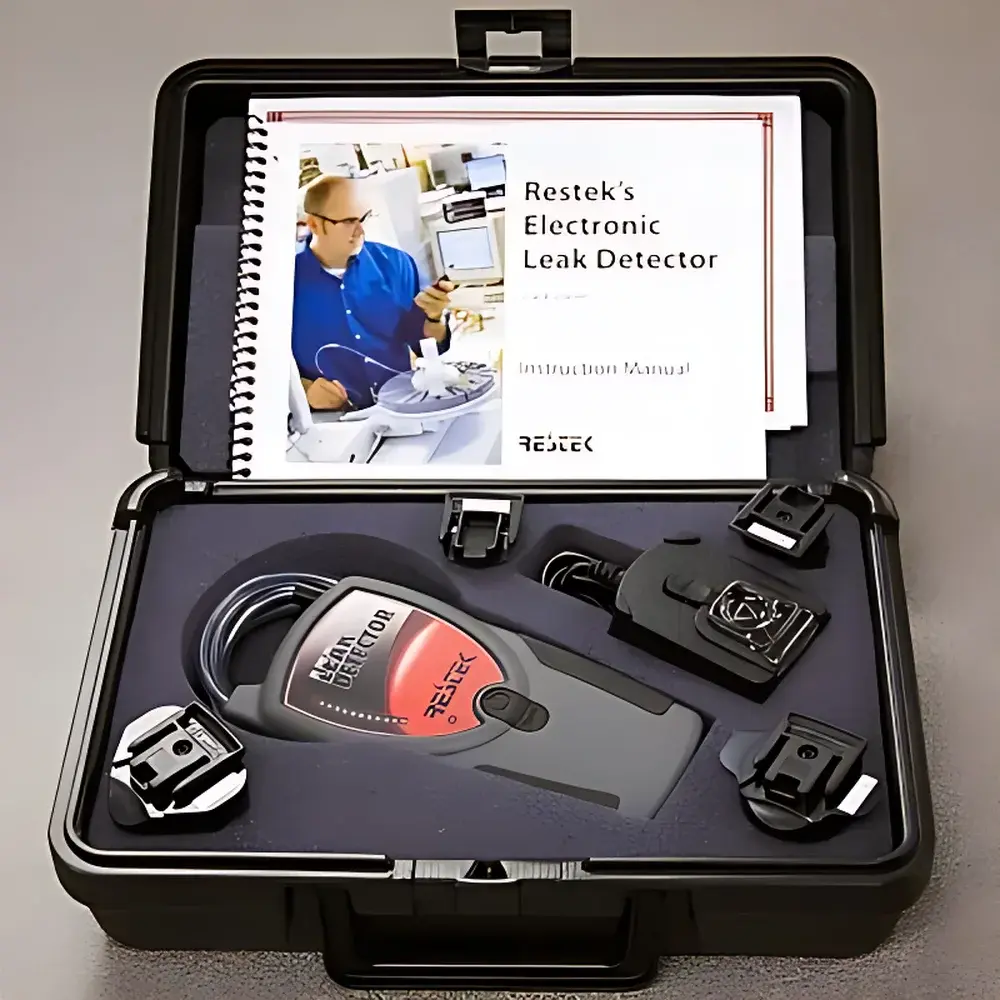
| Accessories Included | Hard-shell carrying case, universal AC adapter kit |
| Warranty | 1 year limited |
Overview
The Restek GC-Specific Thermal Conductivity Gas Leak Detector is a precision-engineered handheld instrument designed exclusively for rapid, reliable leak verification within gas chromatography (GC) systems. It operates on the principle of differential thermal conductivity sensing: ambient air drawn through a reference inlet is compared against sample gas aspirated via a flexible probe tip; any deviation in thermal transport properties—caused by trace concentrations of gases with thermal conductivities distinct from air—generates a measurable voltage shift proportional to leak magnitude. This physics-based detection method enables real-time identification of sub-microliter-per-second leaks without requiring system pressurization or external tracer gases. Unlike soap-bubble or ultrasonic methods, this detector delivers quantitative sensitivity down to 1.0 × 10⁻⁶ atm·cc/sec for hydrogen and 1.0 × 10⁻⁵ atm·cc/sec for helium—levels undetectable by conventional liquid-based techniques. Its application scope is strictly limited to inert or non-flammable environments during GC maintenance, aligning with IEC 60079-0 and ATEX Zone 2 operational safety boundaries.
Key Features
- One-button auto-zero calibration eliminates baseline drift and ensures measurement repeatability across ambient temperature fluctuations.
- Ergonomic, reinforced side-grip housing provides tactile control and mechanical durability during extended field use.
- Multi-color LED indicator system: red for high-sensitivity detection (H₂, He), yellow for moderate-sensitivity gases (N₂, Ar, CO₂), enabling immediate visual leak classification.
- Integrated audible alarm synchronized with LED response—audible tone activates within ≤2 seconds of leak onset, meeting ASTM E2654-20 requirements for operator alert latency.
- Rechargeable NiMH battery pack supports up to six hours of continuous operation; status LEDs indicate charge level and charging progress.
- Modular probe assembly features chemically resistant, cleanable sensor tips and a swappable orientation switch to prevent accidental power activation during storage or transport.
- Automatic shutdown after five minutes of inactivity conserves battery life and complies with ISO 9001 energy management protocols.
Sample Compatibility & Compliance
This detector is validated for use with common GC carrier and makeup gases—including helium, hydrogen, nitrogen, argon, and carbon dioxide—under ambient laboratory conditions (0–48 °C, 0–97 % RH). It is explicitly not certified for use in flammable or explosive atmospheres beyond Class II, Division 2 / Zone 2 per NEC/IEC standards. The device bears CE marking, Ex certification for non-incendive operation, and Japan PSE approval. It conforms to RoHS Directive 2011/65/EU and WEEE Directive 2012/19/EU. While not FDA 21 CFR Part 11–compliant (as it generates no audit-trail-capable digital records), its analog output behavior satisfies GLP-aligned QC documentation requirements when paired with manual log entries per ISO/IEC 17025:2017 Clause 7.7.
Software & Data Management
The GC-Specific Thermal Conductivity Gas Leak Detector operates as a standalone analog instrument with no embedded firmware, cloud connectivity, or data logging capability. All measurements are conveyed via dual-channel real-time feedback: simultaneous LED color coding and pulsed audio signaling. This architecture intentionally omits software dependencies to ensure operational reliability in regulated laboratories where validation of digital subsystems would otherwise require IQ/OQ/PQ documentation per GAMP 5 guidelines. Users maintain compliance by recording detection events—including time, location, gas type inferred, and observed LED/audio response—in paper-based or LIMS-integrated maintenance logs.
Applications
Primary deployment includes routine integrity verification of GC gas delivery pathways: column inlet ferrules, detector base seals, septum purge lines, split/splitless vent fittings, and carrier gas regulators. Early detection prevents baseline noise, retention time shifts, detector contamination, excessive carrier gas consumption, and premature column degradation—common failure modes linked to undetected microleaks per ASTM D3612 and USP . It is also employed during method transfer qualification, post-maintenance revalidation, and vendor qualification audits where documented leak-free status is required under ISO 17025 Clause 6.4.2. The instrument does not replace combustible gas detectors in safety-critical zones but serves as a metrologically traceable tool for analytical system integrity assurance.
FAQ
Is this detector suitable for locating leaks in hydrogen-fueled environments?
No. It is certified only for non-incendive use in Zone 2 / Class II, Division 2 areas. Hydrogen leak detection in potentially flammable settings requires UL-listed catalytic bead or electrochemical sensors meeting NFPA 505 or IEC 61779-1.
Can the probe be used inside narrow tubing or detector ovens?
Yes. The flexible, low-profile probe tip (diameter <3 mm) accesses confined spaces including GC oven interiors, detector housings, and 1/16″ stainless steel capillary connections without risk of fracture.
Does the device require periodic calibration with certified gas standards?
No. The auto-zero function compensates for thermal drift; however, annual functional verification using a known 1 × 10⁻⁵ atm·cc/sec helium leak standard (e.g., NIST-traceable orifice) is recommended per ISO/IEC 17025 Clause 6.6.
What accessories are included with model #22839?
A hard-shell carrying case, universal AC adapter kit (100–240 VAC input), and user manual. Optional accessories include soft pouch (#22657) and micro-probe adapter (#22658) for sub-2 mm access points.