
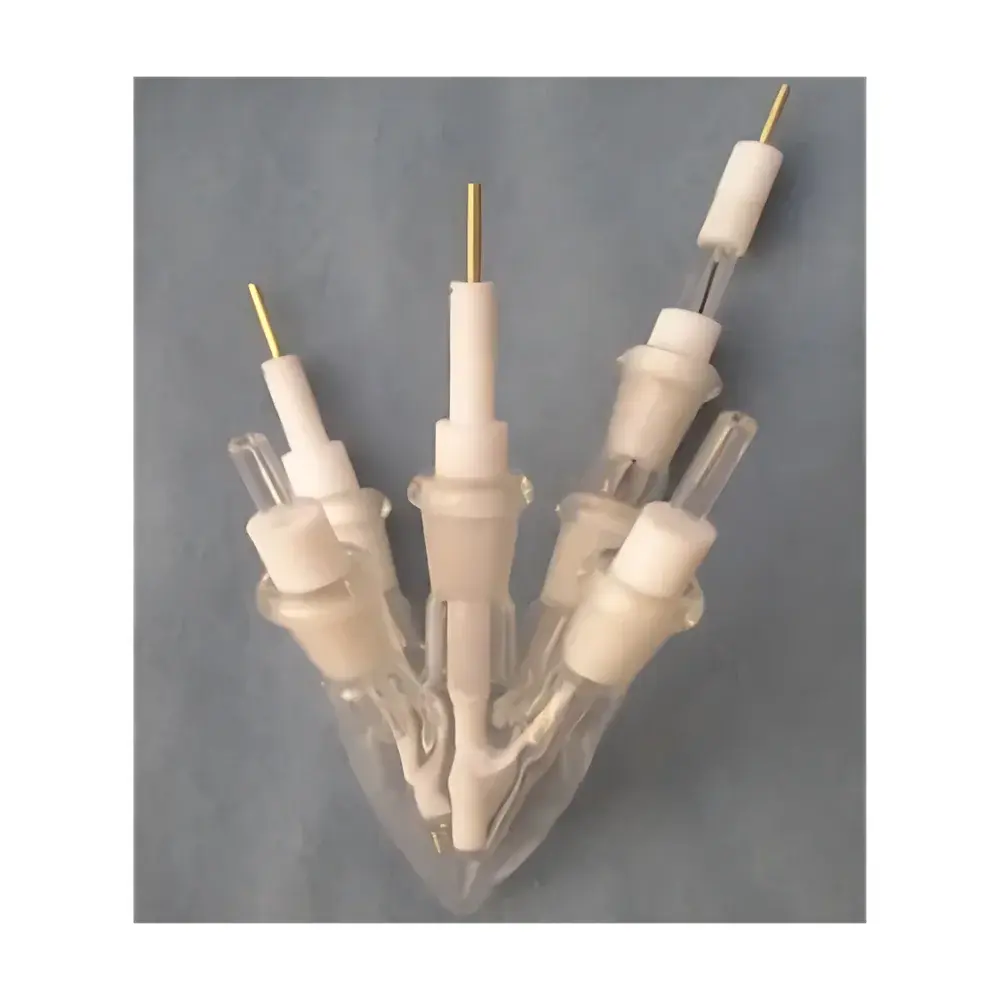
Five-Port Electrochemical Cell (Zhongjiaojinyuan C004 & C010)
| Brand | Zhongjiaojinyuan |
|---|---|
| Origin | Beijing, China |
| Manufacturer Type | Direct Manufacturer |
| Origin Category | Domestic (China) |
| Model | C004 (5–20 mL capacity) / C010 (150–500 mL capacity) |
| Electrode Ports | Five Standard Ground-Glass Joints (24/29 or 29/32, configurable per order) |
| Material | High-Purity Borosilicate Glass (DIN/ISO-compliant) |
| Thermal Stability | –20 °C to +150 °C |
| Pressure Rating | Ambient to 0.2 MPa (gauge) |
| Sealing | PTFE-coated ground-glass joints with vacuum grease compatibility |
Overview
The Zhongjiaojinyuan Five-Port Electrochemical Cell is a modular, all-glass electrochemical reactor engineered for controlled potentiostatic and galvanostatic experiments under inert, humidified, or reactive gas atmospheres. Designed around the Couette-type three-electrode configuration, it enables precise electrochemical impedance spectroscopy (EIS), cyclic voltammetry (CV), chronoamperometry, and bulk electrolysis in both aqueous and non-aqueous media. Its five standardized ground-glass ports—two dedicated to gas inlet/outlet, one for the Luggin capillary (optional), and two for independent electrode insertion—provide full configurability of electrode geometry, inter-electrode distance, and mass transport conditions. The cell’s borosilicate glass construction ensures chemical inertness toward strong acids (e.g., H₂SO₄, HCl), alkalis (e.g., KOH), organic solvents (e.g., acetonitrile, DMF), and halogenated electrolytes, while supporting optical access for in situ UV-Vis or Raman spectroelectrochemical coupling.
Key Features
- Two distinct volume variants: C004 (5–20 mL) optimized for low-volume, high-sensitivity measurements with minimal electrolyte consumption and rapid potential settling; C010 (150–500 mL) designed for extended-duration electrolysis, multi-electrode arrays, or integration with external flow cells and gas recirculation manifolds.
- Five interchangeable 24/29 or 29/32 ground-glass joints (specify at time of order), each fitted with PTFE-sealed stopcocks or threaded caps for leak-tight operation under static or dynamic gas purging.
- Integrated Luggin capillary port (standard on C010; optional add-on for C004) enables accurate uncompensated solution resistance (Ru) correction and minimizes iR drop during high-current-density experiments.
- All electrodes supplied as extended-length variants (≥150 mm shaft length), facilitating deep immersion into tall vessels and compatibility with commercial rotating disk electrode (RDE) stands and glovebox-mounted potentiostat interfaces.
- Borosilicate glass body conforms to ISO 3585 and ASTM E438 Type I, Class A specifications, ensuring dimensional repeatability, thermal shock resistance, and long-term stability under repeated autoclaving (up to 121 °C, 20 min).
Sample Compatibility & Compliance
The cell accommodates standard electrochemical working electrodes—including Pt, Au, GC, Ni foam, and custom-printed electrodes—as well as reference systems such as Ag/AgCl (3 M KCl), SCE, and reversible hydrogen electrode (RHE) assemblies. It supports gas-saturated electrolytes (N₂, Ar, O₂, CO₂, H₂) via dual-port mass flow control and is compatible with anhydrous conditions when used with Schlenk-line or glovebox protocols. The design meets fundamental requirements of ASTM D1148 (electrochemical corrosion testing), ISO 17469 (electrochemical sensor calibration), and supports GLP-compliant documentation when paired with 21 CFR Part 11–enabled potentiostats and audit-trail-capable software.
Software & Data Management
While the cell itself is hardware-only, its mechanical interface is fully compatible with major electrochemical workstations—including BioLogic SP-300, Metrohm Autolab PGSTAT302N, Pine Research WaveDriver series, and CH Instruments CHI760E. All five ports allow unobstructed cable routing and strain relief, minimizing electromagnetic interference. When used with compliant instrumentation, experimental metadata—including timestamped electrode positioning, gas flow rates, temperature logs, and cell constant validation records—can be embedded directly into binary data files (.mpt, .gp, .ch) for traceable, reproducible reporting aligned with ISO/IEC 17025 laboratory accreditation criteria.
Applications
- Electrocatalyst evaluation for CO₂ reduction, oxygen evolution/reduction, and nitrogen fixation under controlled mass transport.
- In situ electrochemical quartz crystal microbalance (EQCM) studies requiring simultaneous gas purging and acoustic coupling.
- Photoelectrochemical (PEC) testing when mounted on optical benches with collimated light sources (AM 1.5G, monochromated UV-Vis).
- Corrosion mechanism studies using electrochemical noise analysis (ENA) and localized electrochemical impedance mapping.
- Development and validation of solid-state electrolyte interfaces (SEI) in Li-ion and Na-ion battery half-cells.
FAQ
Can the C004 cell be used with a standard rotating disk electrode (RDE) setup?
Yes—the extended-length electrodes and vertical port alignment support direct mounting onto common RDE chucks; however, rotational speed must remain ≤1200 rpm to avoid vortex-induced seal leakage.
Is the cell suitable for high-temperature electrochemistry above 80 °C?
The C010 variant is rated for continuous operation up to 150 °C; use silicone-based vacuum grease and verify joint torque per DIN 12877 to maintain integrity.
Do you supply custom port configurations (e.g., side-arm condenser attachment)?
Yes—custom joint angles, additional side ports, and fused-quartz optical windows are available as OEM options upon engineering review.
What is the recommended procedure for verifying cell constant prior to quantitative conductivity measurements?
Calibrate using certified KCl standards (e.g., 0.01 M and 0.1 M) at 25 °C and apply the geometric cell constant (A/L) derived from electrode surface area and inter-electrode spacing—values are provided in the dimensional drawing package.
Are replacement ground-glass joints and PTFE sleeves available as spare parts?
Yes—all consumable sealing components are stocked under part numbers ZJY-GG2429-S, ZJY-GG2932-S, and ZJY-PTFE-SEAL-5PK, with lead time ≤5 business days.



