


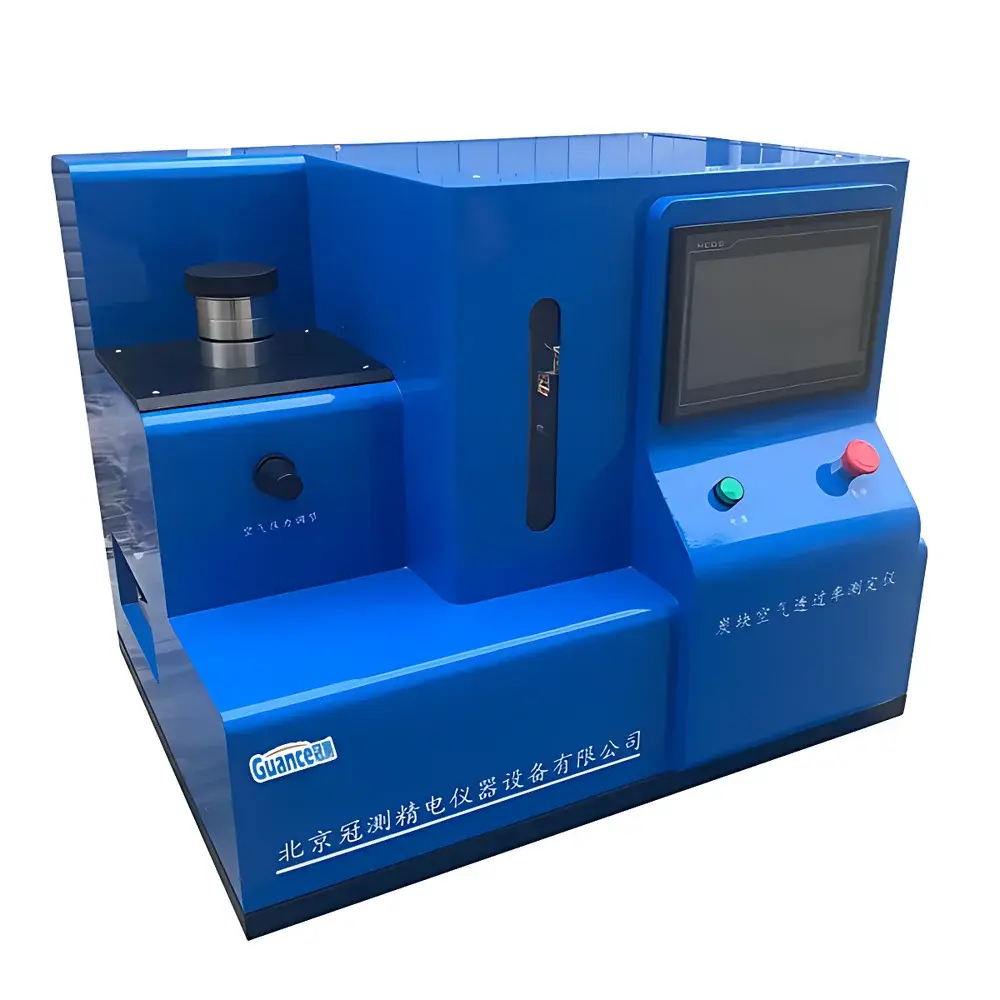
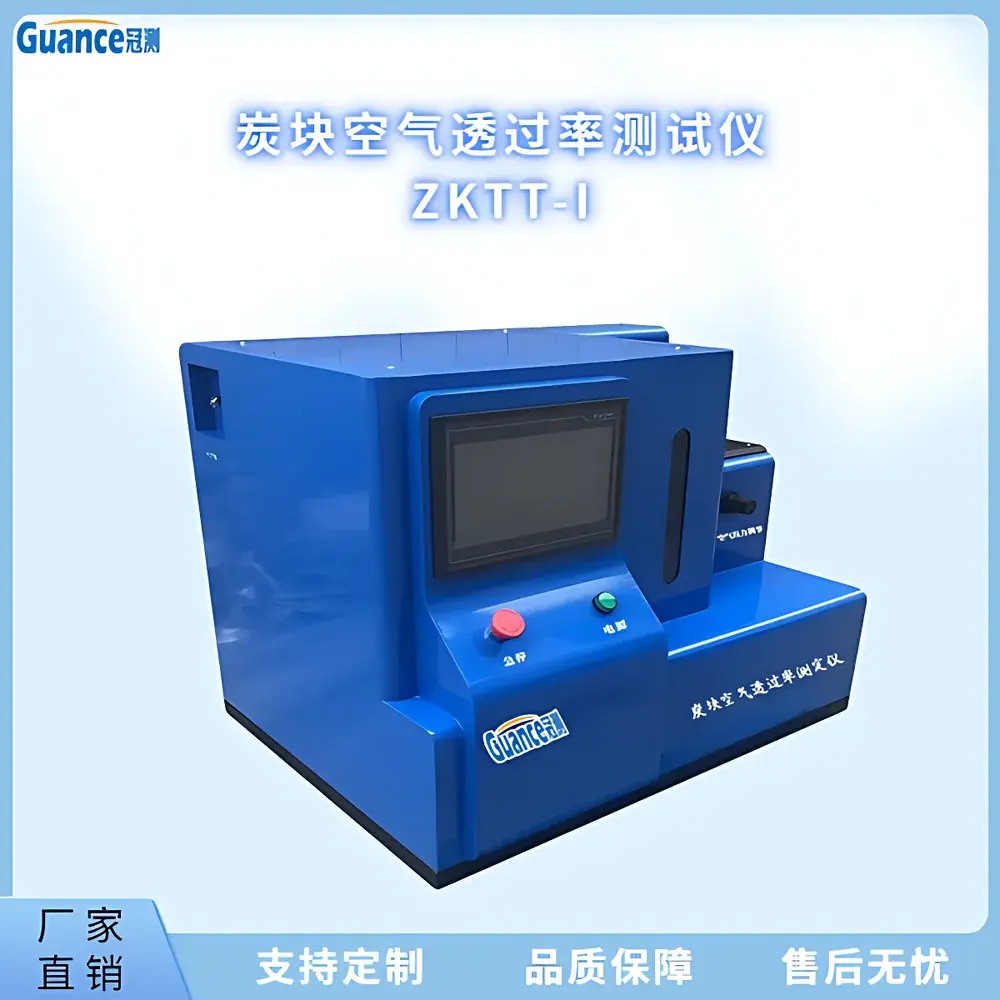
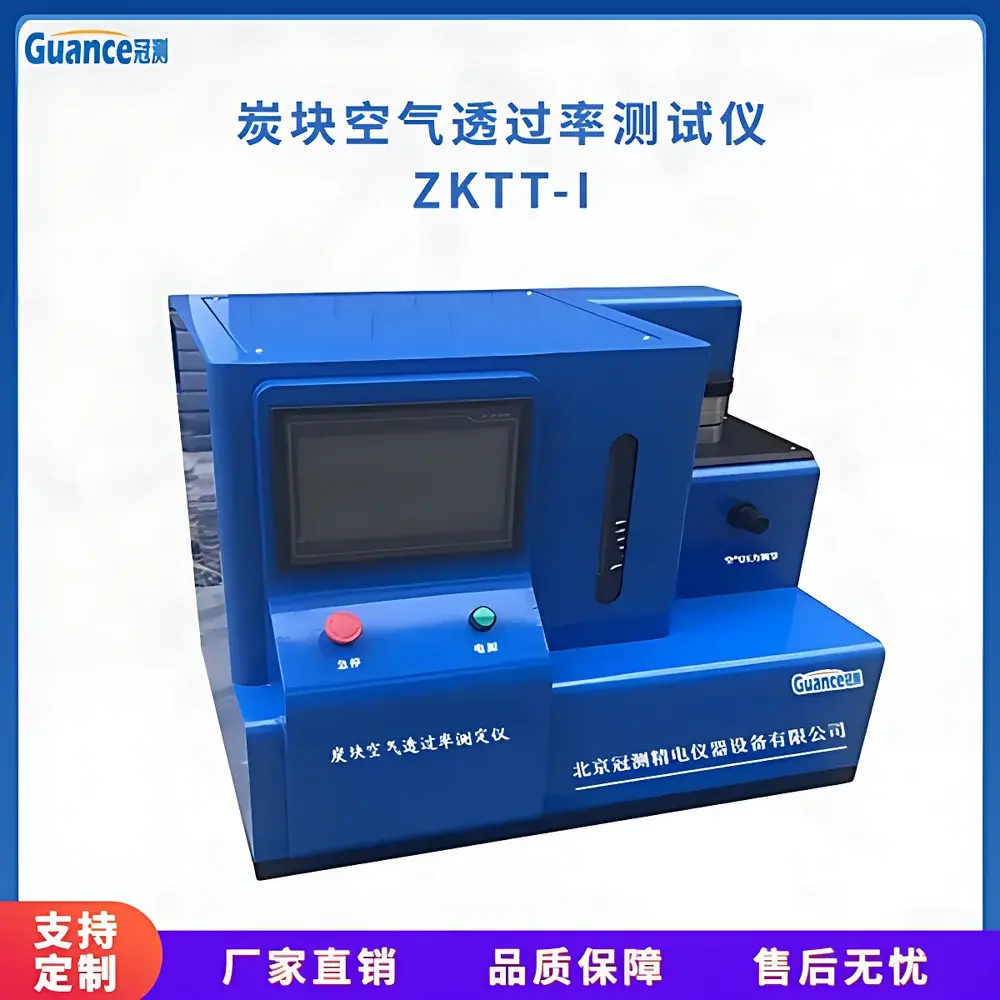
GuanCe Instruments ZKTT-I Prebaked Anode Air Permeability Tester
| Brand | GuanCe Instruments |
|---|---|
| Origin | Beijing, China |
| Manufacturer Type | Authorized Distributor |
| Origin Category | Domestic (China) |
| Model | ZKTT-I |
| Price | USD 950 (FOB Beijing) |
| Rated Power | 1 kW |
| Rated Voltage | 220 V / 50 Hz |
| Pressure Sensor Range | 0–1 MPa and −100 kPa–0 |
| Sample Dimensions | Ø50 mm × 20 mm |
| Measurement Range | 0.01 × 10⁻⁹ m² to 20 × 10⁻⁹ m² |
| Maximum Flow Rate | 25 L/min |
| Equipment Dimensions | 800 mm (L) × 620 mm (W) × 670 mm (H) |
| Weight | 100 kg |
Overview
The GuanCe Instruments ZKTT-I Prebaked Anode Air Permeability Tester is a precision-engineered instrument designed specifically for the quantitative determination of air permeability in carbonaceous prebaked anodes used in aluminum electrolysis. It operates on the principle of Darcy’s law under controlled differential pressure conditions: air is driven through a cylindrical sample under a regulated vacuum and upstream pressure, and the resulting volumetric flow rate is measured with high-stability differential pressure transducers. The derived permeability coefficient—expressed in square meters (m²)—is calculated directly from the measured flow, pressure gradient, sample cross-sectional area, and thickness. This method aligns with standardized gas transport physics for porous solids and is essential for predicting anode oxidation behavior, energy efficiency, and service life in Hall–Héroult cells. The ZKTT-I is not a generic gas permeability tester; it is purpose-built for the mechanical and thermal constraints of baked carbon anodes, including dimensional tolerances, surface roughness effects, and low-permeability ranges typical of high-density graphitized carbon.
Key Features
- PLC-based embedded control architecture ensures deterministic timing, repeatable vacuum ramping, and real-time error handling during test cycles.
- Dual-range pressure sensing system: high-resolution absolute sensor (−100 kPa to 0) for vacuum chamber monitoring and robust gauge sensor (0–1 MPa) for upstream compressed air regulation—enabling precise differential pressure control across the full measurement range.
- Integrated human-machine interface (HMI) via 7-inch industrial touchscreen: displays real-time flow curves, pressure stabilization status, elapsed time, and pass/fail indicators per ISO 15906 protocol steps.
- Compressed-air-assisted rapid evacuation: eliminates reliance on mechanical vacuum pumps alone, reducing cycle time by up to 40% while maintaining <±0.5% pressure stability during steady-state flow measurement.
- Modular hardware design supports optional integration of desiccant drying units and certified oil-free compressors—critical for eliminating moisture-induced measurement drift in low-permeability samples.
- Electrostatically coated steel enclosure (RAL 7035) provides corrosion resistance compliant with ISO 12944 C3 industrial environments and meets IP54 ingress protection for laboratory deployment near casting or anode handling zones.
Sample Compatibility & Compliance
The ZKTT-I accepts cylindrical specimens conforming strictly to YS/T 63.10–2012 and ISO 15906:2007: Ø50.0 ± 0.1 mm diameter and 20.0 ± 0.2 mm height, with parallel end faces ground to ≤0.05 mm flatness. Sample preparation follows GB/T 26297.3–2010 Part 3 for representative core extraction from prebaked anode blocks. The instrument satisfies metrological traceability requirements for Type A uncertainty evaluation per ISO/IEC 17025:2017. All pressure sensors are factory-calibrated against NIM (National Institute of Metrology, China) reference standards, with calibration certificates provided. Test reports generated include mandatory fields required for internal QA audits and third-party certification submissions—including operator ID, environmental temperature/humidity logs, sample identification, and raw sensor output timestamps.
Software & Data Management
The ZKTT-I supports dual-mode operation: standalone HMI control and PC-based supervision via Ethernet TCP/IP. The optional GuanCe PermeaSoft v2.3 application (Windows 10/11, 64-bit) provides GLP-compliant data management: user-level access control (admin/operator), electronic signatures, full audit trail (per FDA 21 CFR Part 11 Annex 11), and automated report generation in PDF/A-1b format. Raw data exports include CSV files with millisecond-resolution pressure and flow timestamps, enabling post-hoc Darcy coefficient regression using custom MATLAB or Python scripts. Software updates are delivered via signed firmware packages with SHA-256 verification to prevent unauthorized modification.
Applications
- Quality control of prebaked anodes prior to furnace entry—verifying compliance with smelter-specified permeability limits (typically 1–8 × 10⁻⁹ m²).
- R&D screening of binder formulations, coke particle size distributions, and baking profiles to optimize pore structure development.
- Root-cause analysis of anode consumption anomalies in production cells—correlating lab-measured permeability with field oxidation rates.
- Supplier qualification testing under contractual technical specifications referencing ISO 15906 or customer-specific ASTM-derived protocols.
- Supporting ISO 50001 energy management systems by quantifying anode porosity as a key performance indicator (KPI) affecting current efficiency.
FAQ
What standards does the ZKTT-I fully support out-of-the-box?
It natively implements test sequences, acceptance criteria, and reporting templates for YS/T 63.10–2012, ISO 15906:2007 (MOD), and GB/T 26297.3–2010 Part 3.
Is the instrument suitable for testing green (unbaked) carbon bodies?
No. The ZKTT-I is validated exclusively for prebaked anodes with apparent density ≥1.55 g/cm³ and compressive strength ≥25 MPa. Green bodies exhibit excessive deformation and seal failure under test pressure.
Can the system be integrated into a LIMS environment?
Yes—via OPC UA server mode (optional license) or RESTful API endpoints for direct ingestion into LabVantage, Thermo Fisher SampleManager, or custom MES platforms.
What maintenance intervals are recommended for long-term accuracy?
Pressure sensor recalibration every 12 months; O-ring replacement and vacuum line inspection every 6 months; filter element replacement after 500 test cycles or quarterly—whichever occurs first.
Does the unit include validation documentation for GMP-regulated facilities?
IQ/OQ documentation packages are available upon request, aligned with ASTM E2500 and EU Annex 15; PQ protocols must be developed per site-specific risk assessment.






