
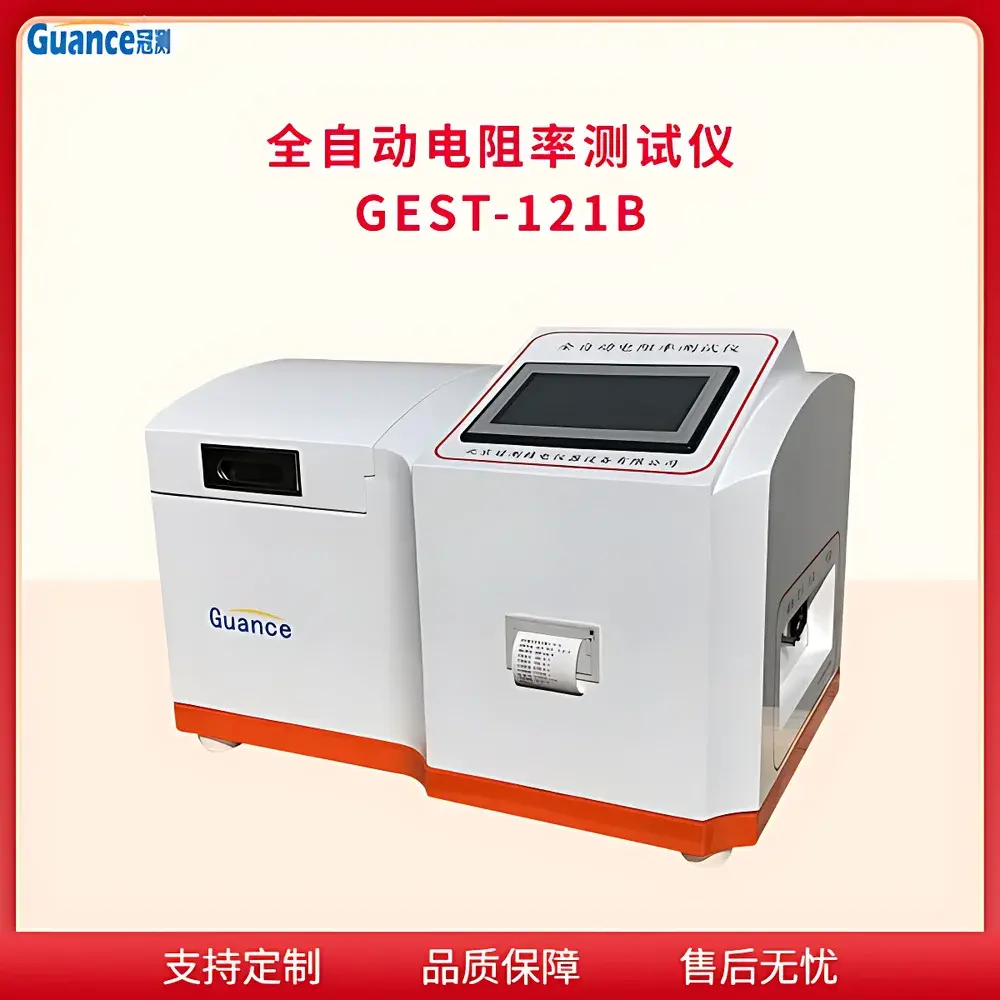
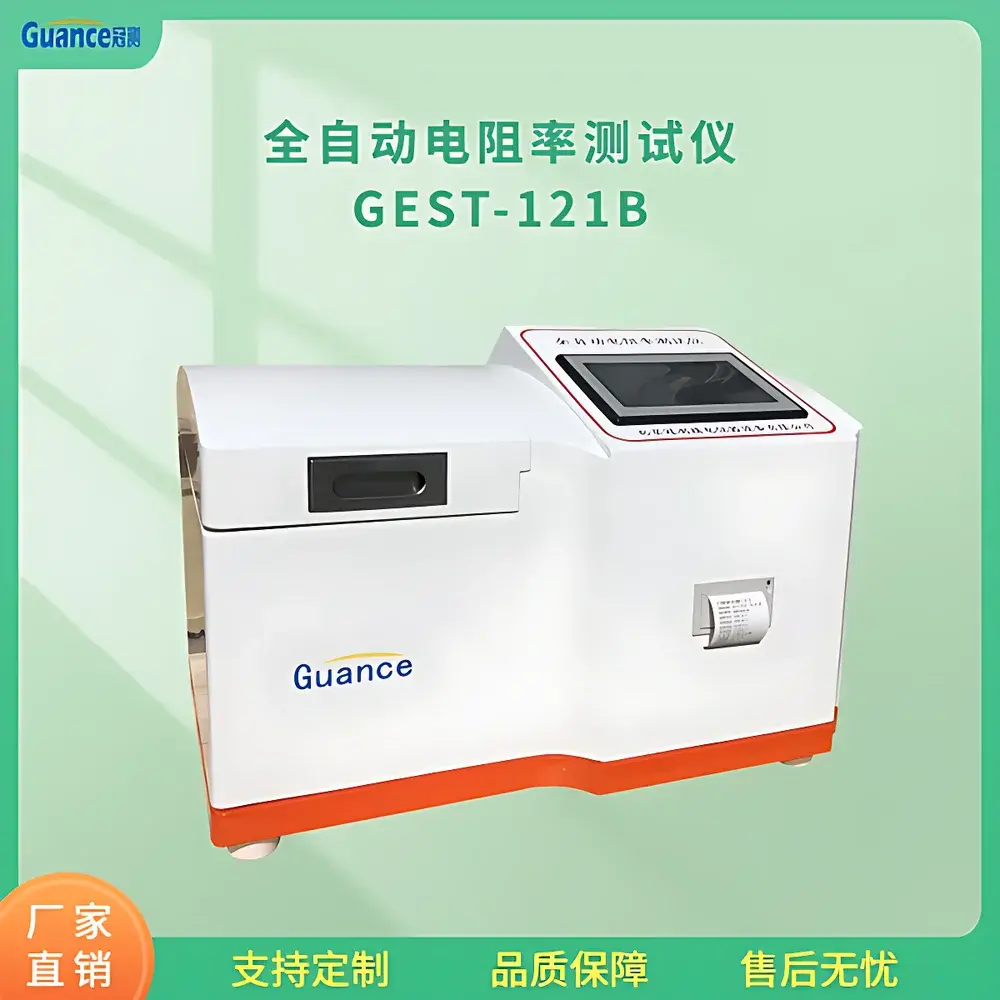
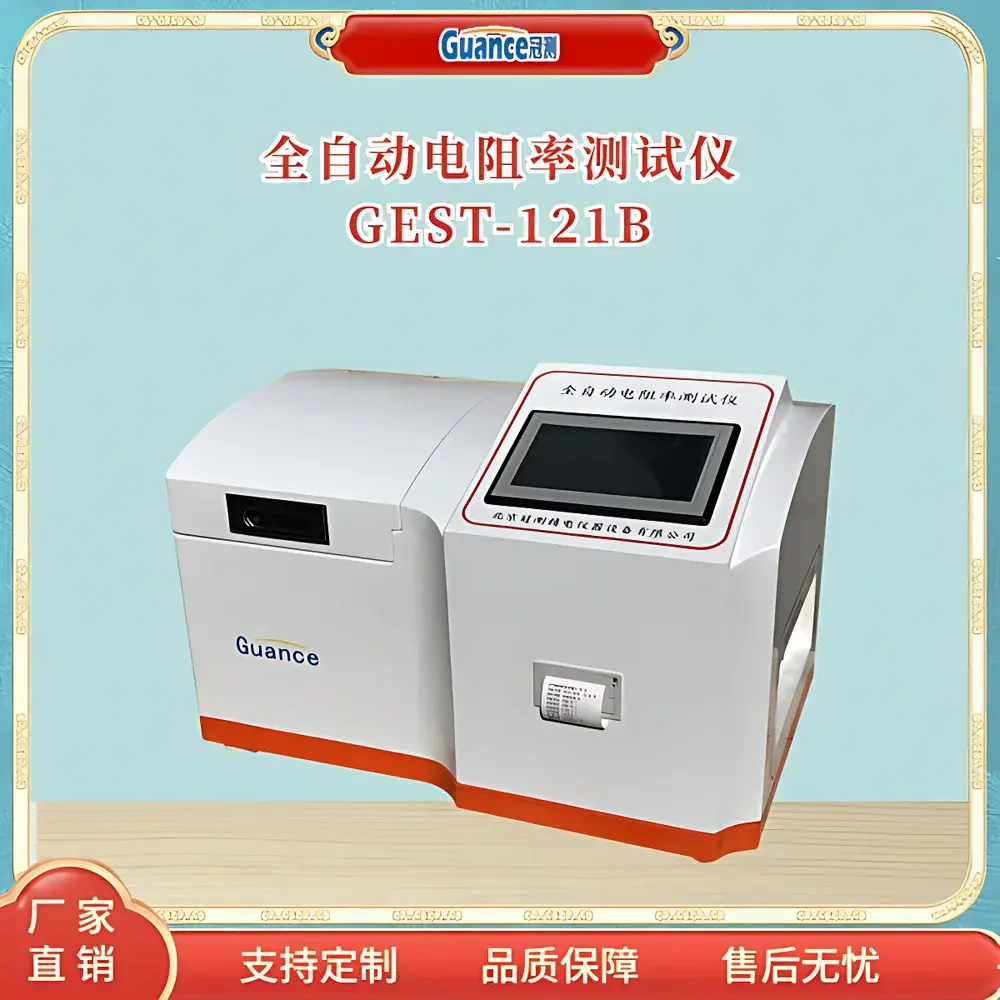
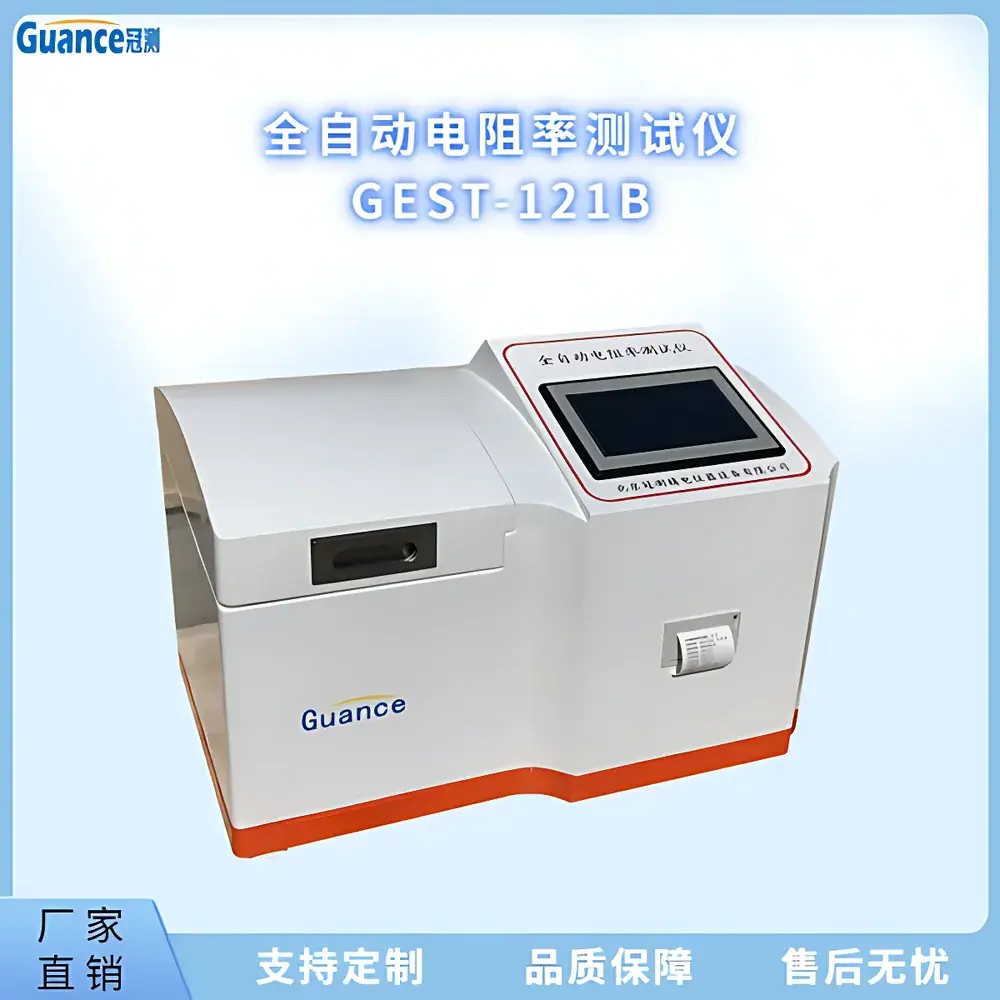
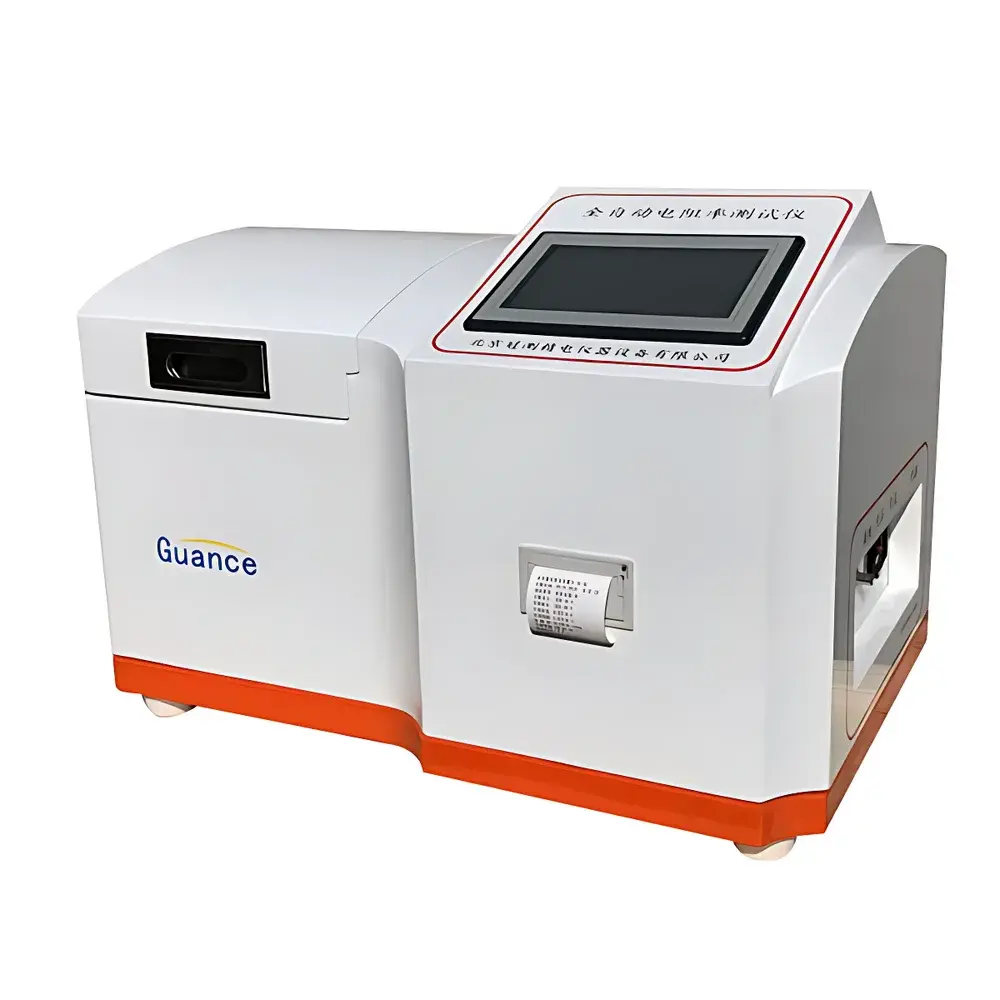
Guance GEST-121B.5 Automated Volume & Surface Resistivity Tester
| Brand | Guance |
|---|---|
| Model | GEST-121B.5 |
| Resistance Range | 1×10⁴ Ω to 1×10¹⁸ Ω |
| Current Range | 1×10⁻¹⁶ A to 2×10⁻⁴ A |
| Test Voltages | 10 V, 50 V, 100 V, 250 V, 500 V, 1000 V (selectable) |
| Accuracy | ±1% of reading |
| Display | 7-inch capacitive touchscreen |
| Compliance | GB/T 1410–2006, ASTM D257–99, GB/T 10581–2006, GB/T 1692–2008, GB/T 2439–2001, GB/T 12703.4–2010, GB/T 10064–2006, GB 1672–1988 |
| Dimensions | 285 mm × 245 mm × 120 mm |
| Weight | 2.5 kg |
| Power | AC 220 V, 50 Hz, ~5 W |
Overview
The Guance GEST-121B.5 Automated Volume & Surface Resistivity Tester is a precision benchtop instrument engineered for high-accuracy DC resistivity characterization of insulating and electrostatic-dissipative materials. It operates on the principle of constant-voltage ohmmetry, applying calibrated DC test potentials across standardized electrode configurations to measure volume resistance (Rv), surface resistance (Rs), and—through geometric correction—volume resistivity (ρv) and surface resistivity (ρs). Designed in strict alignment with international standards including ASTM D257–99 and GB/T 1410–2006, the system supports both guarded and unguarded measurement topologies to minimize leakage current errors and ensure metrological traceability. Its extended resistance range (1×10⁴ Ω to 1×10¹⁸ Ω) and ultra-low current detection capability (down to 1×10⁻¹⁶ A) make it suitable for evaluating highly insulating polymers, elastomers, thin films, powders, pastes, and liquid plasticizers under controlled environmental conditions (0–40 °C, RH <80%). The instrument integrates real-time voltage, current, resistance, and resistivity computation—eliminating manual post-processing while maintaining full compliance with GLP documentation requirements.
Key Features
- Seven programmable DC test voltages (10 V, 50 V, 100 V, 250 V, 500 V, 1000 V) with automatic polarity reversal for charge neutralization
- Auto-ranging electrometer architecture with ±1% basic accuracy across full scale, verified per IEC 61000-4-30 Class S specifications
- 7-inch industrial-grade capacitive touchscreen interface with multi-level password protection (administrator/operator modes)
- Dual measurement modes: manual step-by-step execution and fully automated timed acquisition with user-defined dwell intervals (1 s to 999 s)
- Onboard auto-calibration routine for voltage source and current amplifier offsets, traceable to NIST-certified reference standards
- Real-time display of applied voltage, measured current, raw resistance, geometrically corrected resistivity, and temperature-compensated stability index
- Integrated thermal drift compensation algorithm active during extended measurements (>60 s)
- Front-panel USB port and RS-232 interface for direct data export or remote control via SCPI command set
Sample Compatibility & Compliance
The GEST-121B.5 accommodates solid, semi-solid, and liquid specimens using interchangeable electrode fixtures—including concentric ring electrodes for surface resistivity (per ASTM D257 Figure 4), guarded parallel-plate cells for volume resistivity (GB/T 1410 Clause 6.2), and coaxial tri-electrode systems for anisotropic materials. It supports standardized sample geometries defined in GB/T 2439–2001 (rubber conductivity), GB/T 12703.4–2010 (textile electrostatic evaluation), and GB 1672–1988 (liquid plasticizer testing). All measurement protocols enforce electrode guard-ring activation where applicable to suppress edge leakage, ensuring conformance with ISO/IEC 17025 clause 7.7 (uncertainty estimation) and FDA 21 CFR Part 11 requirements for audit-trail-enabled electronic records. Full compliance documentation—including factory calibration certificates, uncertainty budgets, and standard operating procedure templates—is supplied with each unit.
Software & Data Management
The instrument ships with Guance Resistivity Suite v3.2—a Windows-based PC application supporting real-time waveform monitoring, multi-channel data logging, statistical process control (SPC) charting, and export to CSV, Excel (.xlsx), PDF, and XML formats. The software implements role-based access control, electronic signature capture, and immutable audit trails meeting ALCOA+ principles (Attributable, Legible, Contemporaneous, Original, Accurate, Complete, Consistent, Enduring, Available). Data files include embedded metadata: timestamp, operator ID, environmental readings (optional external sensor input), electrode configuration ID, and calibration expiration date. Remote firmware updates and script-driven batch testing (via Python API wrapper) are supported for integration into automated QA/QC workflows compliant with ISO 9001:2015 and IATF 16949.
Applications
- Volume and surface resistivity mapping of polymer composites, epoxy encapsulants, and aerospace-grade dielectrics
- Quality verification of ESD-safe packaging films, cleanroom garments, and conductive flooring systems
- Characterization of antistatic additives in thermoplastics and rubber compounds per GB/T 1692–2008
- Resistivity profiling of battery separator membranes and solid electrolytes under variable humidity
- Dark current analysis of photodetectors and optoelectronic sensors (current mode, 1 fA–200 nA range)
- Research-grade resistivity-temperature coefficient (αρ) determination in functional nanocomposites
- Validation of resistivity stability in medical device insulation materials per ISO 10993–12
FAQ
Does the GEST-121B.5 support guarded measurements for low-conductivity samples?
Yes—it includes hardware-enforced guard drive circuitry compatible with ASTM D257’s three-terminal configuration to eliminate surface leakage errors in samples with ρv > 1×10¹⁵ Ω·m.
Can test results be exported directly to LIMS or ERP systems?
Yes—via ASCII-formatted CSV output or OPC UA server integration (optional module); all exports include mandatory metadata fields required for 21 CFR Part 11 compliance.
Is calibration traceable to national metrology institutes?
Factory calibration is performed using Fluke 8508A reference standards, with full traceability to NIM (China National Institute of Metrology) documented in the Certificate of Calibration.
What electrode accessories are included by default?
Standard shipment includes a guarded concentric ring electrode (for surface resistivity), parallel-plate cell (25 mm diameter, 1 mm gap), and shielded triaxial cable set with banana-to-BNC adapters.
How is environmental drift compensated during long-duration tests?
The internal temperature sensor feeds a real-time correction factor into the resistivity calculation engine, referencing the material-specific αρ value stored in the method profile.



