
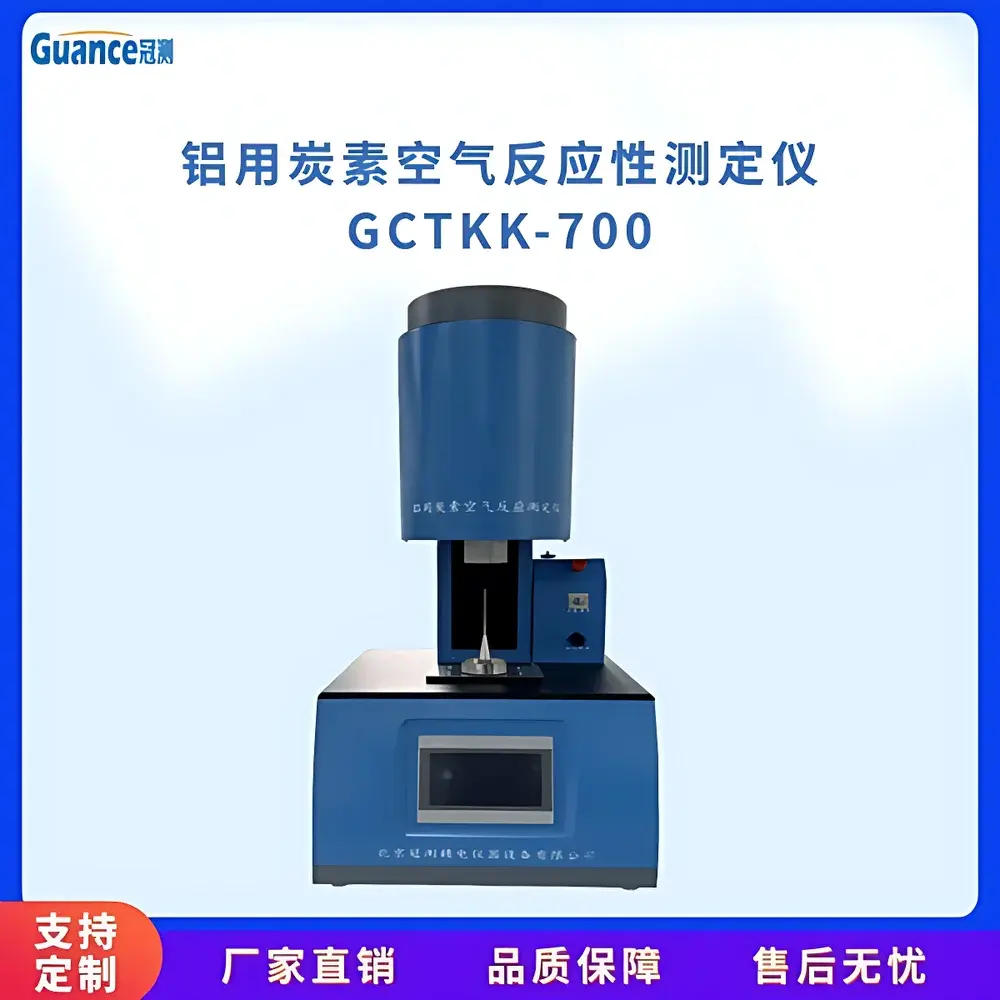
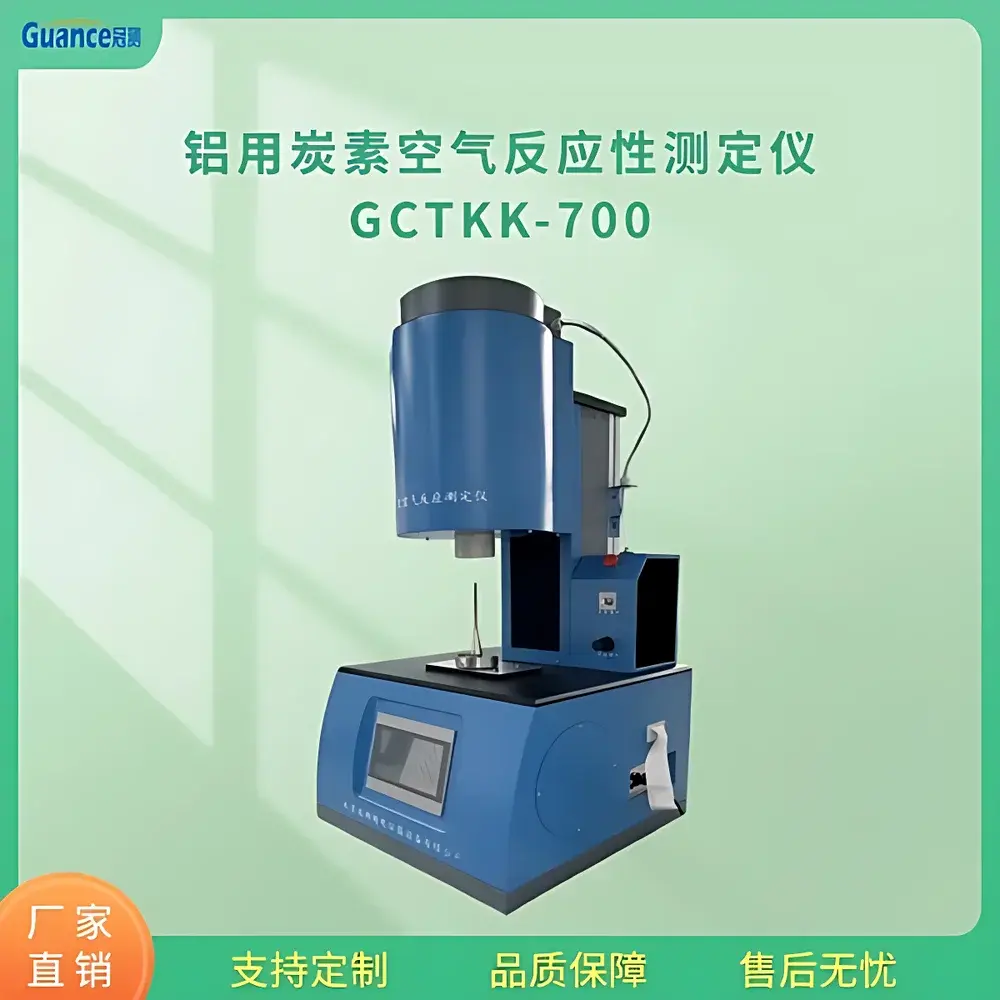
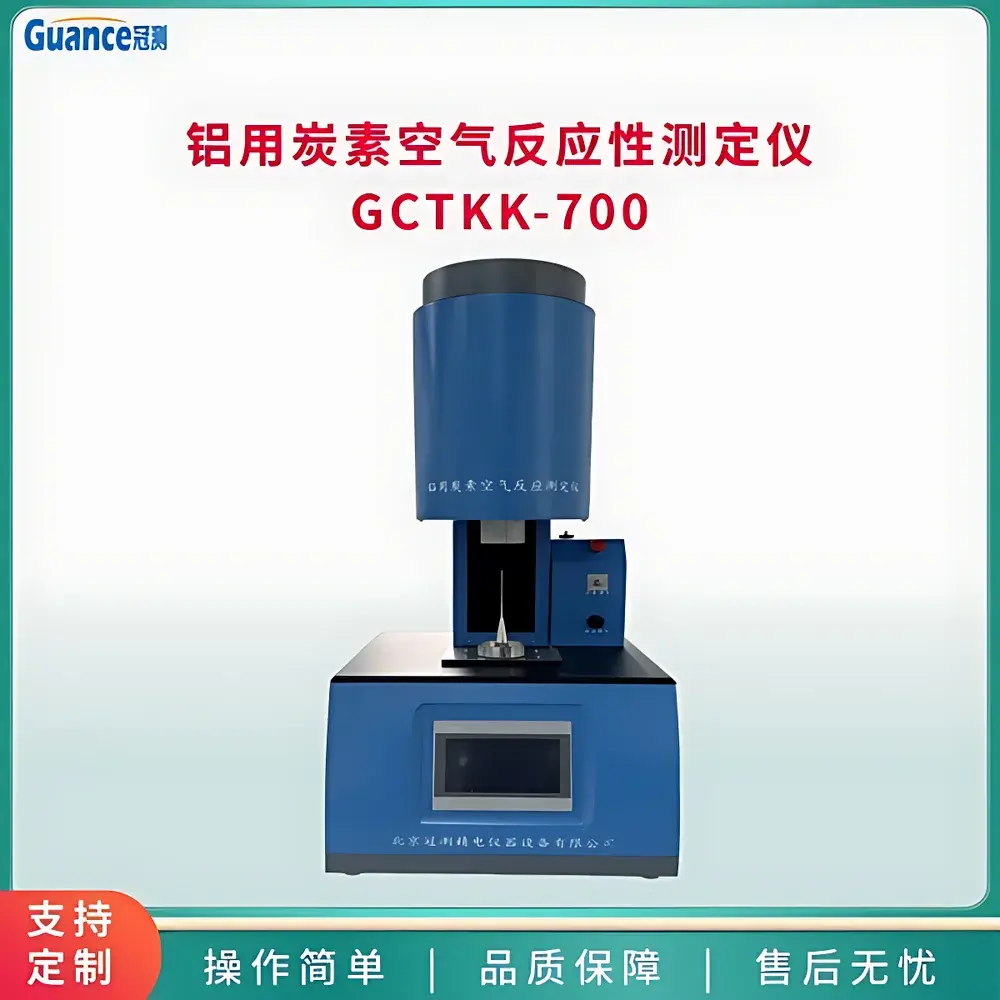
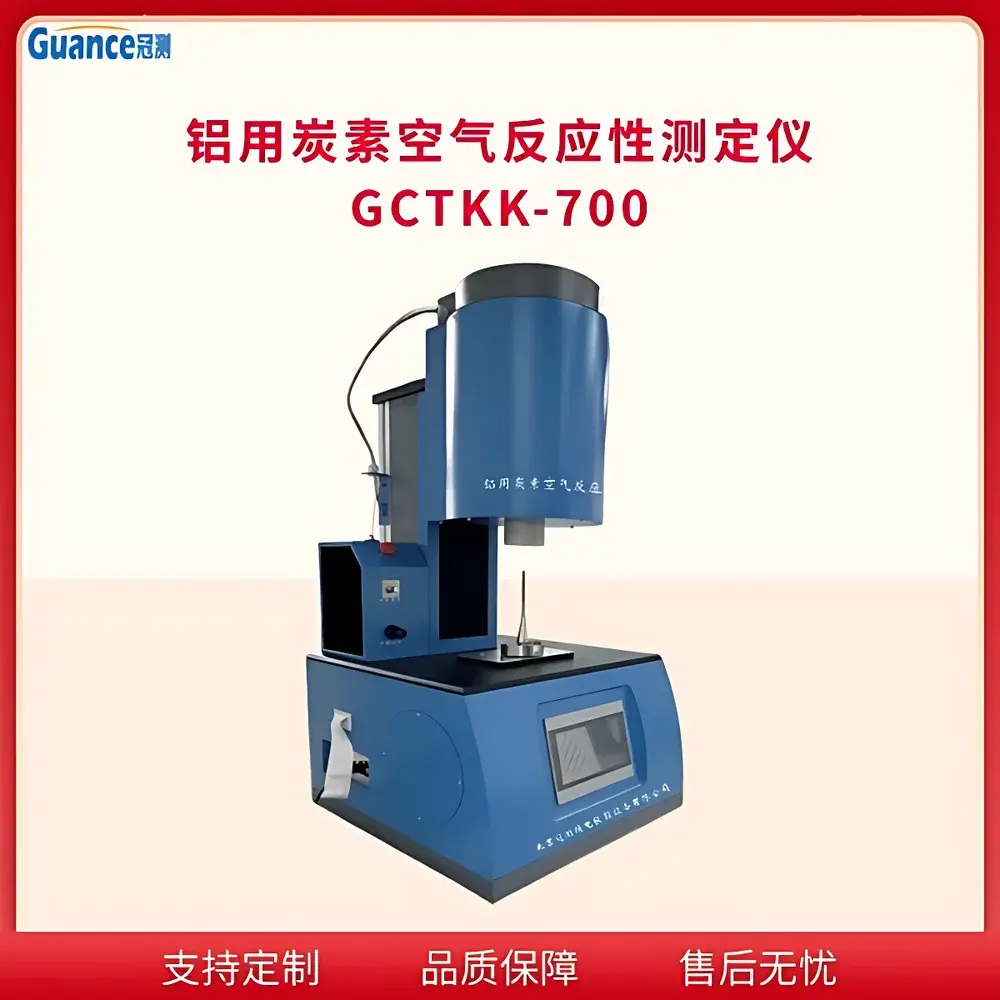
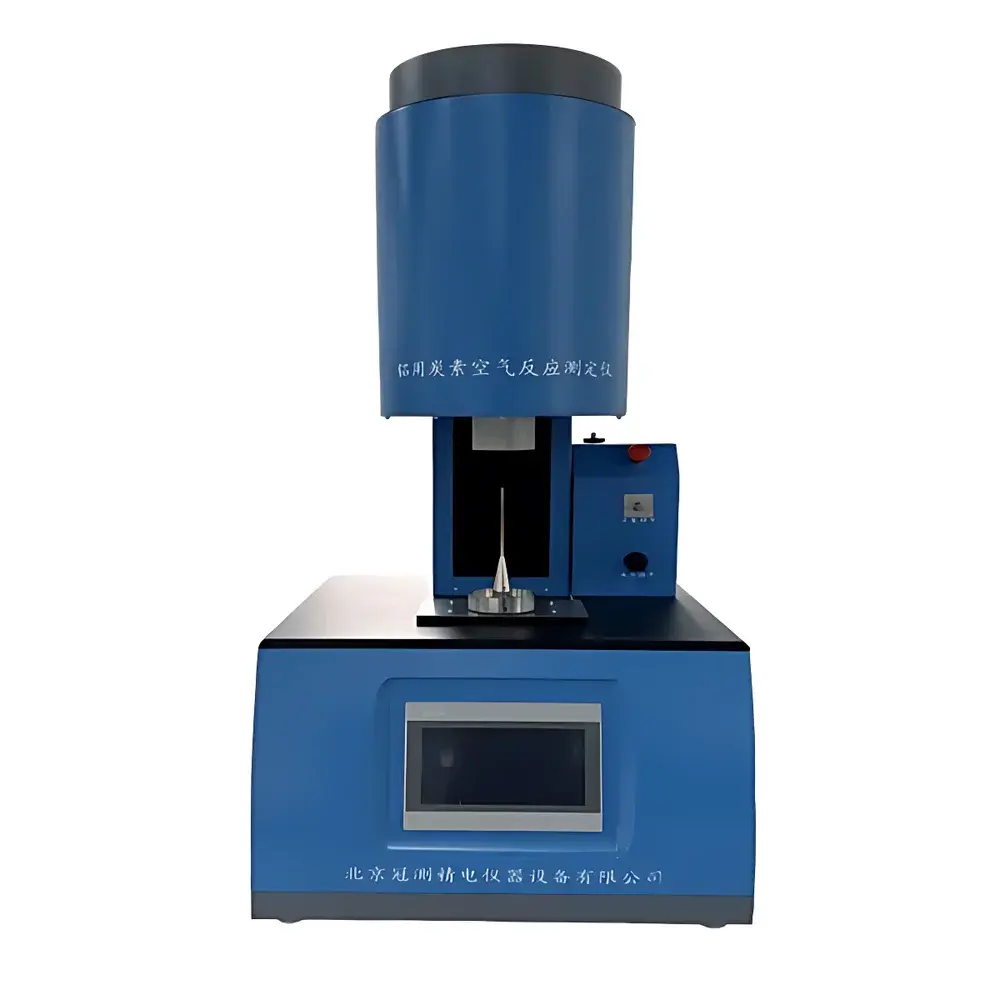
GuanCe Instruments GCTKK-700 Air Reactivity Tester for Carbon Anodes Used in Aluminum Production
| Brand | GuanCe Instruments |
|---|---|
| Origin | Beijing, China |
| Manufacturer Type | Authorized Distributor |
| Region of Manufacture | Domestic (China) |
| Model | GCTKK-700 |
| Power Rating | 1.5 kW |
| Rated Voltage | 220 V / 50 Hz |
| Maximum Operating Temperature | 700 °C |
| Thermocouple Type | K-type (0–800 °C) |
| Gas Flow Sensor Range | 0–250 L/h, Accuracy: ±4% FS |
| Pressure Sensor Range | 0–1 MPa, Accuracy Class ≥ 1.5 |
| Sample Vibration Frequency | 1 rpm |
| Sample Dimensions | Ø50 mm ±1 mm × 60 mm ±1 mm |
| Chamber Uniformity Zone | Stable isothermal zone at 700 °C with ±1 °C stability (PID-controlled) |
| External Dimensions | 750 mm (L) × 700 mm (W) × 1600 mm (H) |
| Net Weight | 150 kg |
Overview
The GuanCe Instruments GCTKK-700 Air Reactivity Tester is a precision-engineered thermal analysis system designed specifically for quantifying the oxidative reactivity of carbonaceous materials used in aluminum smelting—primarily prebaked anodes and sidewall blocks. It operates on the principle of controlled isothermal oxidation under purified, metered airflow, measuring mass loss as a function of time at a fixed temperature (700 °C). This gravimetric method aligns with internationally recognized standard test protocols—including ISO 12989-1:2000 (modified), YS/T 63.11–2006, YS/T 964–2014, and YS/T 62.2–2005/YS/T 62.3–2005—ensuring traceable, repeatable, and auditable results suitable for quality control, R&D, and supplier qualification in carbon material manufacturing and aluminum production facilities.
Key Features
- Robust furnace architecture featuring vacuum-formed high-temperature ceramic fiber insulation and embedded resistance heating elements, delivering exceptional thermal uniformity and long-term stability within the 700 °C isothermal zone.
- High-fidelity PID temperature control system with K-type thermocouple feedback, maintaining setpoint accuracy within ±1 °C after thermal equilibrium is achieved.
- Dual-stage gas delivery subsystem: integrated air filtration and pressure regulation ensures consistent composition and inlet pressure; calibrated mass flow sensor (0–250 L/h, ±4% full-scale accuracy) guarantees precise, reproducible oxidant supply.
- Programmable logic controller (PLC)-based automation core, enabling fully autonomous execution of standardized test sequences—including sample loading, pre-heating, isothermal exposure, cooling, and data logging.
- Human-machine interface (HMI) via industrial-grade touchscreen panel, complemented by optional PC-based software for remote monitoring, real-time parameter visualization, and post-test statistical analysis.
- Mechanically synchronized sample rotation at 1 rpm to ensure uniform surface exposure during oxidation, minimizing directional bias in mass-loss kinetics.
Sample Compatibility & Compliance
The GCTKK-700 accommodates cylindrical specimens conforming to ISO 12989-1 and Chinese industry standards: Ø50 mm ±1 mm × 60 mm ±1 mm, typically machined from prebaked anode or sidewall block billets. Sample preparation follows YS/T 62.2–2005 (sidewall blocks) and YS/T 62.3–2005 (prebaked anodes), including surface cleaning and moisture equilibration prior to testing. The instrument’s operational methodology supports GLP-aligned workflows, with timestamped event logs, user-access controls, and audit-trail-capable data export formats (CSV, XLSX). While not inherently 21 CFR Part 11 compliant, its data integrity framework facilitates integration into validated laboratory information management systems (LIMS) under GMP/QA oversight.
Software & Data Management
The system supports dual-mode operation: local HMI control for rapid setup and diagnostics, and Ethernet-connected PC software for advanced configuration, multi-batch scheduling, and trend analysis. Software outputs include time-resolved mass loss curves, derivative (dm/dt) plots, cumulative mass loss (%) vs. time, and summary reports aligned with YS/T 63.11–2006 reporting requirements. All raw sensor data (temperature, flow, pressure, weight) are logged at configurable intervals (1–60 s), with metadata tagging for operator ID, batch number, and calibration status. Exported datasets retain full traceability for internal review or third-party verification.
Applications
- Quality assurance of carbon anodes prior to furnace installation in Hall–Héroult cells.
- Comparative evaluation of raw material batches (petroleum coke, pitch binder) and baking process optimization.
- Research into oxidation inhibition strategies—including impregnation treatments and antioxidant additives.
- Supplier qualification and incoming inspection per contractual technical specifications.
- Supporting root-cause analysis of premature anode consumption or sidewall degradation in electrolytic cells.
FAQ
What standards does the GCTKK-700 comply with?
It implements ISO 12989-1:2000 (MOD), YS/T 63.11–2006, YS/T 964–2014, and related sampling standards YS/T 62.2–2005 and YS/T 62.3–2005.
Can the instrument operate continuously across multiple test cycles?
Yes—the thermal design and PLC scheduler support unattended sequential testing with automated cooldown and purge phases between runs.
Is calibration documentation provided with the system?
Factory calibration certificates are supplied for the K-type thermocouple, flow sensor, and pressure transducer; users are advised to implement periodic in-house verification using NIST-traceable reference standards.
What safety protections are built into the system?
Over-temperature cutoff, gas-flow interlock, door-open emergency shutdown, and real-time fault diagnostics are embedded in the PLC firmware.
Does the system require external ventilation or fume extraction?
Yes—continuous exhaust ventilation rated for CO/CO₂ removal is mandatory during operation, per OSHA and local occupational health regulations.



