
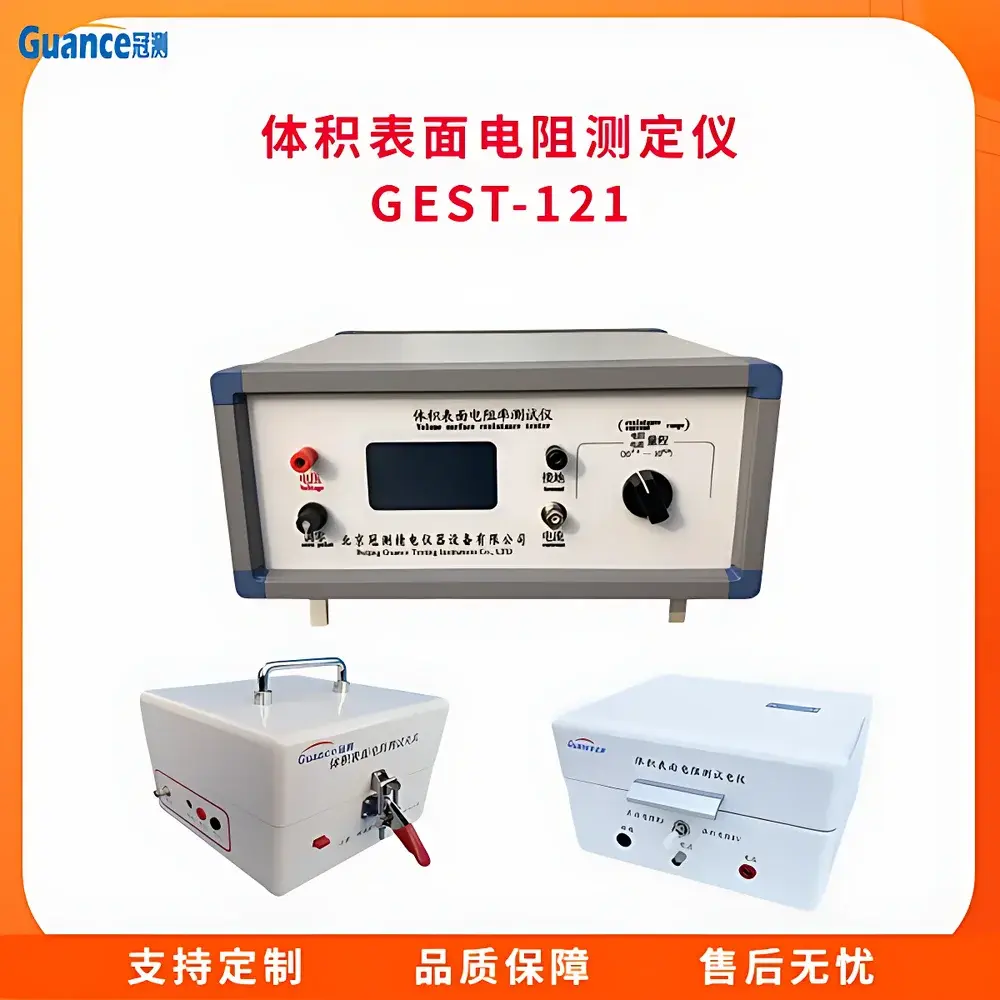
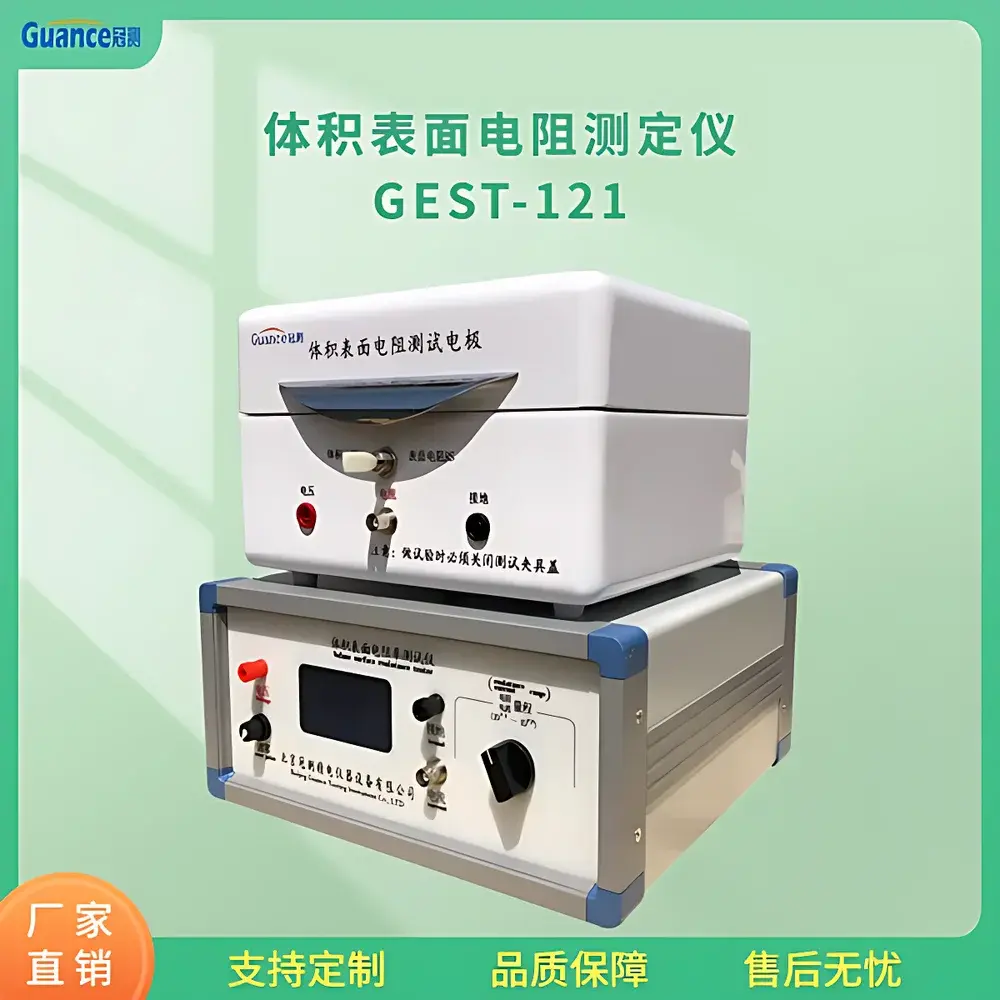
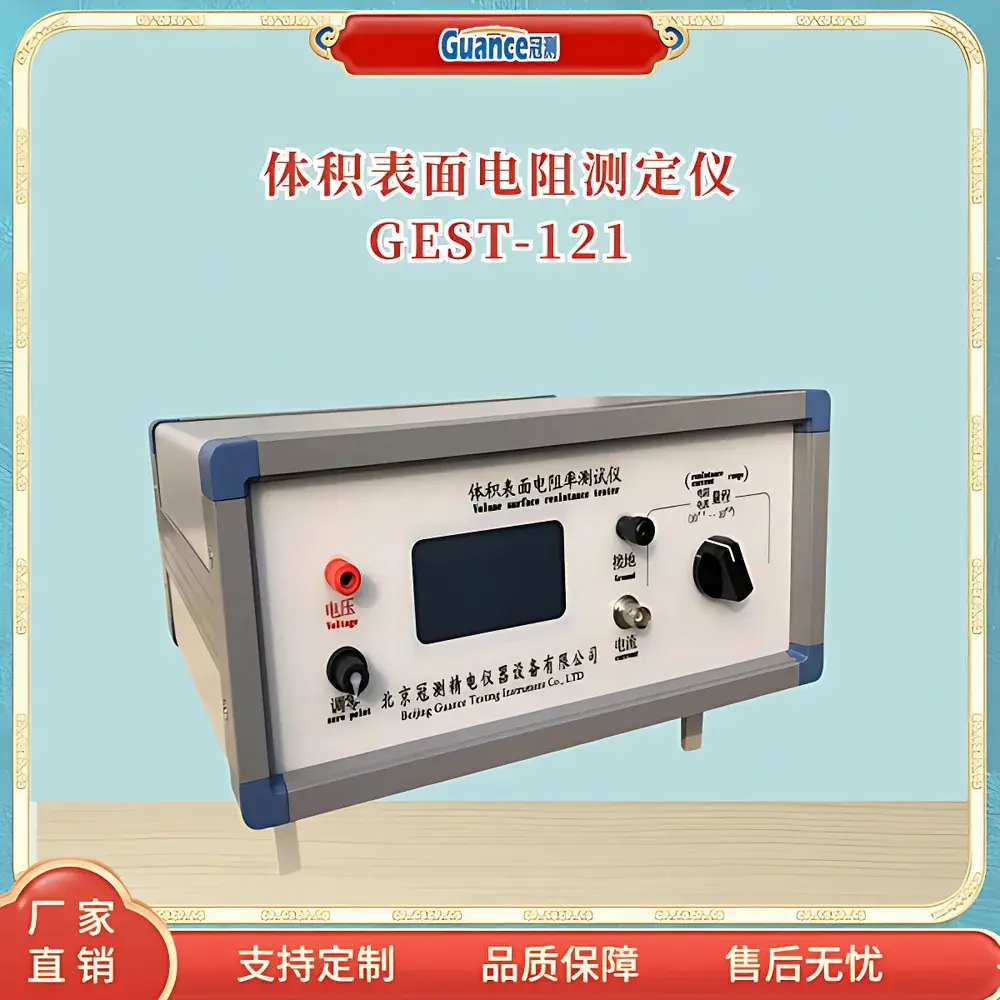
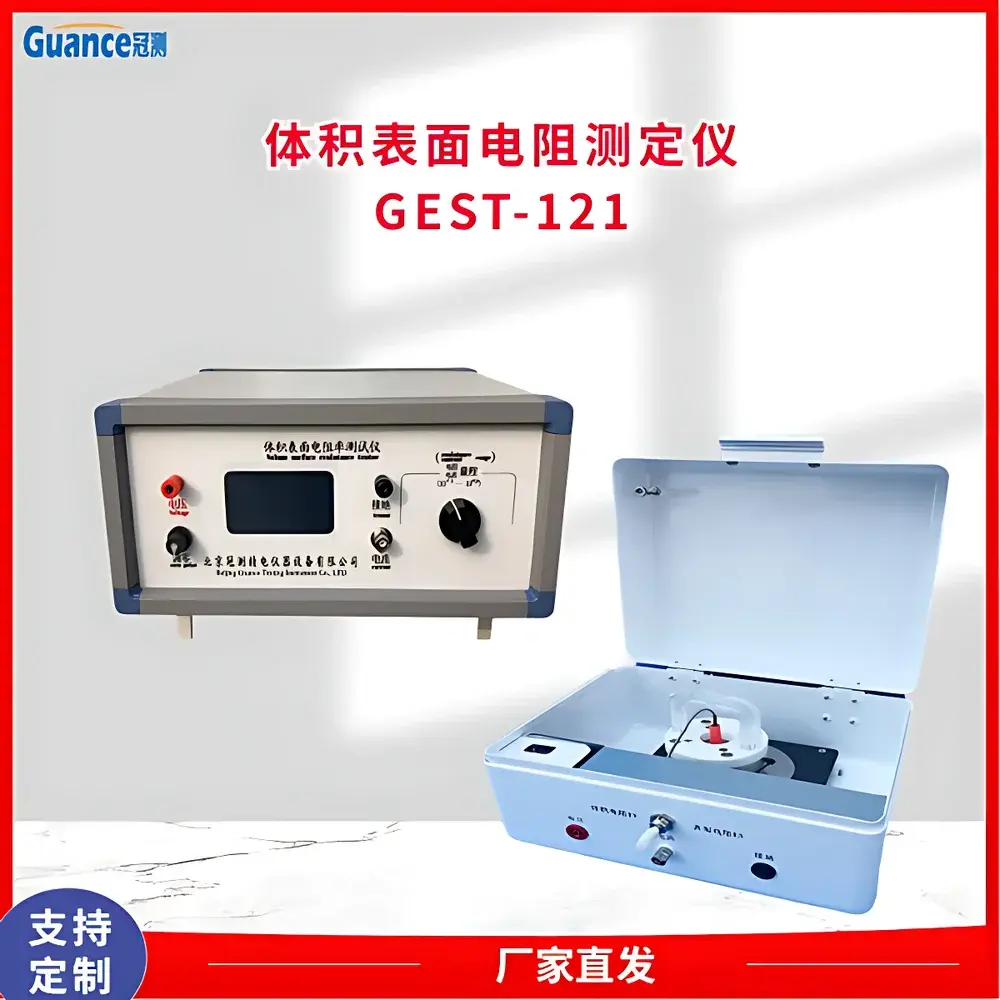
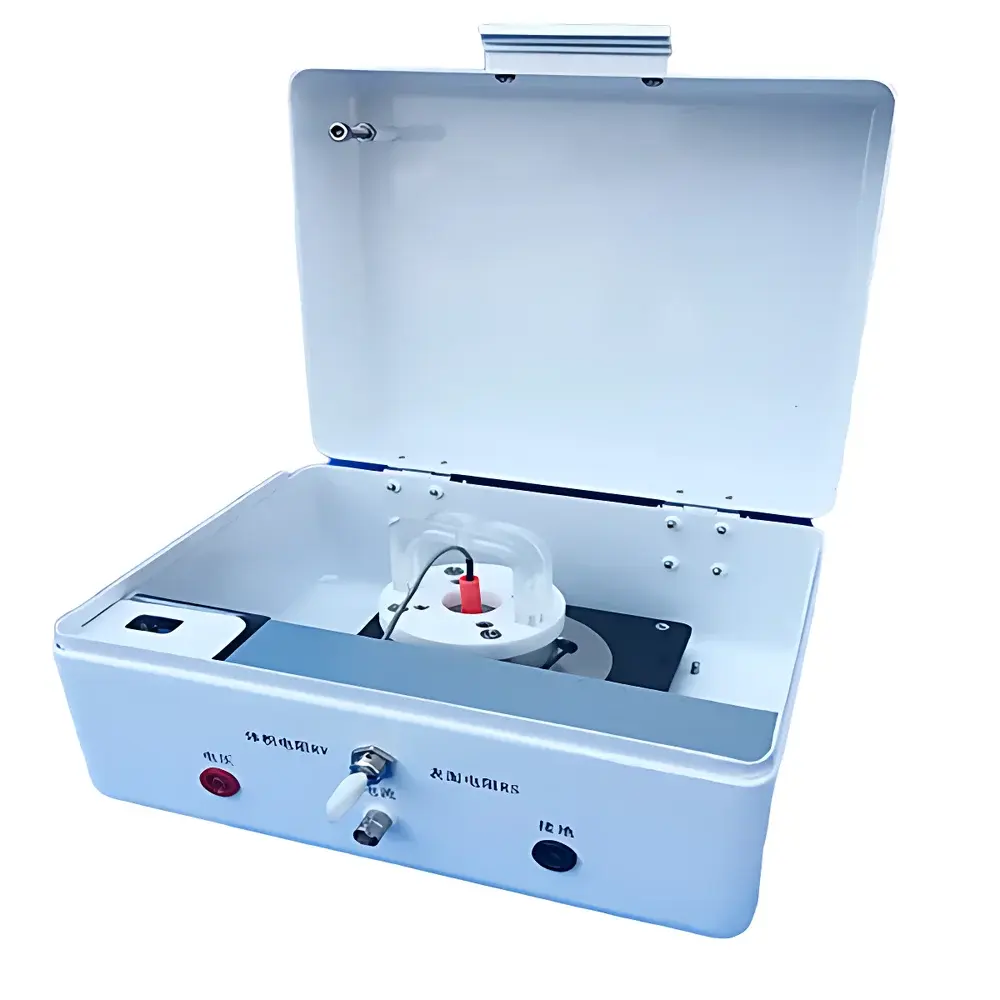
Guance GEST-121Ae Volume & Surface Resistivity Tester for Powders and Insulating Materials
| Brand | Guance |
|---|---|
| Model | GEST-121Ae |
| Origin | Beijing, China |
| Type | Benchtop High-Resistance Meter |
| Resistance Range | 1×10⁴ Ω to 1×10¹⁸ Ω |
| Current Range | 1×10⁻¹⁶ A to 2×10⁻⁴ A |
| Test Voltages | 10 V, 50 V, 100 V, 250 V, 500 V, 1000 V |
| Accuracy | ±1% (≤1×10¹⁰ Ω), ±5–10% (>1×10¹⁰ Ω) |
| Display | Digital LCD |
| Power Supply | 220 V AC / 50 Hz |
| Power Consumption | 100 W |
| Dimensions (L×W×H) | 300 mm × 300 mm × 150 mm |
| Weight | ~5 kg |
| Standard Electrode | Tri-electrode fixture for solid samples ≥80 mm diameter |
| Optional Electrodes | Powder cell, liquid cell, concentric ring, guarded electrode, and custom geometries |
Overview
The Guance GEST-121Ae Volume & Surface Resistivity Tester is a precision benchtop instrument engineered for high-resistance measurement of insulating and electrostatic-dissipative materials. It operates on the principle of constant-voltage DC biasing combined with guarded current measurement—compliant with ASTM D257, IEC 60093, and ISO 3915 standards—to isolate and quantify volume resistivity (ρv) and surface resistivity (ρs) independently. Unlike simplified megohmmeters, the GEST-121Ae integrates a guarded tri-electrode configuration as standard, enabling accurate discrimination between bulk conduction and interfacial leakage paths. Its extended resistance range—from 1×10⁴ Ω up to 1×10¹⁸ Ω—and ultra-low current detection capability (down to 1×10⁻¹⁶ A) make it suitable for characterizing ultra-high-resistivity polymers, ceramic powders, antistatic coatings, and functional nanocomposites used in semiconductor packaging, aerospace composites, and cleanroom flooring validation.
Key Features
- Multi-range DC voltage sourcing (10 V to 1000 V) with programmable hold time and auto-ranging current measurement
- Dual-mode resistivity calculation: automated volume resistivity (Ω·cm) and surface resistivity (Ω/sq) based on electrode geometry and sample thickness inputs
- Guarded tri-electrode system (standard) minimizes stray current errors and ensures compliance with ASTM D257 Section 11 for volume resistivity and Section 12 for surface resistivity
- High-impedance input stage with low-leakage shielding and guarded cabling architecture to maintain measurement integrity at >10¹⁵ Ω
- Real-time stability monitoring: built-in drift compensation algorithm tracks baseline current drift during extended dwell measurements (e.g., 60-s or 120-s dwell per ASTM)
- Compact footprint (300 × 300 × 150 mm) and low thermal mass design reduce ambient temperature-induced offset in lab environments without climate control
Sample Compatibility & Compliance
The GEST-121Ae supports heterogeneous sample forms—including powders (via optional compression cell), liquids (in guarded beaker electrodes), thin films (<0.5 mm), rigid sheets (≥80 mm diameter), pastes, and elastomeric solids—without hardware modification. Powder testing follows ASTM D4496 Annex A3 using a defined compaction force and electrode contact area; liquid resistivity adheres to ASTM D117 for insulating oils. All measurement protocols are traceable to NIST-calibrated reference resistors (10⁴–10¹² Ω) and verified annually per ISO/IEC 17025 requirements. The instrument meets electromagnetic compatibility (EMC) Class B per EN 61326-1 and safety requirements per IEC 61010-1 for laboratory electrical equipment. While not FDA 21 CFR Part 11–certified out-of-the-box, audit-ready data logs (timestamped, user-ID tagged, non-editable binary export) support GLP/GMP-aligned quality systems when paired with validated SOPs.
Software & Data Management
The GEST-121Ae operates autonomously via front-panel controls but supports optional USB-to-PC connectivity for data capture using Guance’s ResiLog v2.1 software (Windows 10/11 compatible). ResiLog enables batch test sequencing, multi-sample comparative reporting, automatic ρv/ρs conversion using user-defined geometric constants, and export to CSV, PDF, or XML for LIMS integration. All raw current-vs.-time datasets are stored with metadata: test voltage, dwell duration, electrode ID, operator tag, ambient temperature/humidity (if external sensor connected), and calibration expiry date. Audit trails record parameter changes, measurement starts/stops, and firmware updates—supporting ISO 17025 clause 7.7.2 on result validity assurance.
Applications
- Volume resistivity verification of polyimide films and epoxy mold compounds in microelectronics packaging
- Surface resistivity mapping of ESD-safe workbench laminates and conductive floor tiles per ANSI/ESD S20.20
- Quality control of carbon-black-loaded TPEs and silicone gels for medical device housings
- R&D screening of dielectric fillers (e.g., SiO₂, Al₂O₃, BN) in polymer matrix composites
- Validation of antistatic additives in toner powders and pharmaceutical excipients per USP
- Baseline characterization of insulating ceramics and optical glasses prior to metallization
FAQ
What electrode configurations are required for powder resistivity testing?
For reproducible powder measurements, the optional GEST-Powder Cell (part #EC-PC121) is recommended: it applies controlled axial pressure (1–5 MPa), maintains uniform density, and incorporates guard rings to eliminate edge leakage. ASTM D4496 specifies minimum 13 mm diameter and 3 mm thickness under 2.5 MPa compaction.
Can this instrument measure resistivity according to IEC 62631-3-1?
Yes—the GEST-121Ae satisfies the voltage application, guarding, and timing requirements of IEC 62631-3-1 for volume resistivity of solid insulating materials. Users must manually enter sample thickness and electrode area; the instrument computes ρv per Equation 1 in the standard.
Is calibration traceable to national standards?
All factory calibrations use NIST-traceable high-value resistors (10⁹–10¹² Ω) and picoammeter standards (Keysight B2987A). A full calibration certificate—including uncertainty budgets per GUM (JCGM 100:2008)—is supplied with each unit.



