
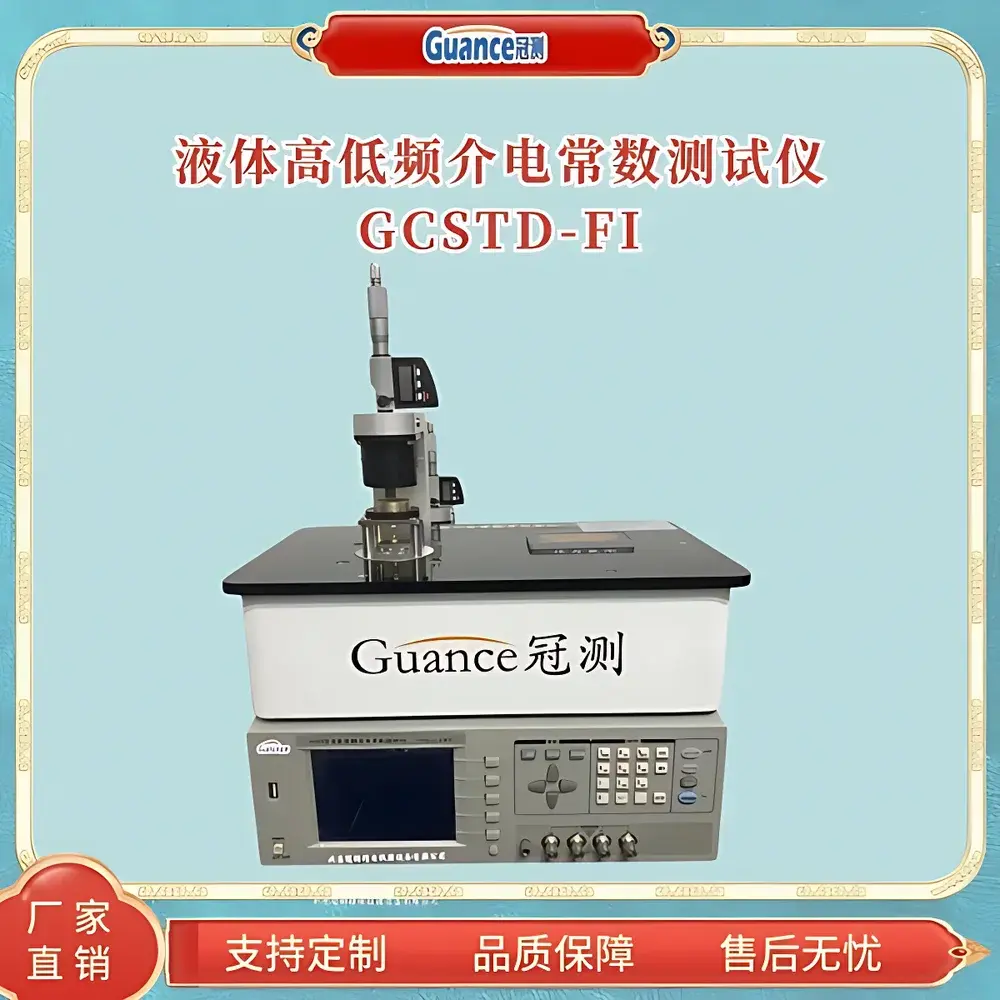
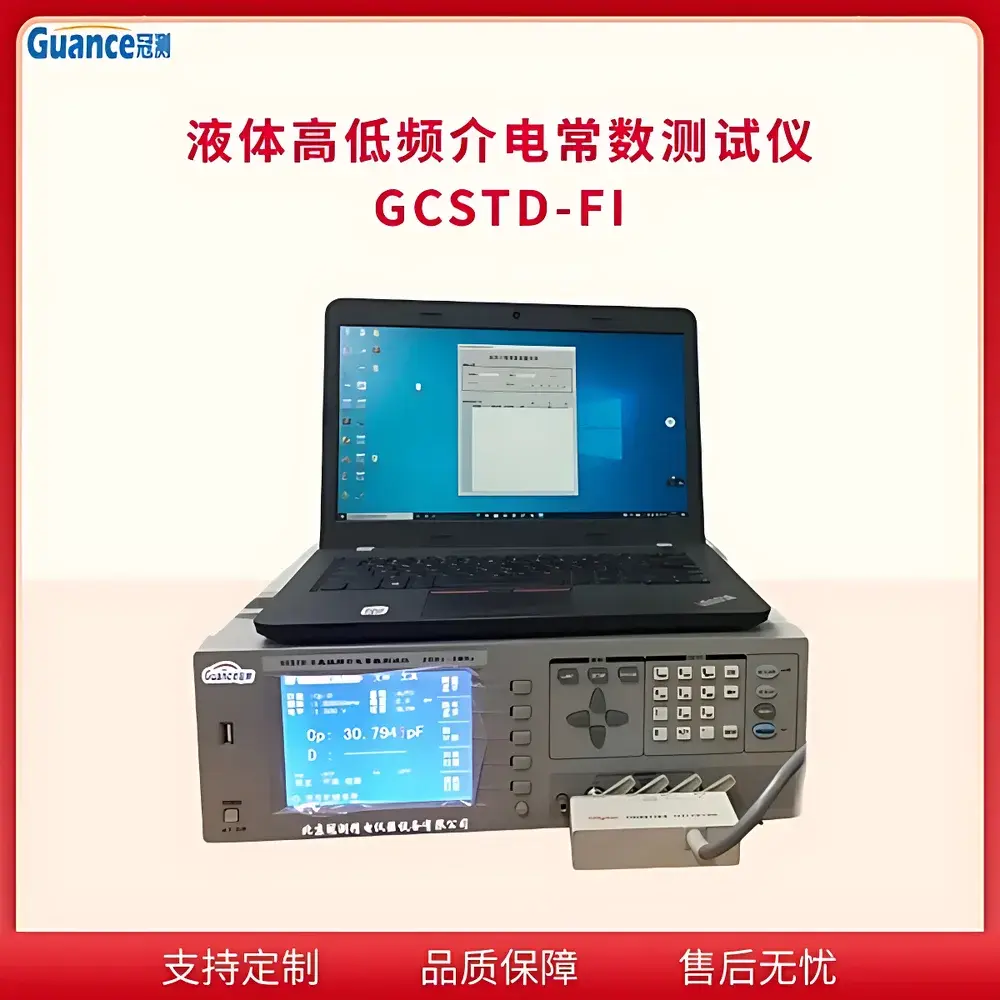
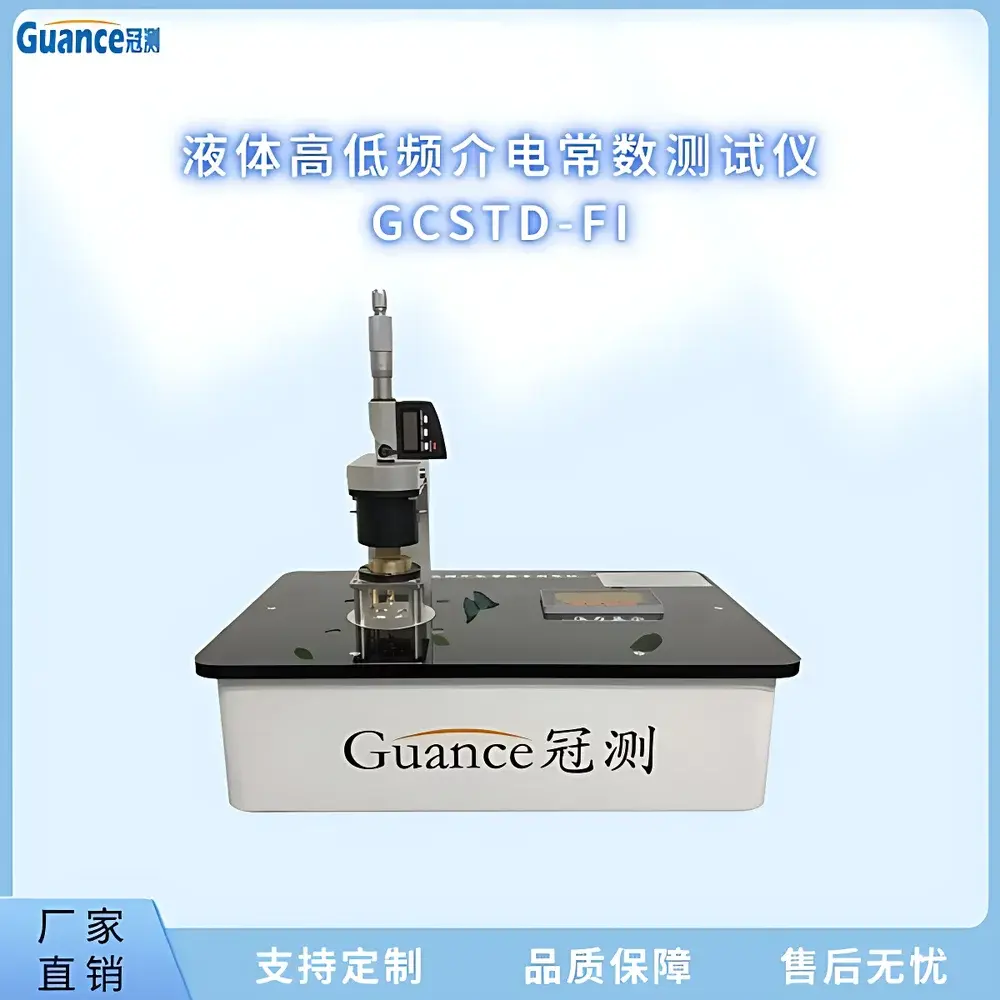
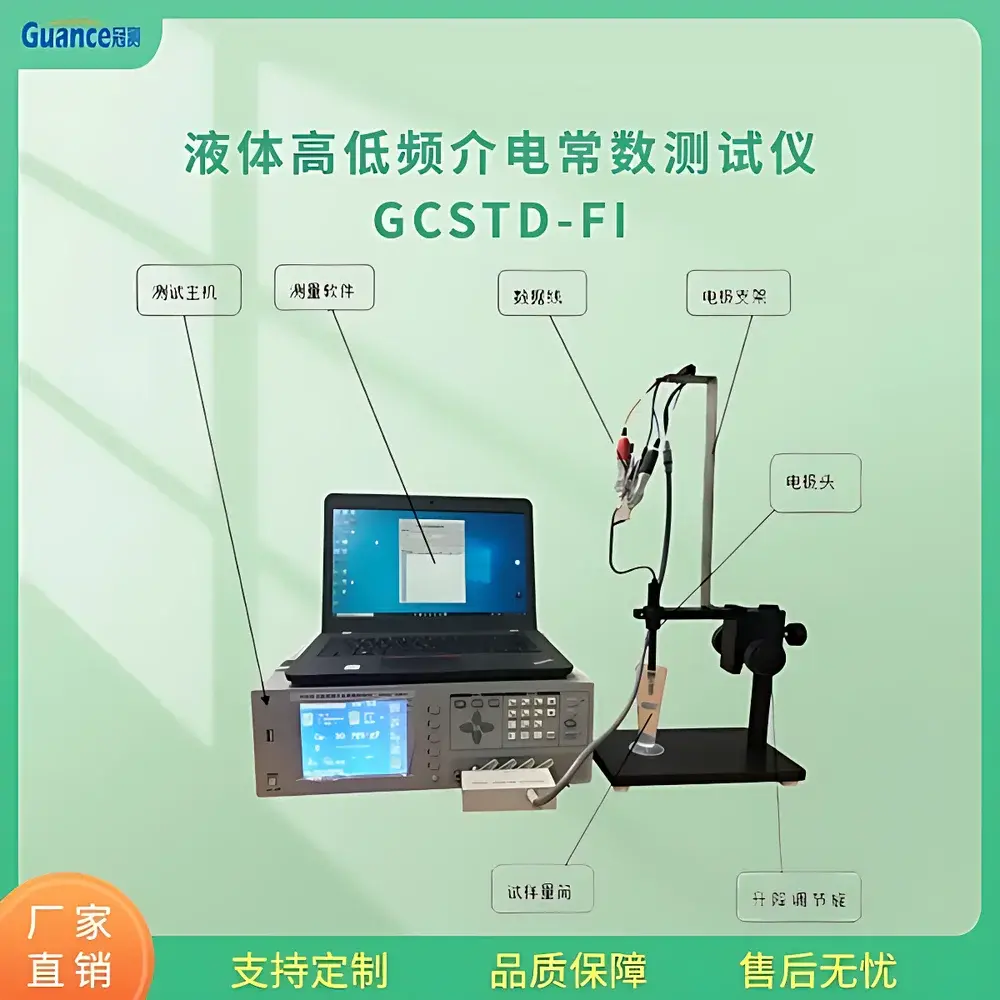
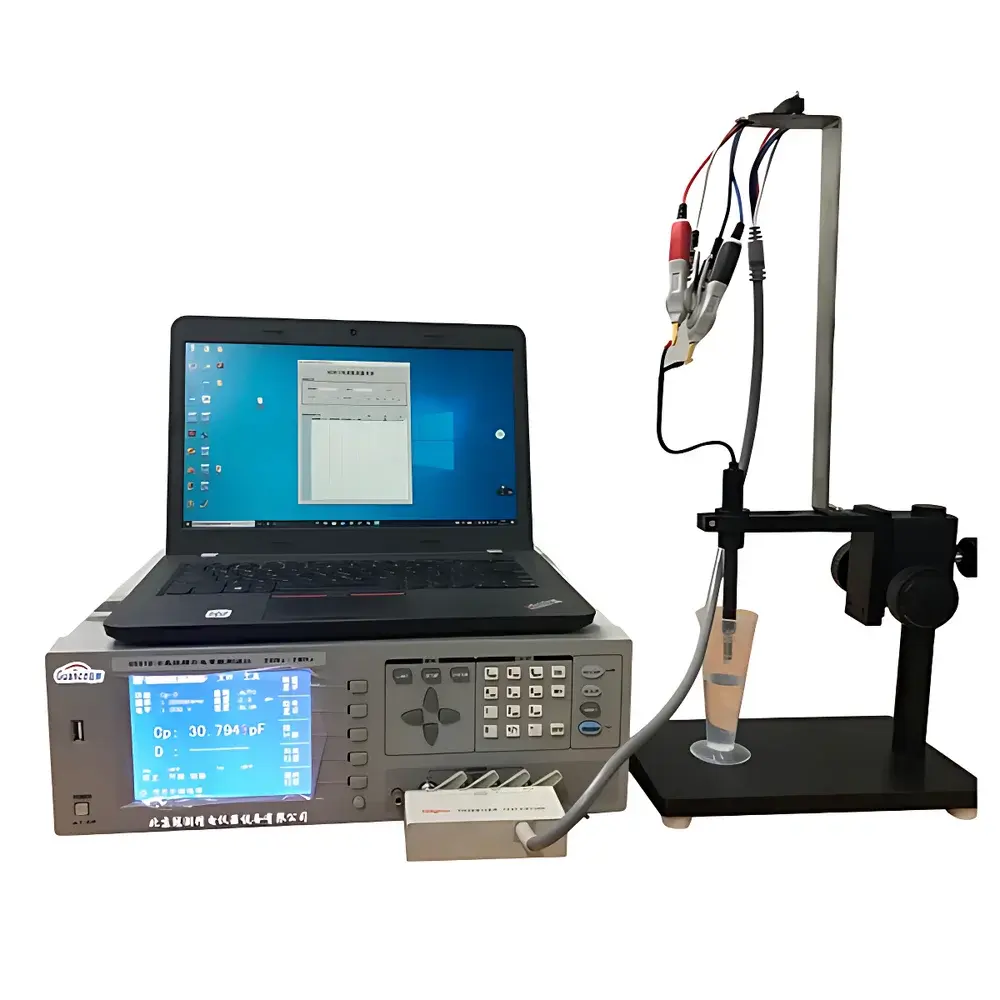
GuanCe Instruments GCSTD-FI Liquid Dielectric Constant Analyzer
| Brand | GuanCe Instruments |
|---|---|
| Origin | Beijing, China |
| Manufacturer Type | Authorized Distributor |
| Product Origin | Domestic (China) |
| Model | GCSTD-FI |
| Price | USD 1,920 (approx. based on ¥13,700 at 7.14 exchange rate) |
| Measurement Principle | Capacitance-based dielectric spectroscopy at fixed frequency |
| Test Frequency | 10 kHz sinusoidal excitation |
| Electrode Type | External coaxial cylindrical electrode (316 stainless steel outer/inner cylinders, nylon spacers) |
| Measurement Ranges | 1–20 and 1–200 (dimensionless relative permittivity, εᵣ) |
| Accuracy | ±2% of reading |
| Repeatability & Linearity | ±0.2% of full scale |
| RMS Excitation Voltage | ~7 V (range 1–20), ~0.7 V (range 1–200) |
| Compliance Standards | GB/T 1409–2006, GB/T 5654–2007, GB/T 21216–2007, GB/T 1693–2007, GB/T 5594.4–1985 |
Overview
The GuanCe Instruments GCSTD-FI Liquid Dielectric Constant Analyzer is a precision benchtop instrument engineered for the quantitative determination of relative permittivity (dielectric constant, εᵣ) and related dielectric properties of liquid insulating materials under controlled single-frequency AC excitation. Operating at a stable 10 kHz sinusoidal signal, the system employs a calibrated coaxial cylindrical electrode configuration—comprising concentric 316 stainless steel cylinders with precisely maintained geometric spacing—to establish a well-defined electric field volume. This geometry enables direct capacitance measurement, from which εᵣ is derived using fundamental electrostatic relationships (C ∝ εᵣ). The instrument is not a broadband spectrometer; rather, it delivers high-reproducibility measurements at a fixed frequency optimized for routine quality control and comparative material characterization in industrial and academic laboratories. Its design prioritizes mechanical stability, thermal drift mitigation, and operator-safe handling of low-voltage excitation signals—critical for consistent evaluation of transformer oils, silicone fluids, hydrocarbon solvents, and other electrically insulating liquids.
Key Features
- Fixed-frequency (10 kHz) capacitance-based measurement architecture ensures minimal phase-error contribution and high signal-to-noise ratio for stable εᵣ readout.
- Removable external coaxial electrode assembly fabricated from 316 stainless steel, PTFE-insulated spacers, and nylon positioning screws—designed for chemical compatibility and mechanical rigidity.
- Dual-range measurement capability (1–20 and 1–200 εᵣ) with auto-ranging voltage scaling (7 V RMS and 0.7 V RMS respectively) to maintain optimal signal integrity across low- and high-permittivity samples.
- Open-structure electrode geometry facilitates rapid, non-destructive cleaning—critical for eliminating cross-contamination between dissimilar liquid samples (e.g., polar vs. non-polar solvents).
- No disassembly required: Electrode calibration integrity is preserved by maintaining factory-set cylinder alignment; users are explicitly advised against dismantling the probe to avoid geometric deviation.
- Compliance-ready design supporting traceable testing workflows aligned with national standards including GB/T 5654–2007 (liquid insulation) and GB/T 1409–2006 (solid insulation at power/audio frequencies).
Sample Compatibility & Compliance
The GCSTD-FI is validated for use with non-conductive and weakly conductive liquids exhibiting bulk resistivity >10⁹ Ω·m—typical of mineral oils, synthetic esters, silicone oils, aliphatic/aromatic hydrocarbons, and halogenated solvents. It is not suitable for aqueous electrolytes, ionic liquids, or highly conductive media where electrode polarization dominates the measured impedance. All test procedures conform to the electrode geometry, temperature control (ambient only), and data reporting requirements specified in GB/T 5654–2007 and GB/T 21216–2007. While the instrument itself does not provide temperature regulation or humidity control, its mechanical construction minimizes thermal expansion effects on electrode spacing over typical laboratory temperature ranges (15–30 °C). For GLP/GMP environments, manual logbook entries—including sample ID, date/time, operator, electrode cleaning method, and raw capacitance readings—are recommended to support audit readiness.
Software & Data Management
The GCSTD-FI operates as a standalone analog-digital hybrid instrument with front-panel digital display and manual range selection. It does not include embedded microprocessor-based software, USB connectivity, or automated data logging. Measurement values are output as numeric εᵣ readings directly on the LCD screen. Users are expected to record results manually or integrate the unit into custom PC-based acquisition systems via optional analog voltage output (if equipped per customer specification). No firmware updates, cloud synchronization, or FDA 21 CFR Part 11-compliant electronic signatures are provided. For regulated laboratories requiring full audit trails, integration with third-party LIMS or spreadsheet-based documentation protocols is advised.
Applications
- Quality assurance of transformer and switchgear insulating oils per IEC 60296 and GB/T 7595 specifications (εᵣ trending as indicator of moisture ingress or oxidation).
- Comparative screening of dielectric coolants in high-power electronics packaging.
- R&D evaluation of novel bio-based lubricants and fluorinated heat-transfer fluids.
- Teaching laboratories demonstrating fundamental relationships between molecular polarity, intermolecular forces, and macroscopic permittivity.
- Batch consistency verification for solvent manufacturing (e.g., acetone, toluene, chloroform) where εᵣ serves as a purity proxy.
FAQ
Can the GCSTD-FI measure dielectric loss tangent (tan δ)?
No—the instrument reports only relative permittivity (εᵣ) derived from capacitance magnitude at 10 kHz. It does not resolve phase angle or conductance components required for tan δ calculation.
Is temperature control integrated into the system?
No. The GCSTD-FI assumes ambient temperature operation. For temperature-dependent studies, users must employ external thermostatted sample baths and manually record temperature alongside εᵣ values.
What cleaning protocol is recommended between samples?
Immerse the electrode in ultrasonic bath with appropriate solvent (e.g., acetone for hydrocarbons, ethanol for polar residues) for 5–10 minutes, followed by gentle nitrogen or clean dry air drying. Never wipe or scrape electrode surfaces.
Does the instrument support ASTM D150 or IEC 60250 standards?
It is designed to meet equivalent technical requirements of GB/T 1409–2006, which harmonizes closely with IEC 60250:2018 for solid materials; however, no formal ASTM or IEC certification is held by the manufacturer.
Is calibration traceable to national metrology institutes?
Calibration is performed using NIST-traceable reference capacitors and certified standard liquids (e.g., cyclohexane, methanol) at time of manufacture. A certificate of conformance is supplied with each unit.



