
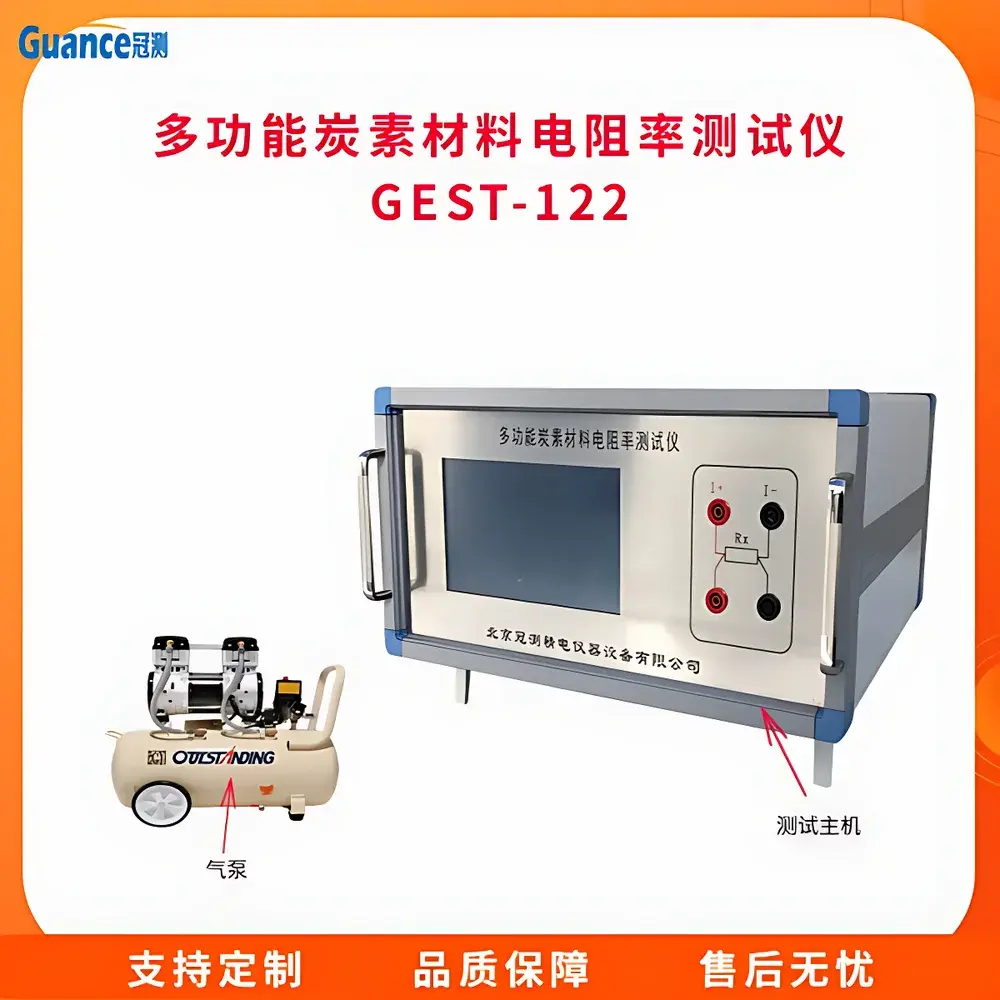
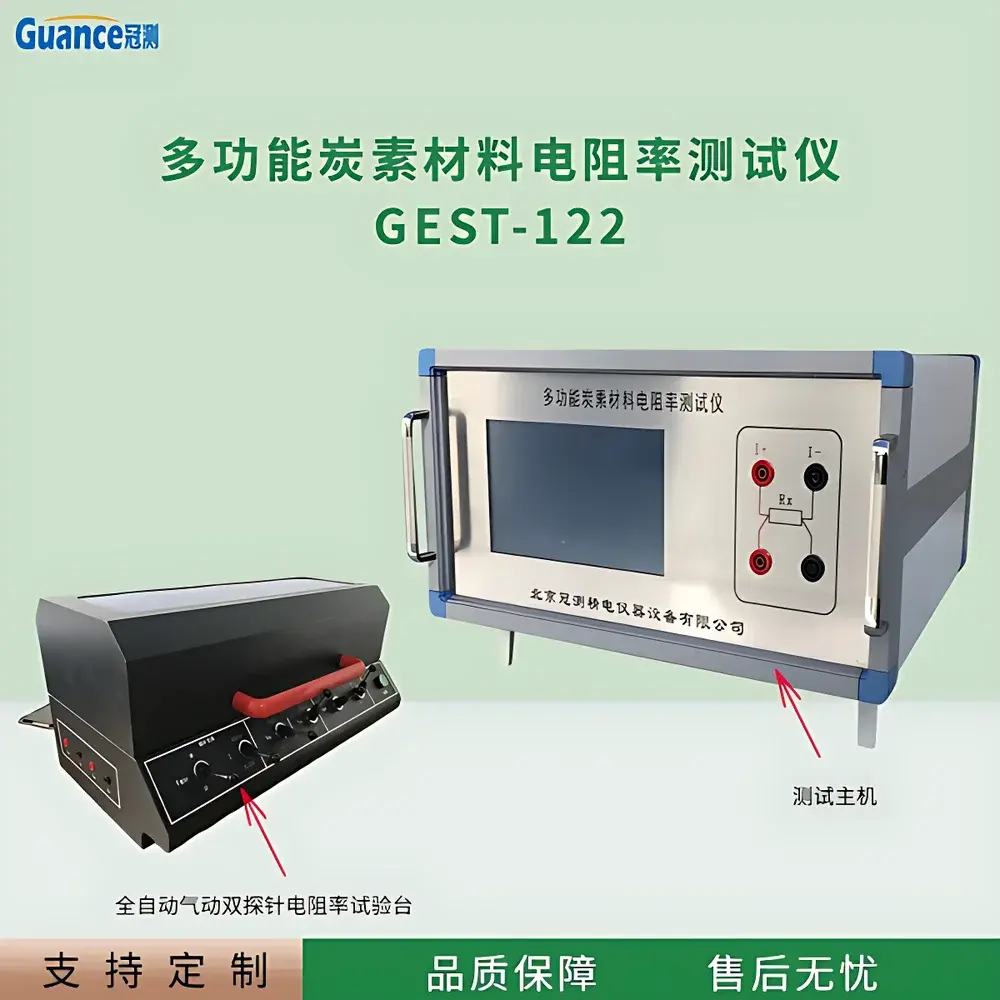
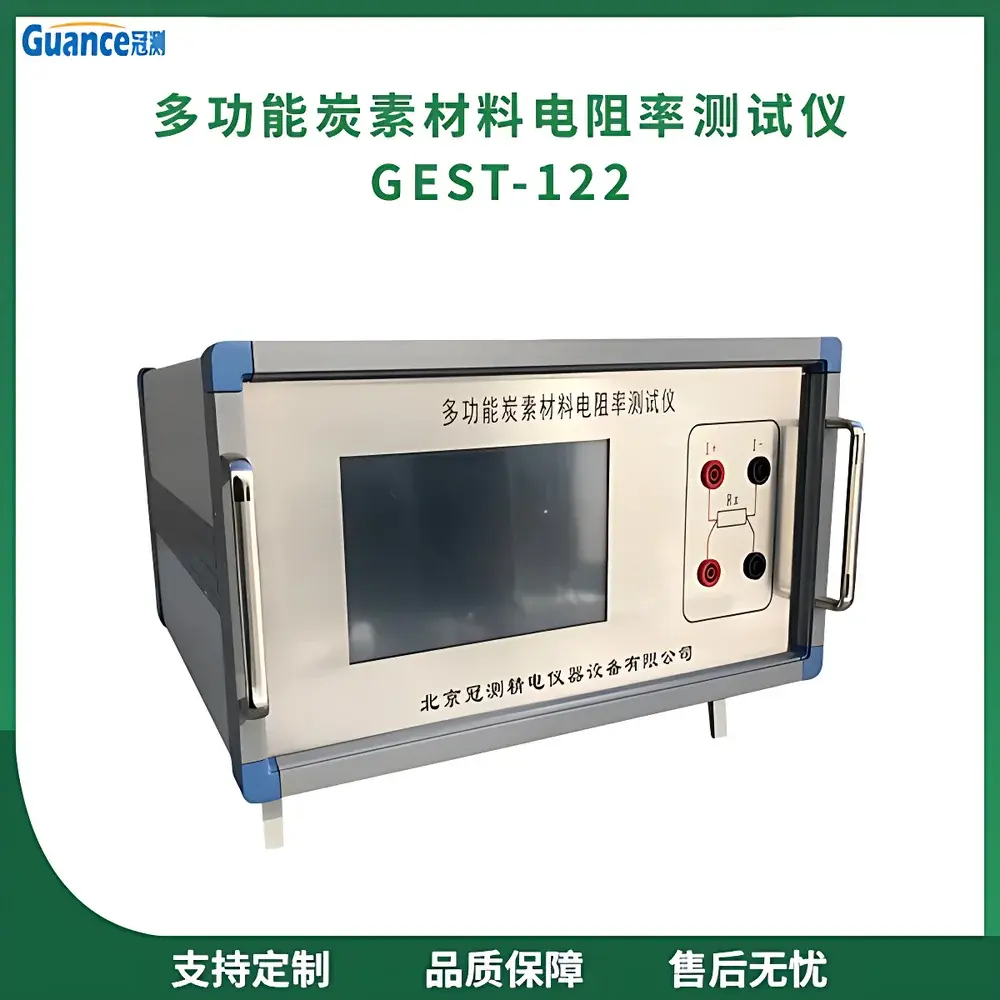
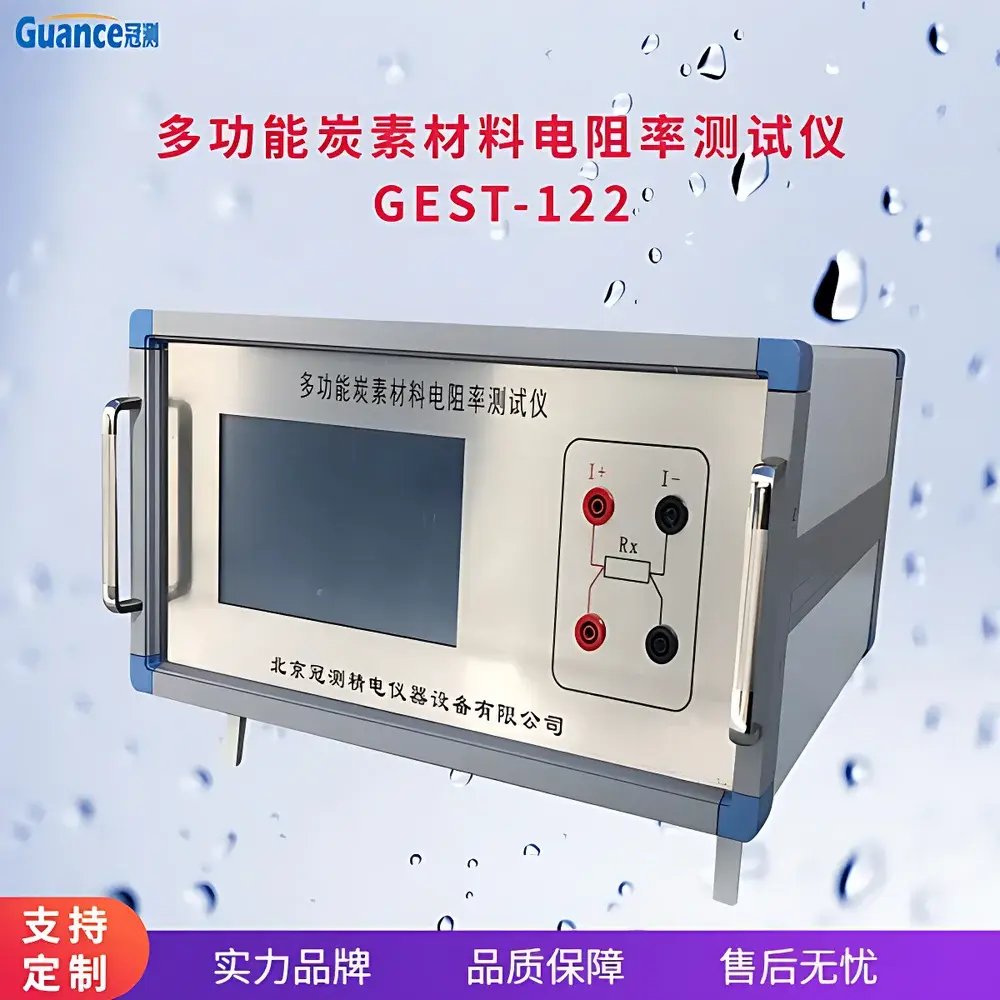
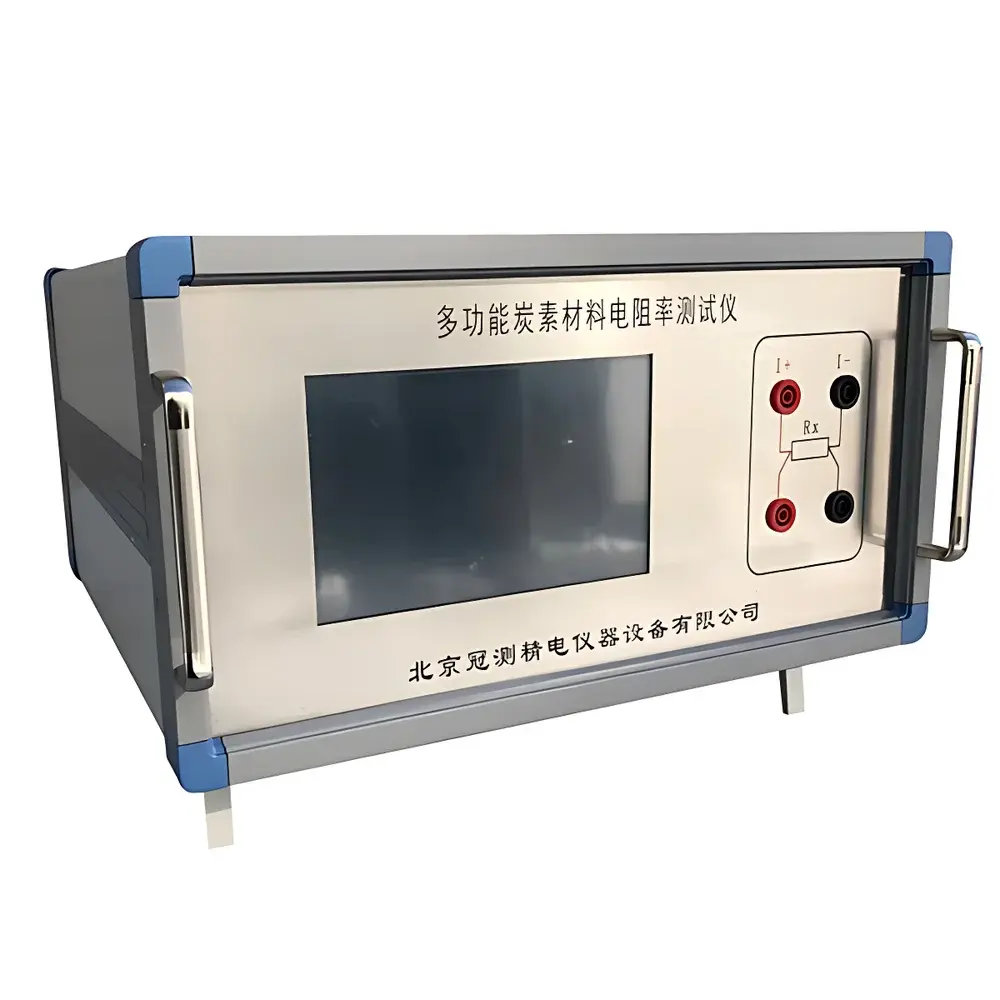
GuanCe GEST-122b Bipolar Plate Material Resistivity Tester
| Brand | GuanCe |
|---|---|
| Model | GEST-122b |
| Measurement Principle | Four-Probe DC Resistivity Method (ASTM D257, IEC 60093 compliant) |
| Sample Types | Powder, Solid Block, Rod |
| Standard Compliance | YS/T 587.6–2006, GB/T 24525–2009, GB/T 24521–2009, GB/T 3782–2016 |
| Display Interface | Integrated 7-inch TFT Touchscreen with Onboard Data Logging |
| Output | Thermal Printer Support (Optional) |
| Power Supply | AC 220 V ±10%, 50 Hz |
| Dimensions (W×D×H) | 320 × 300 × 150 mm |
| Weight | 8.5 kg |
Overview
The GuanCe GEST-122b Bipolar Plate Material Resistivity Tester is a precision-engineered four-probe DC resistivity measurement system designed specifically for R&D laboratories, quality control departments, and material certification facilities working with conductive and semiconductive carbon-based materials. It operates on the principle of the four-terminal (Kelvin) method, eliminating contact resistance errors inherent in two-probe configurations—ensuring traceable, repeatable, and standards-compliant resistivity quantification across heterogeneous sample geometries. Unlike generic ohmmeters, the GEST-122b integrates calibrated current sourcing and high-impedance voltage sensing circuits optimized for low-resistance ranges typical of graphite, calcined petroleum coke, lithium-ion battery anode materials, and fuel cell bipolar plate precursors. Its architecture conforms to the fundamental metrological requirements outlined in ASTM D257 (Standard Test Methods for DC Resistance or Conductance of Insulating Materials), IEC 60093 (Methods of Test for Volume Resistivity and Surface Resistivity of Solid Electrical Insulating Materials), and national standards including GB/T 24525–2009 and YS/T 587.6–2006—making it suitable for GLP-aligned testing environments where auditability and method validation are mandatory.
Key Features
- Modular four-probe test platform supporting interchangeable electrode fixtures for powder compaction cells, solid block clamps, and cylindrical rod holders—enabling seamless transition between material forms without recalibration.
- Dual-mode firmware interface: dedicated test pages for powder resistivity (with controlled compaction pressure feedback) and bulk resistivity (with contact-force optimization algorithms), each aligned with corresponding standard test procedures.
- Integrated 7-inch capacitive touchscreen HMI with intuitive icon-driven navigation, real-time resistance/resistivity calculation, and automatic unit conversion (Ω·cm, μΩ·m, S/m).
- Onboard data storage (≥10,000 records) with timestamp, operator ID, sample ID, and environmental metadata (optional temperature/humidity input via external sensor).
- Thermal printer output support (USB or parallel interface) for immediate hard-copy reporting compliant with internal QA documentation workflows.
- Compact benchtop design (320 × 300 × 150 mm) with EMI-shielded enclosure and isolated analog signal paths to ensure measurement stability in shared laboratory environments.
Sample Compatibility & Compliance
The GEST-122b accommodates a defined range of carbonaceous and metallic materials per international and industry-specific test protocols. For powdered samples—including acetylene black, synthetic graphite powders, and silicon-carbon composites—the instrument implements a standardized die compaction protocol per YS/T 587.6–2006, applying controlled axial pressure (1.0–5.0 MPa, user-selectable) while monitoring displacement to calculate true geometric cross-section. For solid specimens—such as sintered graphite blocks, extruded carbon rods, or machined bipolar plate blanks—the system employs spring-loaded, gold-plated tungsten carbide probes with force-limiting mechanisms to prevent surface damage while ensuring uniform contact pressure. All measurement modes are validated against reference standards traceable to NIM (National Institute of Metrology, China) and cross-referenced to ISO/IEC 17025 accredited calibration practices. The device meets electromagnetic compatibility (EMC) Class B requirements per GB/T 18268.1–2010 and safety specifications per GB 4793.1–2007.
Software & Data Management
Data acquisition and reporting are managed through embedded firmware—not external PC software—minimizing dependency on proprietary drivers or operating system versions. Each test record includes raw voltage/current pairs, calculated resistivity, sample dimensions (entered or auto-populated from fixture ID), test standard identifier, and operator credentials. Export options include CSV via USB flash drive for integration into LIMS or statistical process control (SPC) platforms. Audit trail functionality logs all parameter changes, test initiations, and firmware updates with digital timestamps—supporting compliance with FDA 21 CFR Part 11 (when used in regulated battery material qualification workflows) and internal GLP/GMP documentation policies. Optional RS-232 or Ethernet modules enable remote status monitoring and batch data retrieval in automated production QC lines.
Applications
- Characterization of proton exchange membrane fuel cell (PEMFC) bipolar plate candidates—including graphite composites, metal-coated titanium, and molded carbon-polymer laminates—for interfacial contact resistance (ICR) screening prior to stack assembly.
- Quality assurance of anode active materials (e.g., spherical graphite, hard carbon) in lithium-ion battery manufacturing, verifying batch-to-batch consistency in electronic conductivity.
- Routine verification of calcined coke resistivity in aluminum smelting anode production, in accordance with YS/T 587.6–2006 and GB/T 24521–2009.
- Research-grade evaluation of novel conductive fillers (e.g., graphene nanoplatelets, carbon nanotubes) dispersed in polymer matrices, where bulk resistivity correlates with percolation threshold behavior.
- Calibration and verification of secondary reference standards in metrology labs accredited to ISO/IEC 17025.
FAQ
Does the GEST-122b comply with ASTM D257 for volume resistivity measurements?
Yes—it implements the four-terminal DC method specified in ASTM D257 Annex A2 for low-resistance materials, with current source stability <±0.05% and voltage measurement resolution ≤1 µV.
Can the instrument measure resistivity of non-carbon conductors such as copper or aluminum foils?
It is optimized for resistivity ranges typical of carbon-based materials (10−5 to 102 Ω·cm); metals with resistivity <10−6 Ω·cm require specialized micro-ohmmeters and are outside its calibrated range.
Is firmware upgrade capability available?
Yes—field-upgradable via USB stick; version history and release notes are provided with each update to support regulatory change tracking.
What calibration certificates are supplied with the instrument?
A factory calibration report traceable to NIM standards is included; optional ISO/IEC 17025-accredited calibration is available upon request.
How is probe wear compensated during long-term operation?
The system includes a built-in probe resistance compensation routine executed during startup; users may also perform manual zero-offset correction using short-circuit verification jigs.



