
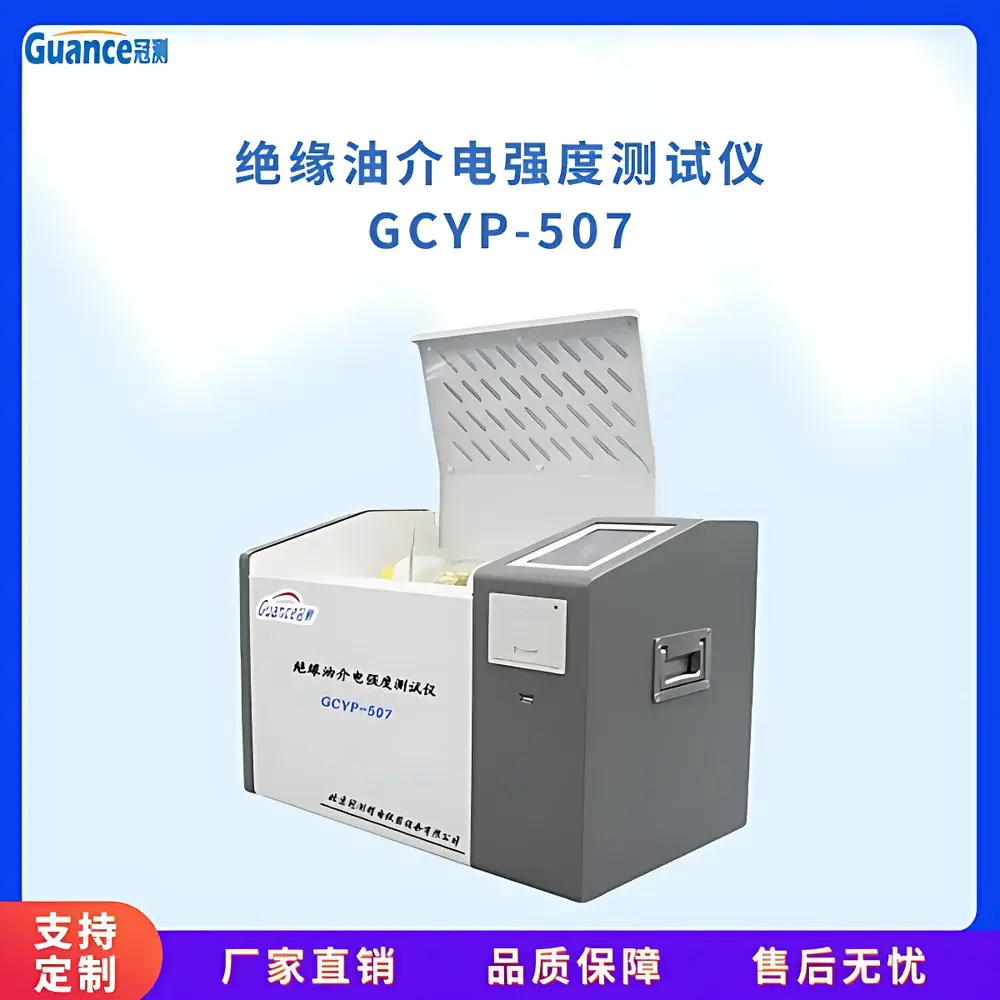
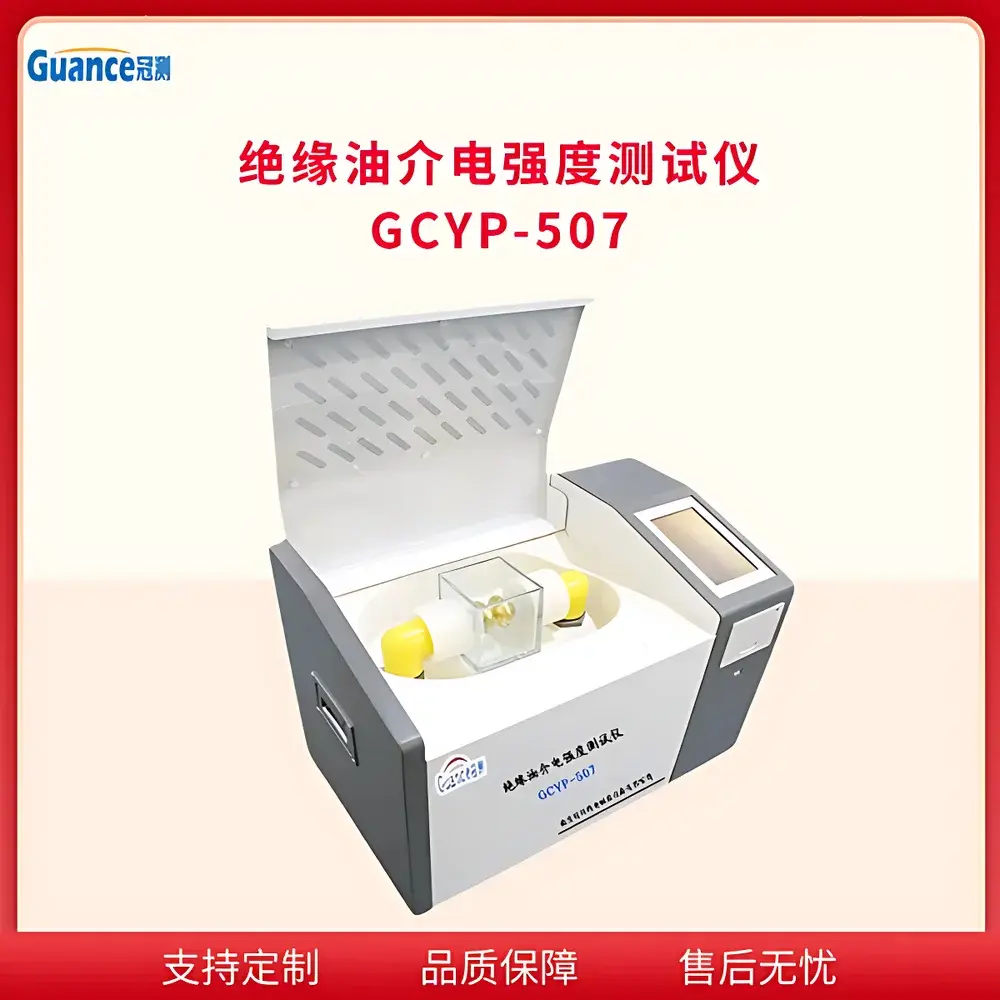
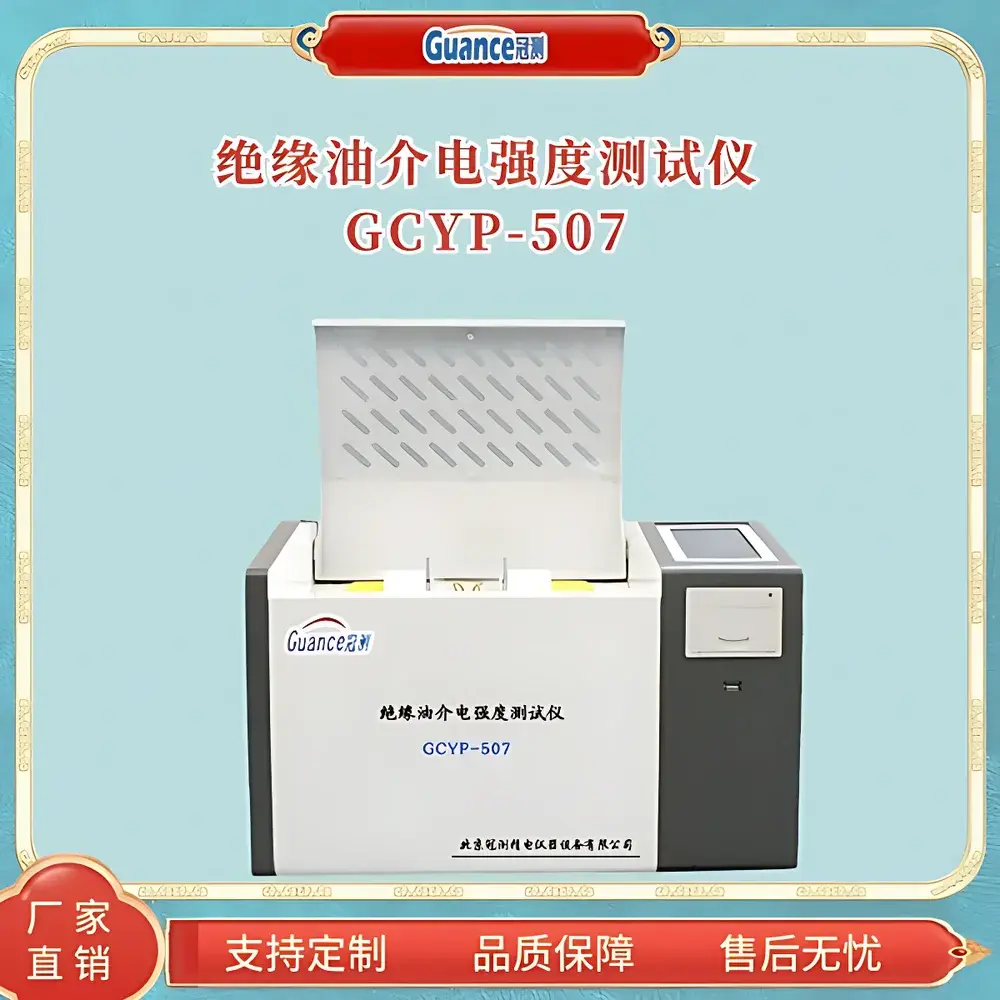
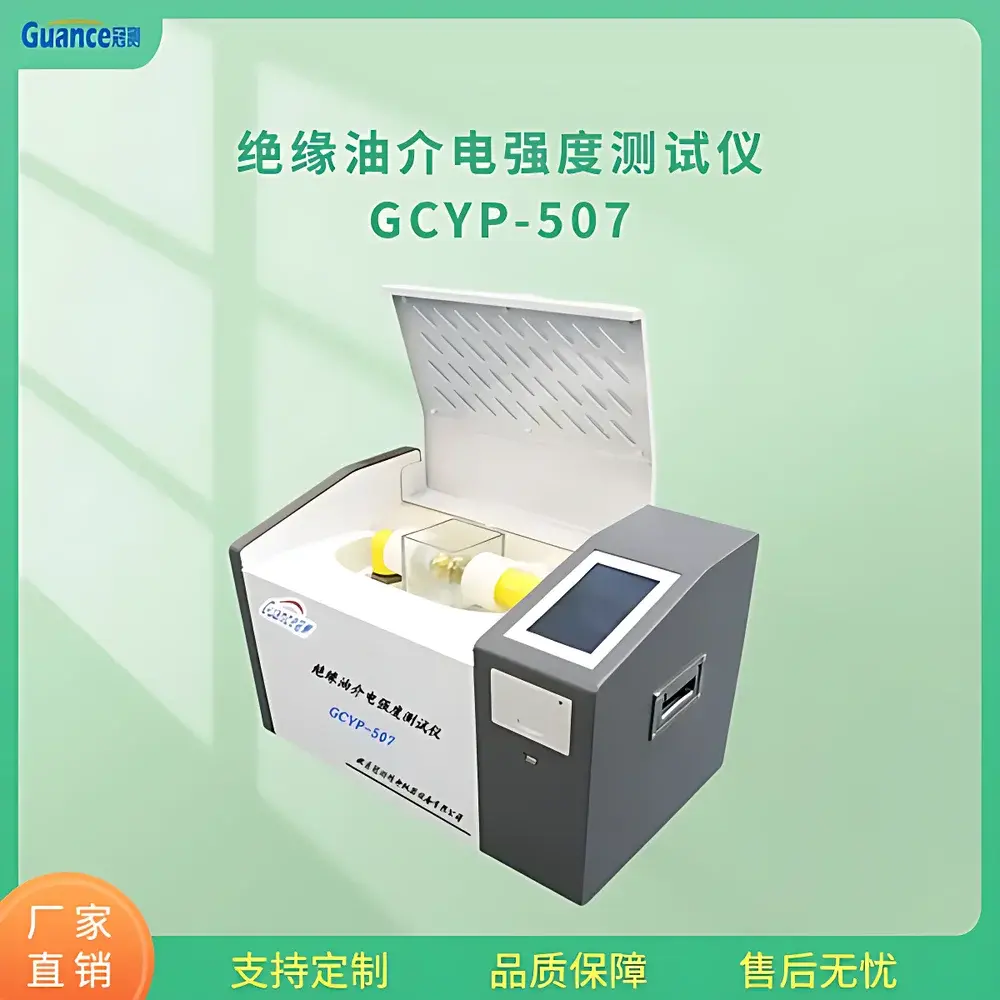
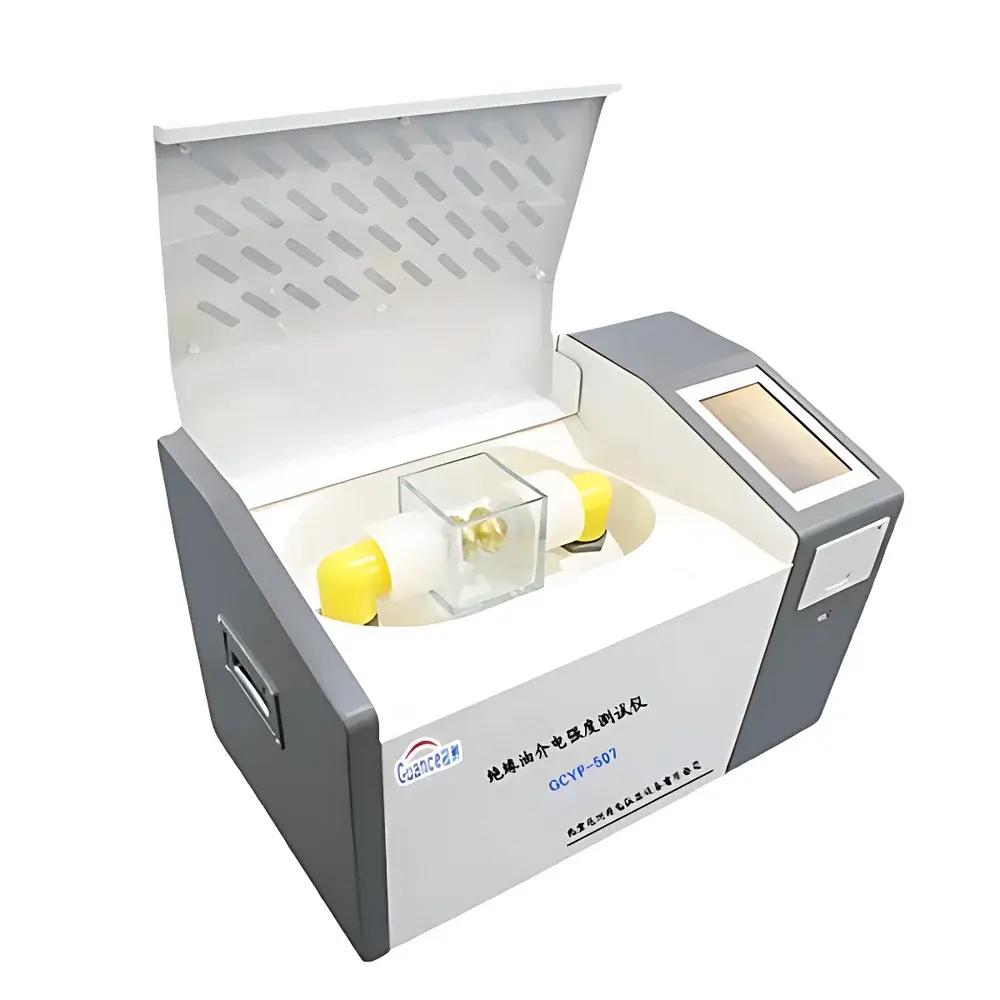
GuanCe GCYP-507.4 Insulating Oil Dielectric Strength Tester
| Brand | GuanCe Instruments |
|---|---|
| Origin | Beijing, China |
| Manufacturer Type | Authorized Distributor |
| Country of Origin | China |
| Model | GCYP-507.4 |
| Breakdown Voltage Range | 0–100 kV |
| Compliance Standards | GB/T 507–1986, GB/T 507–2002, DL 429.9, IEC 60156 |
| Communication Interface | RS-232 |
| Display | Dual-language (English/Chinese) LCD with real-time temperature & humidity monitoring |
| Optional Feature | Infrared oil temperature measurement module |
| Safety Protections | Overcurrent, overvoltage, short-circuit, and watchdog circuitry |
| Electrode Cup Material | Chemically resistant borosilicate glass + high-performance polymer composite |
| Measurement Architecture | High-voltage direct-sampling A/D conversion (no analog signal conditioning stage) |
Overview
The GuanCe GCYP-507.4 Insulating Oil Dielectric Strength Tester is a fully digital, microprocessor-controlled instrument engineered for precise determination of the dielectric breakdown voltage (BDV) of insulating oils used in power transformers, circuit breakers, and high-voltage switchgear. It operates on the principle of stepwise voltage ramping across standardized electrode geometries immersed in conditioned oil samples, per ASTM D877, IEC 60156, and GB/T 507 methodologies. The system applies AC voltage at 50/60 Hz, monitors current leakage in real time, and automatically terminates the test upon dielectric failure—recording the peak voltage prior to arcing as the BDV value. Designed for laboratory and field service environments, the GCYP-507.4 integrates industrial-grade HV generation (0–100 kV), robust electromagnetic shielding, and deterministic firmware architecture to ensure repeatability within ±1.5% of full scale under controlled environmental conditions (20–30 °C, RH < 75%).
Key Features
- Direct high-voltage sampling architecture: Input signal from the high-voltage electrode is digitized at source via isolated 16-bit A/D converter—eliminating analog amplification drift and calibration dependency.
- Dual-language user interface: English and Chinese display modes selectable via front-panel menu; all prompts, error codes, and report headers rendered in native language context.
- Multi-standard compliance engine: Preloaded test protocols include GB/T 507–1986 (step-up method), GB/T 507–2002 (staged ramp), DL 429.9 (Chinese power industry specification), and IEC 60156 (international standard); custom ramp profiles programmable via RS-232.
- Integrated environmental monitoring: Real-time ambient temperature and relative humidity displayed continuously during test sequence; optional IR-based oil surface temperature sensor available for traceable thermal correction (±0.5 °C accuracy).
- Fail-safe hardware design: Triple-redundant protection circuits—overvoltage clamping (110% rated output), current-limiting foldback (<5 mA fault threshold), and hardware watchdog timer (100 ms timeout)—guarantee automatic shutdown without software intervention.
- Electrode cup assembly: Precision-machined brass electrodes (2.5 mm spherical tip, 2.5 mm gap) housed in chemically inert borosilicate glass cell with PTFE-sealed base; validated for >5,000 cycles without dimensional drift or electrolytic corrosion.
Sample Compatibility & Compliance
The GCYP-507.4 is validated for use with mineral-based transformer oils (e.g., naphthenic and paraffinic types), synthetic esters, and silicone fluids meeting IEC 60296 specifications. Sample volume requirement is 350–400 mL per test; moisture content must be ≤30 ppm and particulate contamination <5 µm per ISO 4406:2017 Class 16/14/11 for valid BDV interpretation. Instrument calibration traceability follows JJG 1085–2013 (Chinese national metrological verification regulation) and supports audit-ready documentation per GLP and ISO/IEC 17025 requirements. All electrical safety certifications comply with GB 4793.1–2007 (equivalent to IEC 61010-1) for measurement and laboratory equipment.
Software & Data Management
Data acquisition and reporting are managed through embedded firmware with non-volatile memory storing up to 200 test records—including date/time stamp, ambient conditions, breakdown voltage, number of breakdowns per sample, and pass/fail status against user-defined thresholds. RS-232 serial interface enables bidirectional communication with external PCs running Windows-based data logging software (supplied separately). Export formats include CSV and PDF with embedded instrument ID, operator code, and calibration expiry date. Audit trail functionality logs all parameter changes, test initiations, and system resets—supporting FDA 21 CFR Part 11 compliance when deployed with validated third-party LIMS integration.
Applications
- Routine quality control of new insulating oil batches prior to transformer filling.
- Condition monitoring of in-service transformer oil during preventive maintenance intervals (IEEE C57.106 guidance).
- Failure analysis following internal fault events—correlating BDV decline with dissolved gas analysis (DGA) trends.
- Verification of oil reclamation efficacy post-vacuum dehydration and adsorption filtration.
- Third-party certification testing for OEM supply chain qualification (e.g., Siemens, GE Grid Solutions, Hitachi Energy).
FAQ
What standards does the GCYP-507.4 support out-of-the-box?
It includes factory-loaded firmware for GB/T 507–1986, GB/T 507–2002, DL 429.9, and IEC 60156, with user-definable ramp rates, dwell times, and pass/fail criteria.
Is the electrode cup included with the instrument?
Yes—the unit ships with one certified electrode cup assembly (glass cell + brass electrodes), calibration certificate, and cleaning toolkit.
Can test data be exported to LIMS or ERP systems?
Via RS-232, raw data streams are compatible with common SCADA and laboratory informatics platforms using ASCII protocol; custom API integration available upon request.
What maintenance is required for long-term accuracy?
Annual verification against NIST-traceable HV reference standard is recommended; electrode polishing and cup rinsing with analytical-grade heptane after each test series ensures reproducibility.
Does the instrument meet electromagnetic compatibility (EMC) requirements for substation environments?
Yes—it complies with GB/T 18268.1–2010 (IEC 61326-1) for industrial immunity (surge, ESD, radiated RF) and conducted emissions (Class B).



