
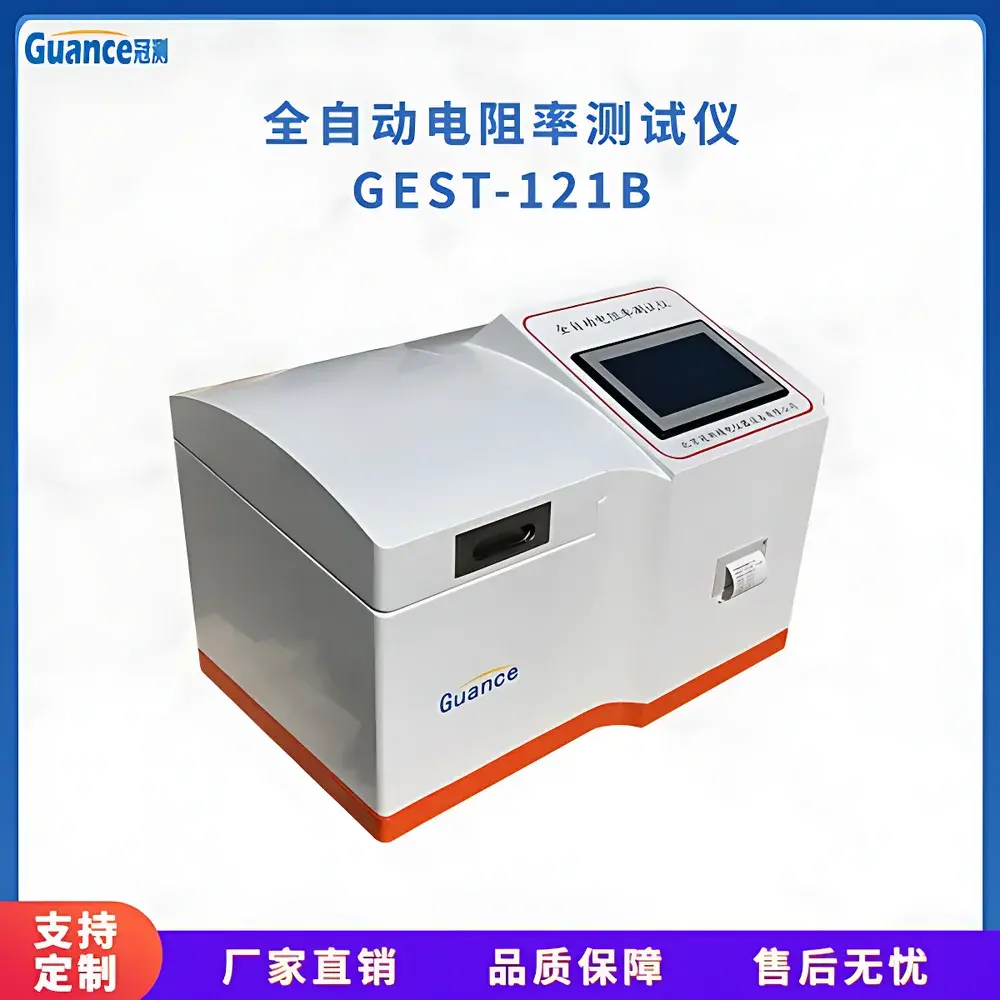
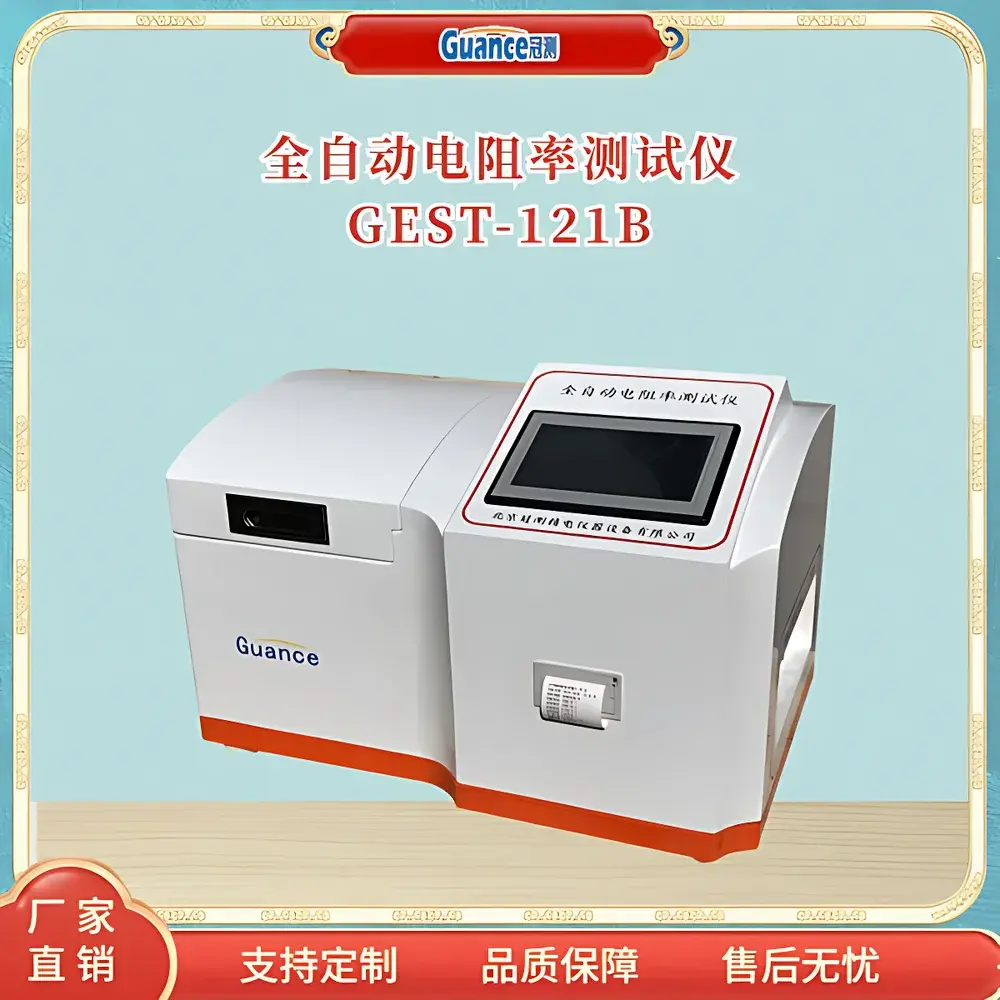
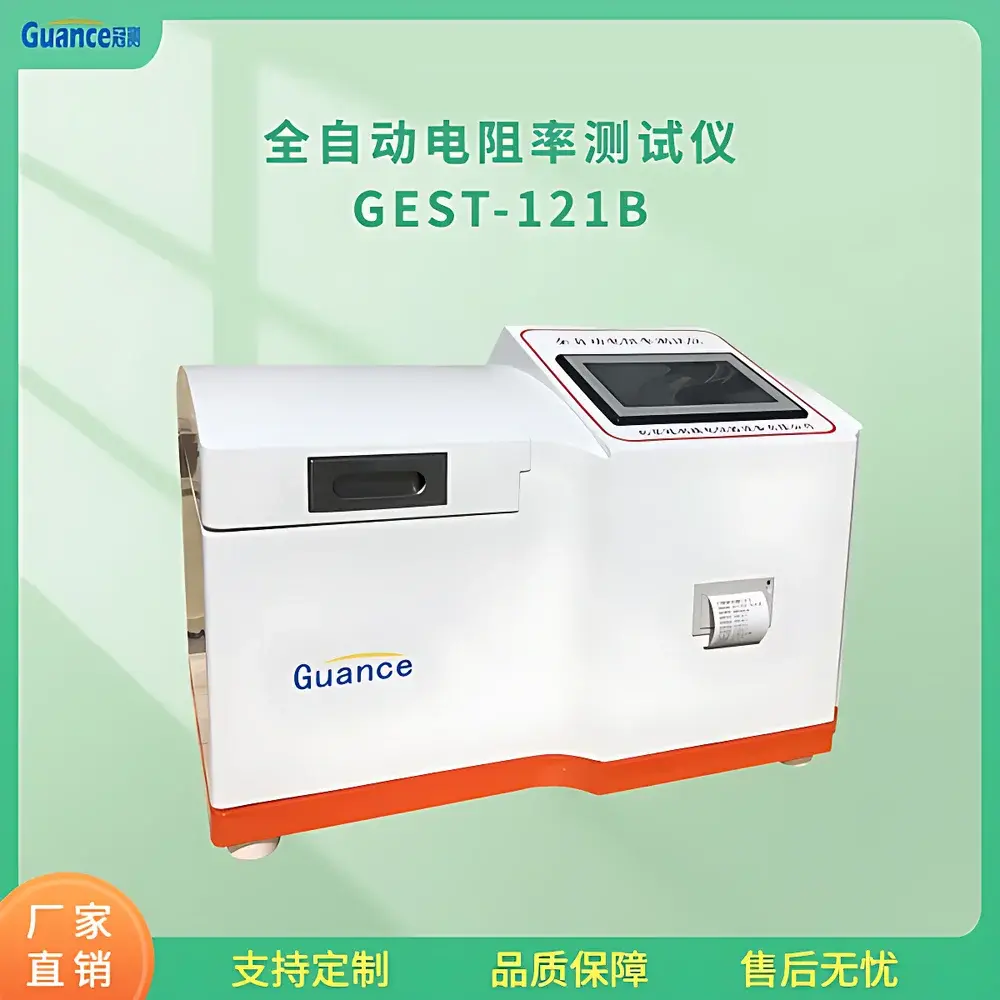
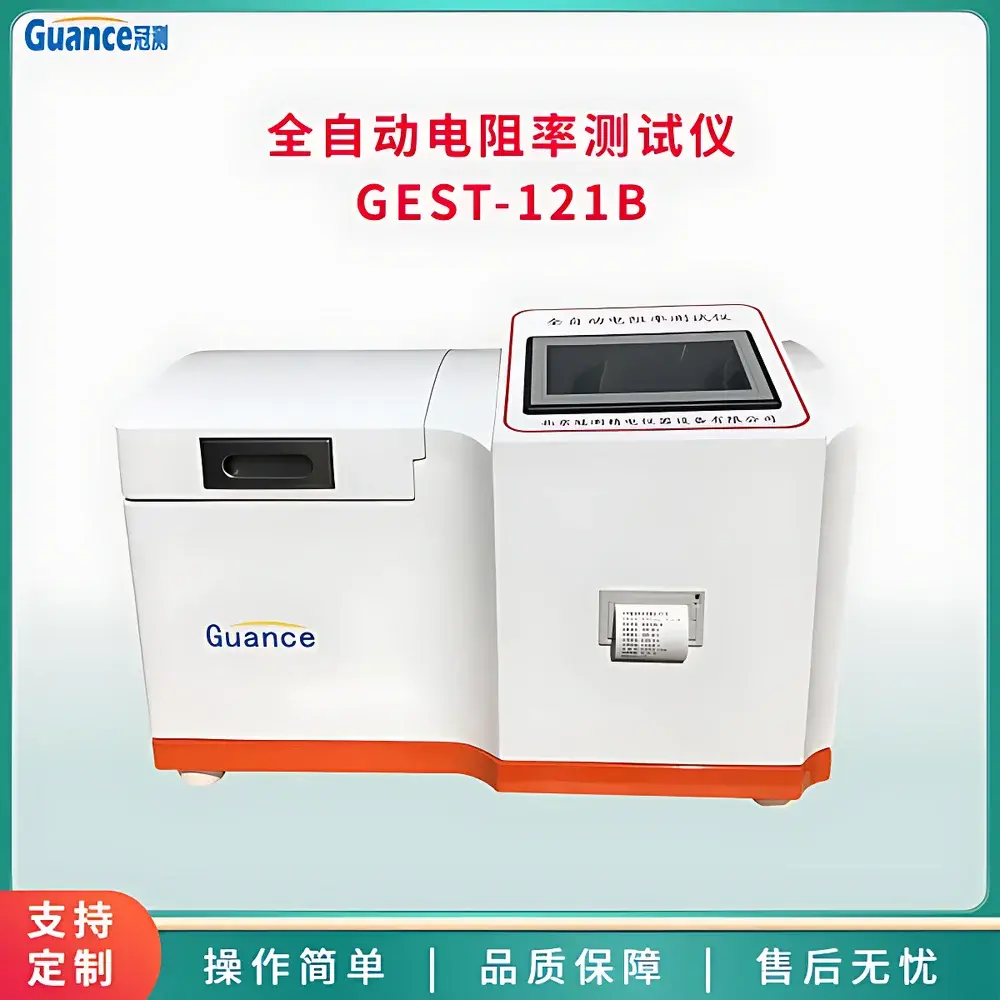
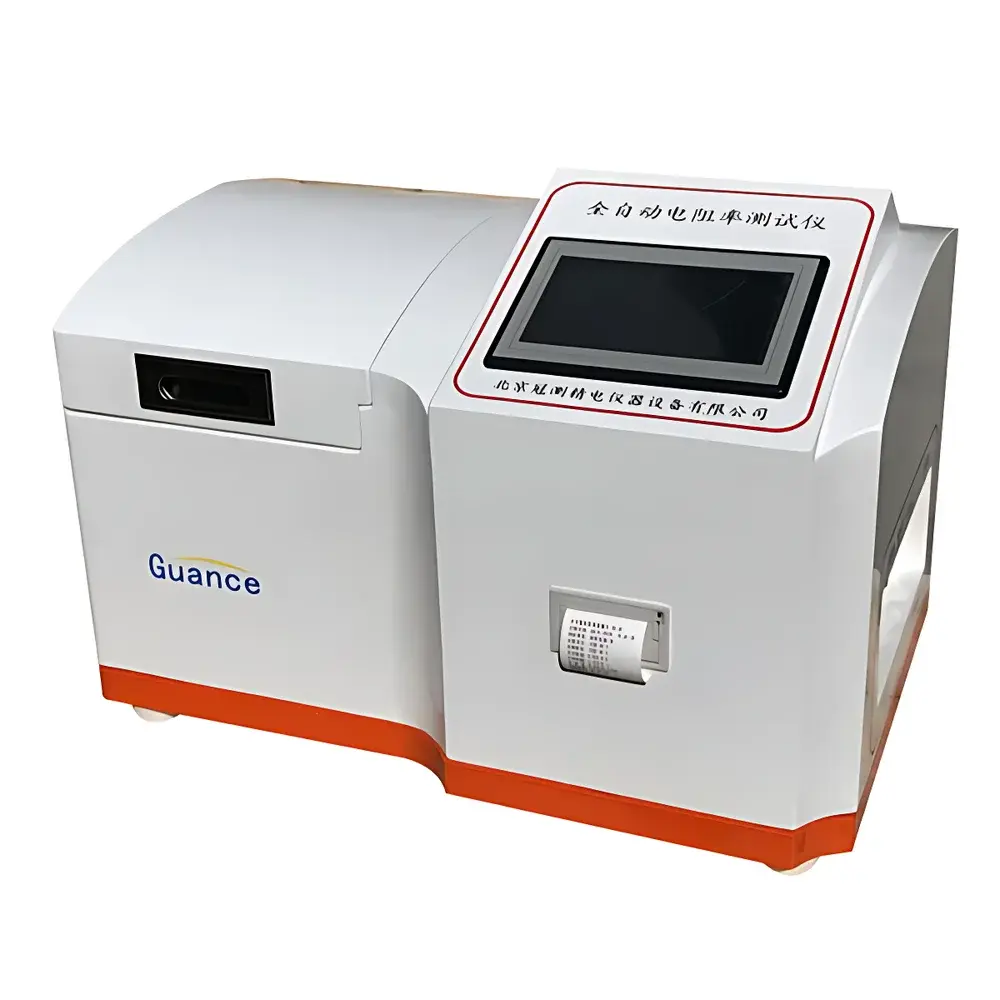
Guance GEST-121B1 Precision Volume & Surface Resistivity Tester
| Brand | Guance |
|---|---|
| Model | GEST-121B1 |
| Measurement Range | 10⁴ Ω to 10¹⁸ Ω |
| Current Range | 1×10⁻¹⁶ A to 2×10⁻⁴ A |
| Test Voltages | 10 V, 50 V, 100 V, 250 V, 500 V, 1000 V (selectable) |
| Accuracy | ±1% |
| Display | 7-inch capacitive touch screen |
| Power Supply | AC 220 V, 50 Hz, ~5 W |
| Dimensions | 285 mm × 245 mm × 120 mm |
| Weight | 2.5 kg |
| Compliance | GB/T 1410–2006, ASTM D257–99, GB/T 10581–2006, GB/T 1692–2008, GB/T 2439–2001, GB/T 12703.4–2010, GB/T 10064–2006, GB 1672–1988 |
Overview
The Guance GEST-121B1 Precision Volume & Surface Resistivity Tester is an engineered solution for high-accuracy DC resistivity characterization of insulating and electrostatic-dissipative materials. Based on the four-terminal (Kelvin) measurement principle and guarded electrode methodology per IEC 62631-3-1 and ASTM D257, the instrument delivers traceable, low-noise resistance and resistivity measurements across an ultra-broad dynamic range—from 10⁴ Ω to 10¹⁸ Ω—enabling reliable evaluation of volume resistivity (ρᵥ) and surface resistivity (ρₛ) in accordance with standardized test configurations. Its integrated high-impedance electrometer architecture minimizes leakage current errors and ensures stable microampere-to-femtoampere current detection (1×10⁻¹⁶ A minimum), critical for evaluating high-resistivity polymers, elastomers, coatings, powders, and liquid plasticizers under controlled DC bias conditions.
Key Features
- Multi-mode DC resistivity analysis: Simultaneous calculation and display of volume resistance, surface resistance, volume resistivity (ρᵥ), and surface resistivity (ρₛ) using user-defined electrode geometries and sample thickness parameters.
- Programmable test voltage sourcing: Six selectable DC output levels (10 V, 50 V, 100 V, 250 V, 500 V, 1000 V) with automatic voltage regulation and real-time monitoring—ensuring compliance with material-specific test protocols (e.g., 100 V for rubber per GB/T 1692, 500 V for plastics per GB/T 1410).
- Auto-calibration system: Internal self-calibration routines for voltage source and current measurement circuitry, reducing drift-induced uncertainty and supporting long-term measurement stability without external recalibration tools.
- Secure operator interface: Password-protected access control restricts configuration changes and test execution to authorized personnel—supporting laboratory SOP enforcement and audit readiness under GLP/GMP frameworks.
- Real-time dual-parameter display: Concurrent visualization of applied voltage, measured current, resistance value, and derived resistivity on a responsive 7-inch capacitive touchscreen with intuitive icon-based navigation.
- Flexible timing control: Adjustable stabilization and sampling intervals in auto-measurement mode, allowing optimization for slow-charging dielectrics or time-dependent conduction phenomena (e.g., space-charge-limited currents).
Sample Compatibility & Compliance
The GEST-121B1 accommodates solid sheets, films, molded parts, granular powders (via compression cell), viscous pastes, and low-conductivity liquids—using standardized electrode fixtures per GB/T 1410 (three-electrode system), ASTM D257 (guarded/un-guarded configurations), and GB/T 2439 (for conductive rubbers). It meets requirements for electrical safety testing of ESD-control materials (e.g., antistatic flooring per GB/T 12703.4, footwear per GB/T 28122), optical component substrates, and aerospace-grade polymer composites. All measurement workflows are aligned with ISO/IEC 17025 documentation practices, and raw data logs include timestamp, operator ID, voltage setting, dwell time, and environmental metadata (ambient temperature/humidity input fields).
Software & Data Management
An optional Windows-based PC software package enables remote instrument control via USB or RS-232, full dataset acquisition, and export to CSV, Excel, or PDF formats. The software supports automated test sequences, statistical analysis (mean, SD, CV%), pass/fail thresholding against specification limits, and generation of calibration-certified reports compliant with FDA 21 CFR Part 11 (electronic signatures, audit trails, and data integrity controls available upon configuration). Instrument firmware stores up to 1,000 test records locally with time-stamped entries, and all exported files retain embedded measurement metadata for traceability.
Applications
- Volume and surface resistivity mapping of polymeric insulators used in HVDC cable jackets and transformer bushings
- Quality assurance of antistatic packaging films and cleanroom garments per ANSI/ESD S20.20
- Resistivity screening of carbon-black-filled elastomers and conductive adhesives in automotive electronics
- Characterization of dielectric losses in optical lens resins and OLED substrate materials
- Research into charge trapping kinetics in ferroelectric thin films and perovskite semiconductors
- Verification of resistivity uniformity in printed electronics substrates and flexible sensors
- Compliance testing of liquid plasticizers per GB 1672–1988 and ISO 1628-5
FAQ
What standards does the GEST-121B1 directly support?
It implements test methods defined in GB/T 1410–2006, ASTM D257–99, GB/T 10581–2006, GB/T 1692–2008, GB/T 2439–2001, GB/T 12703.4–2010, GB/T 10064–2006, and GB 1672–1988—with built-in calculation logic for ρᵥ and ρₛ based on electrode geometry inputs.
Can it measure extremely low currents required for high-resistivity ceramics?
Yes—the electrometer stage achieves a minimum detectable current of 1×10⁻¹⁶ A with <1% basic accuracy at full scale, enabling reproducible characterization of alumina, zirconia, and glass-ceramic insulators.
Is the instrument suitable for routine QC in regulated environments?
Its password-protected UI, automated calibration logging, timestamped data storage, and optional 21 CFR Part 11–compliant software make it suitable for GLP, ISO 9001, and IATF 16949 quality systems.
Does it require external shielding or Faraday cages?
While not mandatory for general use, operation within a grounded shielded enclosure is recommended when measuring >10¹⁵ Ω samples or in electrically noisy lab environments to minimize electromagnetic interference.
How is electrode configuration handled for different sample types?
The instrument does not include electrodes; users select appropriate ASTM/GB-compliant fixtures (e.g., circular guarded electrodes for surface resistivity, concentric ring for volume resistivity) based on material form and standard requirements—configuration parameters are entered manually prior to test initiation.



